#baby $BABY I’ve watched every market cycle invent a new reason to push Bitcoin beyond what it was designed to do.
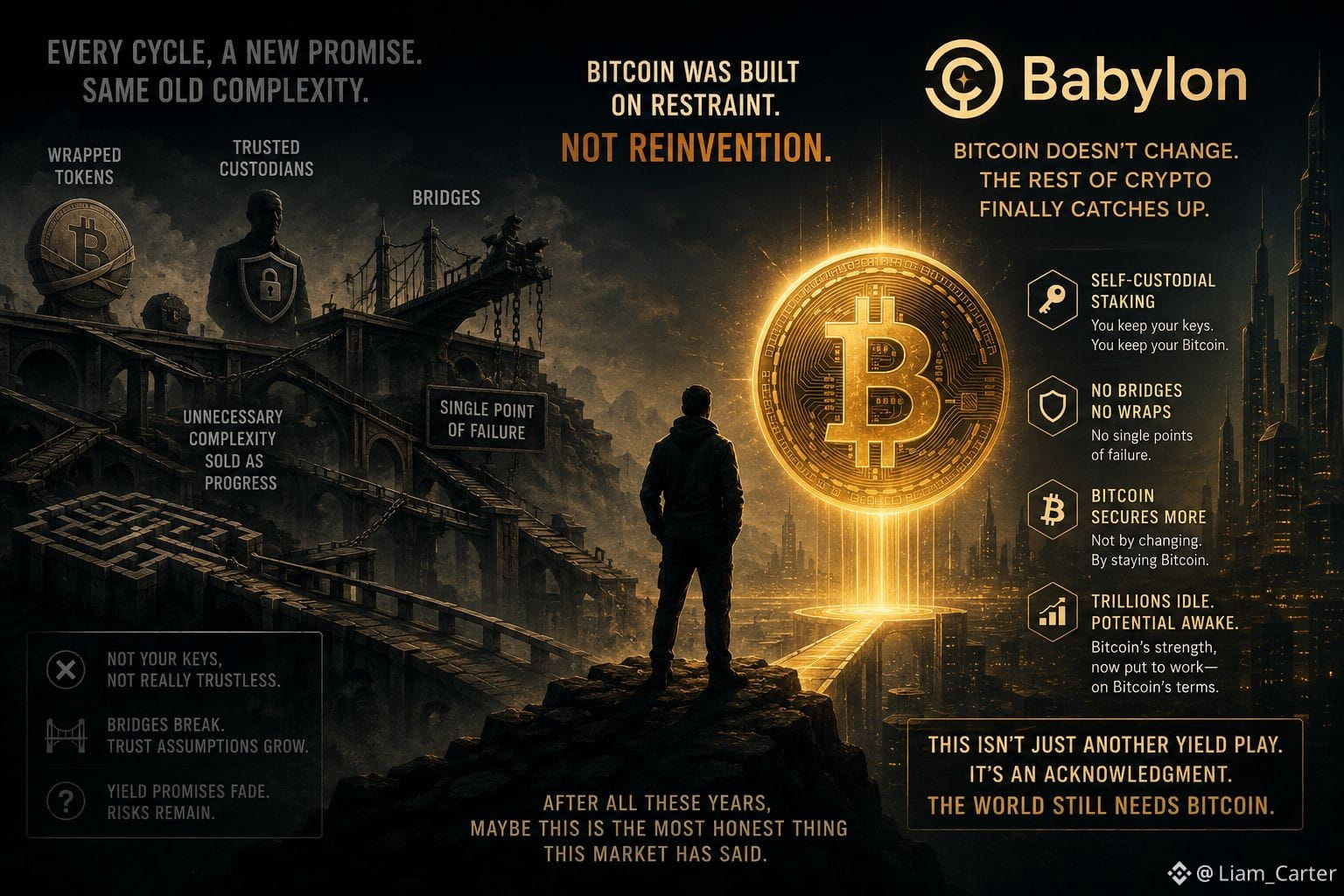
I’ve been around long enough to recall when nearly every second project claimed it would “unlock BTC liquidity.” Most followed the same pattern: wrapped tokens, trusted custodians, bridges that quietly became the single point of failure, and communities treating unnecessary complexity as progress.
Babylon stood out for a reason I didn’t expect. Not because it offered yield—crypto has never lacked promises. It stood out because it starts from an uncomfortable fact: trillions of dollars in Bitcoin largely sit idle while newer chains spend years trying to borrow its credibility.
I’m still not sure whether that problem needs solving.
There’s something odd about watching Bitcoin—the asset built on deliberate restraint—gradually turn into collateral for almost everything else. Self-custodial staking appears cleaner than earlier models. No bridges, no surrendering private keys, no converting coins into unfamiliar forms. Yet I’ve seen enough systems labeled “trustless” slowly accumulate trust assumptions over time.
Still, this one feels different.
Perhaps because Babylon isn’t trying to persuade me that Bitcoin itself must change. It feels more like the rest of crypto finally admitting it still needs Bitcoin.
After all these years, that may be the most honest thing this market has said in a long time.@BabylonLabs_io 😀
I’ve been around long enough to recall when nearly every second project claimed it would “unlock BTC liquidity.” Most followed the same pattern: wrapped tokens, trusted custodians, bridges that quietly became the single point of failure, and communities treating unnecessary complexity as progress.
Babylon stood out for a reason I didn’t expect. Not because it offered yield—crypto has never lacked promises. It stood out because it starts from an uncomfortable fact: trillions of dollars in Bitcoin largely sit idle while newer chains spend years trying to borrow its credibility.
I’m still not sure whether that problem needs solving.
There’s something odd about watching Bitcoin—the asset built on deliberate restraint—gradually turn into collateral for almost everything else. Self-custodial staking appears cleaner than earlier models. No bridges, no surrendering private keys, no converting coins into unfamiliar forms. Yet I’ve seen enough systems labeled “trustless” slowly accumulate trust assumptions over time.
Still, this one feels different.
Perhaps because Babylon isn’t trying to persuade me that Bitcoin itself must change. It feels more like the rest of crypto finally admitting it still needs Bitcoin.
After all these years, that may be the most honest thing this market has said in a long time.@BabylonLabs_io 😀