
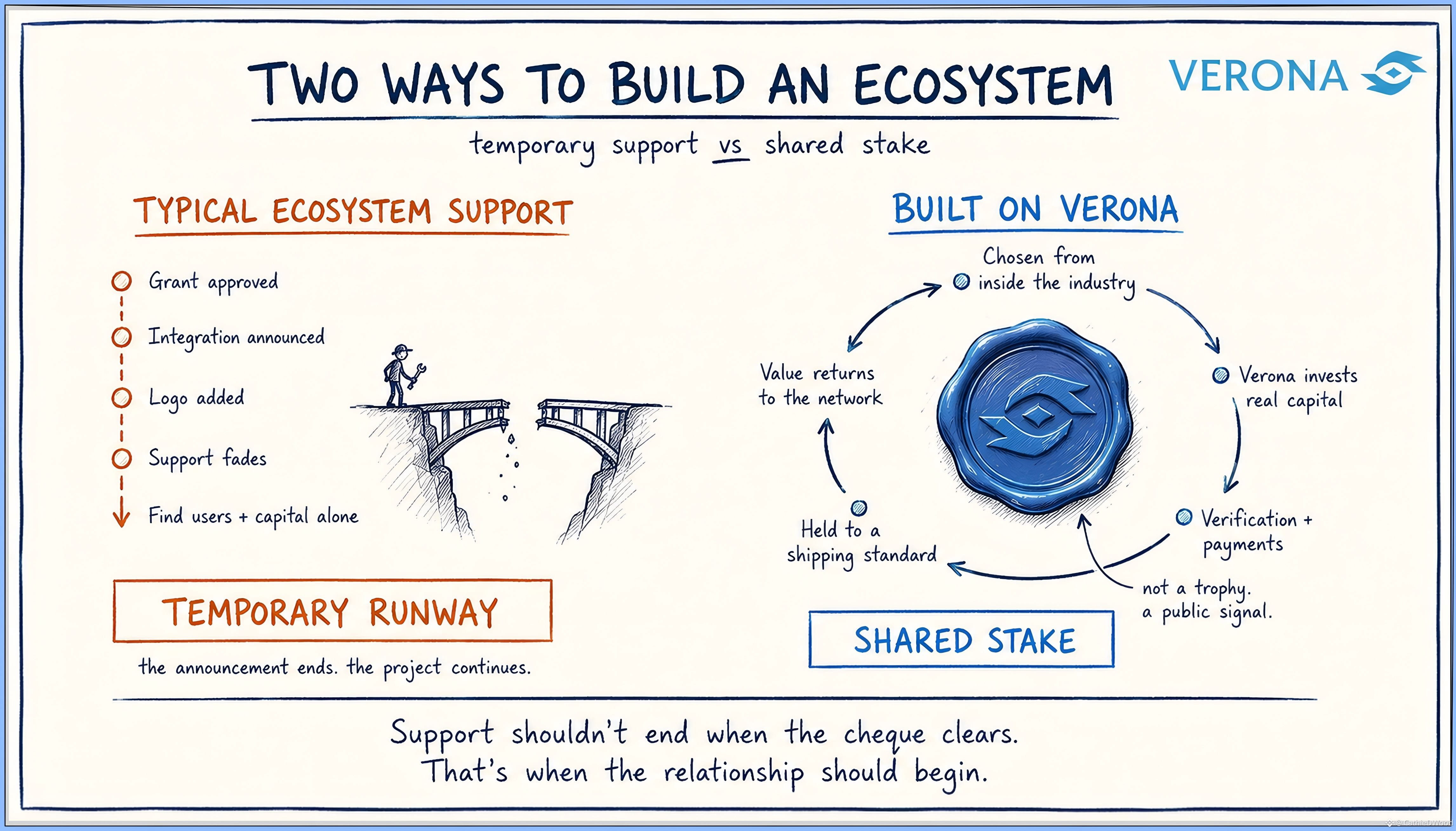
Un projet rejoint un écosystème. Il fait une demande de subvention, intègre l’infrastructure, et les deux équipes publient l’annonce. Ensuite, le cycle de l’annonce se termine, et le projet reste seul pour trouver des utilisateurs, se distribuer, plus de capitaux, et une vraie raison de survivre. En vérité, l’écosystème gagne un autre logo pour son site web tandis que le projet reçoit une piste temporaire, et tout le monde appelle cela du soutien. C’est pourquoi le nouveau tampon « Built on Verona » de @verona_dev a attiré mon attention. Il l’a fait parce que le message derrière n’est pas simplement : « cette application utilise notre infrastructure. » Mais plutôt : « Nous avons choisi cette équipe, investi notre propre capital, et attaché notre réputation à ce qu’elle construit. » Je veux dire, c’est une relation très différente. Verona dit que les équipes portant le tampon sont choisies au sein des secteurs pour lesquels elles construisent, soutenues directement plutôt que financées par des subventions, et censées livrer des produits pour de vrais utilisateurs tout en apportant de la valeur et des revenus au réseau. En termes simples : Une subvention dit « nous voulons vous aider à essayer », tandis qu’un investissement dit « nous prenons le risque avec vous ». Le tampon ajoute alors quelque chose que la plupart des programmes d’écosystème évitent discrètement : > Une norme qui demeure après que l’argent a été versé. Verona ne positionne pas le tampon comme un trophée de participation ou un badge que chaque application reçoit pour avoir terminé une intégration. Parce que si on est honnête, toutes les applications ne l’obtiennent pas. Les équipes qui l’obtiennent sont censées utiliser la vérification de Verona, les paiements, les identifiants privés et des faits prêts pour les agents afin de créer des produits que leurs secteurs ne peuvent pas ignorer. Et si ces produits gagnent, le réseau est conçu pour gagner avec eux. Cette dernière partie compte, car un écosystème ne devrait pas être seulement un ensemble d’applications qui utilisent la même infrastructure. Mais plutôt, il devrait s’agir d’une relation économique dans laquelle le réseau aide ses produits à devenir précieux, les produits apportent de vrais utilisateurs et des revenus, et cette activité renforce le réseau en dessous. #CMC $XION

Publier
Avertissement : ce contenu inclut des opinions de tiers. Il ne constitue pas un conseil. Binance Ai peut être utilisée, sans garantie de résultat. Consultez les CG.