
RIA CRYPTO
865 Publications

RIA CRYPTO
 Compte Square Vérifié+
一位交易员兼爱好者
371 Suivis
33.5K+ Abonnés
13.4K+ J’aime
Publications
Tous
Citations
Vidéos
Direct
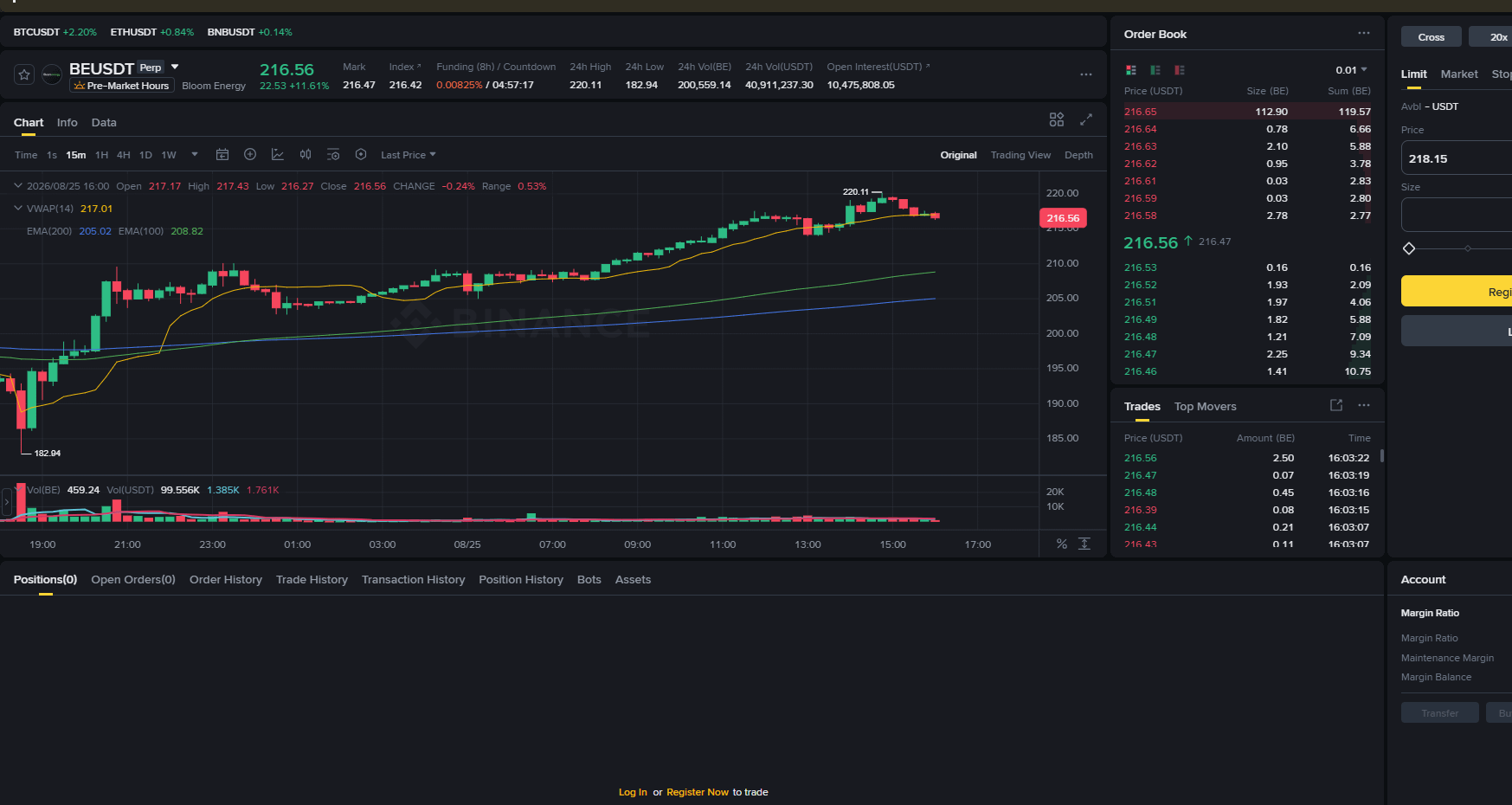
let's break down $BE on the 1-hour timeframe
Price is currently sitting at 216.56 after rejecting the 220 zone
That 220.11 level is acting as a strong resistance for now
VWAP is at 217.01 and price is trading below it
That's a short-term bearish signal
EMA 100 is at 208.82 and EMA 200 at 205.02 both are below
Price is still above both which means the overall trend is still up
But the rejection from 220 is worth paying attention to
Volume is light which tells me there's no strong buying pressure right now
The order book shows some bids around 216.40 to 216.50
And a wall of sellers around 216.64 to 216.65
So price is stuck in a tight range
A break above 217.50 could push it back toward 220
A break below 216.00 could take it toward 214.50 or even 210
MACD is not shown but the rejection candle suggests momentum is cooling
Not financial advice just watching the range
Price is currently sitting at 216.56 after rejecting the 220 zone
That 220.11 level is acting as a strong resistance for now
VWAP is at 217.01 and price is trading below it
That's a short-term bearish signal
EMA 100 is at 208.82 and EMA 200 at 205.02 both are below
Price is still above both which means the overall trend is still up
But the rejection from 220 is worth paying attention to
Volume is light which tells me there's no strong buying pressure right now
The order book shows some bids around 216.40 to 216.50
And a wall of sellers around 216.64 to 216.65
So price is stuck in a tight range
A break above 217.50 could push it back toward 220
A break below 216.00 could take it toward 214.50 or even 210
MACD is not shown but the rejection candle suggests momentum is cooling
Not financial advice just watching the range
·
--
🎙️ $DUSK IS ABOVE SUPPORT WE ARE LEARNING TRADING STRATEGY
Fin
03 h 28 min 11 sec
483
0
·
--
🎙️ Weekend Last day DUSK Volatility, new Trading strategy
Fin
02 h 52 min 29 sec
297
0
been looking into TMX ahead of TGE and honestly the part that stands out to me isn't the token math, it's what already happened before the token even exists.
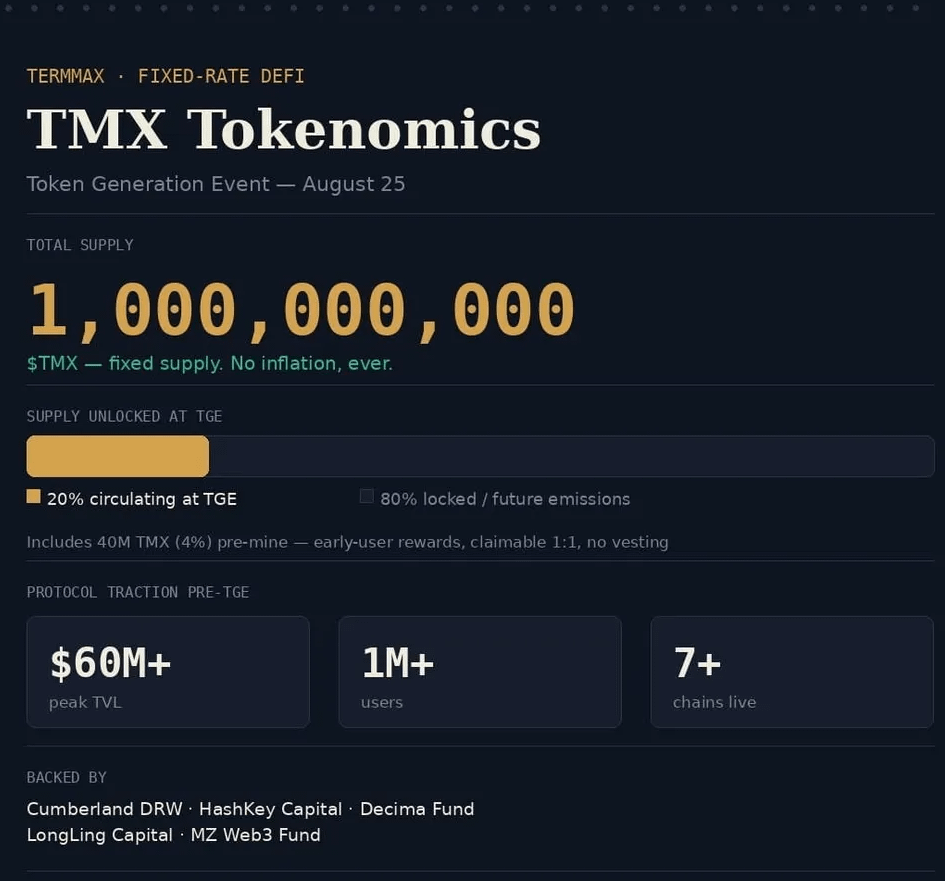
term structure raised a $4.45M seed with cumberland leading it, plus hashkey capital, decima fund, longling capital and mz web3 fund in the round. that's not filler, cumberland is drw's crypto arm, they're not putting name and money behind something they haven't actually diligenced. when a market maker with that much on chain experience backs a protocol pre token, I pay attention differently than I would to some anon team raise.
then there's usage. TermMax crossed over 1M users and 837k+ registered wallets before TGE, hit 170k daily actives at peak, running across 7 chains with tvl sitting around 62-64M depending on the day. that's real people actually borrowing and lending fixed rate positions, not wallets farming an airdrop task list and disappearing right after claim. a lot of protocols get their usage numbers backwards, they inflate with points farmers right before TGE and the activity falls off a cliff the week after. TermMax's growth happened while building the actual product first, token came after.
on the supply side, total is 1B TMX, 20% circulating at TGE, and early users have already been earning TMX for months through the pre-mine campaigns even before a market exists to trade it on, so distribution's been running quietly in the background this whole time.
feels less like a hype launch and more like a protocol that already had the users and just needed the token to catch up.
#TermMax #termmax @TermMax
term structure raised a $4.45M seed with cumberland leading it, plus hashkey capital, decima fund, longling capital and mz web3 fund in the round. that's not filler, cumberland is drw's crypto arm, they're not putting name and money behind something they haven't actually diligenced. when a market maker with that much on chain experience backs a protocol pre token, I pay attention differently than I would to some anon team raise.
then there's usage. TermMax crossed over 1M users and 837k+ registered wallets before TGE, hit 170k daily actives at peak, running across 7 chains with tvl sitting around 62-64M depending on the day. that's real people actually borrowing and lending fixed rate positions, not wallets farming an airdrop task list and disappearing right after claim. a lot of protocols get their usage numbers backwards, they inflate with points farmers right before TGE and the activity falls off a cliff the week after. TermMax's growth happened while building the actual product first, token came after.
on the supply side, total is 1B TMX, 20% circulating at TGE, and early users have already been earning TMX for months through the pre-mine campaigns even before a market exists to trade it on, so distribution's been running quietly in the background this whole time.
feels less like a hype launch and more like a protocol that already had the users and just needed the token to catch up.
#TermMax #termmax @TermMax
pulled up TermMax's live numbers today just to see where things actually stand and it's more real than I expected for a protocol most people still haven't heard of.
over $31M locked right now, close to $28M of that actively out as loans, spread across nine different chains with ethereum carrying most of it.
that ratio between TVL and active loans tells you something, capital isn't just sitting there idle waiting around, it's actually being used for real fixed-rate positions.
that's not always the case with newer lending protocols, plenty of them show a big TVL number and half of it's just parked doing nothing.
what makes that kind of usage possible day to day is the one-click leverage. normally if you wanted to loop a position, borrow, swap, deposit, borrow again, you're doing four or five separate transactions and eating gas each time.
TermMax collapses that into a single click, you get the leveraged position without manually cycling through the loop yourself.
same logic applies on the curator side too, curators and order makers use TermMax's range order tool to set their own pricing curves and slippage instead of being stuck with one fixed protocol wide formula everyone shares.
small thing but it's the kind of detail that actually shows up in real usage numbers instead of just sounding good on a docs page. plenty of protocols talk capital efficiency and you check the chain and it's just not there. TermMax's numbers actually back the pitch instead of contradicting it.
#TermMax #termmax @TermMax
over $31M locked right now, close to $28M of that actively out as loans, spread across nine different chains with ethereum carrying most of it.
that ratio between TVL and active loans tells you something, capital isn't just sitting there idle waiting around, it's actually being used for real fixed-rate positions.
that's not always the case with newer lending protocols, plenty of them show a big TVL number and half of it's just parked doing nothing.
what makes that kind of usage possible day to day is the one-click leverage. normally if you wanted to loop a position, borrow, swap, deposit, borrow again, you're doing four or five separate transactions and eating gas each time.
TermMax collapses that into a single click, you get the leveraged position without manually cycling through the loop yourself.
same logic applies on the curator side too, curators and order makers use TermMax's range order tool to set their own pricing curves and slippage instead of being stuck with one fixed protocol wide formula everyone shares.
small thing but it's the kind of detail that actually shows up in real usage numbers instead of just sounding good on a docs page. plenty of protocols talk capital efficiency and you check the chain and it's just not there. TermMax's numbers actually back the pitch instead of contradicting it.
#TermMax #termmax @TermMax
#termmax
been messing around with what TermMax actually lets you use as collateral and it's a lot more flexible than I expected going in.
if you're holding a Pendle PT token, you don't have to just sit on it till maturity waiting for the yield to show up.
TermMax lets you post that PT as collateral and borrow against it, so you can basically pull liquidity out early or loop the position to stack more exposure to the same yield, without unwinding the PT itself. that's the kind of thing that used to mean juggling three different protocols and now it's just one deposit.
same logic applies to LSTs and LRTs.
staked ETH derivatives keep earning their underlying staking yield the whole time they're sitting as collateral on TermMax, you're not choosing between staking rewards and borrowing power anymore, you get both stacked on top of each other. feels obvious once you see it working but a lot of lending markets still make you pick one or the other.
what makes this actually usable day to day is TermMax isn't stuck on one chain. the same fixed rate model is live across Ethereum, Arbitrum, BNB Chain, Berachain and a few others,
so wherever your PT or LST already lives, chances are you don't need to bridge it somewhere else just to put it to work. that consistency across chains is honestly underrated, most protocols expand and the experience gets worse on the newer chains, this one's held up the same everywhere I've tried it.
@TermMax #TermMax
been messing around with what TermMax actually lets you use as collateral and it's a lot more flexible than I expected going in.
if you're holding a Pendle PT token, you don't have to just sit on it till maturity waiting for the yield to show up.
TermMax lets you post that PT as collateral and borrow against it, so you can basically pull liquidity out early or loop the position to stack more exposure to the same yield, without unwinding the PT itself. that's the kind of thing that used to mean juggling three different protocols and now it's just one deposit.
same logic applies to LSTs and LRTs.
staked ETH derivatives keep earning their underlying staking yield the whole time they're sitting as collateral on TermMax, you're not choosing between staking rewards and borrowing power anymore, you get both stacked on top of each other. feels obvious once you see it working but a lot of lending markets still make you pick one or the other.
what makes this actually usable day to day is TermMax isn't stuck on one chain. the same fixed rate model is live across Ethereum, Arbitrum, BNB Chain, Berachain and a few others,
so wherever your PT or LST already lives, chances are you don't need to bridge it somewhere else just to put it to work. that consistency across chains is honestly underrated, most protocols expand and the experience gets worse on the newer chains, this one's held up the same everywhere I've tried it.
@TermMax #TermMax
the timing on this one is what got me. TermMax just opened the first fixed-rate borrowing market for tokenized stock collateral on BNB Chain, using Ondo Global Markets tokens as the underlying assets, and they launched it right in the middle of some genuinely rough market volatility over the past couple months. that's not a coincidence honestly.
think about what borrowing feels like on a variable rate protocol when the market's swinging hard. you open a position at a rate that looks fine, then two days later funding costs spike because everyone's scrambling and now you're paying way more than you planned for. that unpredictability is exactly what hurts most when things are already shaky, you get punished twice, once by the market and once by your own borrowing cost moving against you at the worst possible time.
TermMax's whole pitch here is you lock the rate the moment you open the position. doesn't matter what chaos happens after, your cost is fixed till maturity. and now that extends to tokenized stocks too, Ondo Global Markets brings over 100 tokenized US stocks and ETFs onto TermMax as eligible collateral, so someone holding tokenized equity can borrow against it at a known rate instead of guessing what a floating market does to them next week.
feels like exactly the kind of product that's supposed to exist for moments like this, not more variable rate stuff stacking uncertainty on top of uncertainty. makes sense why institutional demand picked up around this launch specifically.
@TermMax #TermMax
think about what borrowing feels like on a variable rate protocol when the market's swinging hard. you open a position at a rate that looks fine, then two days later funding costs spike because everyone's scrambling and now you're paying way more than you planned for. that unpredictability is exactly what hurts most when things are already shaky, you get punished twice, once by the market and once by your own borrowing cost moving against you at the worst possible time.
TermMax's whole pitch here is you lock the rate the moment you open the position. doesn't matter what chaos happens after, your cost is fixed till maturity. and now that extends to tokenized stocks too, Ondo Global Markets brings over 100 tokenized US stocks and ETFs onto TermMax as eligible collateral, so someone holding tokenized equity can borrow against it at a known rate instead of guessing what a floating market does to them next week.
feels like exactly the kind of product that's supposed to exist for moments like this, not more variable rate stuff stacking uncertainty on top of uncertainty. makes sense why institutional demand picked up around this launch specifically.
@TermMax #TermMax
#termmax @TermMax
okay so the thing that actually made me trust TermMax vaults more, not less, was realizing how limited curator control actually is.
curators like MEV Capital or Keyrock choose which term markets to allocate into and how to size positions across them. that's basically the extent of it. they can't touch the smart contract logic
, can't change how liquidations work, can't rewrite a rate a borrower already agreed to. all the risk parameters and settlement rules are baked into the protocol itself, curators just operate inside that box. so if a curator makes a bad allocation call you can see it happen and pull out, but they're never in a position to quietly change the rules underneath you while your money's locked in.
that split between "curator judgment" and "protocol enforced" is honestly the part most people skip over when they're sizing up a vault and it's the part that matters most to me.
other thing I didn't expect, capital sitting in TermMax markets doesn't just wait around doing nothing for a match. orders route atomically across markets so the same liquidity gets reused instead of sitting locked up in a queue.
pair that with vault deposits still earning base yield the entire time they're waiting and you're not bleeding opportunity cost just because your order hasn't matched yet.
small detail on paper but it's the kind of thing that tells you the team actually thought through capital efficiency instead of shipping a lending market and calling it a day.
#TermMax
okay so the thing that actually made me trust TermMax vaults more, not less, was realizing how limited curator control actually is.
curators like MEV Capital or Keyrock choose which term markets to allocate into and how to size positions across them. that's basically the extent of it. they can't touch the smart contract logic
, can't change how liquidations work, can't rewrite a rate a borrower already agreed to. all the risk parameters and settlement rules are baked into the protocol itself, curators just operate inside that box. so if a curator makes a bad allocation call you can see it happen and pull out, but they're never in a position to quietly change the rules underneath you while your money's locked in.
that split between "curator judgment" and "protocol enforced" is honestly the part most people skip over when they're sizing up a vault and it's the part that matters most to me.
other thing I didn't expect, capital sitting in TermMax markets doesn't just wait around doing nothing for a match. orders route atomically across markets so the same liquidity gets reused instead of sitting locked up in a queue.
pair that with vault deposits still earning base yield the entire time they're waiting and you're not bleeding opportunity cost just because your order hasn't matched yet.
small detail on paper but it's the kind of thing that tells you the team actually thought through capital efficiency instead of shipping a lending market and calling it a day.
#TermMax
5 USD claim

Crypto_Alchemy
·
--
[Revoir] 🎙️ $DUSK Broke previous 3 days high Lets see how it plays Next
01 h 32 min 06 sec · 1.3k auditeurs
Kept turning the word "privacy" over in my head this week because it gets thrown around so loosely in crypto. On most chains it just means nobody can see anything, full stop. Dusk approaches it differently and it took me a minute to actually get why that matters.
Dusk works around four pillars, privacy where it's needed, transparency where it's useful, selective disclosure for authorized review, and deterministic settlement. That's not four random features bolted together, it's basically one coherent answer to a question regulated finance actually asks, how do you keep sensitive data private without becoming a black box nobody can trust.
That's the part that clicked for me. Privacy on Dusk doesn't mean unaccountable.
A transaction can stay confidential from the public while still being reviewable by whoever is authorized to check it, an auditor, a regulator, a compliance team. Nothing gets hidden from people who legally need to see it, it just isn't broadcast to everyone scrolling a block explorer.
That's what selective disclosure is. Instead of choosing between fully public or fully private, which is the choice every other chain forces on you, Dusk lets specific parties unlock exactly the information they're entitled to see, nothing more.
Add deterministic settlement on top and you get outcomes that are predictable and final, not probabilistic. For anything touching regulated assets, that middle path isn't a compromise, it's the actual requirement.
@Dusk $DUSK #dusk
Dusk works around four pillars, privacy where it's needed, transparency where it's useful, selective disclosure for authorized review, and deterministic settlement. That's not four random features bolted together, it's basically one coherent answer to a question regulated finance actually asks, how do you keep sensitive data private without becoming a black box nobody can trust.
That's the part that clicked for me. Privacy on Dusk doesn't mean unaccountable.
A transaction can stay confidential from the public while still being reviewable by whoever is authorized to check it, an auditor, a regulator, a compliance team. Nothing gets hidden from people who legally need to see it, it just isn't broadcast to everyone scrolling a block explorer.
That's what selective disclosure is. Instead of choosing between fully public or fully private, which is the choice every other chain forces on you, Dusk lets specific parties unlock exactly the information they're entitled to see, nothing more.
Add deterministic settlement on top and you get outcomes that are predictable and final, not probabilistic. For anything touching regulated assets, that middle path isn't a compromise, it's the actual requirement.
@Dusk $DUSK #dusk
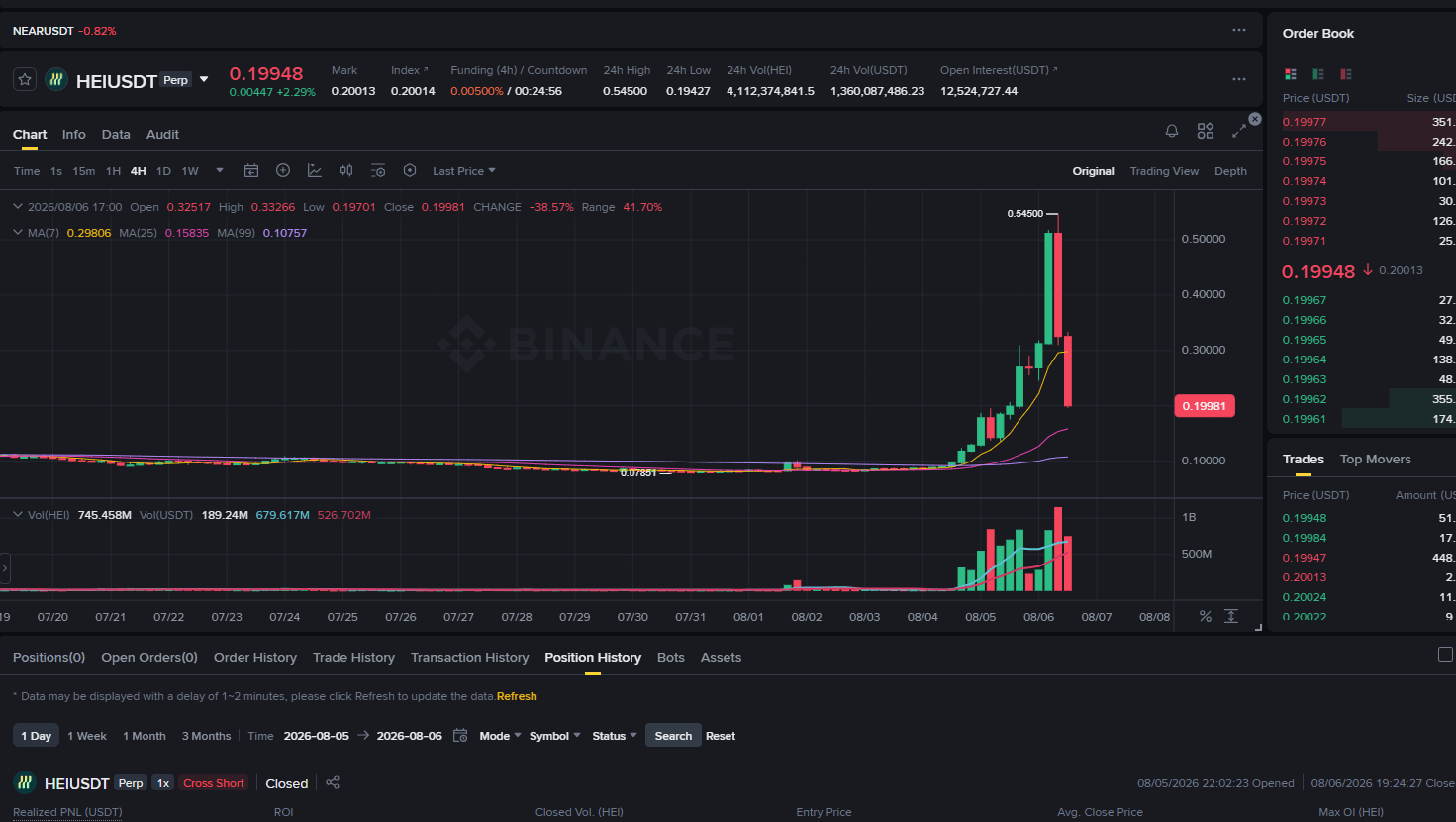
I just took small trade of $HEI and exit fast too as I am confused
what price action we need to look for $HEI
what price action we need to look for $HEI
Connectez-vous pour découvrir plus de contenu