


Spent part of the afternoon setting up 2FA on an account I'd been putting off securing for months, one of those chores that only happens after you read about someone else getting drained. Tedious, but satisfying once it's done, that small relief of closing a door you knew was open.
That whole mindset was still active when I opened Newton Protocol material afterward, and "smarter security framework" caught me differently than it might have on a normal day, because I'd just spent an hour thinking concretely about what actually makes security effective versus what just feels reassuring.
Here's what stood out. "Framework" implies something comprehensive, a structure that covers a range of situations consistently. But going through it, what I found behaved more like a set of individual checks, each one smart in isolation, flagging specific known risk patterns, without much connective logic tying them together into something you'd actually call a framework. A framework suggests the parts relate to each other, that catching one kind of risk informs how the system treats a related risk elsewhere. What I saw felt more like a checklist of smart individual rules sitting next to each other, not a unified system reasoning across them.
I thought that was just semantics at first, framework versus checklist, does it really matter what you call it if the individual checks work. But actually, sitting with it, it matters for exactly the reason my 2FA afternoon reminded me of. Real security gaps usually show up in the connections between things, not within any single check. My compromised accounts risk wasn't really about any one weak setting, it was about how weaknesses compounded across different services I used the same way. A framework, properly built, would account for that kind of compounding. A set of independent checks, however smart individually, doesn't necessarily catch what happens between them.
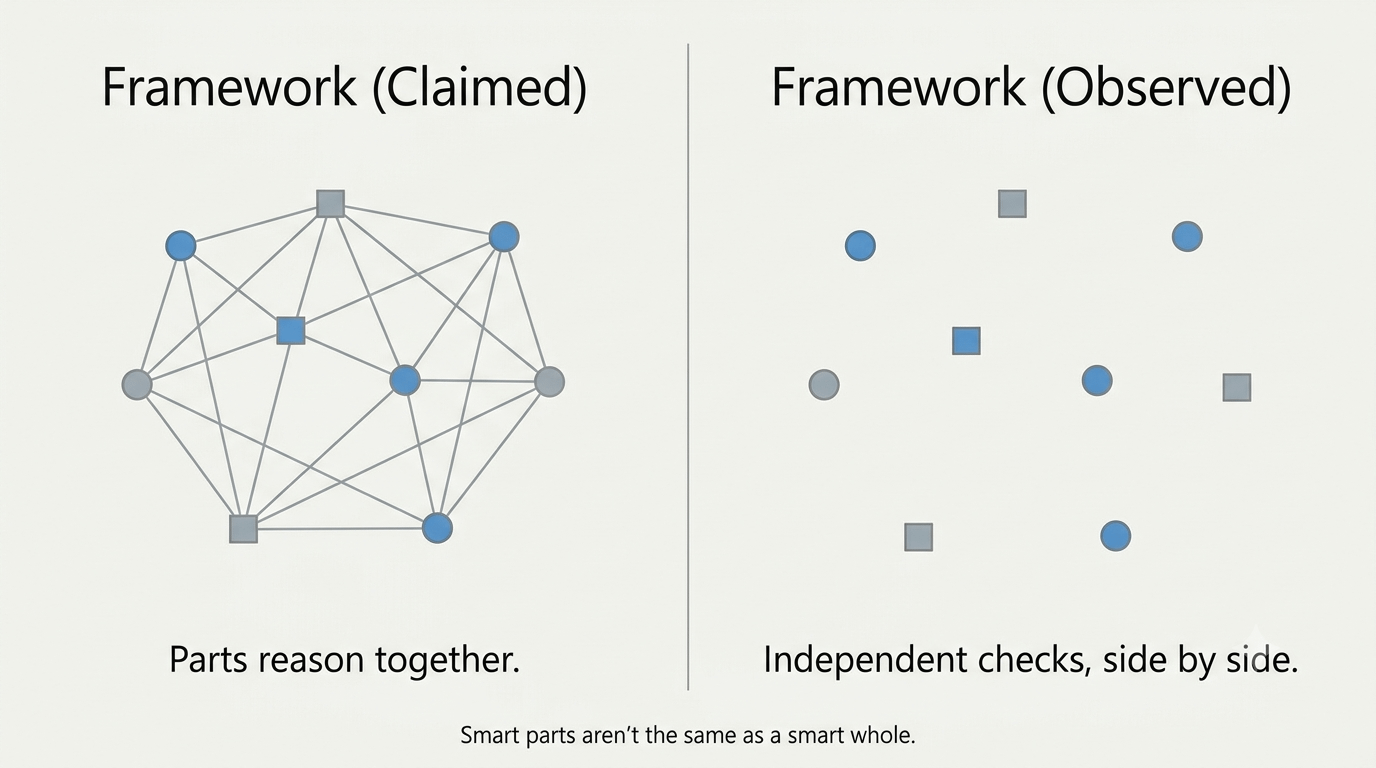
But here's the part that bothers me. If the actual architecture is closer to isolated smart checks than a unified framework, then whatever falls between those checks, the compounding risk, the edge case that doesn't neatly match any single rule, stays uncovered no matter how good any individual check is. Calling it a framework implies that gap doesn't exist, when structurally it probably does. I'm not fully convinced independent smart rules add up to framework-level protection just because each rule performs well on its own. Those feel like different claims to me, and only one of them was actually demonstrated during the task.
I keep going back and forth on whether I'm demanding too much architecturally, most security tooling in this space works this way, rule-based and modular rather than deeply integrated. Maybe expecting a true reasoning framework this early is unrealistic. Still, the word framework specifically implies integration, and what I actually saw was closer to a well-made collection of parts.
Who this matters for is probably anyone whose actual risk comes from combinations of smaller things rather than one obvious red flag, which, based on my own recent audit, is a lot more common than a single glaring vulnerability.
Anyway, finally got that 2FA set up properly, small win for the day. I'll probably keep an eye on whether the individual checks here start talking to each other over time, or whether it stays a strong pile of parts instead of an actual framework.