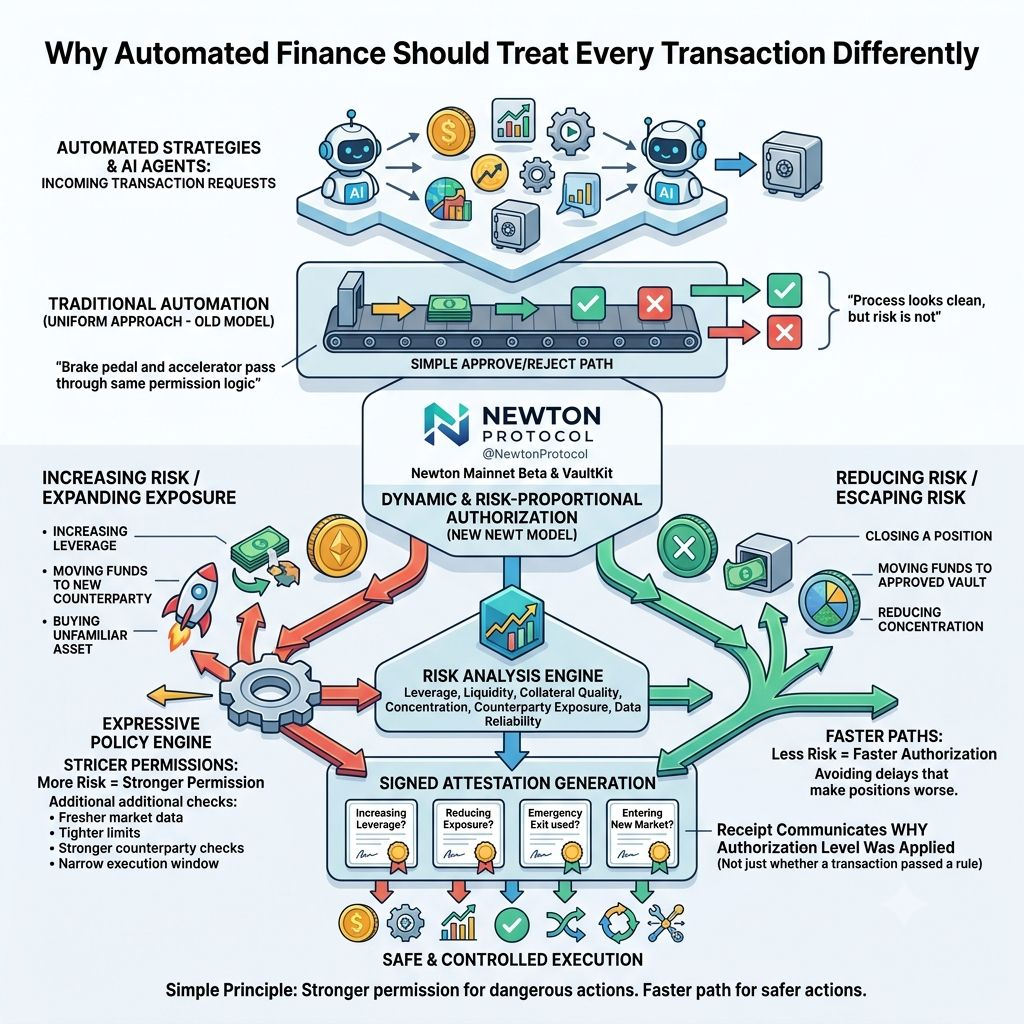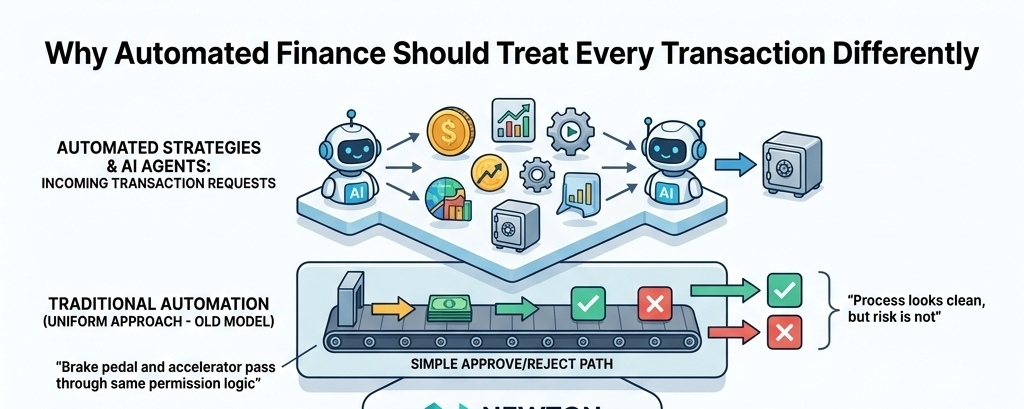

Une pédale de frein et une pédale d’accélérateur ne devraient pas passer par la même logique d’autorisation.
Cela peut sembler évident, mais je pense que la finance automatisée traite souvent les actions de manière trop uniforme. Une transaction arrive, le système vérifie une politique, puis le résultat devient « approuver » ou « rejeter ».
Le processus semble propre.
Le risque derrière chaque action n’est pas identique.
Une stratégie pilotée par l’IA qui augmente l’effet de levier fait quelque chose de fondamentalement différent de la même stratégie qui clôture une position. Déplacer des fonds vers un nouvel intermédiaire crée une exposition différente de celle consistant à retourner du capital vers un coffre-fort approuvé. Acheter un actif inhabituel ne devrait pas nécessairement suivre le même chemin d’autorisation que réduire la concentration d’une position existante.
C’est pour moi là que @NewtonProtocol devient plus intéressant qu’un simple récit d’automatisation.
Le Mainnet Beta de Newton et VaultKit se concentrent sur l’autorisation avant le règlement : vérifier une action par rapport à des règles définies avant qu’elle ne se règle, puis produire une attestation signée qui peut montrer que l’évaluation a bien eu lieu.
Je vois une vraie valeur dans cette conception.
Mais je pense que la version la plus forte de l’idée va au-delà de la question de savoir si une transaction correspond à une politique.
Il se demande quelle quantité d’autorisation cette action spécifique mérite.
Prenez un coffre automatisé pendant un marché volatil.
Une action augmente l’effet de levier parce que la stratégie détecte une opportunité.
Une autre action réduit l’exposition parce que les conditions de la garantie se dégradent.
Si les deux transactions suivent exactement le même processus d’approbation, le système peut être techniquement cohérent tout en restant financièrement insensible.
La première action augmente la perte potentielle.
La seconde peut l’en empêcher.
Cette différence devrait avoir de l’importance.
Pour moi, c’est là que l’autorisation proportionnelle au risque devient importante. Une action qui augmente l’exposition peut nécessiter des conditions plus strictes : des données de marché plus récentes, des limites plus serrées, des contrôles de contrepartie plus forts, ou une fenêtre d’exécution plus étroite.
Une action qui réduit clairement le risque peut nécessiter un chemin plus rapide, surtout lorsque le délai lui-même pourrait aggraver la position.
Je ne prétends pas que les transactions réduisant le risque devraient contourner l’autorisation.
Je soutiens que l’autorisation doit comprendre la direction.
Un système qui ne sait que « autorisé » et « non autorisé » peut manquer la signification économique de ce que l’agent essaie de faire.
Ceci devient encore plus important avec des agents IA, parce que les systèmes automatisés ne s’arrêtent pas naturellement pour interpréter le contexte comme pourrait le faire un trader humain.
Une personne peut regarder le marché et penser :
« Ce trade viole normalement mon itinéraire préféré, mais je dois réduire l’exposition immédiatement. »
Une politique rigide engne ne verra peut-être que que l’itinéraire n’est pas approuvé.
Le résultat pourrait être une contradiction étrange : la couche d’autorisation bloque une action conçue pour rendre le portefeuille plus sûr parce que la transaction ne correspond pas à une règle écrite pour des conditions normales.
Cela ne signifierait pas que la règle a échoué.
Cela voudrait dire que la politique manquait de conscience du risque.
C’est, selon moi, la partie de NEWT qu’il vaut la peine de suivre de très près. Newton cherche à introduire des autorisations opposables dans la finance onchain automatisée. Le défi le plus difficile est de rendre ces autorisations suffisamment expressives pour distinguer les actions qui créent un risque de celles qui l’éliminent.
Une attestation signée pourrait devenir plus utile lorsqu’elle communique cette distinction.
Au lieu de ne prouver que le fait que la transaction a respecté une règle, je voudrais que la logique de politique environnante explique clairement pourquoi ce niveau d’autorisation a été appliqué.
La stratégie augmentait-elle l’effet de levier ?
Réduisait-elle l’exposition ?
Interagissait-elle avec un actif approuvé au préalable ?
S’agissait-il d’entrer sur un nouveau marché ?
Est-ce qu’il utilisait une condition de sortie d’urgence ?
Ces détails peuvent changer à quoi devrait ressembler un processus d’autorisation raisonnable.
Je pense aussi que cela pourrait améliorer la compréhension de l’utilisateur.
La plupart des gens ne veulent pas étudier chaque module interne de politique avant d’utiliser une stratégie automatisée. Ils veulent être sûrs que le système devient plus prudent quand l’action devient plus dangereuse.
C’est plus facile à comprendre qu’une longue liste technique de contrôles.
Le principe est simple :
Plus de risque devrait exiger des permissions plus fortes.
Le risque moindre ne devrait pas être retardé sans une bonne raison.
Bien sûr, appliquer ce principe est difficile.
Le premier problème est de définir ce que signifie réellement « réduire le risque ».
Clôturer une partie d’une position peut réduire l’exposition au marché, mais créer des coûts de liquidité. Passer à un actif stable peut diminuer la volatilité, mais introduire un risque de contrepartie ou de déconnexion (« depegging »). Quitter un coffre peut réduire l’exposition aux smart contracts tout en créant ailleurs un risque de règlement ou de pont (« bridge »).
Les actions financières ne déplacent presque jamais le risque dans un seul sens.
Cela signifie que la politique ne peut pas s’appuyer sur une simple étiquette.
Elle peut devoir prendre en compte plusieurs dimensions à la fois : l’effet de levier, la liquidité, la qualité de la garantie, la concentration, l’exposition à la contrepartie et la fiabilité des données utilisées.
Le second défi est de prévenir les abus.
Si une application accorde une autorisation plus rapide aux actions qui réduisent le risque, une stratégie mal conçue pourrait essayer de classifier un comportement agressif comme défensif. La définition doit être applicable, pas seulement descriptive.
Le troisième défi est la transparence.
Un utilisateur devrait pouvoir comprendre pourquoi une action exigeait une approbation plus forte tandis qu’une autre a suivi un chemin plus rapide. Si la logique est cachée, l’autorisation sensible au risque peut commencer à sembler arbitraire.
C’est ici que des attestations vérifiables pourraient devenir particulièrement significatives.
Un reçu ne devrait pas être traité comme une garantie que chaque jugement financier était correct. Mais il peut fournir une preuve que l’action a été évaluée selon une politique définie et que le chemin d’autorisation requis a bien été suivi.
Pour moi, c’est plus utile que de constater simplement qu’une transaction a été exécutée.
Je veux savoir si le système a reconnu le type de risque qu’il créait.
Je pense aussi que différentes applications auront besoin de profils d’autorisation différents.
Un coffre institutionnel conservateur peut exiger des contrôles stricts pour presque chaque mouvement de capital.
Un outil de rééquilibrage grand public peut utiliser des limites plus simples.
Un agent IA qui gère un ensemble restreint d’actifs approuvés peut avoir besoin de moins de friction qu’un agent opérant sur plusieurs chaînes, avec plusieurs contreparties, et sur des marchés de prêt.
Cette flexibilité est importante parce qu’un modèle de risque universel deviendrait probablement soit trop lâche pour des capitaux sérieux, soit trop restrictif pour un usage pratique.
L’infrastructure spécifique à Newton devient précieuse seulement lorsque les développeurs peuvent traduire ces différences en règles applicables sans rendre l’expérience utilisateur impossible à comprendre.
C’est l’équilibre que je surveillerais avec Newt.
Trop peu de contrôle, et l’automatisation devient dangereuse.
Trop de contrôle rigide, et l’automatisation perd la capacité de réagir quand les marchés évoluent rapidement.
La meilleure couche d’autorisation ne doit pas seulement empêcher les actions interdites. Elle devrait reconnaître que certaines actions méritent un examen plus approfondi que d’autres.
Pour moi, c’est la vraie norme pour la finance IA contrôlée.
Je ne veux pas seulement un agent qui suit des règles.
Je veux un agent dont le système de permissions devient plus strict à mesure que les conséquences deviennent plus importantes.
Parce que, sur des marchés automatisés, traiter chaque transaction de la même manière ne crée pas toujours de l’équité ni de la sécurité.
Parfois, cela ne fait que signifier que le système n’a pas compris la différence entre prendre du risque et s’y soustraire.