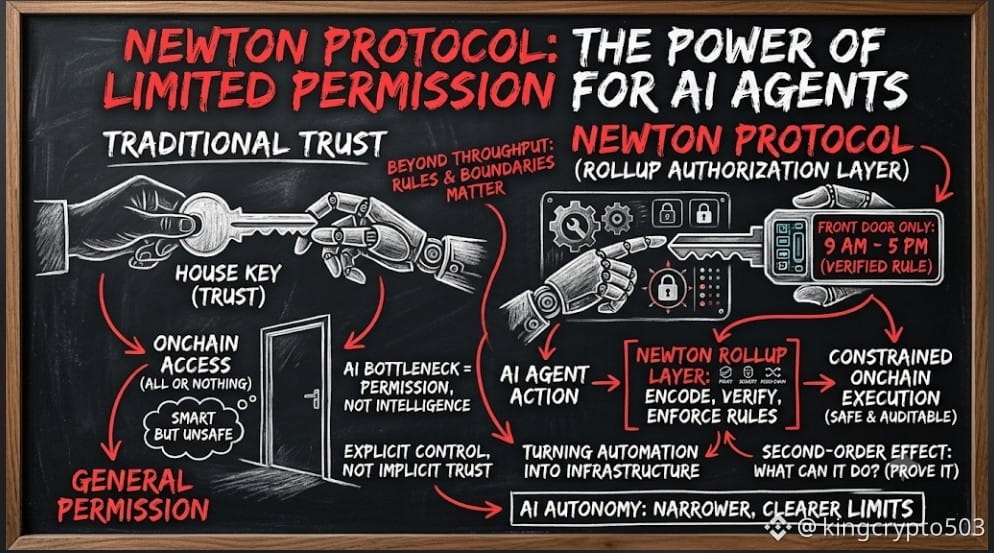
La plupart des gens entendent « rollup » et supposent que le principal avantage est des transactions moins chères et plus rapides. C’est vrai, mais cela semble incomplet. Dans le cas du protocole Newton, l’idée la plus intéressante est que, grâce à un rollup, des agents d’IA peuvent paraître moins comme un logiciel « en vrac » et davantage comme quelque chose qui fonctionne à l’intérieur d’un système borné. Newton se décrit comme une couche d’autorisation onchain, conçue pour encoder, vérifier et faire respecter des règles avant l’exécution des transactions, et son livre blanc inscrit la conception davantage dans une logique de politique, de sécurité et d’exécution inter-chaînes que dans la seule performance brute.
Au début, j’ai pensé qu’il s’agissait simplement d’un autre projet « IA + crypto » avec une meilleure plomberie. Puis le changement plus profond est devenu évident : si un agent d’IA peut agir sur du capital, le véritable goulot d’étranglement n’est pas l’intelligence, mais l’autorisation. Un système peut être intelligent tout en étant dangereux. L’idée de rollup de Newton semble viser à transformer ces autorisations en quelque chose d’explicite, de vérifiable et plus facile à faire respecter.
Une analogie simple : c’est la différence entre donner à quelqu’un la clé de votre maison et lui donner une clé qui n’ouvre que la porte d’entrée entre 9 h et 17 h. La première, c’est la confiance. La seconde, c’est le contrôle.
Ce que beaucoup de gens négligent, c’est l’effet d’ordre supérieur. Une fois que les actions de l’IA sont limitées à l’intérieur d’une couche d’exécution dédiée, la discussion passe de « Cet agent peut-il faire des transactions ? » à « Qu’est-ce qu’il doit exactement être autorisé à faire, et comment prouver qu’il est resté à l’intérieur de ces limites ? » Cela compte encore plus quand le système se développe, parce que l’automatisation à faible volume est un simple confort ; l’automatisation à fort volume devient de l’infrastructure.
Peut-être que c’est là la vraie promesse : non pas une IA plus rapide pour elle-même, mais une IA à laquelle on peut faire confiance pour évoluer à l’intérieur de frontières plus étroites et plus claires. Et en crypto, les frontières pourraient finalement compter davantage que la vitesse.
#Newt #NEWT @NewtonProtocol l $VANRY $BEL #newt $NEWT
Au début, j’ai pensé qu’il s’agissait simplement d’un autre projet « IA + crypto » avec une meilleure plomberie. Puis le changement plus profond est devenu évident : si un agent d’IA peut agir sur du capital, le véritable goulot d’étranglement n’est pas l’intelligence, mais l’autorisation. Un système peut être intelligent tout en étant dangereux. L’idée de rollup de Newton semble viser à transformer ces autorisations en quelque chose d’explicite, de vérifiable et plus facile à faire respecter.
Une analogie simple : c’est la différence entre donner à quelqu’un la clé de votre maison et lui donner une clé qui n’ouvre que la porte d’entrée entre 9 h et 17 h. La première, c’est la confiance. La seconde, c’est le contrôle.
Ce que beaucoup de gens négligent, c’est l’effet d’ordre supérieur. Une fois que les actions de l’IA sont limitées à l’intérieur d’une couche d’exécution dédiée, la discussion passe de « Cet agent peut-il faire des transactions ? » à « Qu’est-ce qu’il doit exactement être autorisé à faire, et comment prouver qu’il est resté à l’intérieur de ces limites ? » Cela compte encore plus quand le système se développe, parce que l’automatisation à faible volume est un simple confort ; l’automatisation à fort volume devient de l’infrastructure.
Peut-être que c’est là la vraie promesse : non pas une IA plus rapide pour elle-même, mais une IA à laquelle on peut faire confiance pour évoluer à l’intérieur de frontières plus étroites et plus claires. Et en crypto, les frontières pourraient finalement compter davantage que la vitesse.
#Newt #NEWT @NewtonProtocol l $VANRY $BEL #newt $NEWT