#opg
In my previous post, I discussed how OpenGradient's Hybrid AI Compute Architecture (HACA) separates model execution from on-chain verification to address the latency limitations faced by many decentralized AI projects.
However, the deeper innovation may be the emergence of verifiable AI as infrastructure rather than just a service.
Today's AI ecosystem largely relies on trust. When an AI model generates an output, users often cannot verify which model produced it, whether the inference process was altered, or whether hidden intermediaries influenced the result. While this may be acceptable for consumer applications, it becomes a critical issue when AI agents manage assets, execute trades, or make autonomous decisions.
Consider an AI trading agent rebalancing a multimillion-dollar portfolio. The key question is no longer how quickly it can act, but whether its decisions can be independently verified.
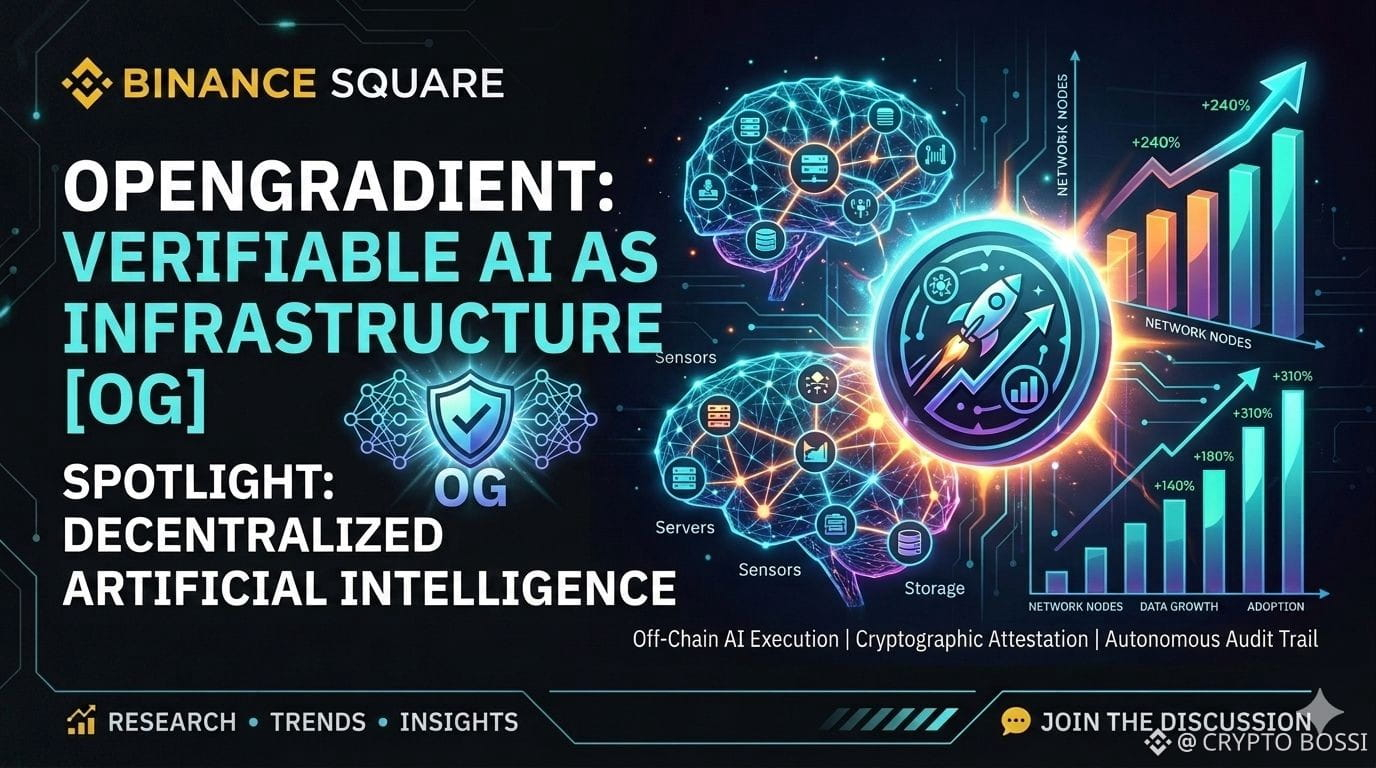
OpenGradient's approach aims to address this by combining off-chain AI execution with cryptographic attestations anchored to decentralized networks. Rather than moving all computation on-chain, it seeks to create verifiable records that make AI outputs auditable digital events.
This model offers a middle ground between traditional AI platforms, which are efficient but trust-based, and fully on-chain AI systems, which are transparent but often costly and less scalable.
Challenges remain, including proof costs, scalability, and defining what should be verified. Yet if autonomous agents and machine-to-machine economies continue to grow, verifiability could become as fundamental to AI as consensus is to blockchains.
The future question may not be, “Which AI is smartest?” but “Which AI can prove it acted honestly?”.$OPG
In my previous post, I discussed how OpenGradient's Hybrid AI Compute Architecture (HACA) separates model execution from on-chain verification to address the latency limitations faced by many decentralized AI projects.
However, the deeper innovation may be the emergence of verifiable AI as infrastructure rather than just a service.
Today's AI ecosystem largely relies on trust. When an AI model generates an output, users often cannot verify which model produced it, whether the inference process was altered, or whether hidden intermediaries influenced the result. While this may be acceptable for consumer applications, it becomes a critical issue when AI agents manage assets, execute trades, or make autonomous decisions.
Consider an AI trading agent rebalancing a multimillion-dollar portfolio. The key question is no longer how quickly it can act, but whether its decisions can be independently verified.
OpenGradient's approach aims to address this by combining off-chain AI execution with cryptographic attestations anchored to decentralized networks. Rather than moving all computation on-chain, it seeks to create verifiable records that make AI outputs auditable digital events.
This model offers a middle ground between traditional AI platforms, which are efficient but trust-based, and fully on-chain AI systems, which are transparent but often costly and less scalable.
Challenges remain, including proof costs, scalability, and defining what should be verified. Yet if autonomous agents and machine-to-machine economies continue to grow, verifiability could become as fundamental to AI as consensus is to blockchains.
The future question may not be, “Which AI is smartest?” but “Which AI can prove it acted honestly?”.$OPG