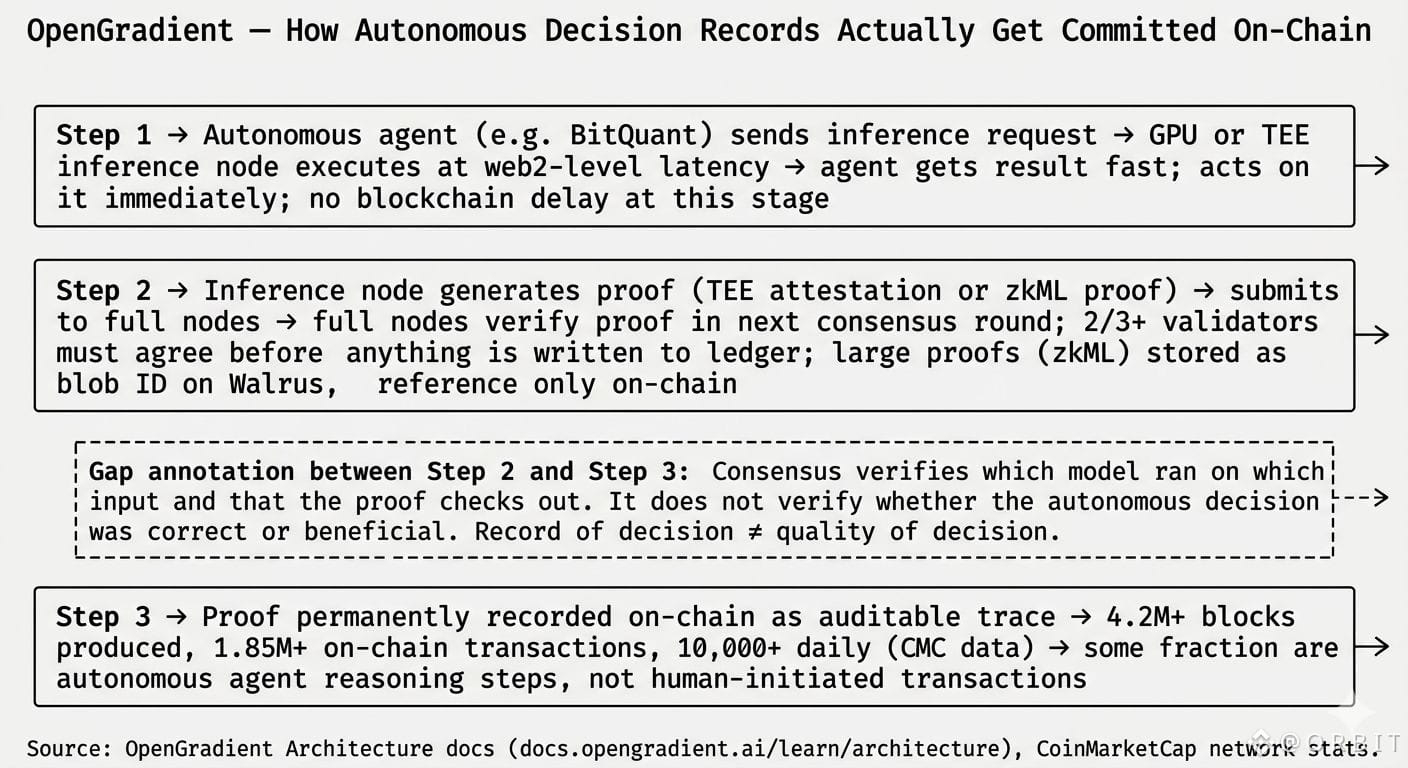
Something in the @OpenGradient architecture docs stopped me mid-task. Not the agent angle — the sequencing. An autonomous agent makes a decision call, inference runs on a GPU/TEE node at web2 speed, but the decision only gets committed to the ledger after 2/3+ validators pass the proof at the next consensus round. The agent acts fast. The record catches up. That separation is what actually makes autonomous decisions auditable rather than just fast. $OPG #OPG
Hold up — that design means every autonomous reasoning step BitQuant takes on a DeFi position isn't just an API call that disappears. It's a permanent, auditable trace on-chain once consensus confirms the proof. The network has produced 4.2 million blocks carrying 1.85 million on-chain transactions, running at 10,000+ daily. Some meaningful fraction of those are autonomous agent decisions, not humans clicking anything.
I spent a while just sitting with that. The narrative around AI agents usually focuses on what they decide. This is the infrastructure layer that makes the record of deciding tamper-evident. Completely different thing. Came at it from the autonomy angle but landed on the accountability angle instead.
Though… the honest gap is still the same one. Verification that a decision was recorded isn't the same as verification that it was a good decision. The proof tells you which model ran and on what input. It says nothing about whether the output was actually right.
Hmm. Does on-chain auditability of bad autonomous decisions help anyone, or just create a cleaner record of the damage?
Hold up — that design means every autonomous reasoning step BitQuant takes on a DeFi position isn't just an API call that disappears. It's a permanent, auditable trace on-chain once consensus confirms the proof. The network has produced 4.2 million blocks carrying 1.85 million on-chain transactions, running at 10,000+ daily. Some meaningful fraction of those are autonomous agent decisions, not humans clicking anything.
I spent a while just sitting with that. The narrative around AI agents usually focuses on what they decide. This is the infrastructure layer that makes the record of deciding tamper-evident. Completely different thing. Came at it from the autonomy angle but landed on the accountability angle instead.
Though… the honest gap is still the same one. Verification that a decision was recorded isn't the same as verification that it was a good decision. The proof tells you which model ran and on what input. It says nothing about whether the output was actually right.
Hmm. Does on-chain auditability of bad autonomous decisions help anyone, or just create a cleaner record of the damage?