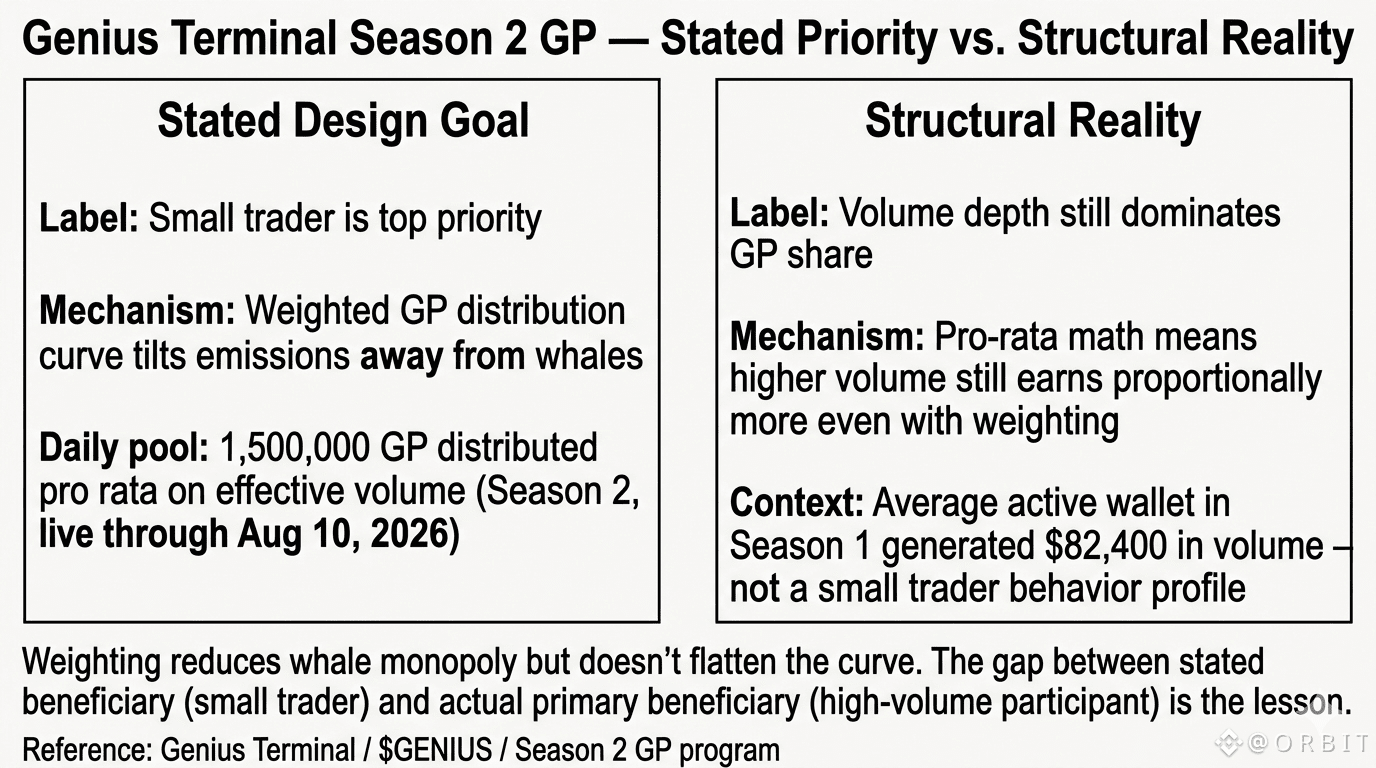
Something caught me during this CreatorPad task that I genuinely hadn't thought about going in. Genius Terminal pitches itself as built for pros — the language everywhere is institutional, whale-focused, high-velocity. But then you look at the actual Season 2 GP mechanics running through August 10, 2026, and the most instructive signal for a new trader is buried in the distribution design. @GeniusOfficial built a weighted model specifically so whales don't monopolize weekly GP emissions. 1,500,000 GP allocated daily, pro rata on effective volume — but with a curve that tilts toward smaller participants. #Genius $GENIUS
Hold up. That's actually one of the better real-world demos of how incentive structures can be designed to serve stated goals without fully delivering on them. Because the curve helps, yes — but at an average active wallet running $82,400 in volume during Season 1, the realistic small trader is still competing against pros who can generate that in a session. The weighting softens the gap; it doesn't close it.
What new traders can actually learn from studying this: the structure of an incentive program tells you who the platform is optimizing for versus who it wants you to think it's for. Those two things can coexist. Genius wants retail engagement on paper. The mechanics reward volume depth in practice. Knowing that gap exists is itself useful.
I walked away with more respect for the structure than the claim it's retail-first. Design intent and design outcome are different things.
Does that weighted curve ever produce genuinely equal access — or does it mostly create the appearance of it?
Hold up. That's actually one of the better real-world demos of how incentive structures can be designed to serve stated goals without fully delivering on them. Because the curve helps, yes — but at an average active wallet running $82,400 in volume during Season 1, the realistic small trader is still competing against pros who can generate that in a session. The weighting softens the gap; it doesn't close it.
What new traders can actually learn from studying this: the structure of an incentive program tells you who the platform is optimizing for versus who it wants you to think it's for. Those two things can coexist. Genius wants retail engagement on paper. The mechanics reward volume depth in practice. Knowing that gap exists is itself useful.
I walked away with more respect for the structure than the claim it's retail-first. Design intent and design outcome are different things.
Does that weighted curve ever produce genuinely equal access — or does it mostly create the appearance of it?