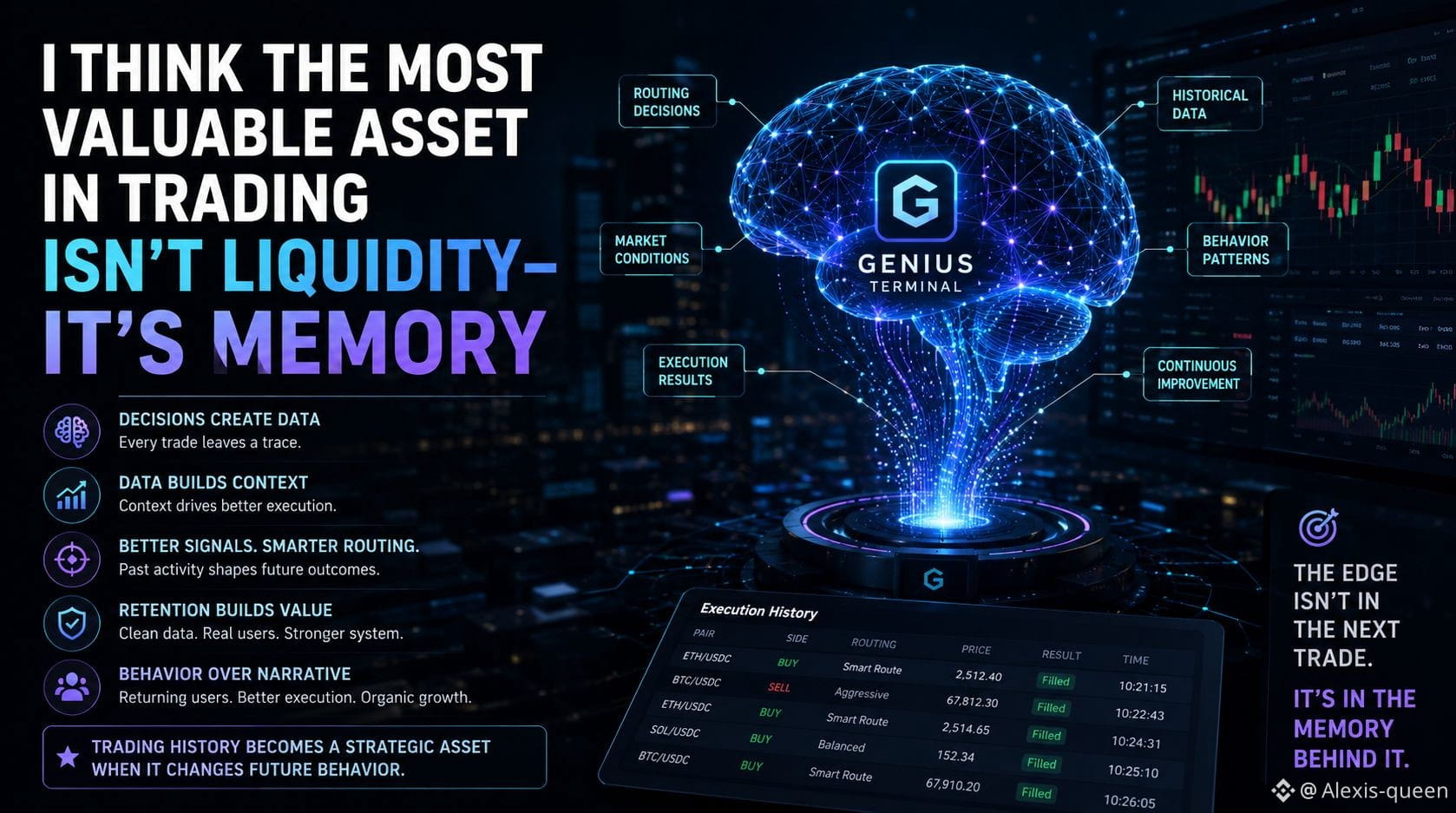
I Think the Most Valuable Asset in Trading Isn't Liquidity — It's Memory
@GeniusOfficial I remember reviewing my trading history after a month of active markets and expecting to find the usual mix of good and bad trades. Instead, I found something much more interesting. The biggest insights were not hidden in the outcomes. They were hidden in the decisions that led to them.
That is one reason Genius Terminal keeps catching my attention.
Most platforms treat execution as the end of the process. A trade is completed, liquidity moves, and the market moves on. But I keep wondering what happens when execution history starts accumulating over time. Across different market environments, that history can become something much more valuable than a simple record of past activity.
Every routing decision, every entry, every execution result creates information. If Genius Terminal can use that information to improve future execution, optimize routing, or generate better insights, then past activity begins influencing future outcomes. The value no longer comes only from liquidity. It comes from context.
What I find most important, however, is retention. Historical data only becomes powerful if traders continue returning and the system keeps improving. Low-quality incentives or artificial activity can weaken the signal over time.
When I evaluate platforms, I watch behavior more than narratives. Are users returning? Is execution quality improving? Is adoption growing organically?
For me, that is where the real edge exists.
Trading history becomes a strategic asset when it changes future behavior, and that is the part I am watching most closely.
#Genius #genius $GENIUS @GeniusOfficial
@GeniusOfficial I remember reviewing my trading history after a month of active markets and expecting to find the usual mix of good and bad trades. Instead, I found something much more interesting. The biggest insights were not hidden in the outcomes. They were hidden in the decisions that led to them.
That is one reason Genius Terminal keeps catching my attention.
Most platforms treat execution as the end of the process. A trade is completed, liquidity moves, and the market moves on. But I keep wondering what happens when execution history starts accumulating over time. Across different market environments, that history can become something much more valuable than a simple record of past activity.
Every routing decision, every entry, every execution result creates information. If Genius Terminal can use that information to improve future execution, optimize routing, or generate better insights, then past activity begins influencing future outcomes. The value no longer comes only from liquidity. It comes from context.
What I find most important, however, is retention. Historical data only becomes powerful if traders continue returning and the system keeps improving. Low-quality incentives or artificial activity can weaken the signal over time.
When I evaluate platforms, I watch behavior more than narratives. Are users returning? Is execution quality improving? Is adoption growing organically?
For me, that is where the real edge exists.
Trading history becomes a strategic asset when it changes future behavior, and that is the part I am watching most closely.
#Genius #genius $GENIUS @GeniusOfficial