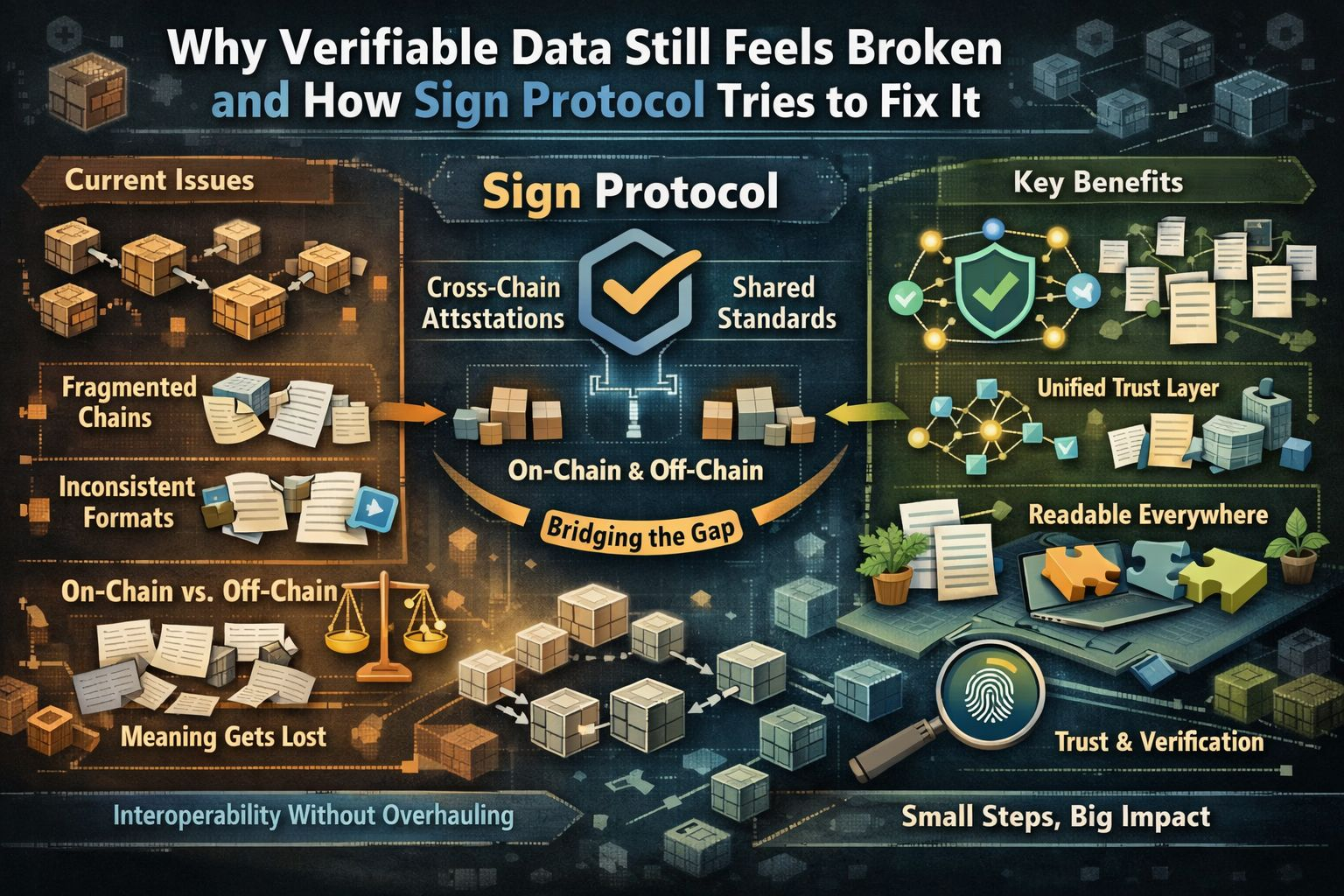
There’s this quiet assumption floating around crypto that “verifiable data” is already solved. Like, we figured out signatures, hashes, proofs—so what’s left, right? But the more you actually look at how data moves (or doesn’t move) between chains, the more it feels… unfinished. Not broken exactly. Just awkward in ways people don’t always admit.
That’s kind of where Sign Protocol slips in. Not with a dramatic entrance, more like someone noticing the room is slightly out of order and starting to rearrange things without making a big deal of it.
At a glance, it’s about attestations. That word again. It sounds formal, almost stiff, but really it’s just a claim backed by some sort of proof. “This person did this.” “This wallet owns that.” “This DAO recognizes this contribution.” Simple statements. Except they aren’t simple once you try to move them across ecosystems.
Because here’s the thing—each chain has its own way of interpreting truth. Not philosophically, but technically. Different formats, different assumptions, different validation logic. So even if two chains are both “verifying” something, they’re not always speaking the same language. It’s like trying to compare two documents written in different dialects that almost overlap but not quite.
Sign Protocol doesn’t try to erase those differences. That would probably be impossible anyway. Instead, it introduces a kind of shared structure—like agreeing on grammar, even if accents remain. And that sounds small, but it changes how data travels.
What I find interesting is how it doesn’t force everything on-chain. There’s this ongoing tension in crypto where on-chain equals trustworthy, off-chain equals flexible, and you’re always trading one for the other. Sign doesn’t pick a side. It lets attestations anchor on-chain while still pointing outward when needed. It’s a bit messy, but in a realistic way. Almost like it accepts that not everything worth verifying fits neatly inside a block.
And honestly, that feels more human than most systems in this space.
Then there’s the cross-chain part, which people love to oversimplify. Moving tokens is one thing—you wrap them, bridge them, replicate them. Data isn’t like that. You can’t just copy it over and expect it to carry the same weight. Meaning doesn’t travel automatically. Trust definitely doesn’t.
So instead of trying to “move” attestations in the usual sense, Sign Protocol makes them readable across environments. It’s a subtle shift. Less about transport, more about interpretation. Like making sure that when something is verified in one place, it doesn’t become meaningless somewhere else.
Still, I can’t help thinking about the trade-offs. Standardization sounds great until it starts feeling restrictive. Too much structure, and creativity gets boxed in. Too little, and everything fragments again. Sign walks that line, though I’m not sure anyone really gets that balance right on the first try.
And then there’s trust—the part no protocol can fully solve. An attestation is only as valuable as the entity behind it. A signature proves who said something, not whether you should believe them. That layer doesn’t disappear just because the format is standardized. If anything, it becomes more visible.
Which is probably a good thing, even if it makes things messier.
I keep coming back to this idea that Sign Protocol isn’t trying to be the star of the show. It’s more like background infrastructure—the kind you don’t think about unless it’s missing. And maybe that’s why it feels different from a lot of crypto projects that aim to redefine everything all at once.
This one just… tidies up something that was quietly inconsistent.
Of course, whether it actually sticks depends on adoption. Standards only matter when people agree to use them, and crypto isn’t exactly famous for collective agreement. Everyone builds, forks, experiments—sometimes at the cost of cohesion.
So yeah, there’s uncertainty. There always is.
But still, there’s something oddly reassuring about the approach. It doesn’t promise a grand future where everything magically works together. It just builds a small piece of that future and leaves it there, usable, waiting.
And maybe that’s enough.
#SignDigitalSovereignInfra @SignOfficial $SIGN