
BeYa_BNB
3.8k Publications

BeYa_BNB
 Compte Square Vérifié+
Simple mind. Clear vision.(X- @BeYa_BNB)
Ouvert au trading
Trade régulièrement
9.3 mois
367 Suivis
32.3K+ Abonnés
8.5K+ J’aime
Publications
Portefeuille
Tous
Citations
Direct
PINNED
@Dusk
A few days ago I was scrolling through my phone, half paying attention, when I noticed the same name popping up everywhere. People talked about it like everyone already knew what it meant. I didn't. So I read the actual paper myself. Here's what I found, in plain words.
Most blockchains show everything to everyone, forever. That's a problem for banks, who need privacy for their clients but also have to prove to regulators that nothing shady is happening. This project was built to do both at once.
Messages travel through the network like a relay, passed only to a few chosen neighbors instead of blasted to everyone. It saves bandwidth, and quietly hides where a message started too.
To agree on what's real, people who lock up coins take turns proposing and checking new blocks. One person proposes, a group checks it, another group confirms the check. Agree fast enough, and the block locks in within seconds. If too many people go offline at once, a backup mode keeps things moving anyway.
There are even two ways to send money: one works like a normal, visible account, easy to audit. The other is private, more like handing someone cash though the network can still confirm no one's cheating, without ever seeing the amounts.
It also skips energy-hungry mining, so it uses far less power, and its heaviest math runs closer to the metal instead of inside a slow virtual sandbox.
A few days ago I couldn't have explained any of this. Now, when someone brings it up, I actually understand what they mean, instead of just nodding along.
@Dusk $DUSK #dusk
A few days ago I was scrolling through my phone, half paying attention, when I noticed the same name popping up everywhere. People talked about it like everyone already knew what it meant. I didn't. So I read the actual paper myself. Here's what I found, in plain words.
Most blockchains show everything to everyone, forever. That's a problem for banks, who need privacy for their clients but also have to prove to regulators that nothing shady is happening. This project was built to do both at once.
Messages travel through the network like a relay, passed only to a few chosen neighbors instead of blasted to everyone. It saves bandwidth, and quietly hides where a message started too.
To agree on what's real, people who lock up coins take turns proposing and checking new blocks. One person proposes, a group checks it, another group confirms the check. Agree fast enough, and the block locks in within seconds. If too many people go offline at once, a backup mode keeps things moving anyway.
There are even two ways to send money: one works like a normal, visible account, easy to audit. The other is private, more like handing someone cash though the network can still confirm no one's cheating, without ever seeing the amounts.
It also skips energy-hungry mining, so it uses far less power, and its heaviest math runs closer to the metal instead of inside a slow virtual sandbox.
A few days ago I couldn't have explained any of this. Now, when someone brings it up, I actually understand what they mean, instead of just nodding along.
@Dusk $DUSK #dusk
@Dusk
Picture a bank wire that settles in seconds instead of days, but still leaves regulators a clear paper trail when they need one. That's the exact problem Dusk is engineering its way through.
Most chains treat "fast," "private," and "compliant" as three things you can't have at once. Dusk's answer is Succinct Attestation, a proof-of-stake consensus where staked "provisioners" take turns proposing and voting on blocks in tight three-step rounds. Finality lands in seconds, and a built-in "rolling finality" system upgrades each block through clear stages accepted, attested, confirmed, final so nodes always know exactly how locked-in a transaction really is.
There's even a fail-safe for chaos: if too many rounds fail because provisioners go offline, the network slides into an emergency mode that keeps producing blocks instead of grinding to a halt.
The incentive design is worth a mention too. Block rewards split across generators and voters, with mechanisms specifically built to stop provisioners from gaming the system by letting earlier rounds fail on purpose. Small detail, but it's the kind of thing that separates a whitepaper idea from a network that actually holds up under real stake.
On the money-movement side, Moonlight handles plain transparent transfers while Phoenix handles the private ones, wrapping amounts and identities in zero-knowledge proofs without breaking auditability. Pair that with Zedger for tokenized securities, and Dusk starts looking like infrastructure built for people who actually have to answer to regulators not just crypto-native traders.
All of this runs on a proof-of-stake base that sidesteps the energy cost of mining entirely, with an efficient P2P layer (Kadcast) trimming bandwidth on top.
Quiet, technical, deliberate not the usual playbook.
@Dusk $DUSK #dusk
Picture a bank wire that settles in seconds instead of days, but still leaves regulators a clear paper trail when they need one. That's the exact problem Dusk is engineering its way through.
Most chains treat "fast," "private," and "compliant" as three things you can't have at once. Dusk's answer is Succinct Attestation, a proof-of-stake consensus where staked "provisioners" take turns proposing and voting on blocks in tight three-step rounds. Finality lands in seconds, and a built-in "rolling finality" system upgrades each block through clear stages accepted, attested, confirmed, final so nodes always know exactly how locked-in a transaction really is.
There's even a fail-safe for chaos: if too many rounds fail because provisioners go offline, the network slides into an emergency mode that keeps producing blocks instead of grinding to a halt.
The incentive design is worth a mention too. Block rewards split across generators and voters, with mechanisms specifically built to stop provisioners from gaming the system by letting earlier rounds fail on purpose. Small detail, but it's the kind of thing that separates a whitepaper idea from a network that actually holds up under real stake.
On the money-movement side, Moonlight handles plain transparent transfers while Phoenix handles the private ones, wrapping amounts and identities in zero-knowledge proofs without breaking auditability. Pair that with Zedger for tokenized securities, and Dusk starts looking like infrastructure built for people who actually have to answer to regulators not just crypto-native traders.
All of this runs on a proof-of-stake base that sidesteps the energy cost of mining entirely, with an efficient P2P layer (Kadcast) trimming bandwidth on top.
Quiet, technical, deliberate not the usual playbook.
@Dusk $DUSK #dusk
@Dusk
I’ve been thinking about what makes a blockchain feel connected to the real world, rather than just another digital system. For me, the interesting part is when rules around ownership, permissions, and assets are considered from the beginning.
That’s one reason Dusk caught my attention. Its whitepaper describes a network designed for regulated financial markets, where privacy and compliance are part of the infrastructure. Zedger is built for securities and real-world assets, with functions such as issuing assets, handling dividends, transfers, and keeping transactions auditable.
The license side is also interesting. Dusk describes a system that can track whether a license is valid, expired, renewed, or revoked, allowing certain actions only when the required license is active.
That feels more practical to me because financial systems involve more than moving tokens. There are legal responsibilities, eligibility requirements, and situations where someone may need to prove that an action was allowed.
Still, I think there is a gap worth watching. A blockchain can record permissions and enforce programmed conditions, but that does not automatically mean every government, court, or regulator will recognize those records as legally binding. Technology can enforce rules inside a network, while real-world law operates through institutions, jurisdictions, and people.
So I’m trying not to judge a project only by how advanced its architecture sounds. I’d rather understand who gives the rules authority, how disputes are handled, and what happens when technology and law disagree.
For me, learning means staying curious, asking uncomfortable questions, and not blindly trusting systems.
There is always more to understand, and continuous learning is part of becoming better at this.
@Dusk $DUSK #dusk
I’ve been thinking about what makes a blockchain feel connected to the real world, rather than just another digital system. For me, the interesting part is when rules around ownership, permissions, and assets are considered from the beginning.
That’s one reason Dusk caught my attention. Its whitepaper describes a network designed for regulated financial markets, where privacy and compliance are part of the infrastructure. Zedger is built for securities and real-world assets, with functions such as issuing assets, handling dividends, transfers, and keeping transactions auditable.
The license side is also interesting. Dusk describes a system that can track whether a license is valid, expired, renewed, or revoked, allowing certain actions only when the required license is active.
That feels more practical to me because financial systems involve more than moving tokens. There are legal responsibilities, eligibility requirements, and situations where someone may need to prove that an action was allowed.
Still, I think there is a gap worth watching. A blockchain can record permissions and enforce programmed conditions, but that does not automatically mean every government, court, or regulator will recognize those records as legally binding. Technology can enforce rules inside a network, while real-world law operates through institutions, jurisdictions, and people.
So I’m trying not to judge a project only by how advanced its architecture sounds. I’d rather understand who gives the rules authority, how disputes are handled, and what happens when technology and law disagree.
For me, learning means staying curious, asking uncomfortable questions, and not blindly trusting systems.
There is always more to understand, and continuous learning is part of becoming better at this.
@Dusk $DUSK #dusk
@Dusk
At first, I believed most crypto projects treated privacy and regulation as opposites you could have one or the other, never both. Anonymity was the whole point, and compliance sounded like a compromise nobody wanted to make.
Then I came across Dusk, a network built specifically for regulated financial markets, and it made me pause. Instead of just hiding transactions, it lets certain parties prove things about themselves ownership, identity, eligibility without revealing everything to everyone. There's a piece called Citadel that handles licenses and self-sovereign identity, so a person can show they're allowed to do something without exposing their whole history. And there's Zedger, built for issuing and managing securities on-chain, with rules for things like dividends and forced transfers baked in, so it isn't just theoretical it's shaped around how real financial instruments actually work.
That's what shifted something for me. It wasn't chasing a vague promise of "the future of finance." It was engineering toward specific legal and operational needs that actual institutions run into. Auditors can check what they need to check. Everyone else stays private. That felt less like a slogan and more like a design decision.
I still have questions, honestly. How much of this depends on regulators actually adopting it? Who decides which entities get audit access, and how is that trust maintained over time? Compliance frameworks change by jurisdiction can one protocol really keep up?
I don't have firm answers yet. But it reminded me how much I still have to learn about where blockchain meets real institutions, and how important it is to keep questioning the parts that sound too clean.
@Dusk $DUSK #dusk
At first, I believed most crypto projects treated privacy and regulation as opposites you could have one or the other, never both. Anonymity was the whole point, and compliance sounded like a compromise nobody wanted to make.
Then I came across Dusk, a network built specifically for regulated financial markets, and it made me pause. Instead of just hiding transactions, it lets certain parties prove things about themselves ownership, identity, eligibility without revealing everything to everyone. There's a piece called Citadel that handles licenses and self-sovereign identity, so a person can show they're allowed to do something without exposing their whole history. And there's Zedger, built for issuing and managing securities on-chain, with rules for things like dividends and forced transfers baked in, so it isn't just theoretical it's shaped around how real financial instruments actually work.
That's what shifted something for me. It wasn't chasing a vague promise of "the future of finance." It was engineering toward specific legal and operational needs that actual institutions run into. Auditors can check what they need to check. Everyone else stays private. That felt less like a slogan and more like a design decision.
I still have questions, honestly. How much of this depends on regulators actually adopting it? Who decides which entities get audit access, and how is that trust maintained over time? Compliance frameworks change by jurisdiction can one protocol really keep up?
I don't have firm answers yet. But it reminded me how much I still have to learn about where blockchain meets real institutions, and how important it is to keep questioning the parts that sound too clean.
@Dusk $DUSK #dusk
@Dusk
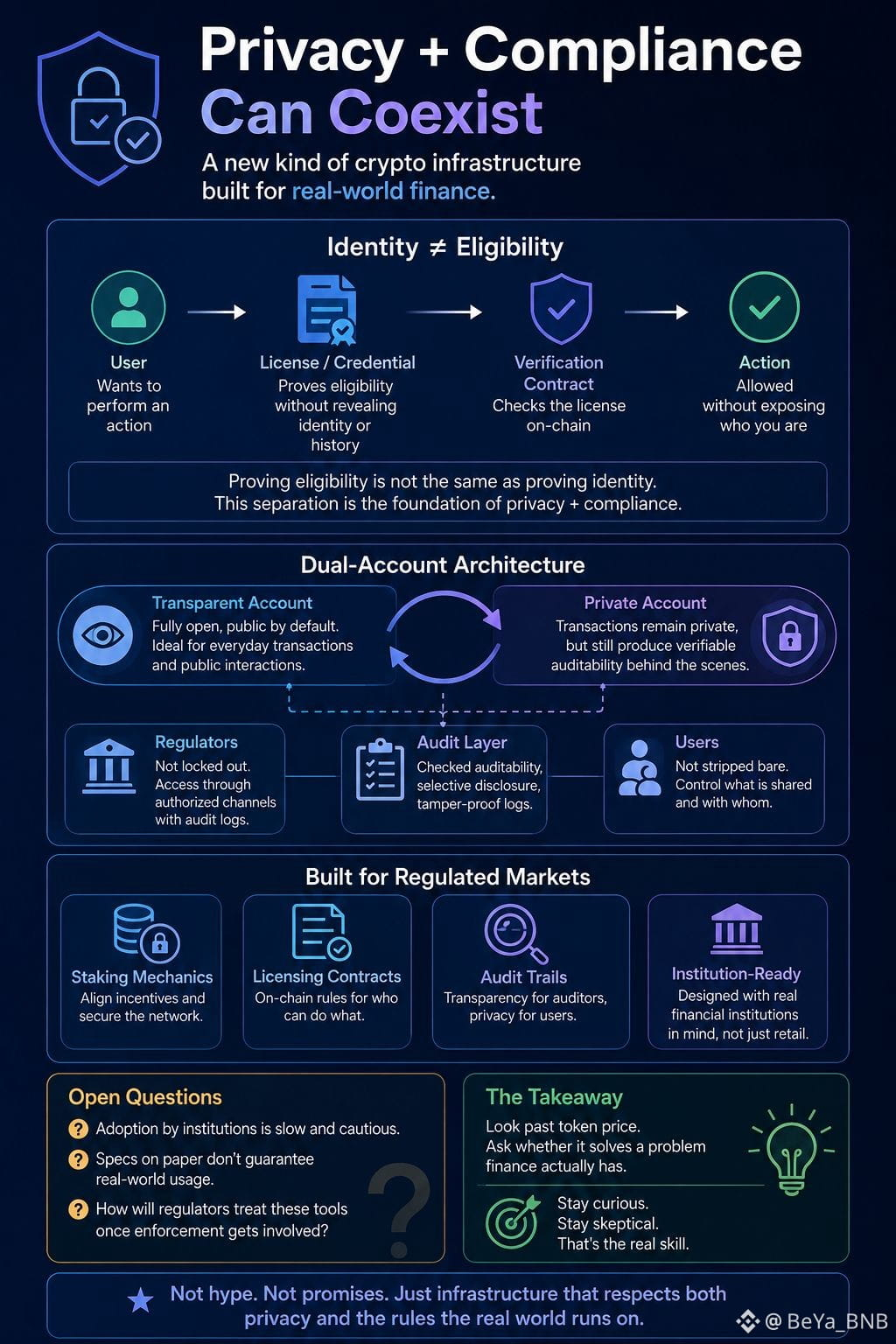
I used to think crypto meant total anonymity or nothing at all that privacy and rules couldn't sit in the same system. Every project I looked at either hid everything or exposed everything, and neither felt built for how institutions actually operate.
Then I came across a network that treats compliance as part of its architecture, not an afterthought. What caught me was the identity piece a license-based system where someone can prove they're allowed to do something without revealing who they are or handing over their entire history. Proving eligibility isn't the same as proving identity, and most chains never bothered to separate the two.
There's also a dual-account setup: one side stays fully transparent, the other lets transactions stay private while still generating checked auditability behind the scenes. Regulators aren't locked out entirely, and ordinary users aren't stripped bare either. That balance felt less like a workaround and more like something designed with real financial institutions in mind, not just retail speculation.
What made this different wasn't a flashy roadmap or a bold promise. It was the plumbing staking mechanics, licensing contracts, audit trails details that only matter if someone genuinely intends this for regulated markets.
Still, I have questions. Adoption by real institutions is slow and cautious, and specs on paper don't guarantee real-world usage. How will regulators actually treat these tools once enforcement gets involved?
I don't have an answer yet. But this shifted how I evaluate projects. I look past token price and ask whether something solves a problem finance actually has. Staying curious, staying skeptical that combination feels like the real skill here.
@Dusk #dusk $DUSK
I used to think crypto meant total anonymity or nothing at all that privacy and rules couldn't sit in the same system. Every project I looked at either hid everything or exposed everything, and neither felt built for how institutions actually operate.
Then I came across a network that treats compliance as part of its architecture, not an afterthought. What caught me was the identity piece a license-based system where someone can prove they're allowed to do something without revealing who they are or handing over their entire history. Proving eligibility isn't the same as proving identity, and most chains never bothered to separate the two.
There's also a dual-account setup: one side stays fully transparent, the other lets transactions stay private while still generating checked auditability behind the scenes. Regulators aren't locked out entirely, and ordinary users aren't stripped bare either. That balance felt less like a workaround and more like something designed with real financial institutions in mind, not just retail speculation.
What made this different wasn't a flashy roadmap or a bold promise. It was the plumbing staking mechanics, licensing contracts, audit trails details that only matter if someone genuinely intends this for regulated markets.
Still, I have questions. Adoption by real institutions is slow and cautious, and specs on paper don't guarantee real-world usage. How will regulators actually treat these tools once enforcement gets involved?
I don't have an answer yet. But this shifted how I evaluate projects. I look past token price and ask whether something solves a problem finance actually has. Staying curious, staying skeptical that combination feels like the real skill here.
@Dusk #dusk $DUSK
@Dusk
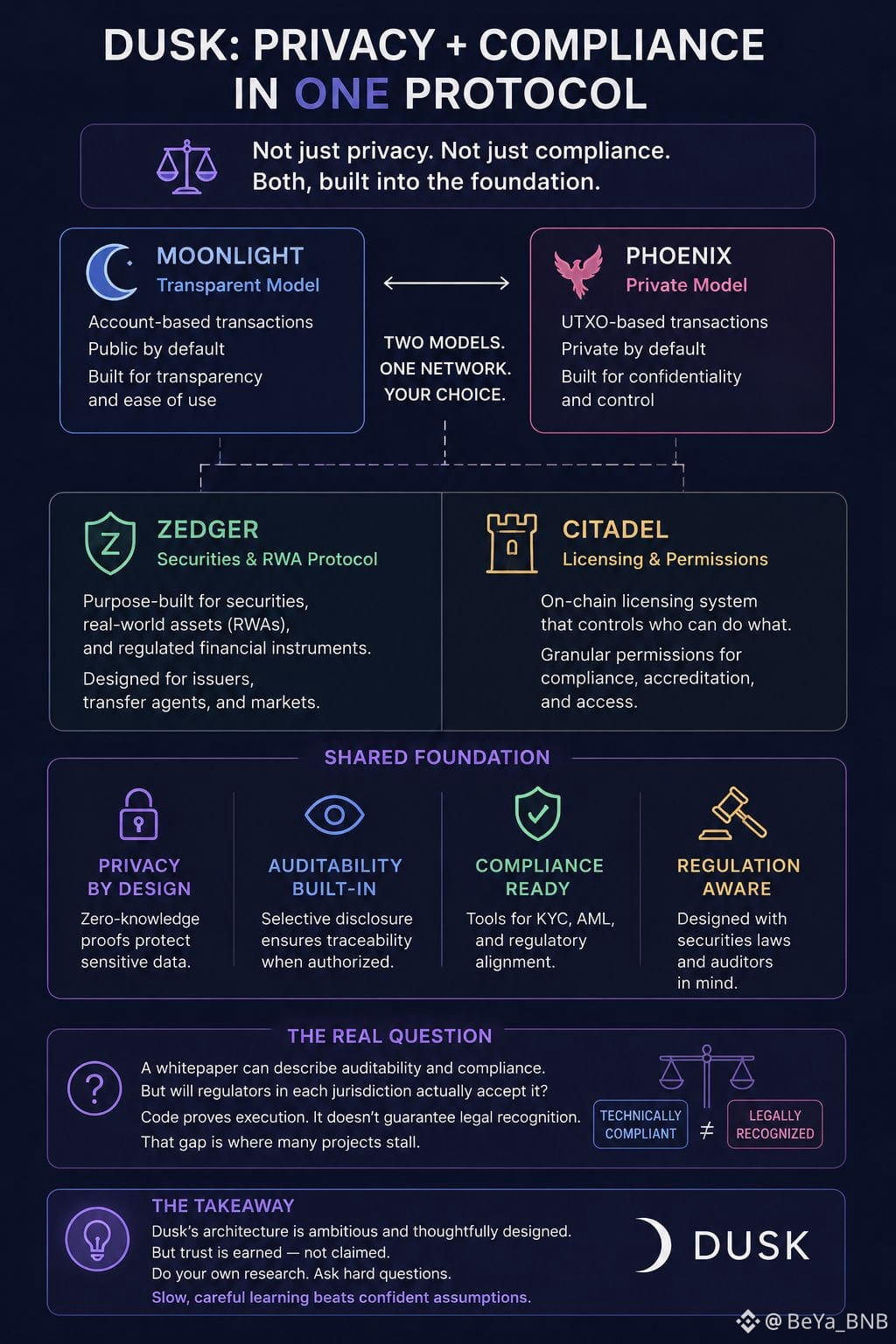
Been reading through Dusk's whitepaper this week, and one detail stuck with me: it's not trying to solve privacy or compliance it's trying to solve both at once, inside the same protocol.
That's what makes it feel more grounded than a lot of projects I've looked at. There's a transparent, account-based transaction model (Moonlight) sitting next to a private, UTXO-based one (Phoenix), and on top of that, a separate protocol called Zedger built specifically for securities and real-world assets, plus a licensing system (Citadel) for controlling who's allowed to do what on the network. None of that reads like decoration. It feels like something designed with actual securities law and actual auditors in mind, not privacy bolted on as a selling point.
But here's where I stay a little cautious. A whitepaper describing auditability and compliance mechanisms isn't the same as a regulator in any given country actually recognizing those mechanisms as sufficient. Code can prove a transaction happened correctly. It can't decide whether a court, a tax authority, or a securities regulator will accept that proof as meeting their bar. That gap between "technically compliant" and "legally recognized" is where a lot of ambitious projects quietly stall, and it's rarely the part anyone highlights.
So I'm not walking away thinking this is settled. I'm walking away with more questions who's actually testing these claims against real jurisdictions, and what enforcement even looks like if something breaks.
Worth digging into the details yourself before deciding what to trust. Slow, careful learning beats confident assumptions here, and honestly most places.
@Dusk $DUSK #dusk
Been reading through Dusk's whitepaper this week, and one detail stuck with me: it's not trying to solve privacy or compliance it's trying to solve both at once, inside the same protocol.
That's what makes it feel more grounded than a lot of projects I've looked at. There's a transparent, account-based transaction model (Moonlight) sitting next to a private, UTXO-based one (Phoenix), and on top of that, a separate protocol called Zedger built specifically for securities and real-world assets, plus a licensing system (Citadel) for controlling who's allowed to do what on the network. None of that reads like decoration. It feels like something designed with actual securities law and actual auditors in mind, not privacy bolted on as a selling point.
But here's where I stay a little cautious. A whitepaper describing auditability and compliance mechanisms isn't the same as a regulator in any given country actually recognizing those mechanisms as sufficient. Code can prove a transaction happened correctly. It can't decide whether a court, a tax authority, or a securities regulator will accept that proof as meeting their bar. That gap between "technically compliant" and "legally recognized" is where a lot of ambitious projects quietly stall, and it's rarely the part anyone highlights.
So I'm not walking away thinking this is settled. I'm walking away with more questions who's actually testing these claims against real jurisdictions, and what enforcement even looks like if something breaks.
Worth digging into the details yourself before deciding what to trust. Slow, careful learning beats confident assumptions here, and honestly most places.
@Dusk $DUSK #dusk
@Dusk
A whitepaper that made me rethink what "compliant" crypto actually means
I was reading through a blockchain whitepaper this week, the kind of document that usually reads like a technical manual and nothing else. But one detail caught my attention: this project isn't just building for other crypto users. It's building with actual securities law and financial compliance in mind, from the ground up.
That's what makes it feel different. Most privacy-focused blockchains hide everything and let regulation catch up later, if ever. This one includes contracts specifically meant for licensing, identity verification, and auditable securities, so a regulator could, in theory, check what needs checking without seeing everyone's transaction history. It's not privacy versus oversight, it's privacy with a door regulators can knock on.
That's a real shift. It suggests these builders expect actual institutions, maybe even actual courts and financial authorities, to interact with this system someday.
But I'll be honest, that's also where my doubt kicks in. Writing compliance into code is one thing. Getting regulators in different countries, with different laws, to actually recognize that code is a completely different challenge. Legal systems move slowly, and they don't always agree on what counts as compliant. There's a real gap between what a protocol can technically prove and what a judge or regulator is willing to accept.
So I'm not ready to call this solved. It's a genuinely interesting attempt at bridging two worlds that usually ignore each other. Whether it holds up once real institutions poke at it is still an open question.
Worth reading closely, worth staying skeptical about, and worth learning from either way. That's really the point, staying curious, questioning what's presented as settled, and growing sharper with each thing you read.
@Dusk $DUSK #dusk
A whitepaper that made me rethink what "compliant" crypto actually means
I was reading through a blockchain whitepaper this week, the kind of document that usually reads like a technical manual and nothing else. But one detail caught my attention: this project isn't just building for other crypto users. It's building with actual securities law and financial compliance in mind, from the ground up.
That's what makes it feel different. Most privacy-focused blockchains hide everything and let regulation catch up later, if ever. This one includes contracts specifically meant for licensing, identity verification, and auditable securities, so a regulator could, in theory, check what needs checking without seeing everyone's transaction history. It's not privacy versus oversight, it's privacy with a door regulators can knock on.
That's a real shift. It suggests these builders expect actual institutions, maybe even actual courts and financial authorities, to interact with this system someday.
But I'll be honest, that's also where my doubt kicks in. Writing compliance into code is one thing. Getting regulators in different countries, with different laws, to actually recognize that code is a completely different challenge. Legal systems move slowly, and they don't always agree on what counts as compliant. There's a real gap between what a protocol can technically prove and what a judge or regulator is willing to accept.
So I'm not ready to call this solved. It's a genuinely interesting attempt at bridging two worlds that usually ignore each other. Whether it holds up once real institutions poke at it is still an open question.
Worth reading closely, worth staying skeptical about, and worth learning from either way. That's really the point, staying curious, questioning what's presented as settled, and growing sharper with each thing you read.
@Dusk $DUSK #dusk
@Dusk
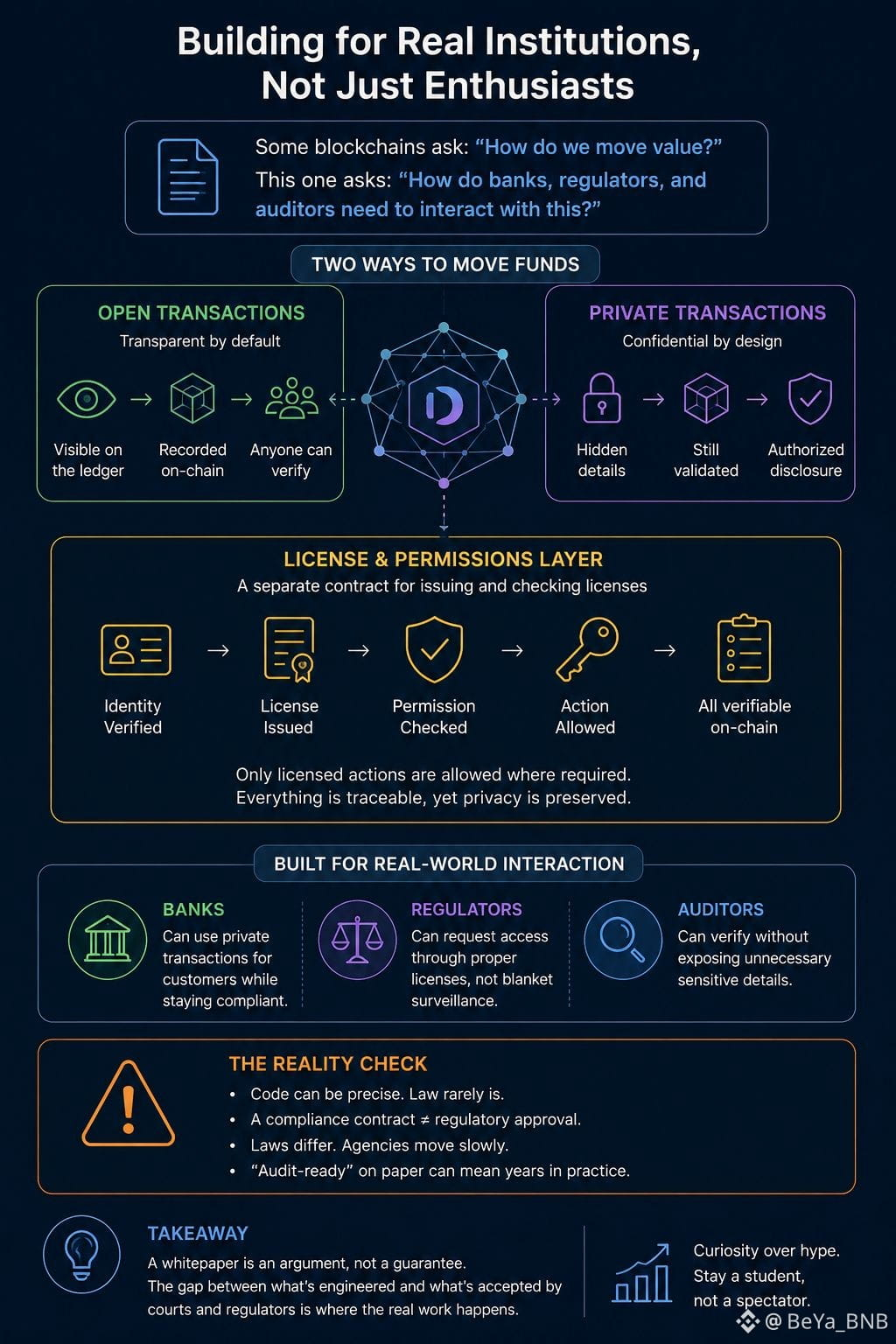
I spent part of this weekend reading a blockchain whitepaper that wasn't trying to sell me anything just a dense explanation of how the network handles transactions. What caught my attention wasn't the cryptography. It was one design choice: the network offers two ways to move funds, one fully open and one private, plus a separate contract just for issuing and checking licenses before certain actions are allowed.
That detail made the project feel more grounded than most. A lot of blockchain systems talk about privacy like it's the whole point, and stop there. This one starts from a different question: how would a bank, a regulator, or an auditor need to interact with this? Keeping a transparent option alongside the private one, and adding a licensing layer on top, suggests the team was thinking about real institutions, not just enthusiasts.
Still, reading a paper is one thing. Watching it work in the real world is another. A contract labeled for compliance doesn't mean a regulator has agreed to recognize it. Laws differ by country, agencies move slowly, and "audit-ready" on paper can still mean years of back-and-forth before it's usable in practice. Code can be precise. Law rarely is.
I'm not walking away convinced this solves the privacy-versus-oversight problem just convinced it's asking a more useful question than most projects bother to.
A whitepaper is an argument, not a guarantee. The gap between what's engineered and what's actually accepted by courts and regulators is where the real work happens.
Good reminder to read slowly, question what's untested, and let curiosity do more work than hype ever could. Growth here comes from staying a student of it, not a spectator.
@Dusk $DUSK #dusk
I spent part of this weekend reading a blockchain whitepaper that wasn't trying to sell me anything just a dense explanation of how the network handles transactions. What caught my attention wasn't the cryptography. It was one design choice: the network offers two ways to move funds, one fully open and one private, plus a separate contract just for issuing and checking licenses before certain actions are allowed.
That detail made the project feel more grounded than most. A lot of blockchain systems talk about privacy like it's the whole point, and stop there. This one starts from a different question: how would a bank, a regulator, or an auditor need to interact with this? Keeping a transparent option alongside the private one, and adding a licensing layer on top, suggests the team was thinking about real institutions, not just enthusiasts.
Still, reading a paper is one thing. Watching it work in the real world is another. A contract labeled for compliance doesn't mean a regulator has agreed to recognize it. Laws differ by country, agencies move slowly, and "audit-ready" on paper can still mean years of back-and-forth before it's usable in practice. Code can be precise. Law rarely is.
I'm not walking away convinced this solves the privacy-versus-oversight problem just convinced it's asking a more useful question than most projects bother to.
A whitepaper is an argument, not a guarantee. The gap between what's engineered and what's actually accepted by courts and regulators is where the real work happens.
Good reminder to read slowly, question what's untested, and let curiosity do more work than hype ever could. Growth here comes from staying a student of it, not a spectator.
@Dusk $DUSK #dusk
@Dusk
I keep coming back to $DUSK not because I think the technology needs more hype, but because the adoption gap is unusually important.
Dusk is trying to solve a problem institutions actually have: financial activity can’t be completely transparent, but it also can’t become a black box for regulators.
That makes the architecture interesting. But architecture doesn’t create token demand by itself.
Right now, the harder part is simple: where is the recurring usage?
If confidential contracts, tokenized securities, and privacy-focused financial infrastructure remain early, then $DUSK is still relying heavily on gas and staking utility while emissions continue to add supply.
That doesn’t mean the thesis is wrong.
It means the market is being asked to wait for the thesis to become measurable.
I’d rather watch transaction growth, real institutional users, and repeat demand than speculate on the size of the future privacy market.
Dusk may be early.
And being early can look exactly like being wrong until usage finally shows up.
@Dusk $DUSK #dusk
I keep coming back to $DUSK not because I think the technology needs more hype, but because the adoption gap is unusually important.
Dusk is trying to solve a problem institutions actually have: financial activity can’t be completely transparent, but it also can’t become a black box for regulators.
That makes the architecture interesting. But architecture doesn’t create token demand by itself.
Right now, the harder part is simple: where is the recurring usage?
If confidential contracts, tokenized securities, and privacy-focused financial infrastructure remain early, then $DUSK is still relying heavily on gas and staking utility while emissions continue to add supply.
That doesn’t mean the thesis is wrong.
It means the market is being asked to wait for the thesis to become measurable.
I’d rather watch transaction growth, real institutional users, and repeat demand than speculate on the size of the future privacy market.
Dusk may be early.
And being early can look exactly like being wrong until usage finally shows up.
@Dusk $DUSK #dusk
@Dusk
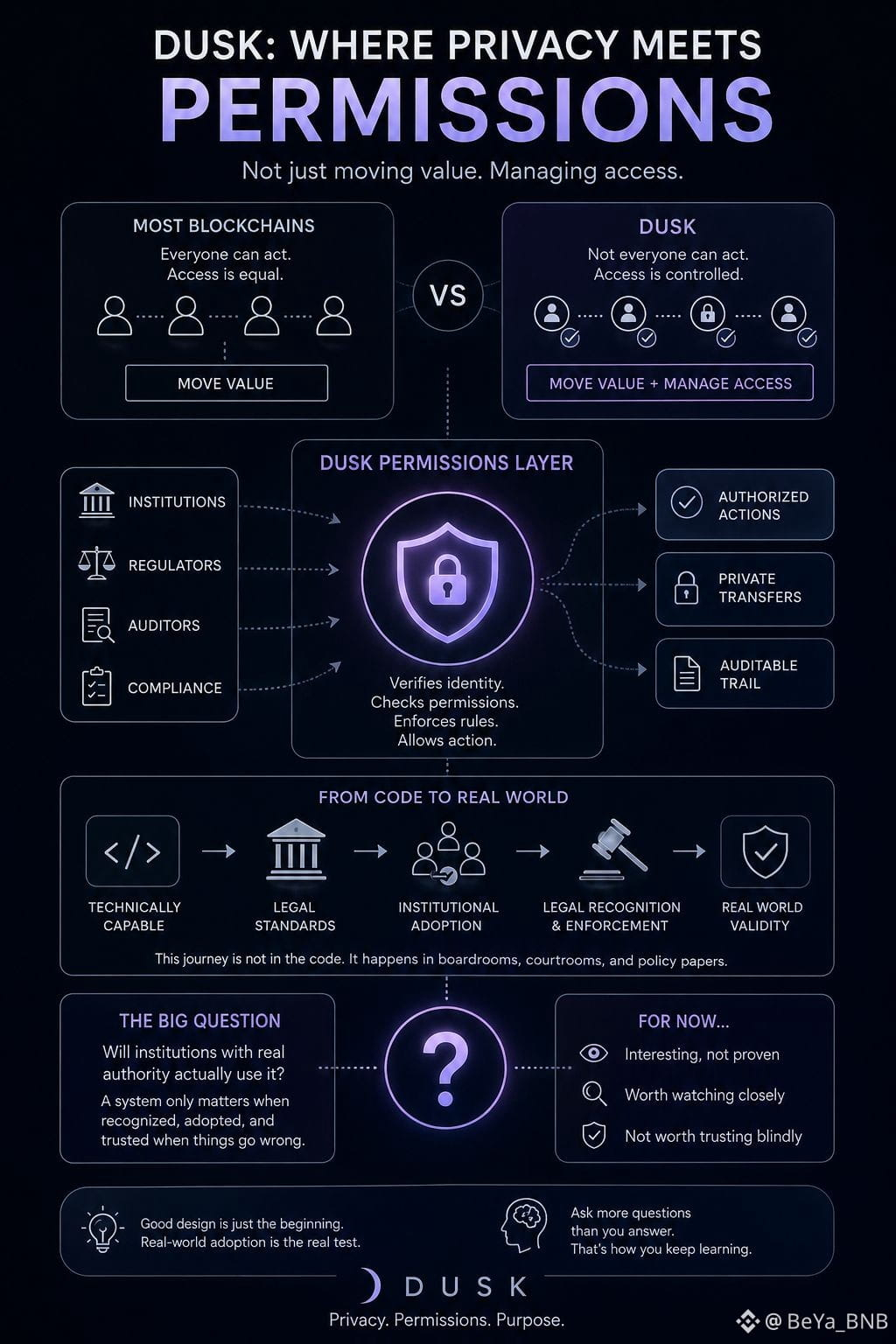
One detail in Dusk's design caught my attention: buried in there is a permissions layer that decides who gets to act on the network and who doesn't almost like built-in credentials.
That's an odd thing to find interesting, but it stuck with me. Most blockchain projects only care about moving value. Dusk adds a layer for identity and permissions, closer to how a bank or exchange actually works, where access isn't automatically equal for everyone. Its private transfers still leave room for authorized checks. That feels less like a rejection of institutions and more like an attempt to hand them a tool they might actually use.
Still, I keep asking one question: does anyone with real authority actually plan to use this? A system like that only matters once an institution recognizes it, adopts it, and stands behind it when things go wrong. None of that lives in the code. Building something technically capable of meeting legal standards is one step; getting judges, auditors, or governments to treat it as valid is a slower, separate fight and plenty of well-built systems never clear it.
So for now I'm calling this interesting, not proven. Worth watching closely, not worth trusting blindly. The space between good design and real-world adoption is where most projects quietly disappear.
Honestly, digging into projects like this reminds me how little I actually understand about where law and technology meet and I'm fine with that. There's always another layer to learn. Asking more questions than you answer will always serve you better than trusting a system just because it sounds well designed.
@Dusk $DUSK #dusk
One detail in Dusk's design caught my attention: buried in there is a permissions layer that decides who gets to act on the network and who doesn't almost like built-in credentials.
That's an odd thing to find interesting, but it stuck with me. Most blockchain projects only care about moving value. Dusk adds a layer for identity and permissions, closer to how a bank or exchange actually works, where access isn't automatically equal for everyone. Its private transfers still leave room for authorized checks. That feels less like a rejection of institutions and more like an attempt to hand them a tool they might actually use.
Still, I keep asking one question: does anyone with real authority actually plan to use this? A system like that only matters once an institution recognizes it, adopts it, and stands behind it when things go wrong. None of that lives in the code. Building something technically capable of meeting legal standards is one step; getting judges, auditors, or governments to treat it as valid is a slower, separate fight and plenty of well-built systems never clear it.
So for now I'm calling this interesting, not proven. Worth watching closely, not worth trusting blindly. The space between good design and real-world adoption is where most projects quietly disappear.
Honestly, digging into projects like this reminds me how little I actually understand about where law and technology meet and I'm fine with that. There's always another layer to learn. Asking more questions than you answer will always serve you better than trusting a system just because it sounds well designed.
@Dusk $DUSK #dusk
@Dusk
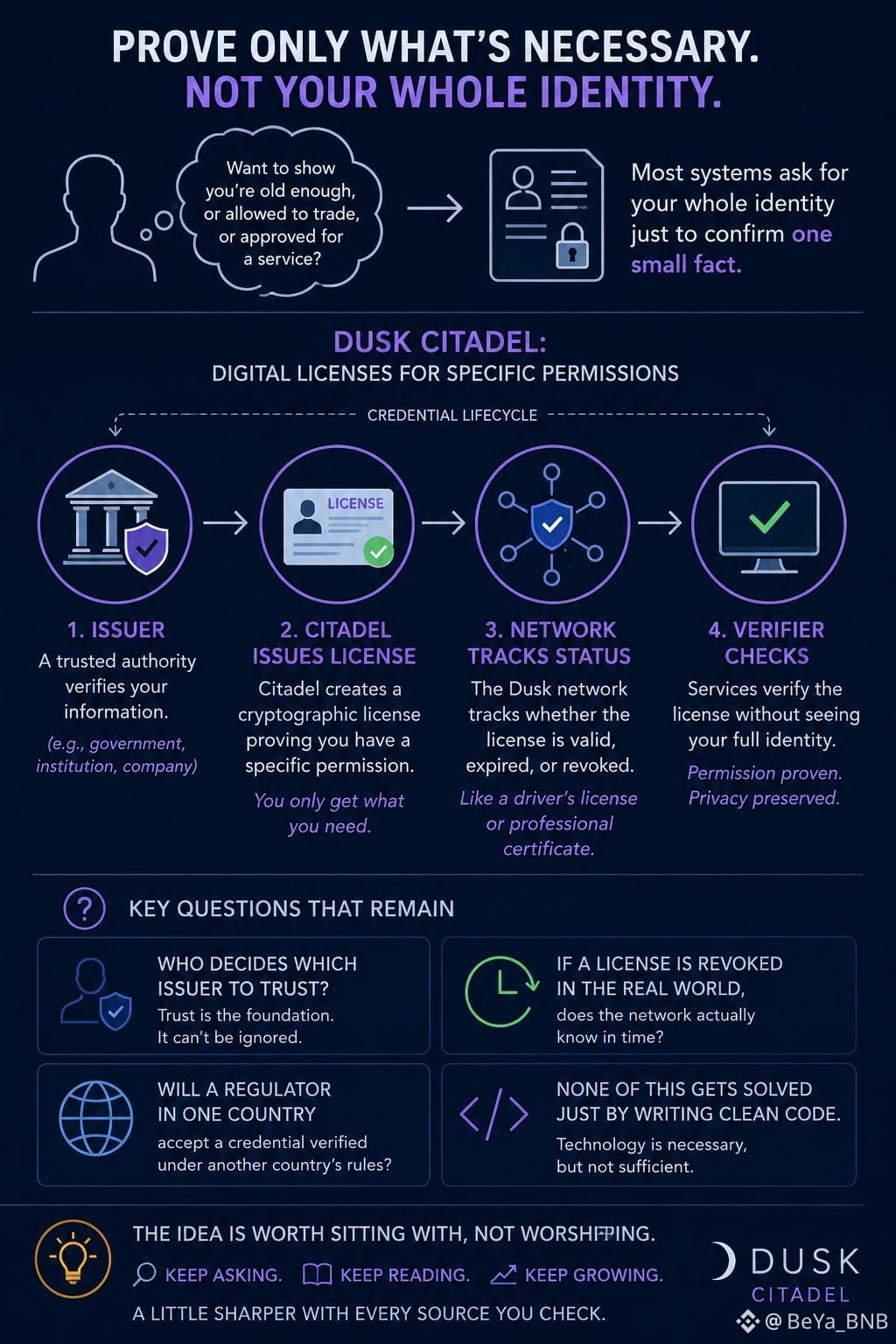
Something I came across this week made me rethink how much of ourselves we hand over just to prove one small fact. Want to show you're old enough, or allowed to trade something, or approved to access a service? Most systems ask for your whole identity just to confirm that single detail.
There's a piece inside Dusk's design called Citadel that tries to flip this. Instead of exposing everything, it issues something closer to a digital license: proof that you're allowed to do a specific thing, without handing over the rest of your personal file. The network tracks whether that license is valid, expired, or revoked, similar to how a driver's license or professional certificate works in the physical world, except the checking happens through code instead of a clerk behind a counter.
What pulls me in is how ordinary this is. It's not chasing some abstract idea of freedom or secrecy. It's copying something we already trust, license-based permission, and trying to make it programmable. That's a much smaller, more grounded claim than most crypto projects make, and honestly, smaller claims are usually the ones worth paying attention to.
But a license only matters if the right authority stands behind it. Who decides which issuer to trust? If a license gets revoked in the real world, does the network actually know in time? And will a regulator in one country accept a credential that was verified under another country's rules? None of that gets solved just by writing clean code.
So I'm left curious rather than convinced. The idea is worth sitting with, not worshipping. Keep asking, keep reading, keep growing a little sharper with every source you check.
@Dusk $DUSK #dusk
Something I came across this week made me rethink how much of ourselves we hand over just to prove one small fact. Want to show you're old enough, or allowed to trade something, or approved to access a service? Most systems ask for your whole identity just to confirm that single detail.
There's a piece inside Dusk's design called Citadel that tries to flip this. Instead of exposing everything, it issues something closer to a digital license: proof that you're allowed to do a specific thing, without handing over the rest of your personal file. The network tracks whether that license is valid, expired, or revoked, similar to how a driver's license or professional certificate works in the physical world, except the checking happens through code instead of a clerk behind a counter.
What pulls me in is how ordinary this is. It's not chasing some abstract idea of freedom or secrecy. It's copying something we already trust, license-based permission, and trying to make it programmable. That's a much smaller, more grounded claim than most crypto projects make, and honestly, smaller claims are usually the ones worth paying attention to.
But a license only matters if the right authority stands behind it. Who decides which issuer to trust? If a license gets revoked in the real world, does the network actually know in time? And will a regulator in one country accept a credential that was verified under another country's rules? None of that gets solved just by writing clean code.
So I'm left curious rather than convinced. The idea is worth sitting with, not worshipping. Keep asking, keep reading, keep growing a little sharper with every source you check.
@Dusk $DUSK #dusk
@BabylonLabs_io
At first I assumed "trustless" was just marketing language crypto projects use to sound safe. Then I read through a whitepaper on Bitcoin vault designs, and it made me pause. Instead of asking blockchains to trust bridges or custodians, the idea is to let bitcoin holders lock funds in vaults that only release based on cryptographic proof, not someone's promise to behave.
What made it feel more real to me wasn't the technology itself, but what it's replacing. Most of the times we hear about hacks or frozen funds, it comes back to some committee, operator, or custodian holding assets on someone's behalf. This design tries to remove that middle layer entirely so no one person or group can quietly become the weak point.
But here's where I stayed cautious. Removing trust from the technical layer doesn't automatically remove it from the human layer. Someone still writes the code, someone still decides which proofs count as valid, and someone still has to maintain the systems reading data across chains. If any of that has bugs, delays, or disputes, users could still end up stuck, even if the design on paper looks airtight. Law and enforcement haven't caught up to systems like this either, so if something does go wrong, it isn't clear who you'd even turn to.
That gap between clean design and messy reality is worth sitting with. It's a reminder that no system, however clever, replaces the need to actually understand what you're trusting and why.
Keep learning before you commit capital. Growth in this space comes from asking better questions, not fewer of them.
@BabylonLabs_io $BABY #baby
At first I assumed "trustless" was just marketing language crypto projects use to sound safe. Then I read through a whitepaper on Bitcoin vault designs, and it made me pause. Instead of asking blockchains to trust bridges or custodians, the idea is to let bitcoin holders lock funds in vaults that only release based on cryptographic proof, not someone's promise to behave.
What made it feel more real to me wasn't the technology itself, but what it's replacing. Most of the times we hear about hacks or frozen funds, it comes back to some committee, operator, or custodian holding assets on someone's behalf. This design tries to remove that middle layer entirely so no one person or group can quietly become the weak point.
But here's where I stayed cautious. Removing trust from the technical layer doesn't automatically remove it from the human layer. Someone still writes the code, someone still decides which proofs count as valid, and someone still has to maintain the systems reading data across chains. If any of that has bugs, delays, or disputes, users could still end up stuck, even if the design on paper looks airtight. Law and enforcement haven't caught up to systems like this either, so if something does go wrong, it isn't clear who you'd even turn to.
That gap between clean design and messy reality is worth sitting with. It's a reminder that no system, however clever, replaces the need to actually understand what you're trusting and why.
Keep learning before you commit capital. Growth in this space comes from asking better questions, not fewer of them.
@BabylonLabs_io $BABY #baby
@BabylonLabs_io
I've been sitting with a strange number: less than 1% of all Bitcoin ever touches DeFi. Not because people don't want the yield, but because using it usually means handing your coins to a bridge, a custodian, or some committee and just trusting they'll behave. After all these years, that still feels off to me.
What caught my attention in Babylon's new vault design is that it's not just theory. It builds on a staking protocol already holding billions in real BTC, and the vaults lock coins with pre-signed transactions that only release funds once a cryptographic proof checks out, not when someone promises they will. They've tested it on Bitcoin's mainnet too, where the routine cost runs a few dollars. That's what makes it feel grounded instead of hypothetical.
But here's where I slow down. Cutting trust out of the code doesn't cut it out of everything around the code. Someone still has to report price data honestly. If a counterparty disappears or a linked contract gets exploited, no court has actually ruled on whether a pre-signed Bitcoin transaction counts as a binding agreement. The math can be airtight while the legal ground underneath it stays completely untested.
That gap between clean code and messy law is exactly why I don't take any of it at face value, mine included. Solving one problem well doesn't mean every problem's been solved.
The habit worth keeping isn't blind trust in any system it's staying curious enough to keep learning how these things actually work, one honest question at a time.
@BabylonLabs_io $BABY #baby
I've been sitting with a strange number: less than 1% of all Bitcoin ever touches DeFi. Not because people don't want the yield, but because using it usually means handing your coins to a bridge, a custodian, or some committee and just trusting they'll behave. After all these years, that still feels off to me.
What caught my attention in Babylon's new vault design is that it's not just theory. It builds on a staking protocol already holding billions in real BTC, and the vaults lock coins with pre-signed transactions that only release funds once a cryptographic proof checks out, not when someone promises they will. They've tested it on Bitcoin's mainnet too, where the routine cost runs a few dollars. That's what makes it feel grounded instead of hypothetical.
But here's where I slow down. Cutting trust out of the code doesn't cut it out of everything around the code. Someone still has to report price data honestly. If a counterparty disappears or a linked contract gets exploited, no court has actually ruled on whether a pre-signed Bitcoin transaction counts as a binding agreement. The math can be airtight while the legal ground underneath it stays completely untested.
That gap between clean code and messy law is exactly why I don't take any of it at face value, mine included. Solving one problem well doesn't mean every problem's been solved.
The habit worth keeping isn't blind trust in any system it's staying curious enough to keep learning how these things actually work, one honest question at a time.
@BabylonLabs_io $BABY #baby
@BabylonLabs_io
I was reading a paper on how Bitcoin might finally plug into DeFi without wrapping or bridging it anywhere, and one detail stood out: they didn't just describe the idea, they tested it on Bitcoin's mainnet and reported the real dollar cost of each transaction.
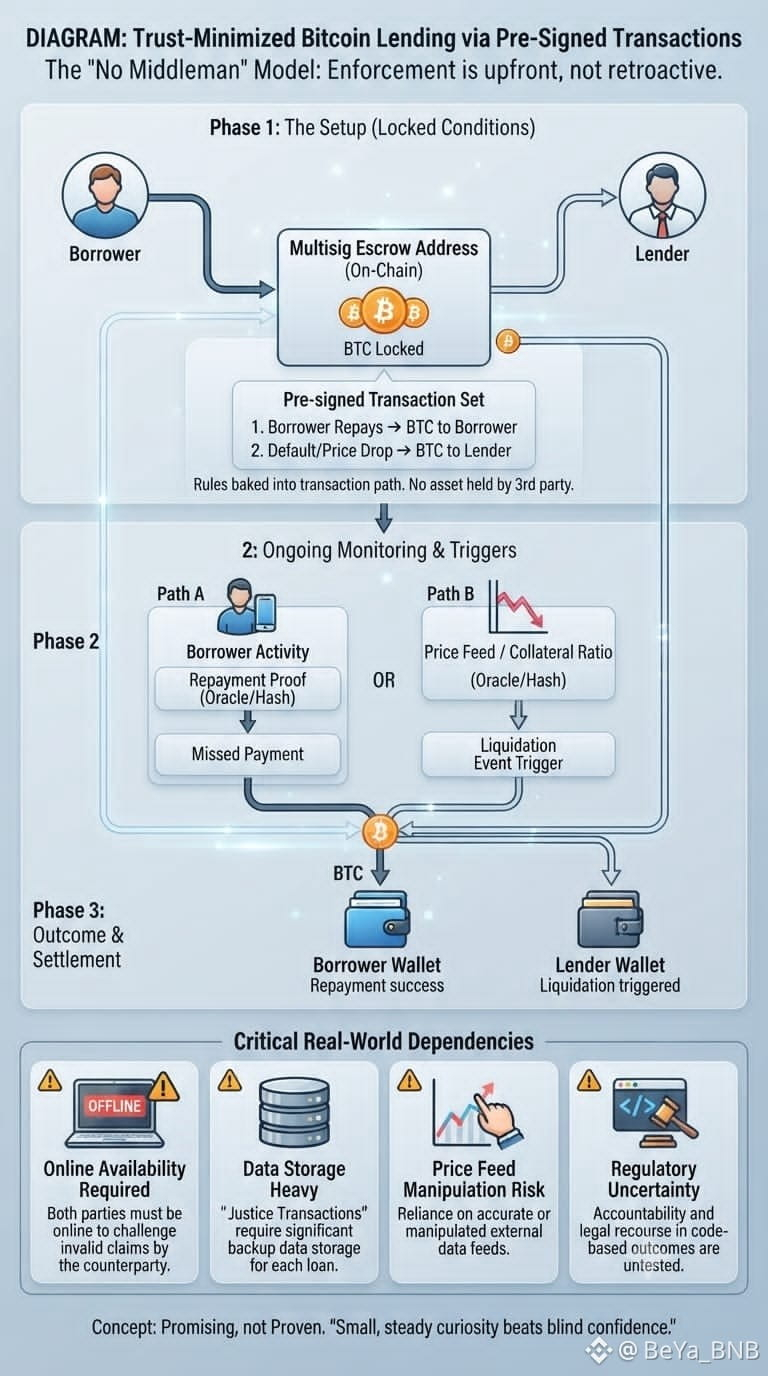
That's what makes it feel more real than most things I read in this space. Instead of asking you to trust a team or a custodian, the design lets each side prove its case with cryptographic proofs enforced directly by Bitcoin's own scripting rules, with a challenge process that only kicks in if someone tries to cheat. The worst-case fee for that fallback dropped from over fifteen thousand dollars in an earlier attempt to under a hundred dollars now. That's the kind of improvement that comes from actually building something, not just describing it.
Still, I don't think "trustless" ever means zero assumptions. These vaults depend on liveness someone has to be watching, ready to challenge within a set window, and running the infrastructure needed to generate and store proofs. If nobody's paying attention, or if that job quietly consolidates into a few professional operators for convenience, some of the original self-custody promise fades. And no cryptographic proof settles what happens if a court somewhere later disputes the underlying loan or collateral itself.
So I'm holding two things at once: this is genuinely careful engineering, and it's still early, still dependent on people doing their part correctly, still untested at real scale.
Worth understanding closely. Not worth trusting blindly.
Learning how these systems actually work, piece by piece, is a habit worth keeping no matter which project ends up mattering in the end.
@BabylonLabs_io $BABY #baby
I was reading a paper on how Bitcoin might finally plug into DeFi without wrapping or bridging it anywhere, and one detail stood out: they didn't just describe the idea, they tested it on Bitcoin's mainnet and reported the real dollar cost of each transaction.
That's what makes it feel more real than most things I read in this space. Instead of asking you to trust a team or a custodian, the design lets each side prove its case with cryptographic proofs enforced directly by Bitcoin's own scripting rules, with a challenge process that only kicks in if someone tries to cheat. The worst-case fee for that fallback dropped from over fifteen thousand dollars in an earlier attempt to under a hundred dollars now. That's the kind of improvement that comes from actually building something, not just describing it.
Still, I don't think "trustless" ever means zero assumptions. These vaults depend on liveness someone has to be watching, ready to challenge within a set window, and running the infrastructure needed to generate and store proofs. If nobody's paying attention, or if that job quietly consolidates into a few professional operators for convenience, some of the original self-custody promise fades. And no cryptographic proof settles what happens if a court somewhere later disputes the underlying loan or collateral itself.
So I'm holding two things at once: this is genuinely careful engineering, and it's still early, still dependent on people doing their part correctly, still untested at real scale.
Worth understanding closely. Not worth trusting blindly.
Learning how these systems actually work, piece by piece, is a habit worth keeping no matter which project ends up mattering in the end.
@BabylonLabs_io $BABY #baby
@BabylonLabs_io
Was reading a new whitepaper on Bitcoin vaults last night, and it made me pause on something I don't think about enough: how much of "decentralized finance" quietly runs on people trusting other people.
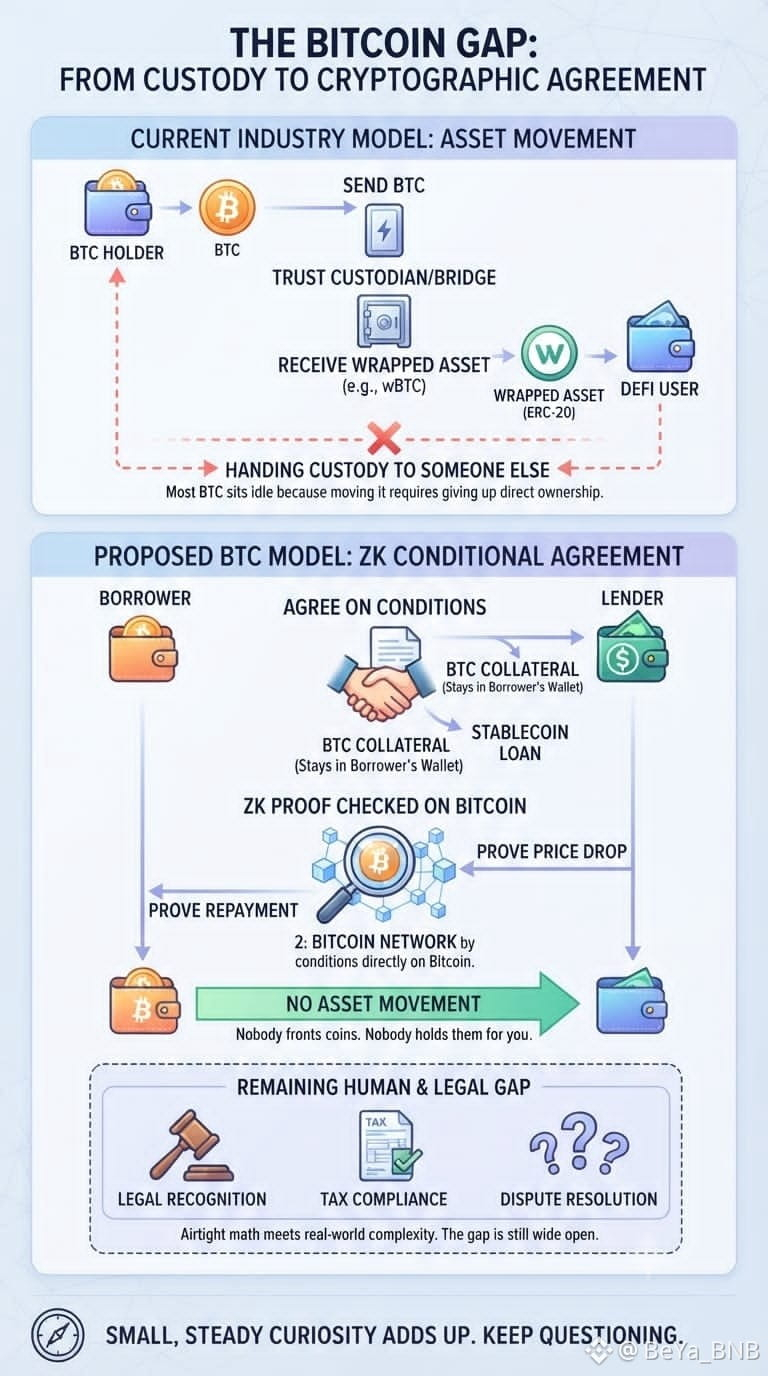
Most BTC bridges today work because a committee, a set of operators, or some custodian promises to behave. That's not so different from trusting a bank, just dressed in crypto language. What caught my attention here is the attempt to remove that human layer entirely, using pre-signed Bitcoin transactions and cryptographic proofs instead of promises. No custodian holding your coins, no committee that could collude, no operator you're hoping stays honest.
That's what makes it feel more grounded than a lot of DeFi pitches. It isn't asking you to trust a company or a legal entity. The security is meant to live in math and verifiable proofs, closer to how Bitcoin was originally designed to work.
Still, I'm not fully convinced. The system leans on a price oracle somewhere, and an oracle is still a trust point, whatever you call it. There's also a real gap between "trustless in theory" and "trustless in practice." Challenge windows, storage costs, and whether liquidators actually show up and behave as designed all matter. Code can be flawless and still fail because of how people use it or route around it.
So I'm treating this as interesting, not proven. Worth understanding slowly, worth questioning just as much.
Systems calling themselves trustless still deserve scrutiny, maybe more than ones that don't hide behind the word. Keep reading the fine print, keep asking how things actually fail, and keep growing a little skeptical and a little curious, one paper at a time.
@BabylonLabs_io $BABY #baby
Was reading a new whitepaper on Bitcoin vaults last night, and it made me pause on something I don't think about enough: how much of "decentralized finance" quietly runs on people trusting other people.
Most BTC bridges today work because a committee, a set of operators, or some custodian promises to behave. That's not so different from trusting a bank, just dressed in crypto language. What caught my attention here is the attempt to remove that human layer entirely, using pre-signed Bitcoin transactions and cryptographic proofs instead of promises. No custodian holding your coins, no committee that could collude, no operator you're hoping stays honest.
That's what makes it feel more grounded than a lot of DeFi pitches. It isn't asking you to trust a company or a legal entity. The security is meant to live in math and verifiable proofs, closer to how Bitcoin was originally designed to work.
Still, I'm not fully convinced. The system leans on a price oracle somewhere, and an oracle is still a trust point, whatever you call it. There's also a real gap between "trustless in theory" and "trustless in practice." Challenge windows, storage costs, and whether liquidators actually show up and behave as designed all matter. Code can be flawless and still fail because of how people use it or route around it.
So I'm treating this as interesting, not proven. Worth understanding slowly, worth questioning just as much.
Systems calling themselves trustless still deserve scrutiny, maybe more than ones that don't hide behind the word. Keep reading the fine print, keep asking how things actually fail, and keep growing a little skeptical and a little curious, one paper at a time.
@BabylonLabs_io $BABY #baby
@BabylonLabs_io
At first, I believed most "trustless lending" pitches just moved the trust problem instead of removing it. Then I read about a design meant to fix the one flaw I'd never seen anyone actually solve: the free-option problem.
Here's what got me. In older Bitcoin lending setups, repayment works through a secret that only gets revealed once you pay back your loan. Sounds fine, until you realize the lender can simply choose not to reveal it. Nothing forces them. You did everything right and you're still stuck hoping someone else feels like cooperating. I'd never seen that flaw named so directly before, let alone addressed.
The fix wasn't a promise, it was a mechanism. Both sides commit ahead of time to conditions built around proofs, not favors. If you try to walk away without repaying, the other party can catch it. If they try to block you unfairly, you can catch that too. Nobody's holding a secret over anyone's head. It's not "please be nice," it's "here's what happens if you're not."
What made it land for me wasn't the cryptography it was realizing how long this specific problem had just been quietly tolerated across the space, treated as a cost of doing business instead of something worth fixing.
I still wonder how this holds up with real crowds involved many lenders, many liquidators, not just two people who trust the math. Coordination gets messier than any diagram shows.
But I noticed something in myself: I used to accept small, unfair tradeoffs in these systems because everyone else seemed to. Now I ask why the tradeoff exists at all. That's the actual shift not excitement about a new tool, just less patience for flaws I used to wave off as normal.
@BabylonLabs_io $BABY #baby
At first, I believed most "trustless lending" pitches just moved the trust problem instead of removing it. Then I read about a design meant to fix the one flaw I'd never seen anyone actually solve: the free-option problem.
Here's what got me. In older Bitcoin lending setups, repayment works through a secret that only gets revealed once you pay back your loan. Sounds fine, until you realize the lender can simply choose not to reveal it. Nothing forces them. You did everything right and you're still stuck hoping someone else feels like cooperating. I'd never seen that flaw named so directly before, let alone addressed.
The fix wasn't a promise, it was a mechanism. Both sides commit ahead of time to conditions built around proofs, not favors. If you try to walk away without repaying, the other party can catch it. If they try to block you unfairly, you can catch that too. Nobody's holding a secret over anyone's head. It's not "please be nice," it's "here's what happens if you're not."
What made it land for me wasn't the cryptography it was realizing how long this specific problem had just been quietly tolerated across the space, treated as a cost of doing business instead of something worth fixing.
I still wonder how this holds up with real crowds involved many lenders, many liquidators, not just two people who trust the math. Coordination gets messier than any diagram shows.
But I noticed something in myself: I used to accept small, unfair tradeoffs in these systems because everyone else seemed to. Now I ask why the tradeoff exists at all. That's the actual shift not excitement about a new tool, just less patience for flaws I used to wave off as normal.
@BabylonLabs_io $BABY #baby
@BabylonLabs_io
At first, I believed most "trustless lending" pitches just moved the trust problem instead of removing it. Then I read about a design meant to fix the one flaw I'd never seen anyone actually solve: the free-option problem.
Here's what got me. In older Bitcoin lending setups, repayment works through a secret that only gets revealed once you pay back your loan. Sounds fine, until you realize the lender can simply choose not to reveal it. Nothing forces them. You did everything right and you're still stuck hoping someone else feels like cooperating. I'd never seen that flaw named so directly before, let alone addressed.
The fix wasn't a promise, it was a mechanism. Both sides commit ahead of time to conditions built around proofs, not favors. If you try to walk away without repaying, the other party can catch it. If they try to block you unfairly, you can catch that too. Nobody's holding a secret over anyone's head. It's not "please be nice," it's "here's what happens if you're not."
What made it land for me wasn't the cryptography it was realizing how long this specific problem had just been quietly tolerated across the space, treated as a cost of doing business instead of something worth fixing.
I still wonder how this holds up with real crowds involved many lenders, many liquidators, not just two people who trust the math. Coordination gets messier than any diagram shows.
But I noticed something in myself: I used to accept small, unfair tradeoffs in these systems because everyone else seemed to. Now I ask why the tradeoff exists at all. That's the actual shift not excitement about a new tool, just less patience for flaws I used to wave off as normal.
@BabylonLabs_io $BABY #baby
At first, I believed most "trustless lending" pitches just moved the trust problem instead of removing it. Then I read about a design meant to fix the one flaw I'd never seen anyone actually solve: the free-option problem.
Here's what got me. In older Bitcoin lending setups, repayment works through a secret that only gets revealed once you pay back your loan. Sounds fine, until you realize the lender can simply choose not to reveal it. Nothing forces them. You did everything right and you're still stuck hoping someone else feels like cooperating. I'd never seen that flaw named so directly before, let alone addressed.
The fix wasn't a promise, it was a mechanism. Both sides commit ahead of time to conditions built around proofs, not favors. If you try to walk away without repaying, the other party can catch it. If they try to block you unfairly, you can catch that too. Nobody's holding a secret over anyone's head. It's not "please be nice," it's "here's what happens if you're not."
What made it land for me wasn't the cryptography it was realizing how long this specific problem had just been quietly tolerated across the space, treated as a cost of doing business instead of something worth fixing.
I still wonder how this holds up with real crowds involved many lenders, many liquidators, not just two people who trust the math. Coordination gets messier than any diagram shows.
But I noticed something in myself: I used to accept small, unfair tradeoffs in these systems because everyone else seemed to. Now I ask why the tradeoff exists at all. That's the actual shift not excitement about a new tool, just less patience for flaws I used to wave off as normal.
@BabylonLabs_io $BABY #baby
@BabylonLabs_io
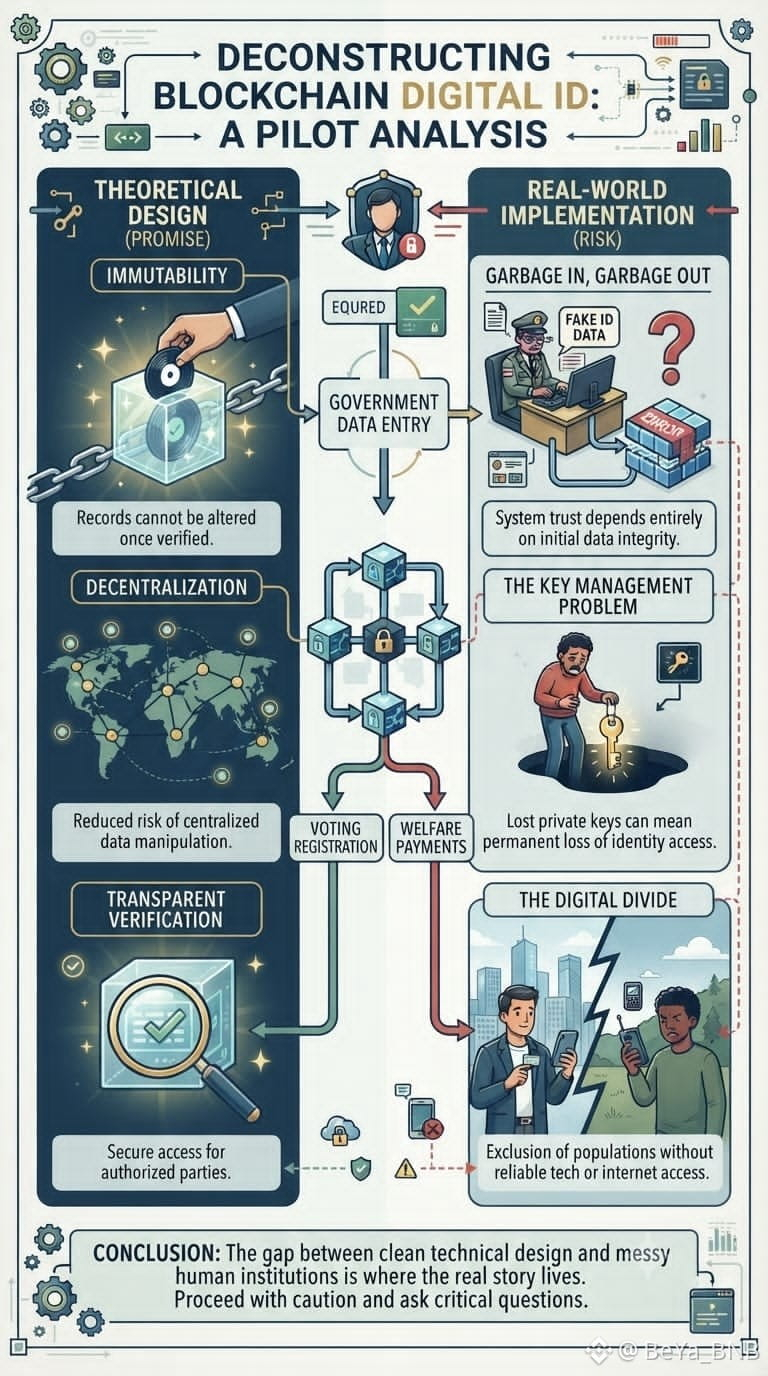
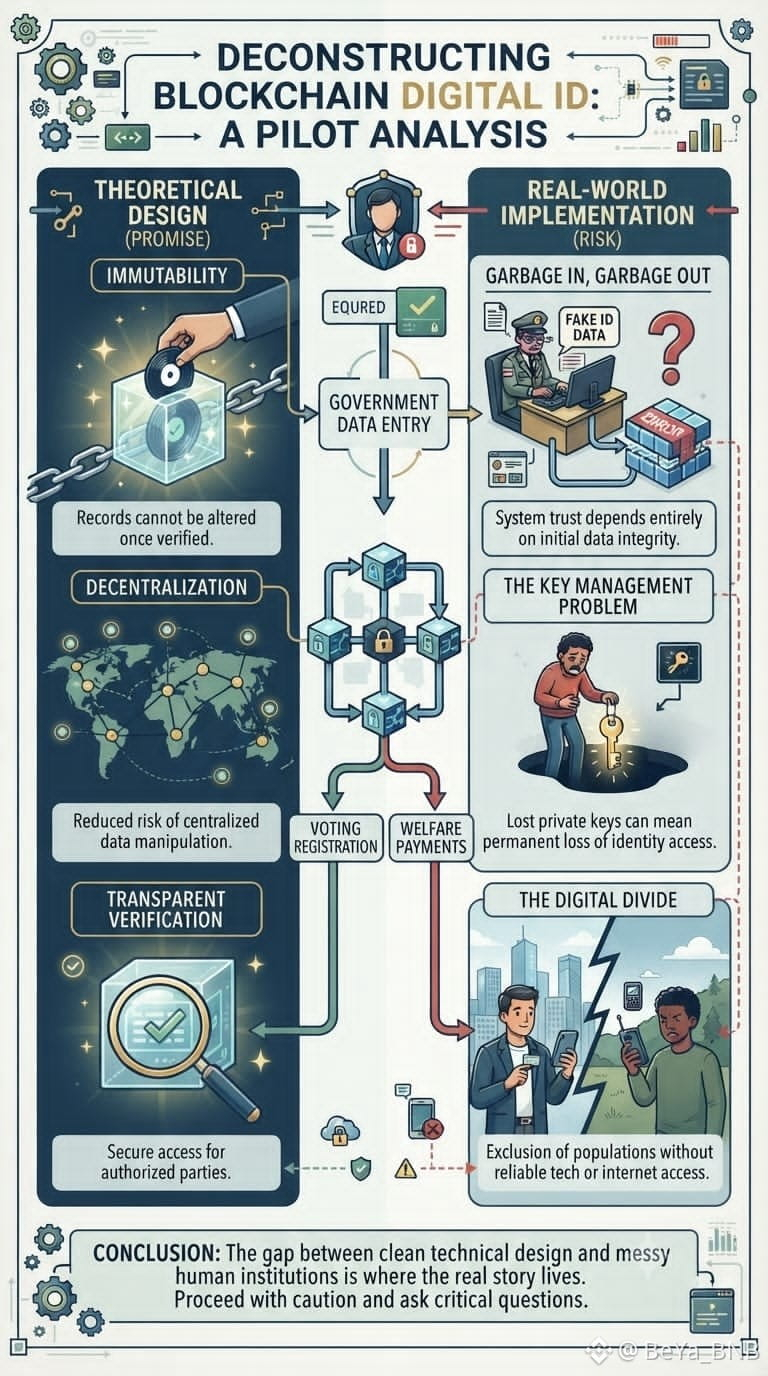
I ran into a random news mention the other day about a country piloting digital ID on a blockchain for things like voting registration and welfare payments. My first thought wasn't excitement, it was: who actually controls that record once it's written down permanently?
That question is exactly what makes this topic feel heavier than most crypto news. Digital identity isn't a speculative asset or a trading pair, it's tied to real legal status: your right to vote, receive benefits, open a bank account, or prove you're a citizen. When a government or regulator actually adopts this kind of system, even in a small pilot, it stops being a theoretical use case and becomes something with actual legal weight behind it. That's a very different level of seriousness compared to most projects that just talk about "adoption."
But this is also where my doubts kick in. A blockchain record is only as trustworthy as the process that puts data on it in the first place. If a corrupt official enters false information, the chain doesn't fix that, it just makes the mistake permanent and harder to quietly correct. There's also the real question of what happens when someone loses their private key, or when the system excludes people without reliable internet or smartphones. Technology solving a trust problem on paper doesn't automatically solve the human and institutional problems underneath it.
So I try to hold both things at once: this is genuinely important work, and it's also far from finished or foolproof. The gap between a clean technical design and messy real-world enforcement is usually where the real story lives.
I'm learning to read these projects slower, ask more questions, and grow a little more before forming an opinion.
@BabylonLabs_io $BABY #baby
I ran into a random news mention the other day about a country piloting digital ID on a blockchain for things like voting registration and welfare payments. My first thought wasn't excitement, it was: who actually controls that record once it's written down permanently?
That question is exactly what makes this topic feel heavier than most crypto news. Digital identity isn't a speculative asset or a trading pair, it's tied to real legal status: your right to vote, receive benefits, open a bank account, or prove you're a citizen. When a government or regulator actually adopts this kind of system, even in a small pilot, it stops being a theoretical use case and becomes something with actual legal weight behind it. That's a very different level of seriousness compared to most projects that just talk about "adoption."
But this is also where my doubts kick in. A blockchain record is only as trustworthy as the process that puts data on it in the first place. If a corrupt official enters false information, the chain doesn't fix that, it just makes the mistake permanent and harder to quietly correct. There's also the real question of what happens when someone loses their private key, or when the system excludes people without reliable internet or smartphones. Technology solving a trust problem on paper doesn't automatically solve the human and institutional problems underneath it.
So I try to hold both things at once: this is genuinely important work, and it's also far from finished or foolproof. The gap between a clean technical design and messy real-world enforcement is usually where the real story lives.
I'm learning to read these projects slower, ask more questions, and grow a little more before forming an opinion.
@BabylonLabs_io $BABY #baby
@BabylonLabs_io
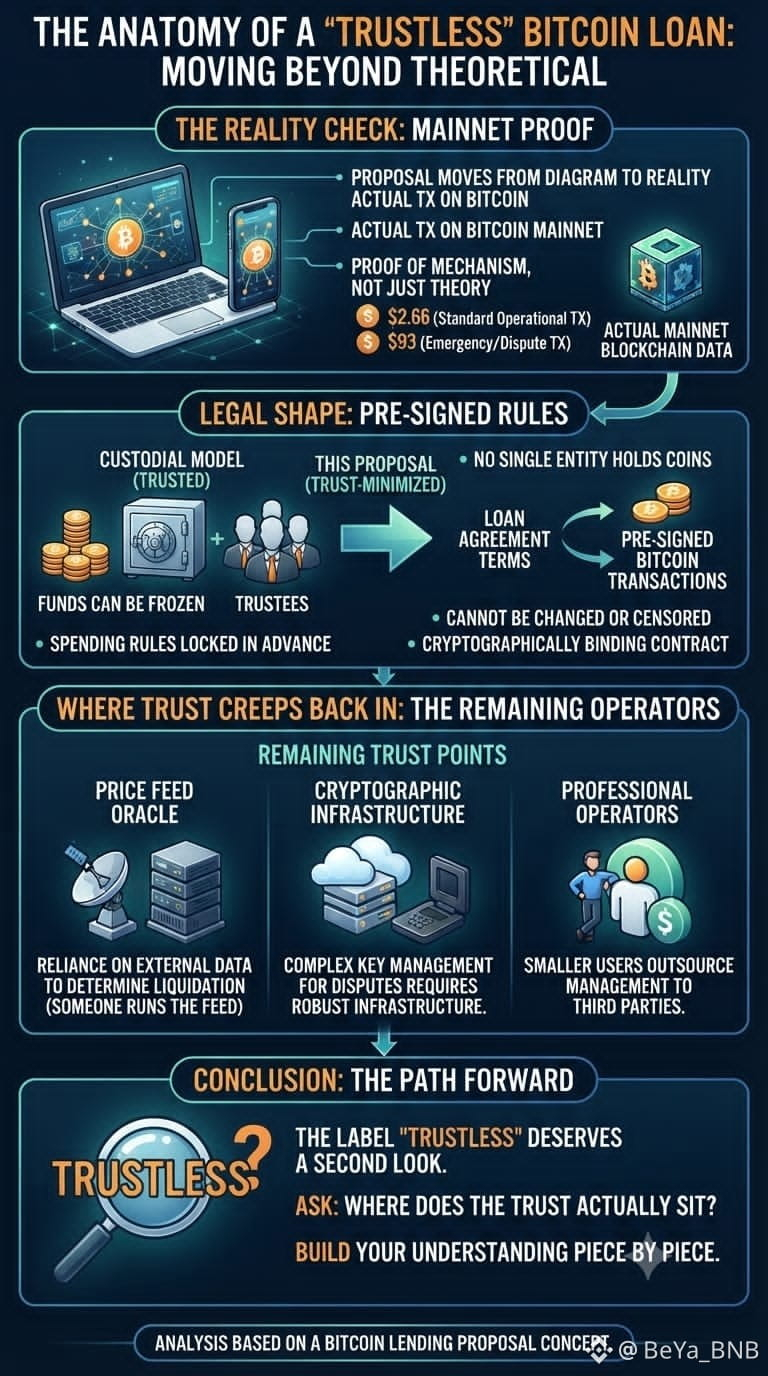
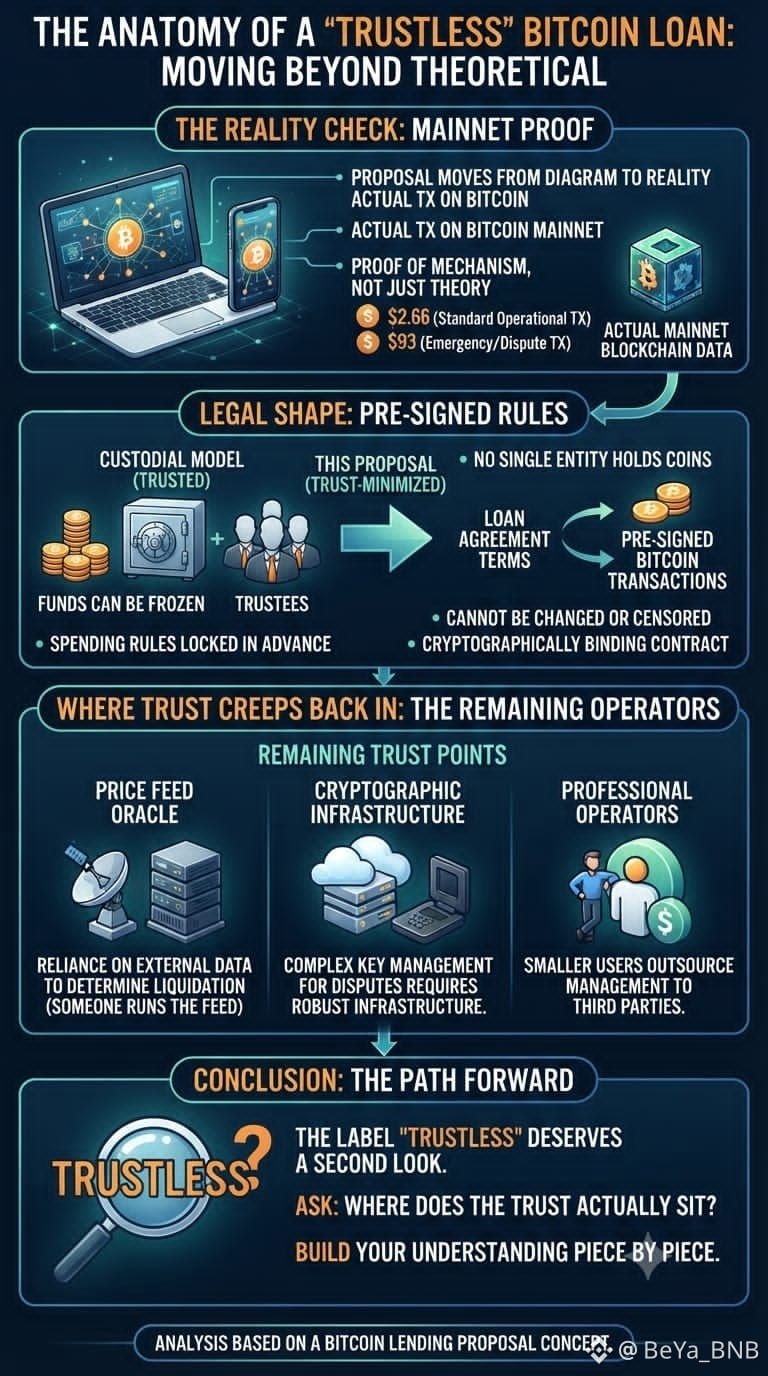
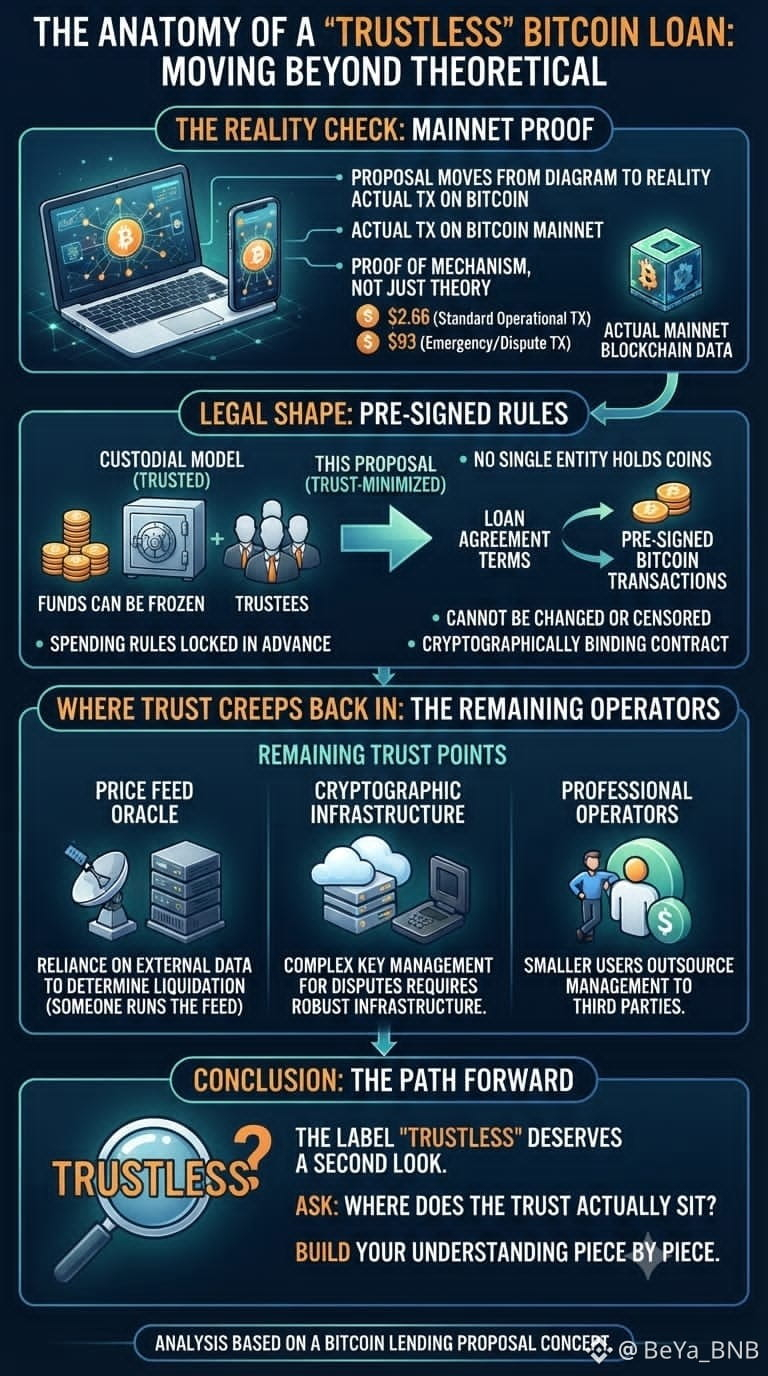
Something small stood out to me while going through a Bitcoin lending proposal the numbers weren't hypothetical. They ran an actual transaction on Bitcoin mainnet, and it cost $2.66. A backup version, the one used only if someone tries to cheat, cost $93. Small dollar amounts, but real ones, on the real chain, not a testnet mockup.
That detail is what made the whole idea land differently for me. A lot of blockchain proposals stay theoretical until someone tries to build them. This one had already paid real fees to prove the mechanism works, which says something about how close it is to being usable rather than just being a nice diagram in a deck.
The part that feels tied to something bigger than price speculation is the legal shape of it. Instead of a company holding your coins, or a group of signers you have to trust collectively, spending rules are locked in ahead of time through pre-signed transactions. No single entity can freeze the funds or quietly change the terms later. That's closer to how a binding contract should behave than how most custodial products work today.
That said, I'm not fully sold that it removes trust entirely. Someone still runs the price feed everyone relies on. Storing and generating the cryptographic material needed for disputes takes real infrastructure, and smaller users will likely lean on "professional" operators to handle that for them which quietly reintroduces a layer of reliance, even if funds technically can't be stolen outright.
None of this makes the idea less interesting. It just means the label "trustless" deserves a second look before anyone treats it as a settled fact.
Slow down, ask where the remaining trust actually sits, and keep building your own understanding piece by piece.
@BabylonLabs_io $BABY #baby
Something small stood out to me while going through a Bitcoin lending proposal the numbers weren't hypothetical. They ran an actual transaction on Bitcoin mainnet, and it cost $2.66. A backup version, the one used only if someone tries to cheat, cost $93. Small dollar amounts, but real ones, on the real chain, not a testnet mockup.
That detail is what made the whole idea land differently for me. A lot of blockchain proposals stay theoretical until someone tries to build them. This one had already paid real fees to prove the mechanism works, which says something about how close it is to being usable rather than just being a nice diagram in a deck.
The part that feels tied to something bigger than price speculation is the legal shape of it. Instead of a company holding your coins, or a group of signers you have to trust collectively, spending rules are locked in ahead of time through pre-signed transactions. No single entity can freeze the funds or quietly change the terms later. That's closer to how a binding contract should behave than how most custodial products work today.
That said, I'm not fully sold that it removes trust entirely. Someone still runs the price feed everyone relies on. Storing and generating the cryptographic material needed for disputes takes real infrastructure, and smaller users will likely lean on "professional" operators to handle that for them which quietly reintroduces a layer of reliance, even if funds technically can't be stolen outright.
None of this makes the idea less interesting. It just means the label "trustless" deserves a second look before anyone treats it as a settled fact.
Slow down, ask where the remaining trust actually sits, and keep building your own understanding piece by piece.
@BabylonLabs_io $BABY #baby
Connectez-vous pour découvrir plus de contenu