
Wei Ling 伟玲
25.5k Publications

Wei Ling 伟玲
 Compte Square Vérifié+
Crypto Leaner &Content Creator
Ouvert au trading
Trade fréquemment
1.1 an(s)
1.0K+ Suivis
35.4K+ Abonnés
35.8K+ J’aime
Publications
Portefeuille
Tous
Citations
Direct
#dusk $DUSK @Dusk
Most privacy coins are for people who want to vanish. Dusk is for people who can’t afford to.
XSC is the real tell. An issuer can put a security token on-chain, keep every balance and transfer encrypted by default, and still let the contract enforce ownership caps, eligibility rules, or a forced transfer when a regulator or the issuer demands proof. Phoenix shields the data. Selective disclosure hands the exact proof only to the parties that need it. Same chain, same finality.
That’s the bit most retail skips. Pure privacy forces a hard choice: hide everything or show everything. Dusk turns the choice into programmable rules. If real securities volume ever shows up, this is the plumbing that removes the biggest institutional blocker. If the volume never comes, the cryptography just sits there looking clever while the chain stays quiet.
I’ve watched enough “compliance-ready” projects die exactly in that gap.
Does the market ever price the ability to stay private from the crowd while still answering to the rules, or does it only notice once the first serious tokens are already moving?
$BTC
Does the market price privacy + compliance for tokenized securities *before* real volume, or only once serious tokens are already moving?
Most privacy coins are for people who want to vanish. Dusk is for people who can’t afford to.
XSC is the real tell. An issuer can put a security token on-chain, keep every balance and transfer encrypted by default, and still let the contract enforce ownership caps, eligibility rules, or a forced transfer when a regulator or the issuer demands proof. Phoenix shields the data. Selective disclosure hands the exact proof only to the parties that need it. Same chain, same finality.
That’s the bit most retail skips. Pure privacy forces a hard choice: hide everything or show everything. Dusk turns the choice into programmable rules. If real securities volume ever shows up, this is the plumbing that removes the biggest institutional blocker. If the volume never comes, the cryptography just sits there looking clever while the chain stays quiet.
I’ve watched enough “compliance-ready” projects die exactly in that gap.
Does the market ever price the ability to stay private from the crowd while still answering to the rules, or does it only notice once the first serious tokens are already moving?
$BTC
Does the market price privacy + compliance for tokenized securities *before* real volume, or only once serious tokens are already moving?
Prices it early as infra
100%
Only after volume arrives
0%
Never values the combo
0%
Institutions force the price
0%
4 Votes • Vote fermé
Vérifié
#dusk $DUSK @Dusk
Everyone still treats Dusk like another privacy coin chasing Monero vibes. That’s the exact mistake that keeps them from seeing the real product.
What actually stands out to me is the XSC standard. These confidential security contracts let an issuer keep balances, ownership, and transfers shielded while still hard-coding eligibility rules and opening selective disclosure to auditors or regulators when needed. It’s not privacy for the sake of hiding. It’s the only practical way real capital markets can move size on-chain without putting their entire book on public display.
Traditional finance is never going to put meaningful volume on a fully transparent ledger. The dual models — Phoenix for shielded flow, Moonlight for transparent — plus those contract controls just remove that blocker. Capital can clear and settle with legal certainty while positions stay private. That’s the adoption path most retail never even looks at.
I’ve watched privacy projects chase pure anonymity for years and fail. Dusk is the first one that actually flipped the priority toward institutions. The only thing that kills this is if issuers never ship under XSC.
$BTC
What is Dusk really?
Everyone still treats Dusk like another privacy coin chasing Monero vibes. That’s the exact mistake that keeps them from seeing the real product.
What actually stands out to me is the XSC standard. These confidential security contracts let an issuer keep balances, ownership, and transfers shielded while still hard-coding eligibility rules and opening selective disclosure to auditors or regulators when needed. It’s not privacy for the sake of hiding. It’s the only practical way real capital markets can move size on-chain without putting their entire book on public display.
Traditional finance is never going to put meaningful volume on a fully transparent ledger. The dual models — Phoenix for shielded flow, Moonlight for transparent — plus those contract controls just remove that blocker. Capital can clear and settle with legal certainty while positions stay private. That’s the adoption path most retail never even looks at.
I’ve watched privacy projects chase pure anonymity for years and fail. Dusk is the first one that actually flipped the priority toward institutions. The only thing that kills this is if issuers never ship under XSC.
$BTC
What is Dusk really?
Just another privacy coin
75%
Compliant securities layer
0%
Monero with contracts
13%
Institutional settlement
12%
8 Votes • Vote fermé
#dusk $DUSK @Dusk
The market keeps treating DUSK like another privacy coin that just hides balances. That’s how you completely miss the real mechanism.
Once you actually look under the hood, the selective disclosure piece is what jumps out. You can keep your position sizes, transfer amounts, and who you’re dealing with private, but still generate proofs a regulator, auditor or issuer can verify when they need to. The XSC standard builds the securities rules—eligibility, transfer limits, corporate actions—straight into the contract instead of bolting them on afterward. Throw in the dual transaction models and confidentiality stops being this all-or-nothing choice.
Most retail never notices this because it doesn’t come with the usual privacy-coin flash or RWA hype. Institutions, though? They’re not moving real size if the chain is broadcasting their book on every trade. Get that controlled privacy working in practice and this starts looking a lot more like actual settlement infrastructure than just another token. If the regulated volume never shows up, though, it stays theory.
$BTC $TRUMP
What do most people actually miss about $DUSK ?
The market keeps treating DUSK like another privacy coin that just hides balances. That’s how you completely miss the real mechanism.
Once you actually look under the hood, the selective disclosure piece is what jumps out. You can keep your position sizes, transfer amounts, and who you’re dealing with private, but still generate proofs a regulator, auditor or issuer can verify when they need to. The XSC standard builds the securities rules—eligibility, transfer limits, corporate actions—straight into the contract instead of bolting them on afterward. Throw in the dual transaction models and confidentiality stops being this all-or-nothing choice.
Most retail never notices this because it doesn’t come with the usual privacy-coin flash or RWA hype. Institutions, though? They’re not moving real size if the chain is broadcasting their book on every trade. Get that controlled privacy working in practice and this starts looking a lot more like actual settlement infrastructure than just another token. If the regulated volume never shows up, though, it stays theory.
$BTC $TRUMP
What do most people actually miss about $DUSK ?
Treats it like a privacy coin
70%
Selective disclosure setup
10%
XSC rules inside contracts
20%
Dual tx models for control 10
0%
10 Votes • Vote fermé
#dusk $DUSK @Dusk
Most people still write DUSK off as just another privacy coin chasing the RWA story. They’re looking at the wrong layer.
What actually stands out is how the XSC contracts work. The rules an issuer needs—who’s allowed to hold, transfer limits, recovering lost keys, paying dividends—sit inside the same private notes. A regulator can get selective visibility when required. Everyone else sees nothing useful. Transparent chains make you choose between leaking the whole position book or staying off-chain entirely.
That’s the part institutions care about for real capital efficiency. You can enforce the full lifecycle and settle cleanly without handing every move to front-runners and competitors. Most retail never digs past the privacy branding long enough to notice.
I’ve watched this stack for years. The cryptography was never the hard part. The open question is whether enough regulated venues actually decide it’s worth building on.$BTC $XRP
What’s the real unlock for $DUSK ?
Most people still write DUSK off as just another privacy coin chasing the RWA story. They’re looking at the wrong layer.
What actually stands out is how the XSC contracts work. The rules an issuer needs—who’s allowed to hold, transfer limits, recovering lost keys, paying dividends—sit inside the same private notes. A regulator can get selective visibility when required. Everyone else sees nothing useful. Transparent chains make you choose between leaking the whole position book or staying off-chain entirely.
That’s the part institutions care about for real capital efficiency. You can enforce the full lifecycle and settle cleanly without handing every move to front-runners and competitors. Most retail never digs past the privacy branding long enough to notice.
I’ve watched this stack for years. The cryptography was never the hard part. The open question is whether enough regulated venues actually decide it’s worth building on.$BTC $XRP
What’s the real unlock for $DUSK ?
Privacy + compliance rules
100%
Institutions actually adopt
0%
Just another privacy L1
0%
4 Votes • Vote fermé
#dusk $DUSK @Dusk
I’ve looked at a handful of privacy chains and most of them still treat “hide the numbers” like it’s the whole product. Dusk’s XSC is the bit that actually sticks with me.
It lets an issuer keep the legal levers they need—who can hold, transfer caps, forced recovery if keys disappear, dividend stuff—while the rest of the network sees almost nothing about positions or who is trading whom. That mix is rare. Transparent RWA setups force you to leak data or patch things off-chain. Straight privacy chains usually can’t enforce the rules institutions actually require.
Most retail still prices this like another privacy token. The real question is whether any regulated volume ever shows up and uses that coordination layer. If it stays empty, the whole design stays theory. The gap it’s aiming at still feels wide open though.
$ETH $TRUMP
What actually decides $DUSK ’s fate?
I’ve looked at a handful of privacy chains and most of them still treat “hide the numbers” like it’s the whole product. Dusk’s XSC is the bit that actually sticks with me.
It lets an issuer keep the legal levers they need—who can hold, transfer caps, forced recovery if keys disappear, dividend stuff—while the rest of the network sees almost nothing about positions or who is trading whom. That mix is rare. Transparent RWA setups force you to leak data or patch things off-chain. Straight privacy chains usually can’t enforce the rules institutions actually require.
Most retail still prices this like another privacy token. The real question is whether any regulated volume ever shows up and uses that coordination layer. If it stays empty, the whole design stays theory. The gap it’s aiming at still feels wide open though.
$ETH $TRUMP
What actually decides $DUSK ’s fate?
Private legal controls
58%
Just more privacy
25%
Institutions never come
17%
12 Votes • Vote fermé
#termmax @TermMax
I’ve lost count of how many leveraged positions I’ve watched get wrecked because the borrowing rate just drifted higher halfway through. Quiet tax nobody really talks about.
TermMax does something different with it. You post the collateral, mint the fixed-rate piece, sell it at a discount, and your cost is locked from that second. No waking up to a worse rate than the one you calculated.
The part that actually stands out is the idle capital. Money sitting in the vaults doesn’t just sit there dead. It gets put to work in Morpho or Aave until someone wants the fixed-rate side. That takes away the usual penalty for providing term liquidity, which is exactly why most of these fixed-rate experiments stay thin.
If the secondary market for those fixed-rate tokens stays quiet though, early exits are still going to suck. And if the rest of crypto keeps chasing floating upside over any kind of certainty, this stays a niche thing.
Whether people start valuing predictable costs enough to keep real size here is the only thing that will decide it.
Anyone actually using the early-exit side, or is everyone just holding to maturity?
$BTC
$XRP
I’ve lost count of how many leveraged positions I’ve watched get wrecked because the borrowing rate just drifted higher halfway through. Quiet tax nobody really talks about.
TermMax does something different with it. You post the collateral, mint the fixed-rate piece, sell it at a discount, and your cost is locked from that second. No waking up to a worse rate than the one you calculated.
The part that actually stands out is the idle capital. Money sitting in the vaults doesn’t just sit there dead. It gets put to work in Morpho or Aave until someone wants the fixed-rate side. That takes away the usual penalty for providing term liquidity, which is exactly why most of these fixed-rate experiments stay thin.
If the secondary market for those fixed-rate tokens stays quiet though, early exits are still going to suck. And if the rest of crypto keeps chasing floating upside over any kind of certainty, this stays a niche thing.
Whether people start valuing predictable costs enough to keep real size here is the only thing that will decide it.
Anyone actually using the early-exit side, or is everyone just holding to maturity?
$BTC
$XRP
Wei Ling 伟玲
·
--
Haussier#dusk $DUSK @Dusk
I’ve sat through enough privacy + RWA pitches that they all start blending together.
The real reason institutions still avoid public chains isn’t some abstract love of secrecy. It’s that every balance, counterparty, and transfer size becomes free market intelligence the moment it hits the ledger. You can’t run proper secondary markets when your inventory is basically public.
What keeps pulling me back to Dusk is the quieter choice. Through XSC and the Phoenix model it keeps those amounts confidential while still letting the issuer or auditor pull the exact proofs they need. Selective disclosure instead of full opacity or full exposure. That coordination problem is the one almost nobody solves cleanly.
Whether it becomes real infrastructure depends on regulated venues clearing repeated trades under those rules, not on partnership announcements. Right now the on-chain volume is still thin, so the thesis remains just a thesis.
That’s the only number I’m watching.
$BTC $XRP
What decides Dusk?
I’ve sat through enough privacy + RWA pitches that they all start blending together.
The real reason institutions still avoid public chains isn’t some abstract love of secrecy. It’s that every balance, counterparty, and transfer size becomes free market intelligence the moment it hits the ledger. You can’t run proper secondary markets when your inventory is basically public.
What keeps pulling me back to Dusk is the quieter choice. Through XSC and the Phoenix model it keeps those amounts confidential while still letting the issuer or auditor pull the exact proofs they need. Selective disclosure instead of full opacity or full exposure. That coordination problem is the one almost nobody solves cleanly.
Whether it becomes real infrastructure depends on regulated venues clearing repeated trades under those rules, not on partnership announcements. Right now the on-chain volume is still thin, so the thesis remains just a thesis.
That’s the only number I’m watching.
$BTC $XRP
What decides Dusk?
#dusk $DUSK @Dusk
I’ve sat through enough privacy + RWA pitches that they all start blending together.
The real reason institutions still avoid public chains isn’t some abstract love of secrecy. It’s that every balance, counterparty, and transfer size becomes free market intelligence the moment it hits the ledger. You can’t run proper secondary markets when your inventory is basically public.
What keeps pulling me back to Dusk is the quieter choice. Through XSC and the Phoenix model it keeps those amounts confidential while still letting the issuer or auditor pull the exact proofs they need. Selective disclosure instead of full opacity or full exposure. That coordination problem is the one almost nobody solves cleanly.
Whether it becomes real infrastructure depends on regulated venues clearing repeated trades under those rules, not on partnership announcements. Right now the on-chain volume is still thin, so the thesis remains just a thesis.
That’s the only number I’m watching.
$BTC $XRP
What decides Dusk?
I’ve sat through enough privacy + RWA pitches that they all start blending together.
The real reason institutions still avoid public chains isn’t some abstract love of secrecy. It’s that every balance, counterparty, and transfer size becomes free market intelligence the moment it hits the ledger. You can’t run proper secondary markets when your inventory is basically public.
What keeps pulling me back to Dusk is the quieter choice. Through XSC and the Phoenix model it keeps those amounts confidential while still letting the issuer or auditor pull the exact proofs they need. Selective disclosure instead of full opacity or full exposure. That coordination problem is the one almost nobody solves cleanly.
Whether it becomes real infrastructure depends on regulated venues clearing repeated trades under those rules, not on partnership announcements. Right now the on-chain volume is still thin, so the thesis remains just a thesis.
That’s the only number I’m watching.
$BTC $XRP
What decides Dusk?
On-chain volume
100%
Partnerships
0%
Privacy tech
0%
6 Votes • Vote fermé
Wei Ling 伟玲
·
--
#termmax @TermMax
Most fixed-rate stuff in DeFi still feels like it’s fighting the market. Looks clean on paper, then the book goes quiet and your capital just sits there dead.
TermMax does something quieter that actually helps. Unmatched money doesn’t wait around doing nothing. It gets pushed into Morpho or Aave while the fixed side tries to fill. You’re not really trading certainty for yield the way most fixed-rate designs force you to. The idle part keeps working until someone shows up on the other side.
You only notice how useful that is after you’ve sat on a thin book and watched capital do zero for days. The FT/XT split plus that background routing is what stops the usual fixed-rate tax from killing the whole thing. Feels closer to an actual term market than most of the previous attempts.
Still pretty fragile. If the floating leg starts underperforming or the curators get lazy on base yields, the edge vanishes and everyone just goes back to pure variable rates.
Hard to say yet if what’s happening now is real demand or just pre-TGE noise. Does that idle-routing edge still matter once the points dry up?
$BTC $ETH $SNDK
Most fixed-rate stuff in DeFi still feels like it’s fighting the market. Looks clean on paper, then the book goes quiet and your capital just sits there dead.
TermMax does something quieter that actually helps. Unmatched money doesn’t wait around doing nothing. It gets pushed into Morpho or Aave while the fixed side tries to fill. You’re not really trading certainty for yield the way most fixed-rate designs force you to. The idle part keeps working until someone shows up on the other side.
You only notice how useful that is after you’ve sat on a thin book and watched capital do zero for days. The FT/XT split plus that background routing is what stops the usual fixed-rate tax from killing the whole thing. Feels closer to an actual term market than most of the previous attempts.
Still pretty fragile. If the floating leg starts underperforming or the curators get lazy on base yields, the edge vanishes and everyone just goes back to pure variable rates.
Hard to say yet if what’s happening now is real demand or just pre-TGE noise. Does that idle-routing edge still matter once the points dry up?
$BTC $ETH $SNDK
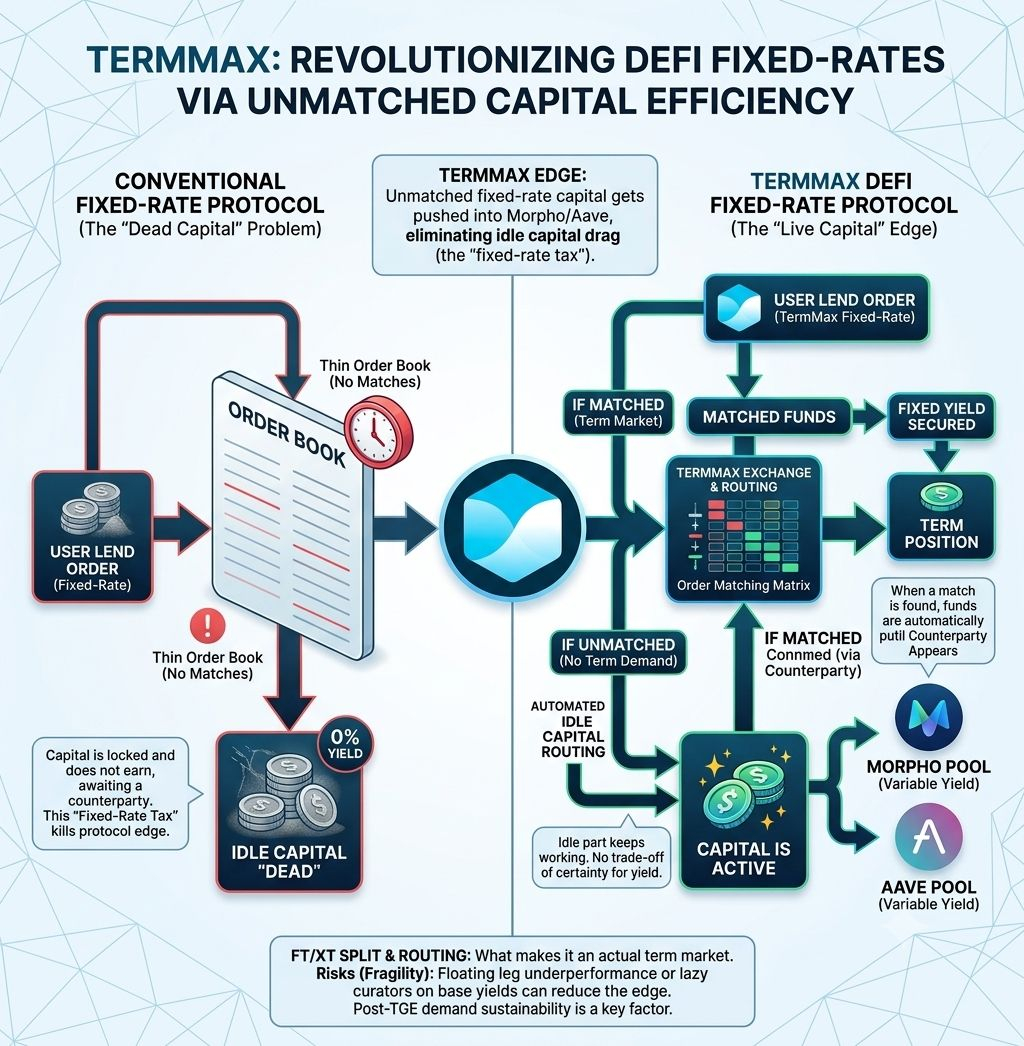
#termmax @TermMax
Most fixed-rate stuff in DeFi still feels like it’s fighting the market. Looks clean on paper, then the book goes quiet and your capital just sits there dead.
TermMax does something quieter that actually helps. Unmatched money doesn’t wait around doing nothing. It gets pushed into Morpho or Aave while the fixed side tries to fill. You’re not really trading certainty for yield the way most fixed-rate designs force you to. The idle part keeps working until someone shows up on the other side.
You only notice how useful that is after you’ve sat on a thin book and watched capital do zero for days. The FT/XT split plus that background routing is what stops the usual fixed-rate tax from killing the whole thing. Feels closer to an actual term market than most of the previous attempts.
Still pretty fragile. If the floating leg starts underperforming or the curators get lazy on base yields, the edge vanishes and everyone just goes back to pure variable rates.
Hard to say yet if what’s happening now is real demand or just pre-TGE noise. Does that idle-routing edge still matter once the points dry up?
$BTC $ETH $SNDK
Most fixed-rate stuff in DeFi still feels like it’s fighting the market. Looks clean on paper, then the book goes quiet and your capital just sits there dead.
TermMax does something quieter that actually helps. Unmatched money doesn’t wait around doing nothing. It gets pushed into Morpho or Aave while the fixed side tries to fill. You’re not really trading certainty for yield the way most fixed-rate designs force you to. The idle part keeps working until someone shows up on the other side.
You only notice how useful that is after you’ve sat on a thin book and watched capital do zero for days. The FT/XT split plus that background routing is what stops the usual fixed-rate tax from killing the whole thing. Feels closer to an actual term market than most of the previous attempts.
Still pretty fragile. If the floating leg starts underperforming or the curators get lazy on base yields, the edge vanishes and everyone just goes back to pure variable rates.
Hard to say yet if what’s happening now is real demand or just pre-TGE noise. Does that idle-routing edge still matter once the points dry up?
$BTC $ETH $SNDK
Wei Ling 伟玲
·
--
#dusk $DUSK @Dusk
Most people still dump Dusk in the privacy bucket and keep scrolling. The piece that actually matters is how XSC handles the exact trade-off institutions won’t touch.
Positions and transfers stay confidential, yet the contract still carries the controls regulated markets require—force transfers, co-signs, eligibility checks, selective disclosure only to authorized parties. Pure privacy kills compliance. Full transparency kills real size. XSC lives in that narrow gap.
That gap is where capital efficiency can finally show up for tokenized securities. Institutions get to move size without handing their books to every competitor and front-runner. The rest of the market still treats transparent ledgers as the only acceptable path, which is why this design keeps getting ignored.
I’ve sat with this thesis through a few RWA cycles while louder names took all the air. The architecture still looks clean. It just hasn’t been tested with real flow yet.
I’ll change my mind the day we see consistent, measurable volume of actual confidential security transfers and corporate actions settling on the network instead of more testnet noise.
$RE $SOL
Will XSC drive real institutional flow?
Most people still dump Dusk in the privacy bucket and keep scrolling. The piece that actually matters is how XSC handles the exact trade-off institutions won’t touch.
Positions and transfers stay confidential, yet the contract still carries the controls regulated markets require—force transfers, co-signs, eligibility checks, selective disclosure only to authorized parties. Pure privacy kills compliance. Full transparency kills real size. XSC lives in that narrow gap.
That gap is where capital efficiency can finally show up for tokenized securities. Institutions get to move size without handing their books to every competitor and front-runner. The rest of the market still treats transparent ledgers as the only acceptable path, which is why this design keeps getting ignored.
I’ve sat with this thesis through a few RWA cycles while louder names took all the air. The architecture still looks clean. It just hasn’t been tested with real flow yet.
I’ll change my mind the day we see consistent, measurable volume of actual confidential security transfers and corporate actions settling on the network instead of more testnet noise.
$RE $SOL
Will XSC drive real institutional flow?
#dusk $DUSK @Dusk
Most people still dump Dusk in the privacy bucket and keep scrolling. The piece that actually matters is how XSC handles the exact trade-off institutions won’t touch.
Positions and transfers stay confidential, yet the contract still carries the controls regulated markets require—force transfers, co-signs, eligibility checks, selective disclosure only to authorized parties. Pure privacy kills compliance. Full transparency kills real size. XSC lives in that narrow gap.
That gap is where capital efficiency can finally show up for tokenized securities. Institutions get to move size without handing their books to every competitor and front-runner. The rest of the market still treats transparent ledgers as the only acceptable path, which is why this design keeps getting ignored.
I’ve sat with this thesis through a few RWA cycles while louder names took all the air. The architecture still looks clean. It just hasn’t been tested with real flow yet.
I’ll change my mind the day we see consistent, measurable volume of actual confidential security transfers and corporate actions settling on the network instead of more testnet noise.
$RE $SOL
Will XSC drive real institutional flow?
Most people still dump Dusk in the privacy bucket and keep scrolling. The piece that actually matters is how XSC handles the exact trade-off institutions won’t touch.
Positions and transfers stay confidential, yet the contract still carries the controls regulated markets require—force transfers, co-signs, eligibility checks, selective disclosure only to authorized parties. Pure privacy kills compliance. Full transparency kills real size. XSC lives in that narrow gap.
That gap is where capital efficiency can finally show up for tokenized securities. Institutions get to move size without handing their books to every competitor and front-runner. The rest of the market still treats transparent ledgers as the only acceptable path, which is why this design keeps getting ignored.
I’ve sat with this thesis through a few RWA cycles while louder names took all the air. The architecture still looks clean. It just hasn’t been tested with real flow yet.
I’ll change my mind the day we see consistent, measurable volume of actual confidential security transfers and corporate actions settling on the network instead of more testnet noise.
$RE $SOL
Will XSC drive real institutional flow?
Yes, eventually
100%
Still unproven
0%
Overrated
0%
Needs volume
0%
6 Votes • Vote fermé
Wei Ling 伟玲
·
--
#termmax @TermMax
Most people still treat fixed rates like some boring institutional toy.
I’ve lived the other side—watching variable rates spike mid-loop and turn a clean yield play into forced deleveraging. TermMax flips that. The quiet part is how unborrowed capital doesn’t sit dead. It auto-routes into Aave or Morpho while waiting for fixed-term demand. That single design choice keeps the pool productive instead of leaking opportunity cost.
Suddenly fixed-rate borrowing stops feeling like a constraint and starts looking like infrastructure for actual capital efficiency. You lock your cost, lenders get predictable yield, and idle money keeps working. Retail keeps chasing the next farm APY. The real edge is this continuous utilization without the rate roulette.
What happens when more structured strategies finally price risk this way instead of just farming emissions?
$RICE $BTW
Most people still treat fixed rates like some boring institutional toy.
I’ve lived the other side—watching variable rates spike mid-loop and turn a clean yield play into forced deleveraging. TermMax flips that. The quiet part is how unborrowed capital doesn’t sit dead. It auto-routes into Aave or Morpho while waiting for fixed-term demand. That single design choice keeps the pool productive instead of leaking opportunity cost.
Suddenly fixed-rate borrowing stops feeling like a constraint and starts looking like infrastructure for actual capital efficiency. You lock your cost, lenders get predictable yield, and idle money keeps working. Retail keeps chasing the next farm APY. The real edge is this continuous utilization without the rate roulette.
What happens when more structured strategies finally price risk this way instead of just farming emissions?
$RICE $BTW
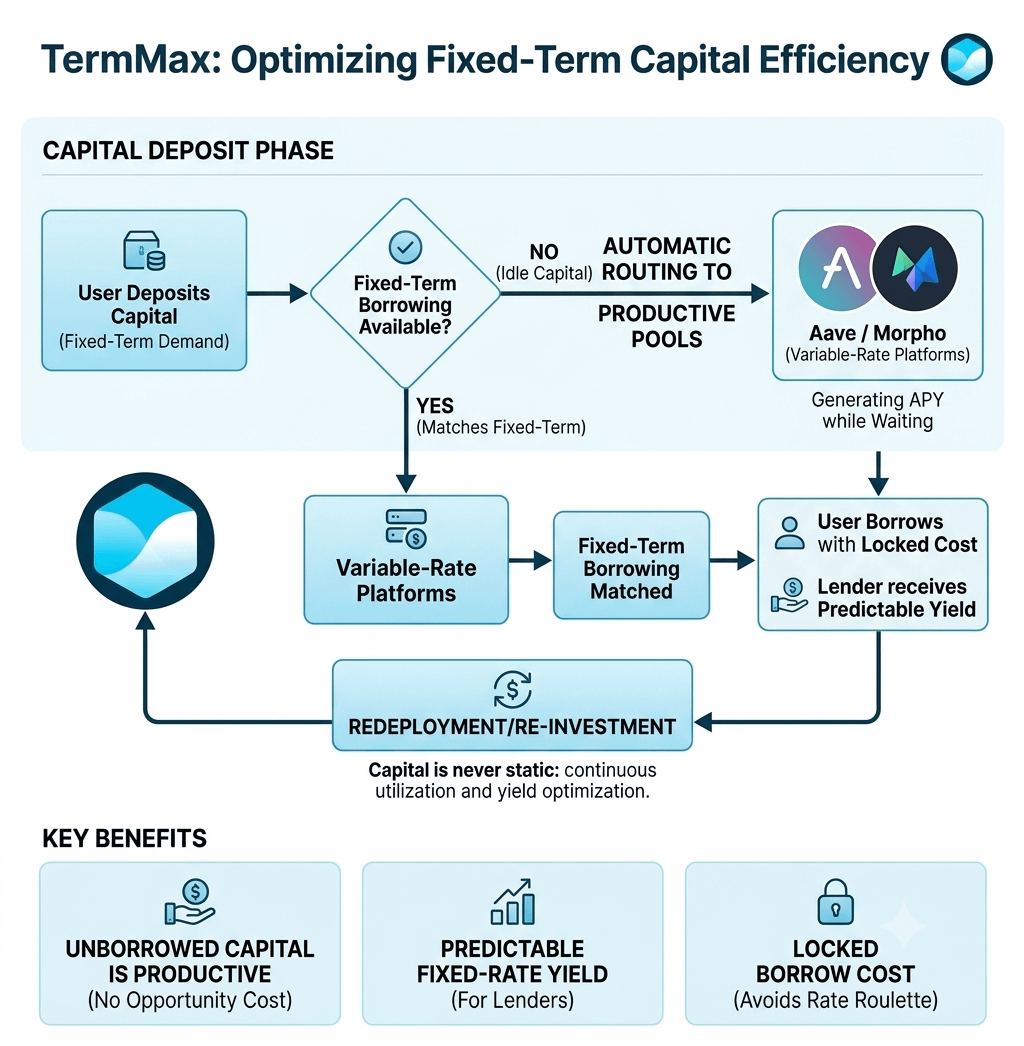

#termmax @TermMax
Most people still treat fixed rates like some boring institutional toy.
I’ve lived the other side—watching variable rates spike mid-loop and turn a clean yield play into forced deleveraging. TermMax flips that. The quiet part is how unborrowed capital doesn’t sit dead. It auto-routes into Aave or Morpho while waiting for fixed-term demand. That single design choice keeps the pool productive instead of leaking opportunity cost.
Suddenly fixed-rate borrowing stops feeling like a constraint and starts looking like infrastructure for actual capital efficiency. You lock your cost, lenders get predictable yield, and idle money keeps working. Retail keeps chasing the next farm APY. The real edge is this continuous utilization without the rate roulette.
What happens when more structured strategies finally price risk this way instead of just farming emissions?
$RICE $BTW
Most people still treat fixed rates like some boring institutional toy.
I’ve lived the other side—watching variable rates spike mid-loop and turn a clean yield play into forced deleveraging. TermMax flips that. The quiet part is how unborrowed capital doesn’t sit dead. It auto-routes into Aave or Morpho while waiting for fixed-term demand. That single design choice keeps the pool productive instead of leaking opportunity cost.
Suddenly fixed-rate borrowing stops feeling like a constraint and starts looking like infrastructure for actual capital efficiency. You lock your cost, lenders get predictable yield, and idle money keeps working. Retail keeps chasing the next farm APY. The real edge is this continuous utilization without the rate roulette.
What happens when more structured strategies finally price risk this way instead of just farming emissions?
$RICE $BTW
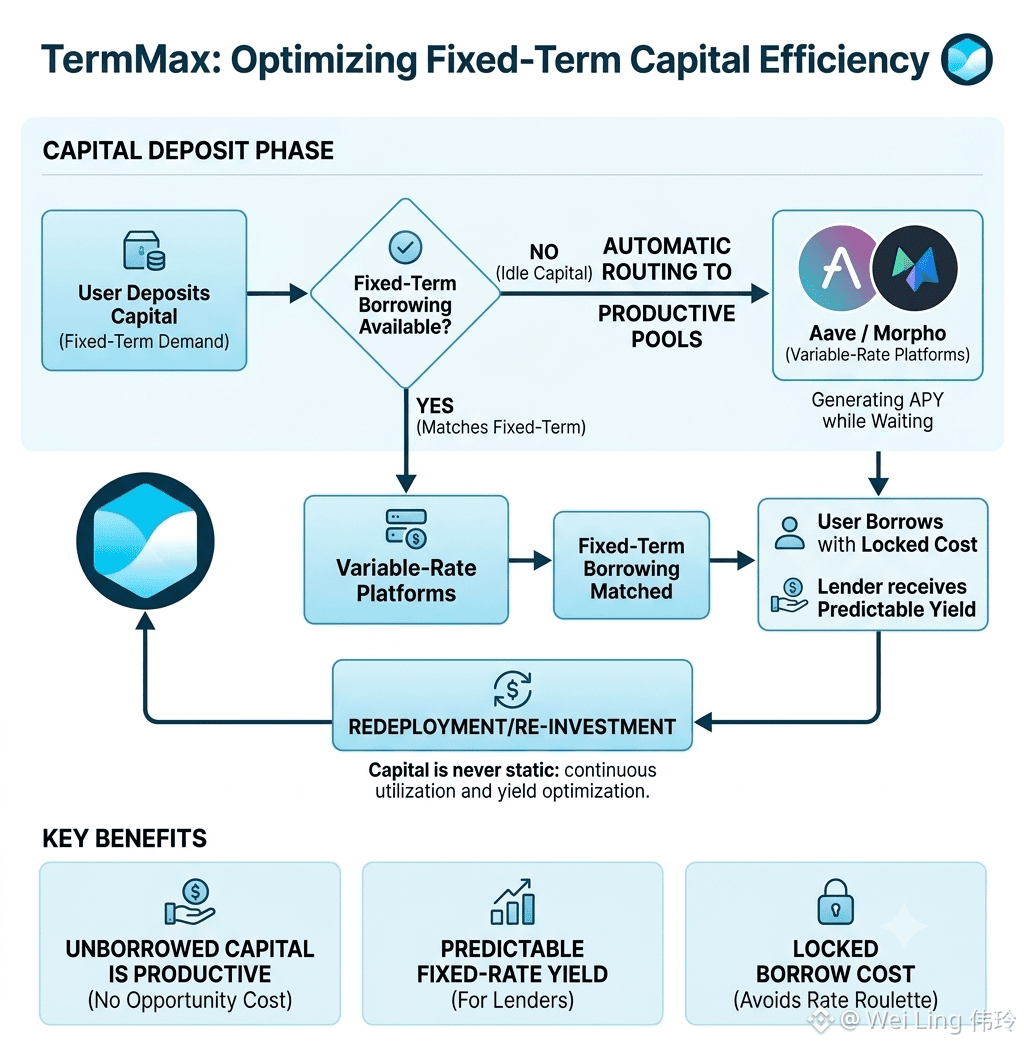
#dusk $DUSK @Dusk
Most people still dump Dusk in with the privacy coins that went quiet. Honestly, I did the same for years.
What finally clicked is that the XSC stuff isn’t pure blackout. The contracts can still enforce the actual rules — who can hold, transfer limits, eligibility — while keeping the sizes and positions hidden. Then it only opens the proof to the people who are supposed to see it.
That’s the bit institutions actually care about. They’re never putting real size on a chain that hands their whole book to every competitor and MEV bot. Transparent ledgers kill that use case.
I sat through the long quiet stretch and still catch myself watching retail volume instead of whether regulated settlements are starting to repeat. If a year from now the on-chain flow from licensed venues is still basically nothing, the whole thesis stays theory.
What do you think actually decides $DUSK long-term?
Most people still dump Dusk in with the privacy coins that went quiet. Honestly, I did the same for years.
What finally clicked is that the XSC stuff isn’t pure blackout. The contracts can still enforce the actual rules — who can hold, transfer limits, eligibility — while keeping the sizes and positions hidden. Then it only opens the proof to the people who are supposed to see it.
That’s the bit institutions actually care about. They’re never putting real size on a chain that hands their whole book to every competitor and MEV bot. Transparent ledgers kill that use case.
I sat through the long quiet stretch and still catch myself watching retail volume instead of whether regulated settlements are starting to repeat. If a year from now the on-chain flow from licensed venues is still basically nothing, the whole thesis stays theory.
What do you think actually decides $DUSK long-term?
Selective disclosure
57%
Real settlements
43%
Retail volume
0%
7 Votes • Vote fermé
great support guys

MrRUHUL
·
--
As a Binance square Creator What we want... What our Expectations From Binance
Guys today I'm going to say something important to the binance team after hearing lot's of creator opinion... So
Dear Binance we as a consistent creator we spend and we give 24/7 hours time to the Binance Day after day months after month year after years with a expectation that We as a creator We can Earn lots of money Form square as a creator we expect that Binance give us some permanent earning solution but our hope and expectations completely going to breaking.
We know that there is a creator pad there is a alpha section write to earn but those are not a permanent solution and we also know what's going on behind the creator paid or alpha section and write to earn etc.
We also see binance always give more priority to the new user and ignore old creator that's why lots of old creator day by day inactive.... But binance forgot that community makes community.
So our Request to the Binance team that Give us a permanent Earning Like Monitization or something like that and the Creator feel more energetic and we will create more Quality Contant..
As a world Largest Exchange Its very easy to solve this issue and one more thing that is if creator getting earning then Binance with the creator will make history...
@Binance Margin @Binance South Africa Official
@Binance Square Official @CZ @ETHcryptohub @AloNe72 @undefined @Jia Lilly @Dr Nohawn @Naccy小妹 @Crypto-First21 @Triple_S @Nadyisom
Dear Binance we as a consistent creator we spend and we give 24/7 hours time to the Binance Day after day months after month year after years with a expectation that We as a creator We can Earn lots of money Form square as a creator we expect that Binance give us some permanent earning solution but our hope and expectations completely going to breaking.
We know that there is a creator pad there is a alpha section write to earn but those are not a permanent solution and we also know what's going on behind the creator paid or alpha section and write to earn etc.
We also see binance always give more priority to the new user and ignore old creator that's why lots of old creator day by day inactive.... But binance forgot that community makes community.
So our Request to the Binance team that Give us a permanent Earning Like Monitization or something like that and the Creator feel more energetic and we will create more Quality Contant..
As a world Largest Exchange Its very easy to solve this issue and one more thing that is if creator getting earning then Binance with the creator will make history...
@Binance Margin @Binance South Africa Official
@Binance Square Official @CZ @ETHcryptohub @AloNe72 @undefined @Jia Lilly @Dr Nohawn @Naccy小妹 @Crypto-First21 @Triple_S @Nadyisom

Wei Ling 伟玲
·
--
#dusk $DUSK @Dusk
Most privacy chains still feel like they’re built for people who just want to hide bags. Dusk doesn’t.
What actually stands out is how selective disclosure sits inside the confidential contracts and the XSC standard. Balances, sizes, and counterparties stay private by default, yet you can still prove exactly what a regulator or auditor needs without broadcasting the entire history. It’s the first chain that ships native confidential smart contracts instead of bolting privacy on later, and XSC lets issuers keep eligibility and transfer rules while holders still self-custody.
Institutions simply won’t move real securities onto a chain if every position becomes free market intel for competitors. This design kills that problem and still delivers deterministic settlement. Most retail is still pricing the privacy story. The real question is whether regulated capital finally gets infrastructure it can actually use without creating a compliance nightmare.
Could still fail if issuers stick to private rails forever. But the mechanism itself feels cleaner than almost anything else in the privacy lane right now.
Will institutions actually use public privacy chains like Dusk?
Most privacy chains still feel like they’re built for people who just want to hide bags. Dusk doesn’t.
What actually stands out is how selective disclosure sits inside the confidential contracts and the XSC standard. Balances, sizes, and counterparties stay private by default, yet you can still prove exactly what a regulator or auditor needs without broadcasting the entire history. It’s the first chain that ships native confidential smart contracts instead of bolting privacy on later, and XSC lets issuers keep eligibility and transfer rules while holders still self-custody.
Institutions simply won’t move real securities onto a chain if every position becomes free market intel for competitors. This design kills that problem and still delivers deterministic settlement. Most retail is still pricing the privacy story. The real question is whether regulated capital finally gets infrastructure it can actually use without creating a compliance nightmare.
Could still fail if issuers stick to private rails forever. But the mechanism itself feels cleaner than almost anything else in the privacy lane right now.
Will institutions actually use public privacy chains like Dusk?
Connectez-vous pour découvrir plus de contenu