

Binance and Franklin Templeton are pioneering an off-exchange collateral program for institutions, enabling traders to leverage tokenized money market fund shares as collateral—bringing yield-bearing, real-world assets directly into the heart of crypto trading.
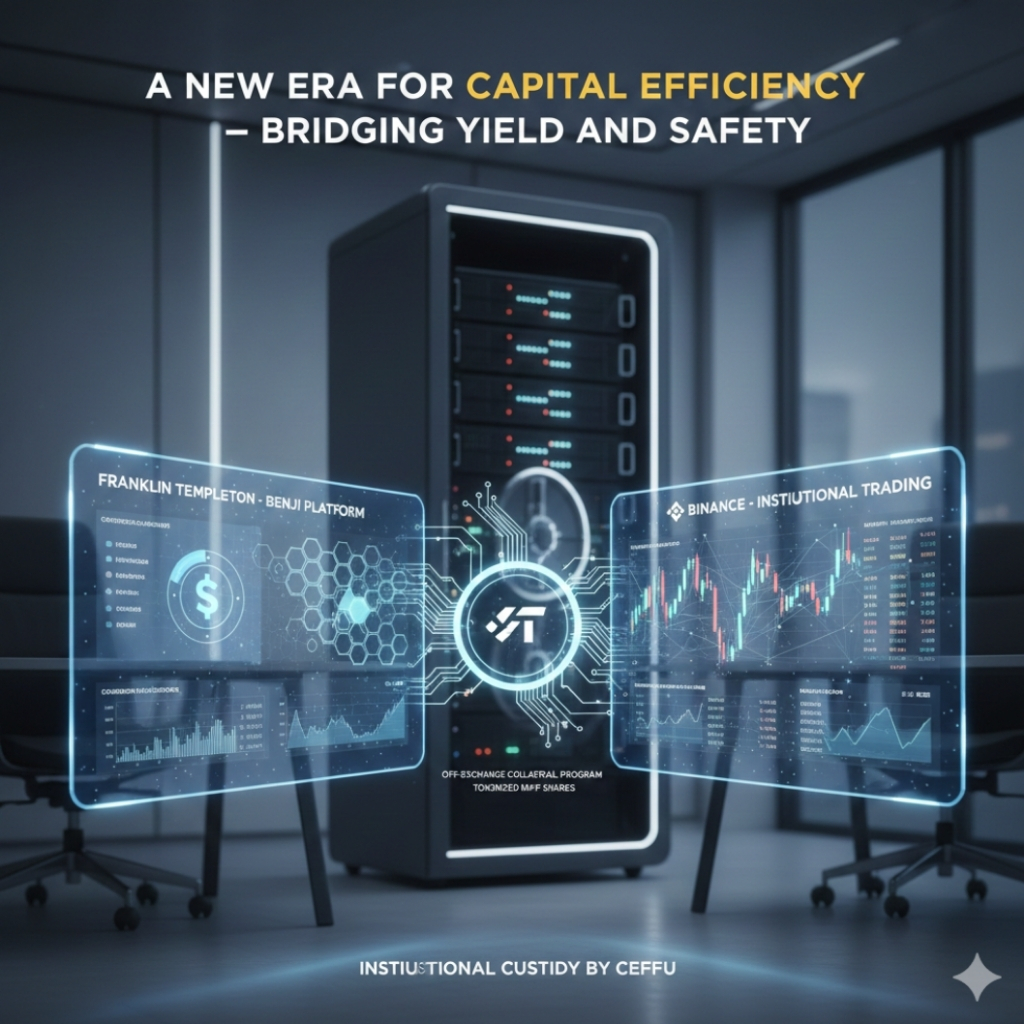
A New Era for Capital Efficiency—Bridging Yield and Safety Without Compromising on Trading Agility
Introduction — The High-Stakes Dilemma of Capital Deployment
For institutional crypto traders, every dollar counts—not just in terms of trading opportunities, but also in terms of risk and return. Traditionally, the industry has forced institutions to make a hard tradeoff: if you want to participate actively in crypto markets, you have to lock up significant amounts of capital—either in cash or stablecoins—on centralized exchanges. That capital is effectively dead weight, earning little to no yield and subject to the ever-present specter of exchange failures or operational risks.
In stark contrast, the world of traditional finance is built around capital efficiency. Trillions of dollars flow through money market funds (MMFs), which are designed to preserve principal while generating steady, regulated returns. These are the backbone of institutional liquidity management. But historically, integrating these high-quality, yield-generating assets into the fast-moving, 24/7 crypto trading ecosystem has proved elusive.
Binance and Franklin Templeton are now stepping forward with a novel solution that addresses this pain point, aiming to bring the best of both worlds together—capital safety and capital productivity, without compromise.
Core Value Proposition — Unlocking Real-World Assets for Crypto Market Utility
The innovation at the heart of this new program is deceptively simple, but potentially transformative: institutional traders can now use tokenized shares of Franklin Templeton’s money market funds as collateral for trading on Binance. These tokenized MMF shares are stored with regulated custodians and never leave their secure environment, but Binance recognizes their value on its trading platform via a mirroring mechanism.
The result is a substantial leap in capital efficiency. Institutions can now keep their principal invested in regulated, yield-bearing assets, eliminating the opportunity cost of idle funds. At the same time, they gain full access to Binance’s deep liquidity pools and trading infrastructure, as if their capital were sitting on the exchange itself—without the associated risks.
This isn’t just another incremental product feature. It represents a fundamental shift in the way real-world assets (RWAs) can be integrated into digital market infrastructure, finally allowing institutions to deploy their capital more intelligently across both traditional and crypto markets.
The Institutional Barrier — Navigating the Friction Points of Crypto Trading
Institutional engagement with crypto has always been hampered by a set of persistent structural issues. First, the need to pre-fund accounts on exchanges means that large sums must be held in non-productive, high-risk environments. Second, the lack of integration between legacy financial systems and crypto trading venues creates operational headaches and additional counterparty risks. Third, the choice has always been binary: prioritize security by keeping assets off-exchange, or prioritize speed and flexibility by moving assets onto the exchange—rarely both.
These frictions have been a major deterrent for mainstream adoption by institutional players such as asset managers, hedge funds, and corporate treasuries. While crypto’s promise has always been global, liquid, and always-on markets, the reality has often been that institutions are forced to operate with one hand tied behind their back.
This new collateral program is designed to dismantle those barriers by providing a robust, familiar, and compliant channel for real-world assets to flow directly into digital trading environments.
Technology Stack — The Infrastructure Making It Possible
1. Tokenization of Money Market Fund Shares
Franklin Templeton’s Benji platform lies at the core of this innovation, enabling investors to own and transfer digital tokens that are fully backed by regulated money market funds. These tokens confer all the benefits of MMFs—liquidity, safety, and yield—while also enjoying the programmability and transparency of blockchain. For institutions, this means the ability to hold tokenized MMF shares on-chain as a digital representation of their capital, enhancing operational flexibility.
2. Off-Exchange Collateral Mirroring
Crucially, these tokenized assets do not move onto Binance’s exchange. Instead, their value is mirrored inside Binance’s risk management and trading systems. Through this arrangement, the capital remains in third-party custody, but its value is unlocked as collateral on Binance. This approach preserves the safety and regulatory clarity of traditional custody, while granting traders full access to crypto market opportunities.
3. Institutional-Grade Custody via Ceffu
Ceffu, Binance’s institutional custody partner, provides the infrastructure for secure storage and settlement of these off-exchange assets. By maintaining a clear separation between asset safekeeping and trading activity, this setup aligns with the best practices of traditional finance. Institutions can be confident that their assets are protected by robust legal and technological safeguards, reducing operational and counterparty risk.
4. Seamless Integration with Binance’s Trading Engine
Binance’s trading infrastructure recognizes the mirrored collateral in real-time, allowing institutions to use their off-exchange MMF tokens for margin trading, settlements, and risk calculations. This integration ensures that capital is always working—generating yield off-chain while providing liquidity and leverage on-chain. The result is a more dynamic, efficient, and secure trading experience for sophisticated participants.
Risk Considerations — Building Institutional Trust
Institutions are inherently risk-averse, especially when it comes to managing large pools of capital. The model introduced by Binance and Franklin Templeton directly addresses the most pressing concerns:
- Asset Segregation: By keeping collateral off-exchange and under third-party custody, institutions are insulated from exchange-specific risks such as insolvency, hacks, or operational failures.
- Regulatory Oversight: The underlying money market funds are subject to stringent regulatory standards and oversight, providing a layer of security and familiarity for compliance teams.
- Structural Separation: Trading and custody functions are clearly divided, mirroring the best practices of established capital markets and reducing single points of failure.
No system can eliminate risk entirely, but this approach introduces multiple lines of defense and aligns closely with the risk management frameworks that institutional players expect.
Strategic Rollout — Scaling Institutional Adoption
This program is not a retail experiment. It is purpose-built for institutions—hedge funds, global asset managers, proprietary trading firms, and corporate treasuries that demand both capital efficiency and robust risk controls. By fusing Franklin Templeton’s expertise in asset management with Binance’s global trading platform, the initiative seeks to drive a new wave of institutional adoption.
For the first time, regulated financial products—tokenized and fully compliant—can be deployed directly into the blockchain economy, enabling institutions to move capital fluidly between traditional and digital markets without sacrificing yield, safety, or speed.
Historical Context — The Next Chapter in Crypto and Traditional Finance Integration
This development marks a significant milestone in the evolution of real-world assets on-chain. Over the past decade, the crypto industry has made enormous strides in creating digital-native assets and infrastructure. However, the integration of mainstream, regulated financial products into these systems has lagged—largely due to legal, operational, and technological challenges.
With the launch of this collateral program, Binance and Franklin Templeton are not just solving a technical problem—they are opening the door for a much deeper convergence between traditional finance and the digital asset ecosystem. If successful, this model could catalyze the next phase of institutional participation in crypto, drive new liquidity into digital markets, and accelerate the adoption of tokenized assets across the financial landscape.
In bringing together compliance, yield, and capital efficiency, this initiative may well become a blueprint for the future of institutional trading—one where the boundaries between real-world and digital assets continue to blur, and where capital can be deployed wherever it is most productive, without unnecessary compromise.
