

#tokenization
tokenization
3.5M vues
15,506 mentions
Populaire
Récents

🚨 WALL STREET PASSE ON-CHAIN — ET APTOS EST DE LA PARTIE.
@BlackRock, le plus grand gestionnaire d’actifs au monde, avec 15 500 milliards de dollars d’actifs sous gestion, a émis 157,16 millions de dollars de son fonds BUIDL sur @Aptos, soit plus de 7 % de la valeur totale du fonds.
Et BlackRock n’est pas le seul. 👀
🏦 Apollo
🏦 Franklin Templeton
🏦 Brevan Howard
🏦 Hamilton Lane
Tous ont des fonds tokenisés sur Aptos.
L’enjeu dépasse celui d’un seul fonds. Cela montre comment la finance institutionnelle explore l’infrastructure blockchain pour transférer les actifs financiers traditionnels on-chain.
La véritable opportunité ? À mesure que la tokenisation se développe, les réseaux capables de prendre en charge des produits financiers de niveau institutionnel pourraient générer une valeur importante à long terme.
Aptos entend bien se faire une place dans cette course. 🌐
La finance traditionnelle passe on-chain. Gardez un œil sur l’infrastructure qui rend cette transition possible. 🔥
#Aptos #RWA #Tokenization $APT
{future}(APTUSDT)
🚨 WALL STREET PASSE ON-CHAIN — ET APTOS EST DE LA PARTIE.
@BlackRock, le plus grand gestionnaire d’actifs au monde, avec 15 500 milliards de dollars d’actifs sous gestion, a émis 157,16 millions de dollars de son fonds BUIDL sur @Aptos, soit plus de 7 % de la valeur totale du fonds.
Et BlackRock n’est pas le seul. 👀
🏦 Apollo
🏦 Franklin Templeton
🏦 Brevan Howard
🏦 Hamilton Lane
Tous ont des fonds tokenisés sur Aptos.
L’enjeu dépasse celui d’un seul fonds. Cela montre comment la finance institutionnelle explore l’infrastructure blockchain pour transférer les actifs financiers traditionnels on-chain.
La véritable opportunité ? À mesure que la tokenisation se développe, les réseaux capables de prendre en charge des produits financiers de niveau institutionnel pourraient générer une valeur importante à long terme.
Aptos entend bien se faire une place dans cette course. 🌐
La finance traditionnelle passe on-chain. Gardez un œil sur l’infrastructure qui rend cette transition possible. 🔥
#Aptos #RWA #Tokenization $APT
274

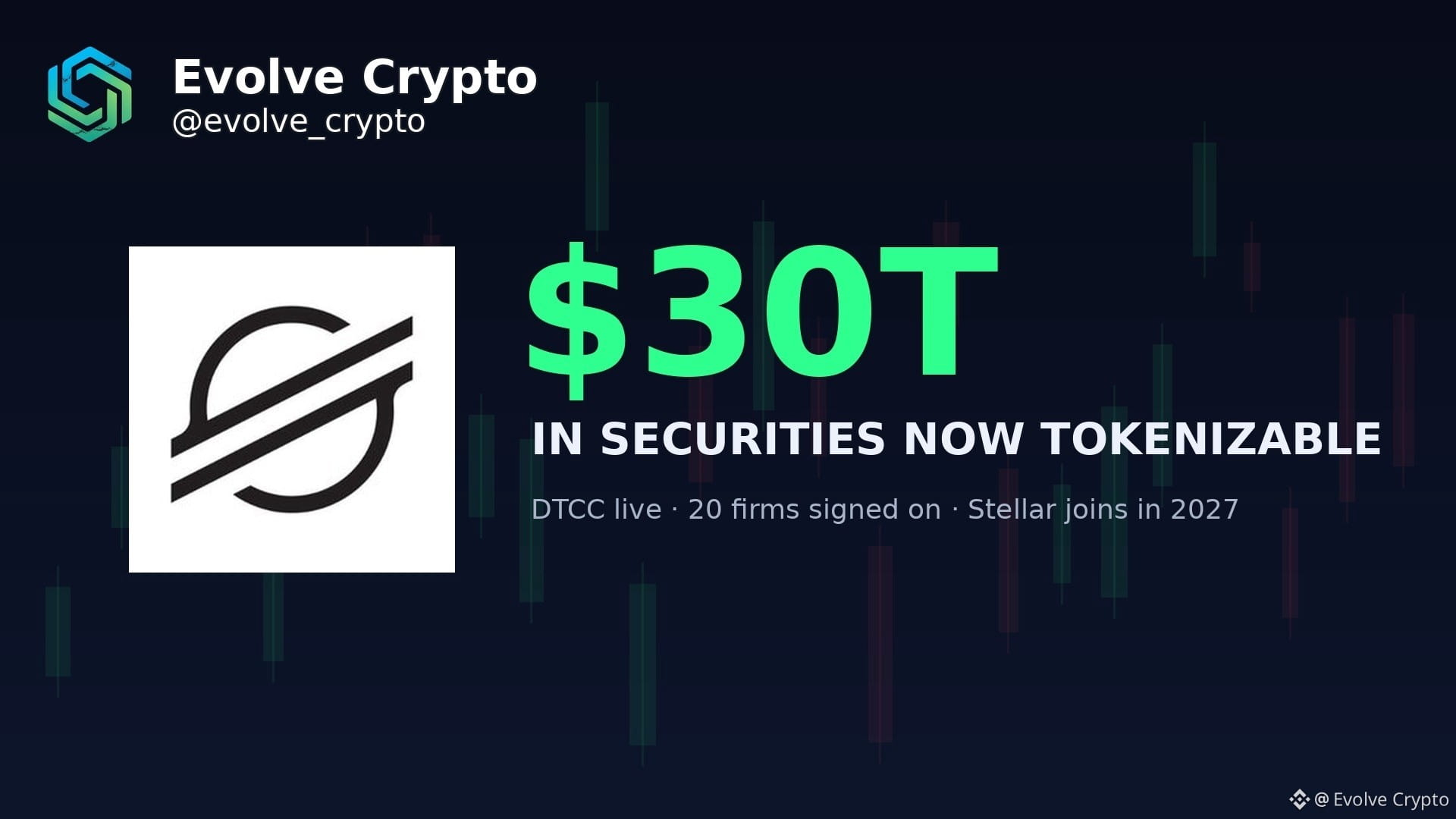
$XLM est le prochain dans la file pour le plus grand pipeline de tokenisation de Wall Street — tu suis ça ? 👀 DTCC a lancé son service avec 30 000 milliards de dollars d’actions et de bons du Trésor admissibles, 20 entreprises ont signé, et Stellar rejoindra le projet en 2027. Si tu as tenu bon pendant les mois calmes, c’est ton moment.
#XLM #Tokenization #CryptoNews
Fais tes propres recherches
#XLM #Tokenization #CryptoNews
Fais tes propres recherches
3
139
Voir la traduction
BoEOpensConsultationOnTokenizedCollateralForClearing 🚨
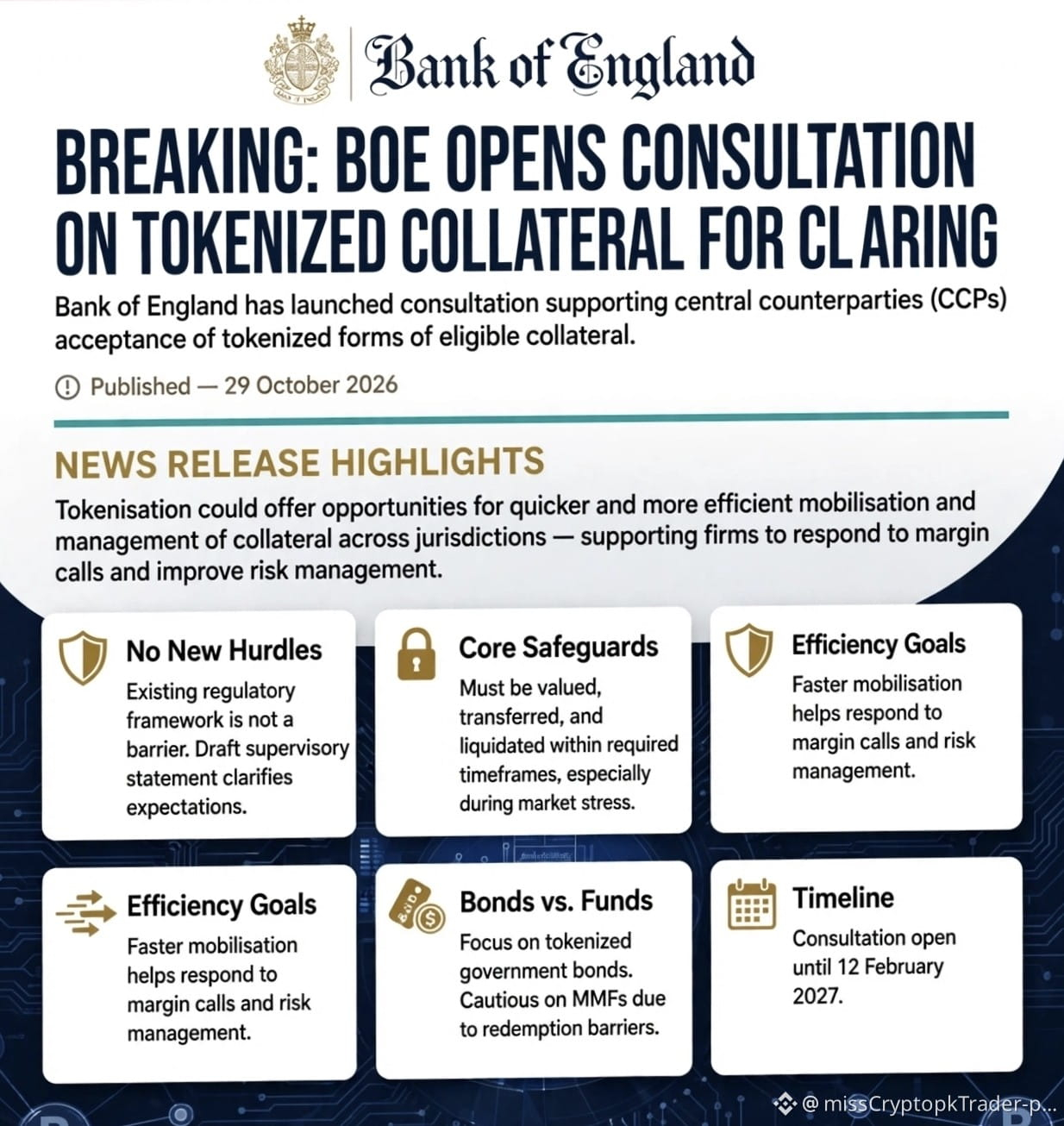
🇬🇧 Bank of England launches consultation on tokenised collateral for central clearing
🏦 The Bank of England is seeking feedback on draft supervisory expectations for central counterparties (CCPs) that want to accept tokenised versions of collateral already eligible under the proposed CCP Rulebook.
🔥 Key highlights:
🔹 The consultation does not create a separate new collateral regime; it clarifies how CCPs should demonstrate that tokenised collateral meets existing eligibility and risk-management standards.
🔹 The scope is broader than only government bonds — it can cover eligible collateral that CCPs already accept, as well as eligible types not currently accepted.
🔹 CCPs would need to show that tokenised collateral can be reliably valued, transferred, and liquidated, including during stressed market conditions.
🔹 Potential benefits include more efficient collateral management and faster support for margin requirements, subject to robust operational and financial-stability safeguards.
🔹 The consultation closes on 12 February 2027.
📈 This is a meaningful regulatory step toward integrating tokenisation into traditional market infrastructure — but it is focused on the safe use of tokenised forms of eligible assets, rather than opening clearing to any crypto asset.
💬 Could clearer CCP standards help accelerate institutional use of tokenisation in wholesale markets?
#BoE #Tokenization #Collateral #CentralClearing #BankOfEngland

·
--
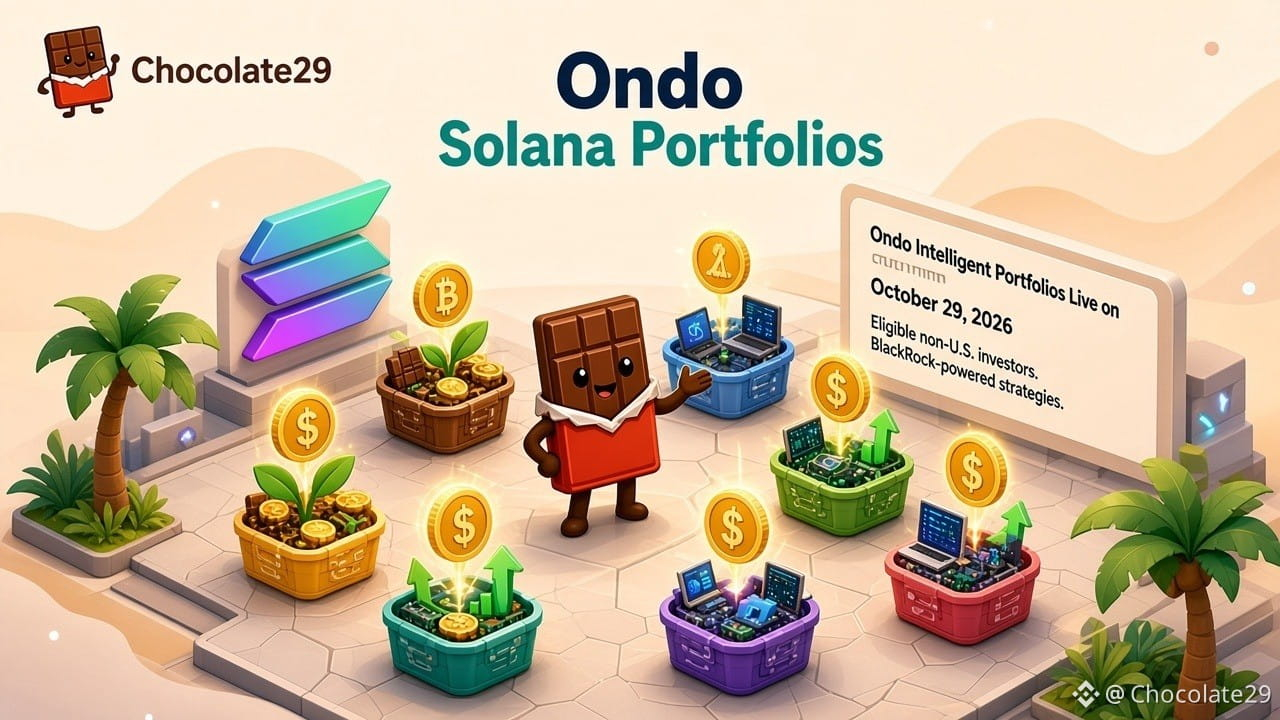
Ondo vient de lancer sept portefeuilles intelligents sur Solana — des stratégies à jeton unique destinées aux investisseurs admissibles hors des États-Unis, dont trois reposent sur BlackRock et $SOL sont sous les projecteurs.
Le 29 octobre 2026, Ondo Finance a annoncé que les sept portefeuilles intelligents Ondo sont désormais accessibles aux investisseurs admissibles hors des États-Unis via les principaux portefeuilles et applications Solana. Chaque portefeuille regroupe plusieurs actifs dans un seul jeton onchain transférable, avec des avoirs visibles et un rééquilibrage programmatique. Trois reposent sur des stratégies élaborées par BlackRock (revenus élevés, forte croissance, croissance diversifiée) ; les quatre autres sont des thèmes conçus par Ondo, allant des Magnificent 7 et des cryptomonnaies aux leaders de l’IA et aux revenus ciblés.
La gamme avait déjà dépassé environ 40 millions de dollars de TVL sur Ethereum et BNB Chain au cours de ses quatre premières semaines. Ondo indique également que la TVL de ses actifs tokenisés sur Solana dépasse déjà 500 millions de dollars. L’accès est réservé aux investisseurs admissibles hors des États-Unis — il s’agit d’un aperçu de l’expansion du produit, et non d’une recommandation.
#Solana #Tokenization #Crypto
Faites vos propres recherches. Ceci ne constitue pas un conseil financier.
62

·
--
Voir la traduction
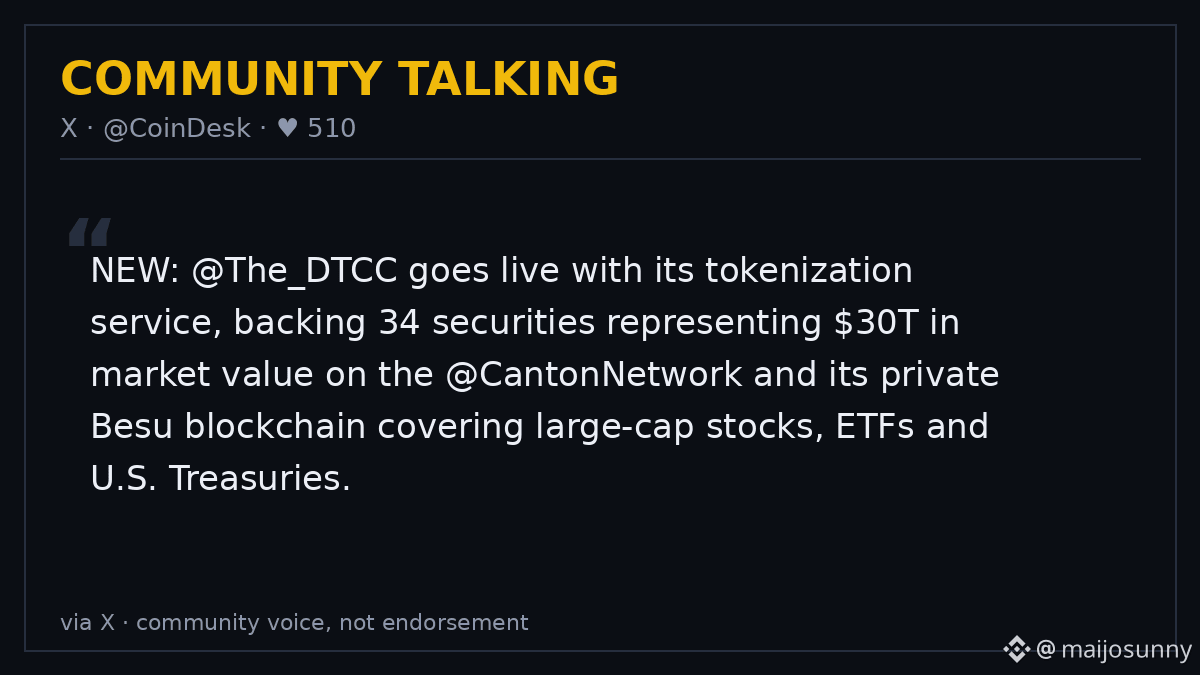
🚨 $30 TRILLION JUST GOT A BLOCKCHAIN ADDRESS (CoinDesk)
Wall Street's plumbing went live on Wednesday. DTCC, the firm that clears and settles most US stock and bond trading, switched on its tokenization service on the Canton Network and its private Besu blockchain.
📊 THE NUMBERS THAT MATTER
34 securities eligible at launch = roughly $30 trillion in market value
20 firms signed up, including JPMorgan, Citi, Morgan Stanley, Bank of America and UBS
$114 trillion+ in securities already sit in DTCC's depository
Tokens are backed one-for-one by real securities held at DTCC's depository, keep existing shareholder rights, and can move between registered wallets around the clock. Conversion takes 15 minutes or less during business hours.
⚠️ $30 trillion in eligible securities ≠ $30 trillion tokenized. That figure is the value of the pool that can use the service, not assets already converted. The real adoption metric is how much actually gets issued and moved in the months ahead, not the headline pool size.
🤔 WHY SHOULD CRYPTO TRADERS CARE?
This is tokenization moving from crypto-native experiments into the infrastructure that already runs US markets. If settlement and collateral rails go onchain here, the networks in the pipeline stand to gain the distribution: Canton now, $XLM and Circle's Arc next year, plus digital-cash settlement and collateral tools on the roadmap. Citi projects tokenized securities become a $5.5 trillion market by 2030.
My take: the headline is not the $30 trillion, it is the 20 signatures. Banks spent years piloting tokenization on the sidelines, and DTCC just gave them a regulated on-ramp with real shareholder rights attached.
What to watch: first actual issuance volumes, whether collateral use follows, and which chain picks up the next wave of firms.
Is this the moment tokenization stops being a crypto story and becomes a market-structure story? 👇
Not financial advice. DYOR.
#crypto #RWA #Tokenization
98

·
--
Voir la traduction
Tokenized assets: are we measuring activity—or actual usefulness? 🤔
A CoinDesk opinion piece makes a point that stuck with me: the numbers most commonly used to assess tokenized assets don’t answer a CIO’s basic balance-sheet question: “What is it doing for me?”
That’s the gap I want explained. Tracking an asset isn’t the same as showing why it belongs on a balance sheet. 🔍
If you were assessing a tokenized asset, what would you want measured first?
#Tokenization #RWA #Blockchain

Voir la traduction
I've been waiting for tokenization to stop being a slide deck, and it took a real step. Canton Strategic Holdings (Nasdaq: CNTN) says its shares will be tradable on TSV on Canton, with trading expected as early as Monday, November 2.
The difference vs OKX-ICE: Canton is sponsoring its own tokenization. SEC-registered transfer agent Fairmint will issue the shares and keep the ownership record, so holders get the same Nasdaq-shareholder rights — no 30-day issuer-objection fight, because the issuer asked for it.
TSV plans 24/7 trading via market maker pools, with atomic settlement, approved participants only, under the same SEC five-year Innovation Exemption OKX-ICE uses, where 33 companies have objected to third-party listings.
Tape: $BTC is near $80,178 (-0.6%/24h), $ETH near $2,326 (-0.5%) on Binance spot — context, not a reaction to this announcement. Monday is "expected," not done.
If issuer-sponsored listings become the template, does tokenization scale, or does the approved-only gate keep it Wall Street in crypto clothing? Not financial advice — do your own research.
#CryptoMarkets #Tokenization #SEC #CantonNetwork #TradFi
·
--
Article
Voir la traduction
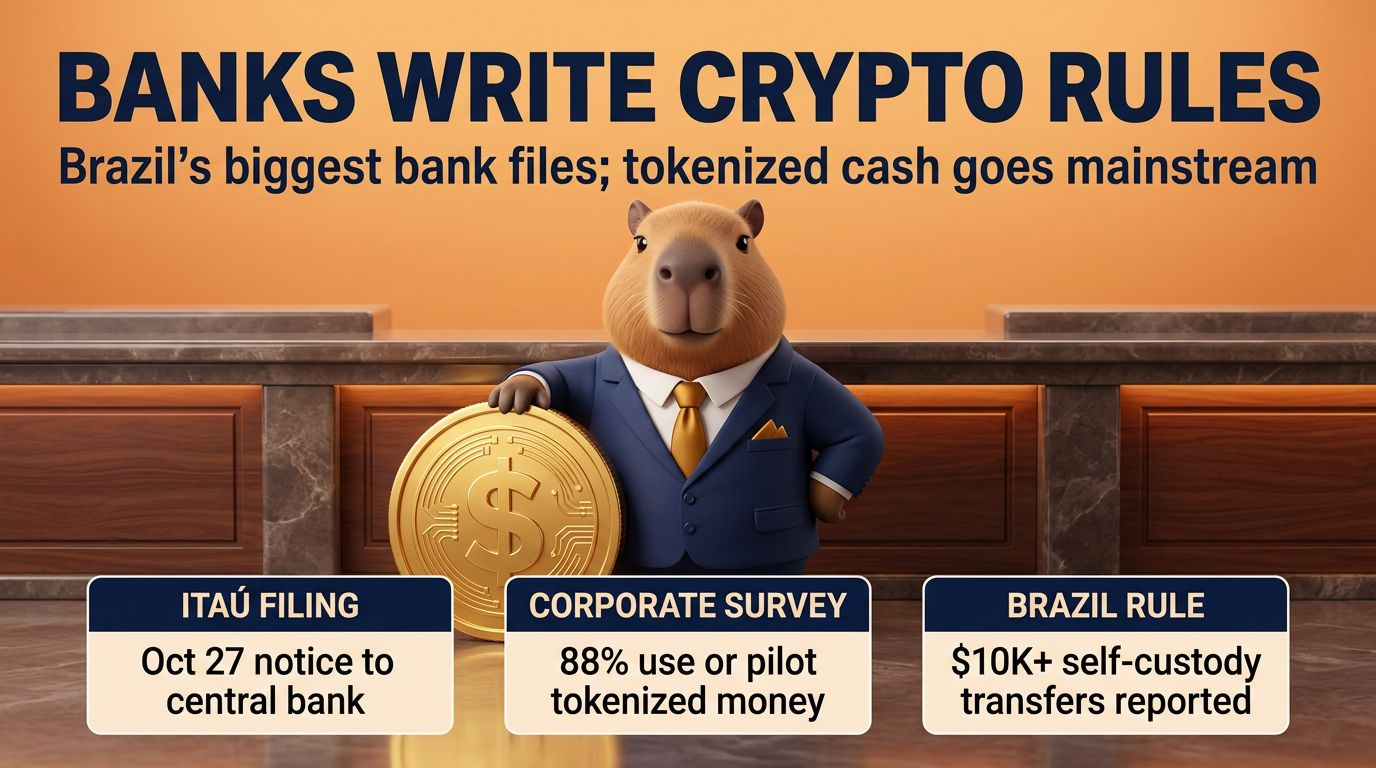
Banks Are Writing Crypto Into Their RulebooksCrypto is increasingly being written into the paperwork of mainstream finance. This week offered a clean example: Brazil's largest private bank formalized its crypto business with the central bank, while a survey of big corporate treasurers suggests tokenized money is already a working tool, not a lab experiment. Here is what actually happened, what it does not mean, and what to watch next.
1) What Itaú actually did
Itaú Unibanco said in an official notice dated October 27 that it formalized its crypto brokerage and custody activity with Banco Central do Brasil. According to reporting by Blockchain Reporter, this was a notification rather than a new license. Brazil built two tracks into its framework: dedicated virtual-asset providers must apply for authorization and wait for approval, while an already-licensed bank simply communicates its activity to the regulator and must meet the same conduct, governance and anti-money-laundering obligations.
The important nuance: this is not a product launch. The same report says Itaú has offered crypto purchases and sales since December 2023 and lists more than 14 virtual assets, including BTC, ETH and USDC. What changed is the legal footing underneath an existing business. The bank also declined to disclose client numbers or volumes, so the filing tells us little about how many Brazilians actually use bank-offered crypto.
2) The rulebook behind it
Brazil assembled its regime in stages. Law 14.478 of 2022 named the central bank as supervisor. Resolutions 519, 520 and 521 took effect on February 2, 2026 and created the formal provider categories: intermediary, custodian and broker. Resolutions 588 and 589, published September 23, tightened the framework and took effect October 1. October is also the final month for providers already operating to formalize their authorization requests.
One detail stands out for everyday users: transfers to or from self-custodied wallets worth the equivalent of US$10,000 or more must be reported to Coaf, Brazil's financial-intelligence unit. That is a concrete compliance cost, and it shows how regulators try to regain visibility when users hold their own keys.
The same regime is reshaping global platforms too. Blockchain Reporter notes that Binance restricted eight services and delisted 22 tokens in Brazil earlier this week to comply with the same central bank rules. Whatever your view on the rules, local licensing is becoming the price of admission in large markets.
3) Corporates are testing tokenized money
A separate data point, reported by CoinDesk and summarized in a daily digest: a DBS survey run by EY polled 422 business and finance leaders across 11 markets, all at companies with more than $500 million in annual revenue. 88% said they use or pilot tokenized money. Stablecoins led, with 63% using them or planning to, ahead of tokenized deposits at 53% and tokenized money market funds at 52%. And 71% said their cross-border payments have improved or will within two years.
Treat survey numbers with care. "Use or pilot" is a broad bucket, and a pilot can be tiny. But the direction is consistent with the rest of the month: banks, card networks and payment firms keep adding stablecoin and tokenization rails, and the most cited benefit is faster, cheaper cross-border settlement.
4) Why this matters for crypto users
First, regulated on-ramps expand the audience. When a household-name bank offers crypto inside its investment app, buying it becomes as ordinary as buying a fund. That can bring in a more cautious crowd.
Second, custody becomes the real question. Assets held by a bank sit under the bank's controls, subject to its compliance rules. Assets in your own wallet are yours to manage, along with every security responsibility that comes with it. Neither is automatically better; they are different trade-offs, and mainstream adoption will push more people to decide consciously.
Third, compliance moves from the edges to the center. Reporting thresholds, delistings and service restrictions are not bearish or bullish on their own. They change which products are available where, and who can offer them.
5) What it does not mean
It does not mean a price catalyst. Nothing in the filing changes supply or demand for any token overnight. It does not mean other banks will follow on a set schedule; reports point to peers such as Nubank and BTG Pactual as names to watch, but that is a thing to monitor, not a certainty. And it does not prove mass adoption, since the bank gave no usage figures.
6) What to watch next
• Whether other large Brazilian lenders file in the coming weeks, which the regulator's public registry should reveal.
• How providers handle the self-custody reporting rule, which could change how users move funds.
• Which more jurisdictions copy the two-track model: light notification for licensed banks, full authorization for crypto-native firms.
• Whether more corporate pilots turn into disclosed production volume.
The takeaway: the loudest crypto stories are often price moves, but the slow, structural ones are rules, licenses and rails. They decide who can reach crypto, how, and under whose supervision. Keep an eye on those, because they tend to outlast any single day's candle.
Which matters more to you: the convenience of a bank-held crypto account, or full control of your own keys? Tell me in the comments.
Sources: Blockchain Reporter, Zypto daily digest, CoinDesk (via digest). Facts as reported on Oct 29, 2026.
#CryptoRegulation #Stablecoins #Tokenization
Not financial advice.
Banks Are Writing Crypto Into Their Rulebooks
Crypto is increasingly being written into the paperwork of mainstream finance. This week offered a clean example: Brazil's largest private bank formalized its crypto business with the central bank, while a survey of big corporate treasurers suggests tokenized money is already a working tool, not a lab experiment. Here is what actually happened, what it does not mean, and what to watch next.
1) What Itaú actually did
Itaú Unibanco said in an official notice dated October 27 that it formalized its crypto brokerage and custody activity with Banco Central do Brasil. According to reporting by Blockchain Reporter, this was a notification rather than a new license. Brazil built two tracks into its framework: dedicated virtual-asset providers must apply for authorization and wait for approval, while an already-licensed bank simply communicates its activity to the regulator and must meet the same conduct, governance and anti-money-laundering obligations.
The important nuance: this is not a product launch. The same report says Itaú has offered crypto purchases and sales since December 2023 and lists more than 14 virtual assets, including BTC, ETH and USDC. What changed is the legal footing underneath an existing business. The bank also declined to disclose client numbers or volumes, so the filing tells us little about how many Brazilians actually use bank-offered crypto.
2) The rulebook behind it
Brazil assembled its regime in stages. Law 14.478 of 2022 named the central bank as supervisor. Resolutions 519, 520 and 521 took effect on February 2, 2026 and created the formal provider categories: intermediary, custodian and broker. Resolutions 588 and 589, published September 23, tightened the framework and took effect October 1. October is also the final month for providers already operating to formalize their authorization requests.
One detail stands out for everyday users: transfers to or from self-custodied wallets worth the equivalent of US$10,000 or more must be reported to Coaf, Brazil's financial-intelligence unit. That is a concrete compliance cost, and it shows how regulators try to regain visibility when users hold their own keys.
The same regime is reshaping global platforms too. Blockchain Reporter notes that Binance restricted eight services and delisted 22 tokens in Brazil earlier this week to comply with the same central bank rules. Whatever your view on the rules, local licensing is becoming the price of admission in large markets.
3) Corporates are testing tokenized money
A separate data point, reported by CoinDesk and summarized in a daily digest: a DBS survey run by EY polled 422 business and finance leaders across 11 markets, all at companies with more than $500 million in annual revenue. 88% said they use or pilot tokenized money. Stablecoins led, with 63% using them or planning to, ahead of tokenized deposits at 53% and tokenized money market funds at 52%. And 71% said their cross-border payments have improved or will within two years.
Treat survey numbers with care. "Use or pilot" is a broad bucket, and a pilot can be tiny. But the direction is consistent with the rest of the month: banks, card networks and payment firms keep adding stablecoin and tokenization rails, and the most cited benefit is faster, cheaper cross-border settlement.
4) Why this matters for crypto users
First, regulated on-ramps expand the audience. When a household-name bank offers crypto inside its investment app, buying it becomes as ordinary as buying a fund. That can bring in a more cautious crowd.
Second, custody becomes the real question. Assets held by a bank sit under the bank's controls, subject to its compliance rules. Assets in your own wallet are yours to manage, along with every security responsibility that comes with it. Neither is automatically better; they are different trade-offs, and mainstream adoption will push more people to decide consciously.
Third, compliance moves from the edges to the center. Reporting thresholds, delistings and service restrictions are not bearish or bullish on their own. They change which products are available where, and who can offer them.
5) What it does not mean
It does not mean a price catalyst. Nothing in the filing changes supply or demand for any token overnight. It does not mean other banks will follow on a set schedule; reports point to peers such as Nubank and BTG Pactual as names to watch, but that is a thing to monitor, not a certainty. And it does not prove mass adoption, since the bank gave no usage figures.
6) What to watch next
• Whether other large Brazilian lenders file in the coming weeks, which the regulator's public registry should reveal.
• How providers handle the self-custody reporting rule, which could change how users move funds.
• Which more jurisdictions copy the two-track model: light notification for licensed banks, full authorization for crypto-native firms.
• Whether more corporate pilots turn into disclosed production volume.
The takeaway: the loudest crypto stories are often price moves, but the slow, structural ones are rules, licenses and rails. They decide who can reach crypto, how, and under whose supervision. Keep an eye on those, because they tend to outlast any single day's candle.
Which matters more to you: the convenience of a bank-held crypto account, or full control of your own keys? Tell me in the comments.
Sources: Blockchain Reporter, Zypto daily digest, CoinDesk (via digest). Facts as reported on Oct 29, 2026.
#CryptoRegulation #Stablecoins #Tokenization
Not financial advice.
37

Voir la traduction
🔥 THE DEAL THAT WILL REWRITE tokenization forever — Bullish just dropped $4.2 B to snap up Equiniti, the backbone of Wall Street’s 24/7 trading dream.
📊 Proof: Institutional futures are screaming confidence — BTC Open Interest sits at $7.75 B with a bullish funding rate of +0.0093% and 68% of traders net long. Meanwhile, smart wallets are already loading up Solana‑based tokenization tools: OREN surged +6,705% and TTWO rose +8,430% in the last hour. #Tokenization #Bullish #Equiniti
💥 Stakes: This merger turbo‑charges the bridge between traditional finance and crypto, turning every $1 of BTC OI into a potential ticket for the next wave of 24/7 securities — #DeFi #Crypto
❓ Drop a 🔥 if you think the flood has started, and tell me which token you’ll ride to the moon as Wall Street goes token‑first.
10
Voir la traduction
🦈 $TS REACHES $4.63B – STABLECOIN MILLISTONE REVISITED 📊
Tokenized equities have just crossed the $4.63 B threshold, mirroring the stable‑coin market size back in March 2020. 🦈 This parity flags a potential inflection point where institutional appetite could start to surface.
The 64‑fold expansion of stablecoins was fueled by widening use‑cases and regulatory clarity; tokenized stocks still wrestle with custody, liquidity, and securities‑law hurdles. 📊 Yet the blockchain layer promises faster settlement and 24/7 access, laying groundwork for a new liquidity wave. 🌊
Smart‑money eyes will watch whether the next liquidity sweep materializes as custodial solutions mature and compliance frameworks solidify. 🔍
💬 Will you position early for the next institutional influx or wait for the regulatory green light? 👇
⚠️ Not financial advice. Always manage your risk. 🛡️
🏷️ #TS #Tokenization #MarketStructure #CryptoAssets
🚀 ⚡
8
·
--
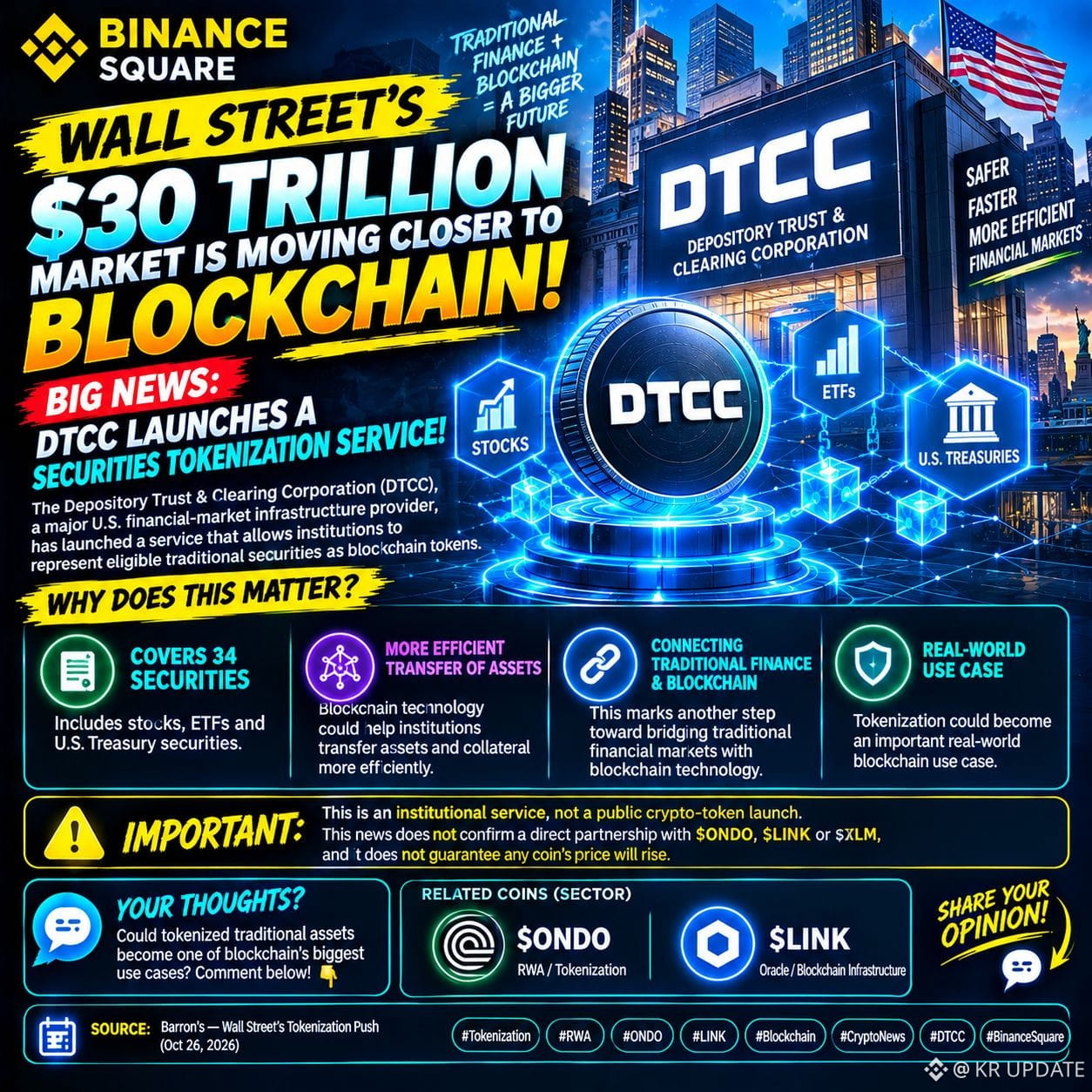
🚨 LE MARCHÉ DE 30 000 MILLIARDS DE DOLLARS DE WALL STREET SE RAPPROCHE DE LA BLOCKCHAIN ! 🌐
🏦 GRANDE NOUVELLE : DTCC lance un service de tokenisation de titres !
La Depository Trust & Clearing Corporation (DTCC), un important fournisseur d’infrastructures des marchés financiers américains, a lancé un service permettant aux institutions de représenter des titres traditionnels admissibles sous forme de jetons sur la blockchain.
🔥 POURQUOI EST-CE IMPORTANT ?
🔹 Cette initiative concerne 34 titres, notamment des actions, des ETF et des titres du Trésor américain.
🔹 La technologie blockchain pourrait aider les institutions à transférer des actifs et des garanties plus efficacement.
🔹 Il s’agit d’une nouvelle étape vers le rapprochement de la finance traditionnelle et de la technologie blockchain.
🔹 La tokenisation pourrait devenir un cas d’usage important de la blockchain dans le monde réel.
⚠️ IMPORTANT : Il s’agit d’un service institutionnel, et non du lancement public d’un cryptojeton. Cette nouvelle ne confirme aucun partenariat direct avec $ONDO , $LINK ou $XLM , et ne garantit pas que le prix d’une quelconque cryptomonnaie augmentera.
💬 VOTRE AVIS : Les actifs traditionnels tokenisés pourraient-ils devenir l’un des cas d’usage les plus importants de la blockchain ?
Commentez ci-dessous ! 👇
Cryptomonnaies associées :ONDO LINK
#Tokenization #RWA #ONDO #LINK #BinanceSquare
96
·
--
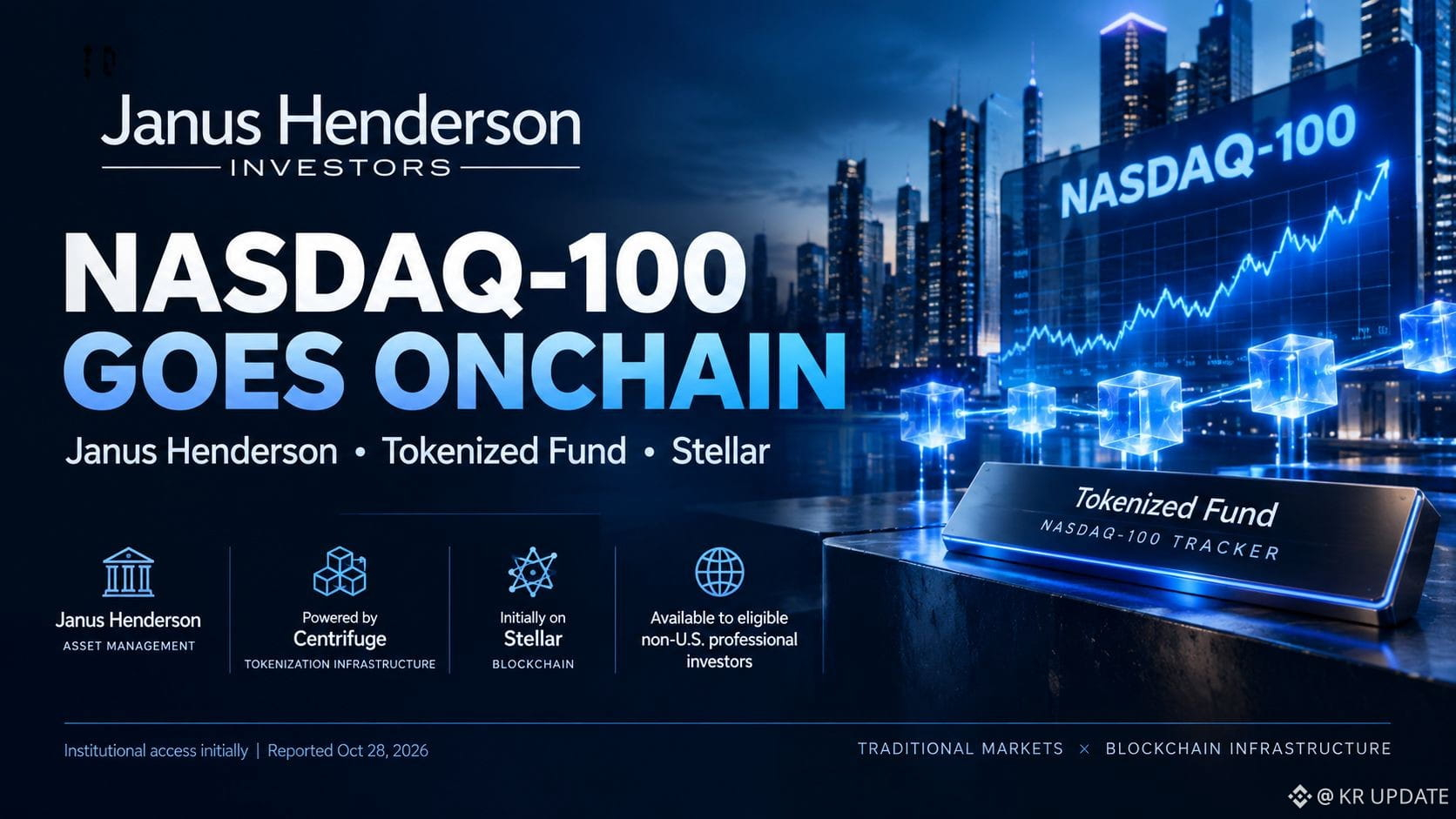
LA FINANCE TRADITIONNELLE RENCONTRE LA BLOCKCHAIN
LE NASDAQ-100 PASSE SUR LA BLOCKCHAIN
Un nouveau chapitre de la finance tokenisée est en train de s’écrire.
Janus Henderson a lancé un fonds tokenisé qui suit l’indice Nasdaq-100. Le produit est d’abord proposé aux investisseurs professionnels éligibles hors des États-Unis, via une infrastructure blockchain alimentée par Centrifuge sur Stellar.
POURQUOI C’EST IMPORTANT
01 — Des actifs traditionnels, une infrastructure numérique
Un indice boursier bien connu est intégré à une structure d’investissement reposant sur la blockchain.
02 — La tokenisation dépasse le cadre des actifs natifs des cryptomonnaies
Cette initiative montre que l’infrastructure blockchain est étudiée pour des produits financiers traditionnellement proposés sur les marchés classiques.
03 — L’accès reste limité
Il ne s’agit pas d’un lancement public destiné à tous les utilisateurs de cryptomonnaies. Dans un premier temps, seuls les investisseurs professionnels qualifiés hors des États-Unis sont éligibles, avec un investissement minimum annoncé de 100 000 $.
VUE D’ENSEMBLE
La prochaine phase d’adoption de la blockchain ne sera peut-être pas uniquement portée par de nouveaux jetons. Elle pourrait aussi passer par l’intégration de produits financiers traditionnels dans une infrastructure numérique.
La question essentielle n’est plus simplement de savoir si un actif peut être tokenisé, mais comment il peut être proposé, réglementé et accessible.
Source : The Wall Street Journal, 28 octobre 2026.
#Tokenization #stellar #Centrifuge #Nasdaq100 #RWA
92


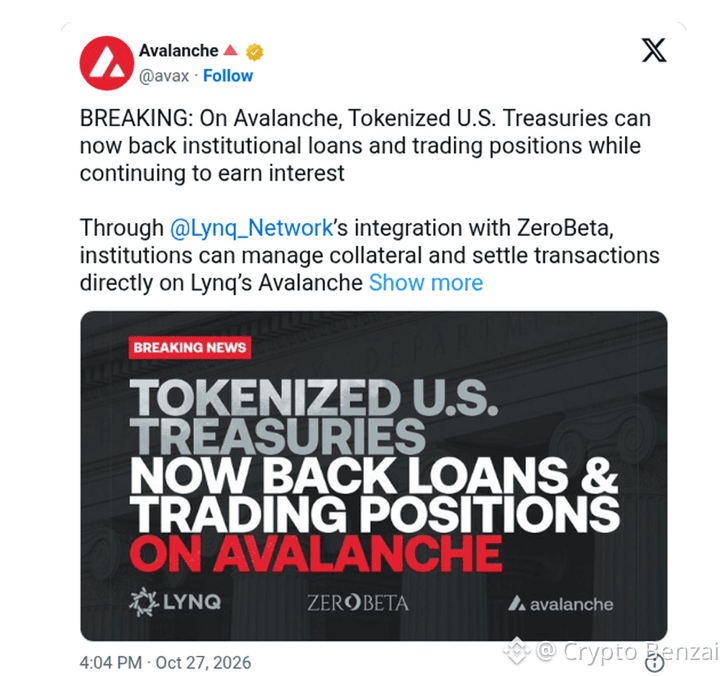
Les bons du Trésor tokenisés peuvent désormais servir de garantie sur $AVAX
Avalanche indique que les bons du Trésor américain tokenisés peuvent désormais garantir des prêts institutionnels et des positions de trading, tout en continuant à générer des intérêts. Cela est rendu possible grâce à l’intégration de Lynq avec ZeroBeta. Les institutions gèrent les garanties et effectuent les règlements directement sur la L1 Avalanche de Lynq, sans transférer les actifs hors du réseau. Les intérêts continuent de courir pendant que les actifs servent de garantie. C’est le genre d’infrastructure dont les actifs du monde réel (RWA) avaient besoin.
Mettriez-vous des bons du Trésor tokenisés en garantie ?
#Avalanche #RWA #Tokenization
{spot}(AVAXUSDT)
Les bons du Trésor tokenisés peuvent désormais servir de garantie sur $AVAX
Avalanche indique que les bons du Trésor américain tokenisés peuvent désormais garantir des prêts institutionnels et des positions de trading, tout en continuant à générer des intérêts. Cela est rendu possible grâce à l’intégration de Lynq avec ZeroBeta. Les institutions gèrent les garanties et effectuent les règlements directement sur la L1 Avalanche de Lynq, sans transférer les actifs hors du réseau. Les intérêts continuent de courir pendant que les actifs servent de garantie. C’est le genre d’infrastructure dont les actifs du monde réel (RWA) avaient besoin.
Mettriez-vous des bons du Trésor tokenisés en garantie ?
#Avalanche #RWA #Tokenization
2
310

·
--
🌊 LES ACTIFS DU MONDE RÉEL SE DÉVELOPPENT À MESURE QUE LA TECHNOLOGIE $RWA RELIE DIRECTEMENT LES ACTIONS TRADITIONNELLES À LA DEFI ! 💥
Les investisseurs avisés continuent discrètement à construire des passerelles entre les actions de Wall Street et les infrastructures décentralisées. 💡 En intégrant l’API Swap native de Rialto, Arrow Finance permet d’exécuter instantanément des transactions sur des actions tokenisées, sans quitter la plateforme ni fragmenter la liquidité.
📊 Cette intégration sans friction permet aux traders de mettre en œuvre des stratégies de rendement DeFi directement sur leur exposition aux actions traditionnelles. 🔍 Suivez de près les flux d’ordres dans le secteur des actifs tokenisés, tandis que le règlement fluide sur la blockchain continue d’attirer les liquidités de la TradFi vers les marchés décentralisés.
🤔 La tokenisation fluide des actions sera-t-elle le catalyseur qui libérera la prochaine vague de liquidités institutionnelles dans la DeFi ? 👇
⚠️ Ceci ne constitue pas un conseil financier. Gérez toujours vos risques. 🛡️
🏷️ #RWA #DeFi #Tokenization #Crypto
⚡ 💎
13

·
--
Article
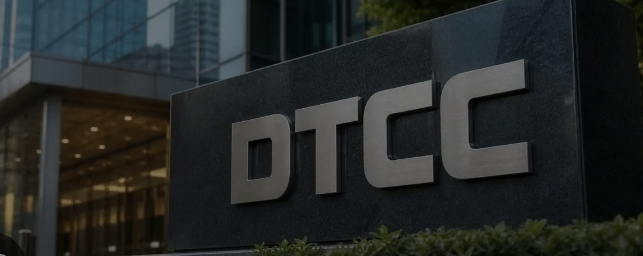
🚨 WALL STREET PASSE ON-CHAIN : LA DTCC LANCE UN SERVICE DE TOKENISATION POUR LES TITRES AMÉRICAINS 🇺🇸🔗
Une étape majeure pour l’avenir de la finance ! 🚀
Le 28 octobre 2026, la Depository Trust & Clearing Corporation (DTCC) a officiellement lancé son service de tokenisation, rapprochant les marchés financiers traditionnels américains de la technologie blockchain.
💰 Points clés
🔹 34 titres au lancement : Le service prendrait en charge 34 titres admissibles.
🔹 Une opportunité de 30 000 milliards de dollars : Des titres admissibles d’une valeur d’environ 30 000 milliards de dollars pourraient être intégrés à une infrastructure blockchain.
🔹 Transferts 24 h/24 et 7 j/7 : Les titres tokenisés peuvent être transférés entre portefeuilles numériques enregistrés à toute heure.
🚨 WALL STREET PASSE ON-CHAIN : LA DTCC LANCE UN SERVICE DE TOKENISATION POUR LES TITRES AMÉRICAINS 🇺🇸🔗
Une étape majeure pour l’avenir de la finance ! 🚀
Le 28 octobre 2026, la Depository Trust & Clearing Corporation (DTCC) a officiellement lancé son service de tokenisation, rapprochant les marchés financiers traditionnels américains de la technologie blockchain.
💰 Points clés
🔹 34 titres au lancement : Le service prendrait en charge 34 titres admissibles.
🔹 Une opportunité de 30 000 milliards de dollars : Des titres admissibles d’une valeur d’environ 30 000 milliards de dollars pourraient être intégrés à une infrastructure blockchain.
🔹 Transferts 24 h/24 et 7 j/7 : Les titres tokenisés peuvent être transférés entre portefeuilles numériques enregistrés à toute heure.
35
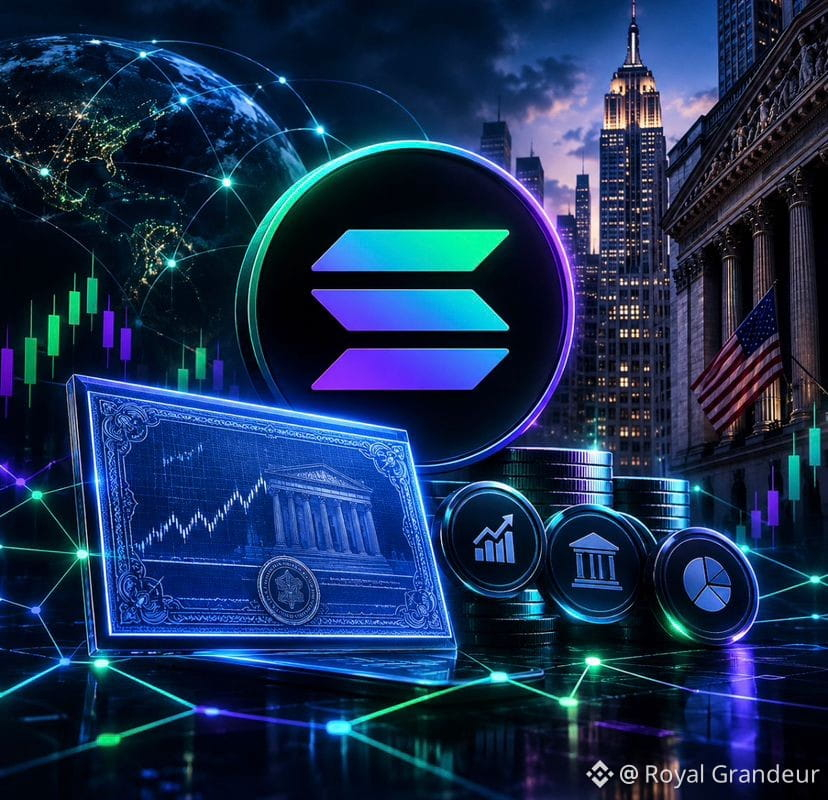
🚨 DERNIÈRE MINUTE : 🇺🇸 Le cofondateur de Solana, Anatoly Yakovenko, réplique aux entreprises américaines qui s’opposent à la négociation d’actions tokenisées, en leur disant : « Elles n’ont qu’à redevenir privées, alors. »
Le débat sur l’intégration des actions traditionnelles aux réseaux blockchain s’intensifie. 🏦⚡
Les entreprises devraient-elles pouvoir empêcher que leurs actions soient négociées sur des plateformes blockchain, ou les investisseurs devraient-ils avoir plus de liberté ? 👀👇
$SOL
$BTC $ETH #Tokenization #Crypto
{spot}(SOLUSDT)
🚨 DERNIÈRE MINUTE : 🇺🇸 Le cofondateur de Solana, Anatoly Yakovenko, réplique aux entreprises américaines qui s’opposent à la négociation d’actions tokenisées, en leur disant : « Elles n’ont qu’à redevenir privées, alors. »
Le débat sur l’intégration des actions traditionnelles aux réseaux blockchain s’intensifie. 🏦⚡
Les entreprises devraient-elles pouvoir empêcher que leurs actions soient négociées sur des plateformes blockchain, ou les investisseurs devraient-ils avoir plus de liberté ? 👀👇
$SOL
$BTC $ETH #Tokenization #Crypto
81
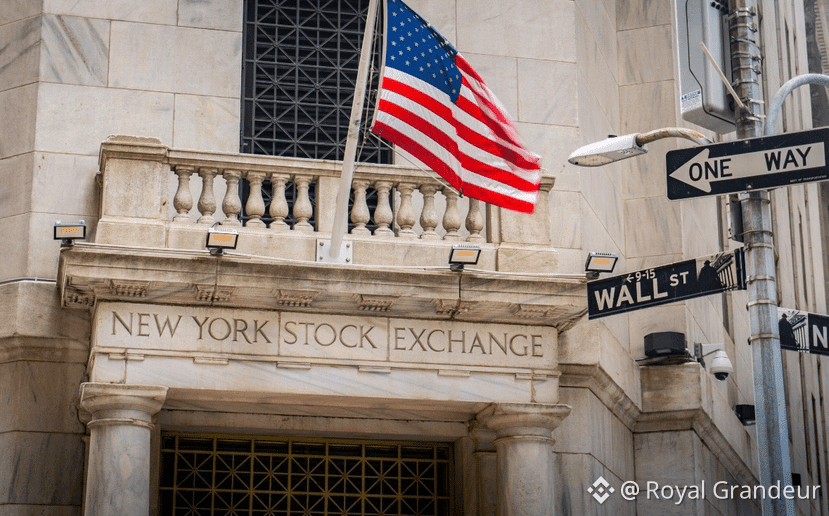
🚨 DERNIÈRE MINUTE : 🇺🇸 33 grandes entreprises américaines s’opposent désormais à la tokenisation de leurs actions sur la plateforme de négociation prévue par OKX et ICE.
🏦 Parmi les grands noms figurent Microsoft, Alphabet, JPMorgan, Coca-Cola, AMD, Intel, Oracle et Goldman Sachs.
⚠️ Cette opposition croissante soulève des questions sur la protection des investisseurs, la surveillance réglementaire et l’avenir de la négociation d’actions basée sur la blockchain. $BTC $XAU $ETH
#crypto #Tokenization #StockMarket
{spot}(BTCUSDT)
🚨 DERNIÈRE MINUTE : 🇺🇸 33 grandes entreprises américaines s’opposent désormais à la tokenisation de leurs actions sur la plateforme de négociation prévue par OKX et ICE.
🏦 Parmi les grands noms figurent Microsoft, Alphabet, JPMorgan, Coca-Cola, AMD, Intel, Oracle et Goldman Sachs.
⚠️ Cette opposition croissante soulève des questions sur la protection des investisseurs, la surveillance réglementaire et l’avenir de la négociation d’actions basée sur la blockchain. $BTC $XAU $ETH
#crypto #Tokenization #StockMarket
2
283
Voir la traduction
Wall Street's plumbing went onchain — and this one is hard to dismiss as another pilot.
DTCC, the clearing giant behind much of US securities settlement, went live today with its tokenization service. Twenty firms — JPMorgan, Citi, Bank of America, Morgan Stanley, UBS, Fidelity among them — have signed up to convert stocks, ETFs and Treasuries held at its depository into tokens.
I've been watching tokenization promises for years, and the detail that matters here is what it isn't: these aren't synthetic trackers. Each token is backed one-for-one by a security held at DTC, which keeps the official books. Transfers between registered wallets can run around the clock, on Canton and DTCC's private Besu chain.
One thing to keep straight: the $30 trillion figure is the value of the 34 eligible securities, not money already tokenized. Adoption will be proven by usage, not sign-ups.
Crypto majors barely blinked — $BTC steady near $80.5K — which tells me this is infrastructure news, not a price catalyst.
Does Wall Street moving its rails onchain change how you see tokenization — real shift, or just repackaged plumbing? DYOR.
#Tokenization #DTCC #WallStreet #CryptoAdoption
2

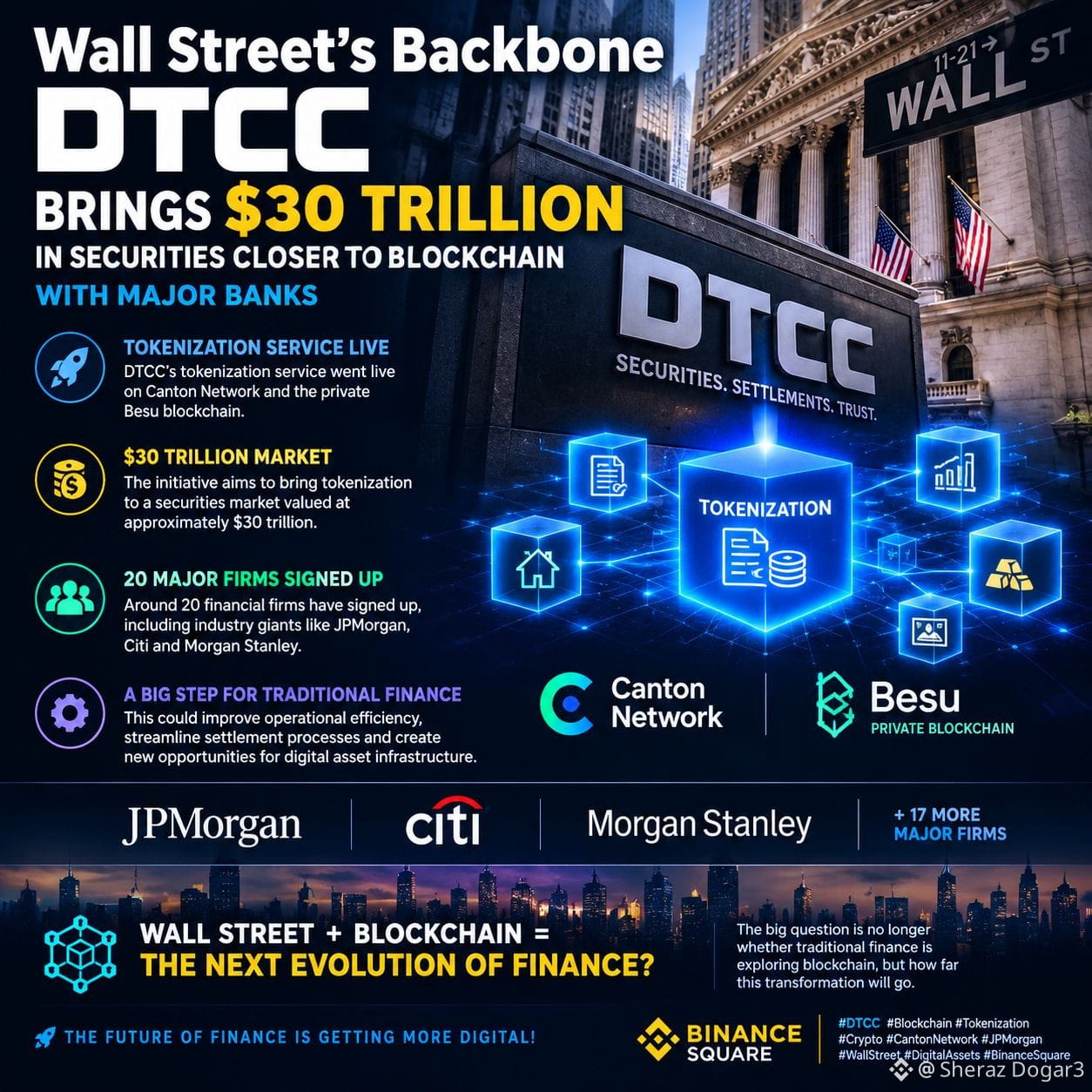
🚨 DTCC RAPPROCHE 30 000 MILLIARDS DE DOLLARS DE TITRES DE LA BLOCKCHAIN ! 🔥
Wall Street franchit une nouvelle étape majeure vers l’adoption de la blockchain ! 🏦⛓️
La Depository Trust & Clearing Corporation (DTCC), l’une des institutions les plus importantes du marché financier américain, a lancé son service de tokenisation sur Canton Network et la blockchain privée Besu.
💰 Cette initiative vise à introduire la tokenisation sur un marché des titres évalué à environ 30 000 milliards de dollars, ce qui pourrait transformer la gestion et le transfert des actifs financiers traditionnels.
🤝 Une vingtaine de grandes sociétés financières y ont adhéré, notamment des géants du secteur comme JPMorgan, Citi et Morgan Stanley.
C’est un nouveau signe majeur que la finance traditionnelle explore la technologie blockchain à bien plus grande échelle. La tokenisation pourrait améliorer l’efficacité opérationnelle, simplifier les processus de règlement et créer de nouvelles possibilités pour les infrastructures d’actifs numériques.
🌍 Wall Street + blockchain = la prochaine évolution de la finance ?
La grande question n’est plus de savoir si la finance traditionnelle explore la blockchain, mais jusqu’où ira cette transformation.
🚀 L’avenir de la finance se numérise de plus en plus !
#DTCC #Blockchain #Tokenization #Crypto #CantonNetwork #JPMorgan #WallStreet #DigitalAssets #BinanceSquare
58
·
--
30 000 milliards de dollars plus proches de la blockchain ≠ 30 000 milliards déjà sur la chaîne. Cette distinction compte. 👀
Le service de tokenisation de DTCC est opérationnel sur Canton Network et sur la blockchain privée Besu. JPMorgan, Citi et Morgan Stanley font partie des 20 entreprises inscrites.
Ce qui me frappe, ce n’est pas une nouvelle promesse de tokenisation. C’est l’infrastructure de Wall Street qui passe de l’annonce à un service opérationnel. 🏦
Pour vous, est-ce une adoption significative de la blockchain, ou le choix du réseau compte-t-il davantage ?
#Tokenization #Blockchain #DTCC

33
Connectez-vous pour découvrir plus de contenu
Rejoignez la communauté mondiale des adeptes de cryptomonnaies sur Binance Square
⚡️ Suviez les dernières informations importantes sur les cryptomonnaies.
💬 Jugé digne de confiance par la plus grande plateforme d’échange de cryptomonnaies au monde.
👍 Découvrez les connaissances que partagent les créateurs vérifiés.
Adresse e-mail/Nº de téléphone
Sujets d’actualité
1
#FedWatch
16.2M vues
38,596 mentions
2
#EarningsSeason
6.3M vues
31,346 mentions
3
#USMidtermElections
5,977 vues
247 mentions
4
#BitcoinDropsBelow$80K
7,618 vues
50 mentions
5
#BoEOpensConsultationOnTokenizedCollateralForClearing
16 vues
5 mentions
6
#BrazilCryptoExchangesMustApplyForLicensesByFriday
3,317 vues
205 mentions
7
#ICEPartnersWithTradeXYZToBringPerpetualContractsToUS
453 vues
12 mentions
8
#SolidusLabsReportsSuspected$170MSpoofingOnHyperliquidOilContracts
805 vues
20 mentions
9
#StanDruckenmillerBecomesInvestorInTradeXYZ
4,892 vues
226 mentions
10
#RussiaProposedNonCustodialWalletLimitsExcludeIntlSettlements
1,331 vues
37 mentions