

#btcstaking
btcstaking
21,152 vues
151 mentions
Populaire
Récents

Bitcoin yield models are transitioning from centralized lending toward self custodial staking, DeFi vaults, and wrapped BTC strategies through 2026.
#BitcoinYield #BTCStaking
Bitcoin yield models are transitioning from centralized lending toward self custodial staking, DeFi vaults, and wrapped BTC strategies through 2026.
#BitcoinYield #BTCStaking
#BitcoinYield #BTCStaking
1
7

·
--
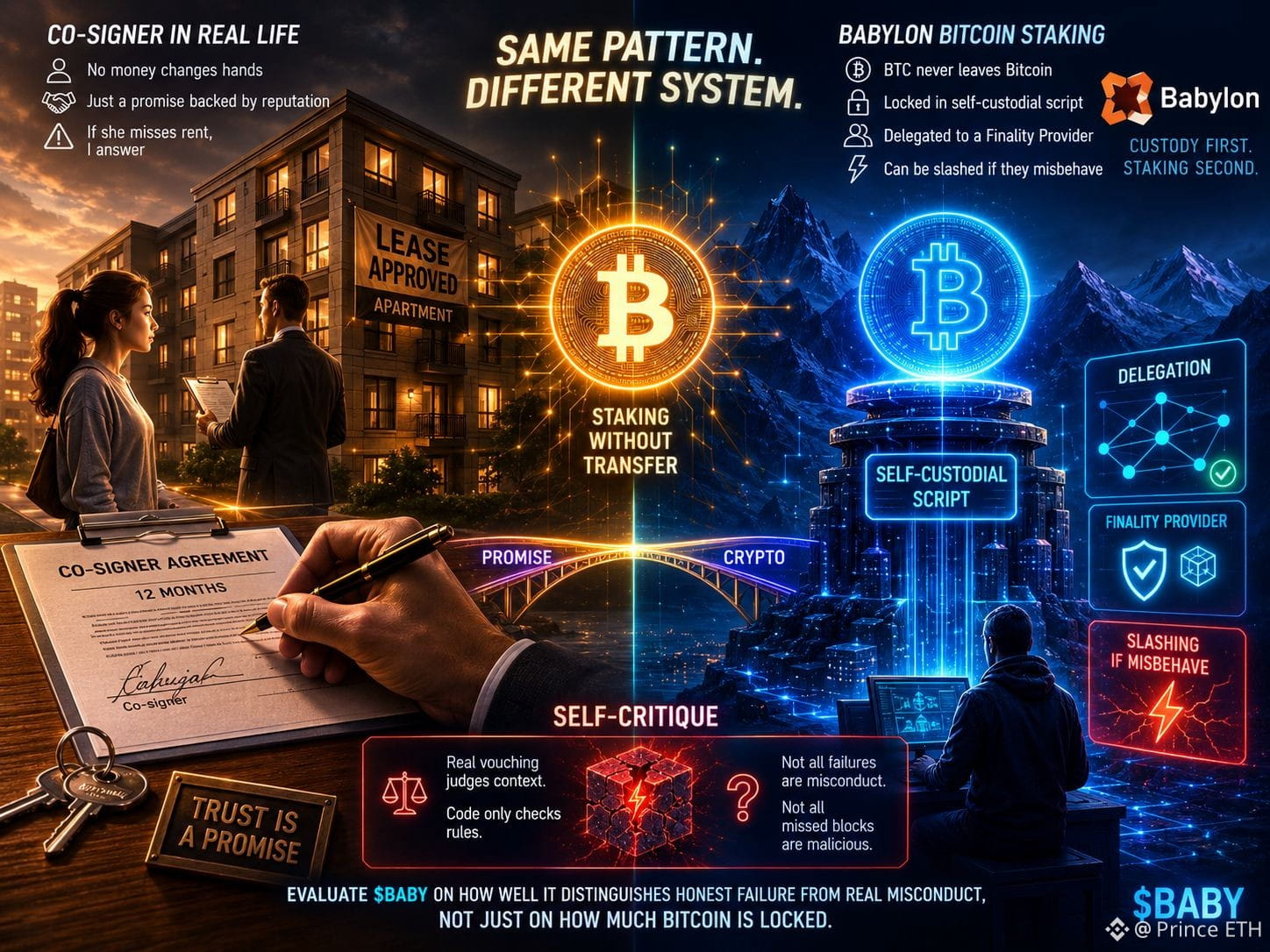
A few years ago a friend needed a co-signer for her first apartment. She had the job and the deposit, but not the three months of pay stubs the leasing office wanted as proof. I did not give her money or hold her deposit. I signed a form saying if she missed rent, the property manager could come after me instead. Nothing physical changed hands. The only thing that moved was a promise, my name attached to her ability to pay for twelve months.
That is the same pattern crypto uses to describe putting something at risk. Staking and collateralizing almost always assume the asset itself has to move first, into a contract, a custodian, a bridge, before it can back anything. The object travels, and the risk travels with it.
Babylon's staking design questions that assumption. The Bitcoin being staked never leaves the Bitcoin chain or the owner's own keys, staying locked in a self-custodial script rather than a custodian's wallet or a bridge contract. It can still be penalized if the validator it is delegated to acts dishonestly. @babylonlabs_io placing the custody question before the staking question changes what is actually being asked of the asset: not hand this over so we know you are serious, but keep it, and answer for what you attached it to.
Self-critique: I did not sign that lease and disappear for a year. When her payment was two days late once, I called the landlord myself, because I could tell the difference between carelessness and an actual crisis. A slashing condition cannot make that distinction. It does not know if a validator went offline from malice or a power outage. It only knows a signature was missing at a specific block. Real vouching is an ongoing judgment call, renewed or withdrawn based on context nobody can fully encode. Code can enforce a rule. It cannot read a situation.
$BABY should be evaluated on how much room its finality provider and slashing design leave for telling an honest failure apart from real misconduct, not just on how much Bitcoin has been locked into it.
#BTCStaking #baby $BLESS $SKYAI
A few years ago a friend needed a co-signer for her first apartment. She had the job and the deposit, but not the three months of pay stubs the leasing office wanted as proof. I did not give her money or hold her deposit. I signed a form saying if she missed rent, the property manager could come after me instead. Nothing physical changed hands. The only thing that moved was a promise, my name attached to her ability to pay for twelve months.
That is the same pattern crypto uses to describe putting something at risk. Staking and collateralizing almost always assume the asset itself has to move first, into a contract, a custodian, a bridge, before it can back anything. The object travels, and the risk travels with it.
Babylon's staking design questions that assumption. The Bitcoin being staked never leaves the Bitcoin chain or the owner's own keys, staying locked in a self-custodial script rather than a custodian's wallet or a bridge contract. It can still be penalized if the validator it is delegated to acts dishonestly. @BabylonLabs_io placing the custody question before the staking question changes what is actually being asked of the asset: not hand this over so we know you are serious, but keep it, and answer for what you attached it to.
Self-critique: I did not sign that lease and disappear for a year. When her payment was two days late once, I called the landlord myself, because I could tell the difference between carelessness and an actual crisis. A slashing condition cannot make that distinction. It does not know if a validator went offline from malice or a power outage. It only knows a signature was missing at a specific block. Real vouching is an ongoing judgment call, renewed or withdrawn based on context nobody can fully encode. Code can enforce a rule. It cannot read a situation.
$BABY should be evaluated on how much room its finality provider and slashing design leave for telling an honest failure apart from real misconduct, not just on how much Bitcoin has been locked into it.
#BTCStaking #baby $BLESS $SKYAI
That is the same pattern crypto uses to describe putting something at risk. Staking and collateralizing almost always assume the asset itself has to move first, into a contract, a custodian, a bridge, before it can back anything. The object travels, and the risk travels with it.
Babylon's staking design questions that assumption. The Bitcoin being staked never leaves the Bitcoin chain or the owner's own keys, staying locked in a self-custodial script rather than a custodian's wallet or a bridge contract. It can still be penalized if the validator it is delegated to acts dishonestly. @BabylonLabs_io placing the custody question before the staking question changes what is actually being asked of the asset: not hand this over so we know you are serious, but keep it, and answer for what you attached it to.
Self-critique: I did not sign that lease and disappear for a year. When her payment was two days late once, I called the landlord myself, because I could tell the difference between carelessness and an actual crisis. A slashing condition cannot make that distinction. It does not know if a validator went offline from malice or a power outage. It only knows a signature was missing at a specific block. Real vouching is an ongoing judgment call, renewed or withdrawn based on context nobody can fully encode. Code can enforce a rule. It cannot read a situation.
$BABY should be evaluated on how much room its finality provider and slashing design leave for telling an honest failure apart from real misconduct, not just on how much Bitcoin has been locked into it.
#BTCStaking #baby $BLESS $SKYAI
4
1
171

#baby $BABY I almost skipped learning about Babylon because I assumed all "Bitcoin staking" projects meant wrapping BTC and trusting some third-party bridge. Same story I'd seen fail before.
Babylon doesn't do that. Your BTC never leaves the Bitcoin chain. It stays in Bitcoin's own security, and if a validator misbehaves, the penalty happens on Bitcoin itself — not on some separate, less-secure layer.
That one detail is why this felt different to me. It's not "trust us," it's "prove it on Bitcoin."
BABY is the token that runs the system underneath — staking, governance, gas — and it's already live and tradable on Binance.
Bitcoin holders have waited years for a way to use BTC productively without giving up what makes it Bitcoin. This might be the closest attempt yet. @babylonlabs_io
#baby #Binance #BTCstaking
Would you stake BTC if you never had to leave the Bitcoin chain?
{future}(BABYUSDT)
{future}(DEXEUSDT)
$NVDAB
#baby $BABY I almost skipped learning about Babylon because I assumed all "Bitcoin staking" projects meant wrapping BTC and trusting some third-party bridge. Same story I'd seen fail before.
Babylon doesn't do that. Your BTC never leaves the Bitcoin chain. It stays in Bitcoin's own security, and if a validator misbehaves, the penalty happens on Bitcoin itself — not on some separate, less-secure layer.
That one detail is why this felt different to me. It's not "trust us," it's "prove it on Bitcoin."
BABY is the token that runs the system underneath — staking, governance, gas — and it's already live and tradable on Binance.
Bitcoin holders have waited years for a way to use BTC productively without giving up what makes it Bitcoin. This might be the closest attempt yet. @BabylonLabs_io
#baby #Binance #BTCstaking
Would you stake BTC if you never had to leave the Bitcoin chain?
$NVDAB
Babylon doesn't do that. Your BTC never leaves the Bitcoin chain. It stays in Bitcoin's own security, and if a validator misbehaves, the penalty happens on Bitcoin itself — not on some separate, less-secure layer.
That one detail is why this felt different to me. It's not "trust us," it's "prove it on Bitcoin."
BABY is the token that runs the system underneath — staking, governance, gas — and it's already live and tradable on Binance.
Bitcoin holders have waited years for a way to use BTC productively without giving up what makes it Bitcoin. This might be the closest attempt yet. @BabylonLabs_io
#baby #Binance #BTCstaking
Would you stake BTC if you never had to leave the Bitcoin chain?
$NVDAB
Yes, that changes everything
0%
Still cautious need more proof
0%
I'd rather just hold
0%
Watching but not ready yet
0%
0 Votes • Vote fermé
80

One thing that caught my attention about Babylon...$BABY
When people talk about bringing more utility to Bitcoin the biggest challenge is not simply moving BTC.
The real question is:
How can Bitcoin provide security and enable new applications without giving up its trustless nature?
For years the common approach was to rely on wrapped assets bridges or custodial systems to bring Bitcoin into other ecosystems.
But Babylon $BABY takes a different path.
Through mechanisms like Bitcoin staking EOTS and Trustless Bitcoin Vaults Babylon explores how BTC can contribute security to other networks while remaining anchored to Bitcoin’s original principles.
EOTS introduced a way to enforce accountability through cryptographic conditions while newer approaches like BitVM3 push the idea further by exploring how Bitcoin can verify more complex off chain activity without depending on unnecessary trust.
The interesting part is not just creating more use cases for Bitcoin.
It is creating those use cases without changing what makes Bitcoin valuable: security self custody and trust minimization.
The real innovation is not making Bitcoin act like another asset.
It is expanding what Bitcoin can do while allowing it to remain Bitcoin.
The question now is:
Can Babylon become the bridge between Bitcoin’s security and the wider blockchain ecosystem without introducing the risks of traditional bridges?
Time will tell.
$BABY
#Bitcoin #BABY #BTCStaking
@babylonlabs_io
@MR-KUO
@ELENA-13141314
@hmnghia0612
@EASY7777
@Baoluo123
{future}(BABYUSDT)
One thing that caught my attention about Babylon...$BABY
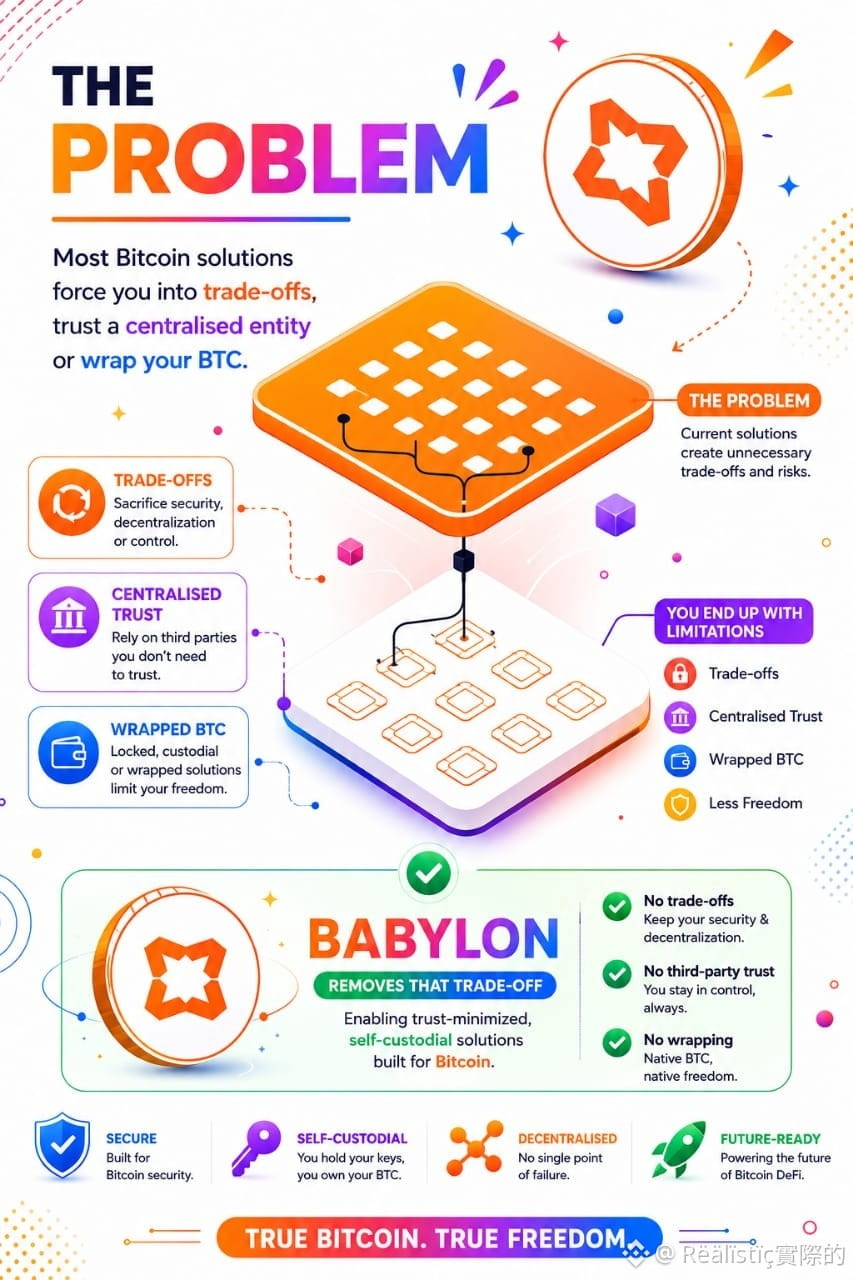
When people talk about bringing more utility to Bitcoin the biggest challenge is not simply moving BTC.
The real question is:
How can Bitcoin provide security and enable new applications without giving up its trustless nature?
For years the common approach was to rely on wrapped assets bridges or custodial systems to bring Bitcoin into other ecosystems.
But Babylon $BABY takes a different path.
Through mechanisms like Bitcoin staking EOTS and Trustless Bitcoin Vaults Babylon explores how BTC can contribute security to other networks while remaining anchored to Bitcoin’s original principles.
EOTS introduced a way to enforce accountability through cryptographic conditions while newer approaches like BitVM3 push the idea further by exploring how Bitcoin can verify more complex off chain activity without depending on unnecessary trust.
The interesting part is not just creating more use cases for Bitcoin.
It is creating those use cases without changing what makes Bitcoin valuable: security self custody and trust minimization.
The real innovation is not making Bitcoin act like another asset.
It is expanding what Bitcoin can do while allowing it to remain Bitcoin.
The question now is:
Can Babylon become the bridge between Bitcoin’s security and the wider blockchain ecosystem without introducing the risks of traditional bridges?
Time will tell.
$BABY
#Bitcoin #BABY #BTCStaking
@BabylonLabs_io
@ETH-阔先生
@Elena神话MUA
@hmnghia0612
@EASY喊單哥
@Baoluo币商资本
When people talk about bringing more utility to Bitcoin the biggest challenge is not simply moving BTC.
The real question is:
How can Bitcoin provide security and enable new applications without giving up its trustless nature?
For years the common approach was to rely on wrapped assets bridges or custodial systems to bring Bitcoin into other ecosystems.
But Babylon $BABY takes a different path.
Through mechanisms like Bitcoin staking EOTS and Trustless Bitcoin Vaults Babylon explores how BTC can contribute security to other networks while remaining anchored to Bitcoin’s original principles.
EOTS introduced a way to enforce accountability through cryptographic conditions while newer approaches like BitVM3 push the idea further by exploring how Bitcoin can verify more complex off chain activity without depending on unnecessary trust.
The interesting part is not just creating more use cases for Bitcoin.
It is creating those use cases without changing what makes Bitcoin valuable: security self custody and trust minimization.
The real innovation is not making Bitcoin act like another asset.
It is expanding what Bitcoin can do while allowing it to remain Bitcoin.
The question now is:
Can Babylon become the bridge between Bitcoin’s security and the wider blockchain ecosystem without introducing the risks of traditional bridges?
Time will tell.
$BABY
#Bitcoin #BABY #BTCStaking
@BabylonLabs_io
@ETH-阔先生
@Elena神话MUA
@hmnghia0612
@EASY喊單哥
@Baoluo币商资本
12
16
437

·
--
借贷创新|Babylon TBV + Aave $BABY
换个角度看 Babylon 和 Aave 的集成是 TBV 落地的关键一步。意义重大。
核心逻辑:Babylon 的 Trustless Bitcoin Vaults 与 Aave V4 的 Hub-and-Spoke 架构结合,BTC 持有者把 BTC 锁在 TBV 里作为抵押品,在 Aave 上借贷,不转让托管权,不包装 BTC。计划 2026 年 4 月上线。
这解决了 BTC 在 DeFi 里的老问题。以前要用 BTC 做 DeFi 抵押,要么卖掉 BTC 换 ETH,要么用 wBTC 但信任托管方。TBV 方案让 BTC 在自托管前提下参与 DeFi,持有者既保留 BTC 上涨敞口,又能获得借贷流动性。
$BABY 在生态里的角色是协议治理和激励。质押 BABY 参与协议决策,BTC 质押者获得 BABY 奖励。当前 $BABY 流通市值 44.18M,FDV 112.41M,排名 453,24h 成交 6.99M。
关注点:Aave 集成上线后的 TVL 增长速度,以及借贷量和清算情况。BTC 抵押借贷量持续增长说明市场需求真实。
方向看明白了,节奏自己掌握。
#baby #Babylon #BTCStaking @BabylonLabs_io
借贷创新|Babylon TBV + Aave $BABY
换个角度看 Babylon 和 Aave 的集成是 TBV 落地的关键一步。意义重大。
核心逻辑:Babylon 的 Trustless Bitcoin Vaults 与 Aave V4 的 Hub-and-Spoke 架构结合,BTC 持有者把 BTC 锁在 TBV 里作为抵押品,在 Aave 上借贷,不转让托管权,不包装 BTC。计划 2026 年 4 月上线。
这解决了 BTC 在 DeFi 里的老问题。以前要用 BTC 做 DeFi 抵押,要么卖掉 BTC 换 ETH,要么用 wBTC 但信任托管方。TBV 方案让 BTC 在自托管前提下参与 DeFi,持有者既保留 BTC 上涨敞口,又能获得借贷流动性。
$BABY 在生态里的角色是协议治理和激励。质押 BABY 参与协议决策,BTC 质押者获得 BABY 奖励。当前 $BABY 流通市值 44.18M,FDV 112.41M,排名 453,24h 成交 6.99M。
关注点:Aave 集成上线后的 TVL 增长速度,以及借贷量和清算情况。BTC 抵押借贷量持续增长说明市场需求真实。
方向看明白了,节奏自己掌握。
#baby #Babylon #BTCStaking @BabylonLabs_io
换个角度看 Babylon 和 Aave 的集成是 TBV 落地的关键一步。意义重大。
核心逻辑:Babylon 的 Trustless Bitcoin Vaults 与 Aave V4 的 Hub-and-Spoke 架构结合,BTC 持有者把 BTC 锁在 TBV 里作为抵押品,在 Aave 上借贷,不转让托管权,不包装 BTC。计划 2026 年 4 月上线。
这解决了 BTC 在 DeFi 里的老问题。以前要用 BTC 做 DeFi 抵押,要么卖掉 BTC 换 ETH,要么用 wBTC 但信任托管方。TBV 方案让 BTC 在自托管前提下参与 DeFi,持有者既保留 BTC 上涨敞口,又能获得借贷流动性。
$BABY 在生态里的角色是协议治理和激励。质押 BABY 参与协议决策,BTC 质押者获得 BABY 奖励。当前 $BABY 流通市值 44.18M,FDV 112.41M,排名 453,24h 成交 6.99M。
关注点:Aave 集成上线后的 TVL 增长速度,以及借贷量和清算情况。BTC 抵押借贷量持续增长说明市场需求真实。
方向看明白了,节奏自己掌握。
#baby #Babylon #BTCStaking @BabylonLabs_io
184
·
--
BTCFi叙事|Babylon TBV 开启 BTCFi $BABY
换个角度看 Babylon TBV 正在打开 BTCFi 的新范式。想象空间不小。
传统 BTC 在 DeFi 里参与方式有限。wBTC 需要信任托管方,tBTC 需要跨链桥,都有中心化风险。TBV 用比特币链上脚本实现自托管质押,BTC 不离开比特币网络就能参与 DeFi。
创新点在于:BTC 持有者不卖币就能获得收益。质押收益以 $BABY 发放,同时保留 BTC 上涨敞口。Aave 集成后,BTC 还能作为抵押品借贷,进一步释放流动性。BTC 市值超过 7000 亿美金,哪怕解锁一小部分进 DeFi 都是巨大的增量市场。
当前 $BABY 现价 0.011246,24h -7.38%,市值 48.18M,FDV 122.64M。协议 TVL 未查到,排名 426。90 天 GitHub 提交 未查到 次,Star 未查到。
BTCFi 叙事想象空间大,但落地速度取决于生态接入进度。盯三个指标:TVL 增长、接入的 PoS 链数量、DeFi 协议集成数。指标持续改善说明叙事在变现实。
不急,让子弹飞一会儿。
#baby #Babylon #BTCStaking @BabylonLabs_io
BTCFi叙事|Babylon TBV 开启 BTCFi $BABY
换个角度看 Babylon TBV 正在打开 BTCFi 的新范式。想象空间不小。
传统 BTC 在 DeFi 里参与方式有限。wBTC 需要信任托管方,tBTC 需要跨链桥,都有中心化风险。TBV 用比特币链上脚本实现自托管质押,BTC 不离开比特币网络就能参与 DeFi。
创新点在于:BTC 持有者不卖币就能获得收益。质押收益以 $BABY 发放,同时保留 BTC 上涨敞口。Aave 集成后,BTC 还能作为抵押品借贷,进一步释放流动性。BTC 市值超过 7000 亿美金,哪怕解锁一小部分进 DeFi 都是巨大的增量市场。
当前 $BABY 现价 0.011246,24h -7.38%,市值 48.18M,FDV 122.64M。协议 TVL 未查到,排名 426。90 天 GitHub 提交 未查到 次,Star 未查到。
BTCFi 叙事想象空间大,但落地速度取决于生态接入进度。盯三个指标:TVL 增长、接入的 PoS 链数量、DeFi 协议集成数。指标持续改善说明叙事在变现实。
不急,让子弹飞一会儿。
#baby #Babylon #BTCStaking @BabylonLabs_io
换个角度看 Babylon TBV 正在打开 BTCFi 的新范式。想象空间不小。
传统 BTC 在 DeFi 里参与方式有限。wBTC 需要信任托管方,tBTC 需要跨链桥,都有中心化风险。TBV 用比特币链上脚本实现自托管质押,BTC 不离开比特币网络就能参与 DeFi。
创新点在于:BTC 持有者不卖币就能获得收益。质押收益以 $BABY 发放,同时保留 BTC 上涨敞口。Aave 集成后,BTC 还能作为抵押品借贷,进一步释放流动性。BTC 市值超过 7000 亿美金,哪怕解锁一小部分进 DeFi 都是巨大的增量市场。
当前 $BABY 现价 0.011246,24h -7.38%,市值 48.18M,FDV 122.64M。协议 TVL 未查到,排名 426。90 天 GitHub 提交 未查到 次,Star 未查到。
BTCFi 叙事想象空间大,但落地速度取决于生态接入进度。盯三个指标:TVL 增长、接入的 PoS 链数量、DeFi 协议集成数。指标持续改善说明叙事在变现实。
不急,让子弹飞一会儿。
#baby #Babylon #BTCStaking @BabylonLabs_io
77
Bitcoin sitting in your wallet is safe — but it's also silent. It doesn't do anything for you besides wait.
What pulled me into Babylon is that it gives BTC a job without touching its security. No wrapping, no bridging, no handing custody to a third party. Your Bitcoin stays exactly where it is, and it still helps secure other networks and earns for doing it.
The part that stood out most: if something goes wrong on the validator side, the protocol can prove and penalize it directly on the Bitcoin chain itself. Not on some separate, less-tested system — on Bitcoin's own security layer.
BABY is the token that keeps this whole system running — gas, governance, staking rewards. It's live on Binance, easy to access without hunting on smaller exchanges.
Bitcoin doesn't have to just sit there anymore. That shift alone changed how I think about holding BTC long-term.
#BABY #Binance #BTCstaking
@babylonlabs_io #baby $BABY
{future}(BABYUSDT)
{alpha}(560x277add739c6e0477616948357af9e79fe1ec9b80)
{future}(DEXEUSDT)
What matters most before you stake a coin?"
Bitcoin sitting in your wallet is safe — but it's also silent. It doesn't do anything for you besides wait.
What pulled me into Babylon is that it gives BTC a job without touching its security. No wrapping, no bridging, no handing custody to a third party. Your Bitcoin stays exactly where it is, and it still helps secure other networks and earns for doing it.
The part that stood out most: if something goes wrong on the validator side, the protocol can prove and penalize it directly on the Bitcoin chain itself. Not on some separate, less-tested system — on Bitcoin's own security layer.
BABY is the token that keeps this whole system running — gas, governance, staking rewards. It's live on Binance, easy to access without hunting on smaller exchanges.
Bitcoin doesn't have to just sit there anymore. That shift alone changed how I think about holding BTC long-term.
#BABY #Binance #BTCstaking
@BabylonLabs_io #baby $BABY
What matters most before you stake a coin?"
What pulled me into Babylon is that it gives BTC a job without touching its security. No wrapping, no bridging, no handing custody to a third party. Your Bitcoin stays exactly where it is, and it still helps secure other networks and earns for doing it.
The part that stood out most: if something goes wrong on the validator side, the protocol can prove and penalize it directly on the Bitcoin chain itself. Not on some separate, less-tested system — on Bitcoin's own security layer.
BABY is the token that keeps this whole system running — gas, governance, staking rewards. It's live on Binance, easy to access without hunting on smaller exchanges.
Bitcoin doesn't have to just sit there anymore. That shift alone changed how I think about holding BTC long-term.
#BABY #Binance #BTCstaking
@BabylonLabs_io #baby $BABY
What matters most before you stake a coin?"
Security of the mechanism
0%
APY / rewards
0%
Who's backing the project
0%
I mainly follow price
0%
0 Votes • Vote fermé
1
1
189
·
--
@babylonlabs_io #baby $BABY
Before writing this post, I challenged one assumption I had about Babylon.
I used to think slashing was mainly about punishing malicious Finality Providers. After studying the implementation, I came away with a different conclusion. Babylon spends just as much engineering effort preventing honest operators from creating unsafe signatures during recovery as it does detecting malicious behavior.
That is one of the protocol's strongest architectural decisions. Instead of assuming perfect infrastructure, it assumes crashes, software bugs, delayed RPC responses, and interupted upgrades are inevitable. The objective is not simply to identify invalid behavior after it happens, but to reduce the conditions under which it can happen at all.
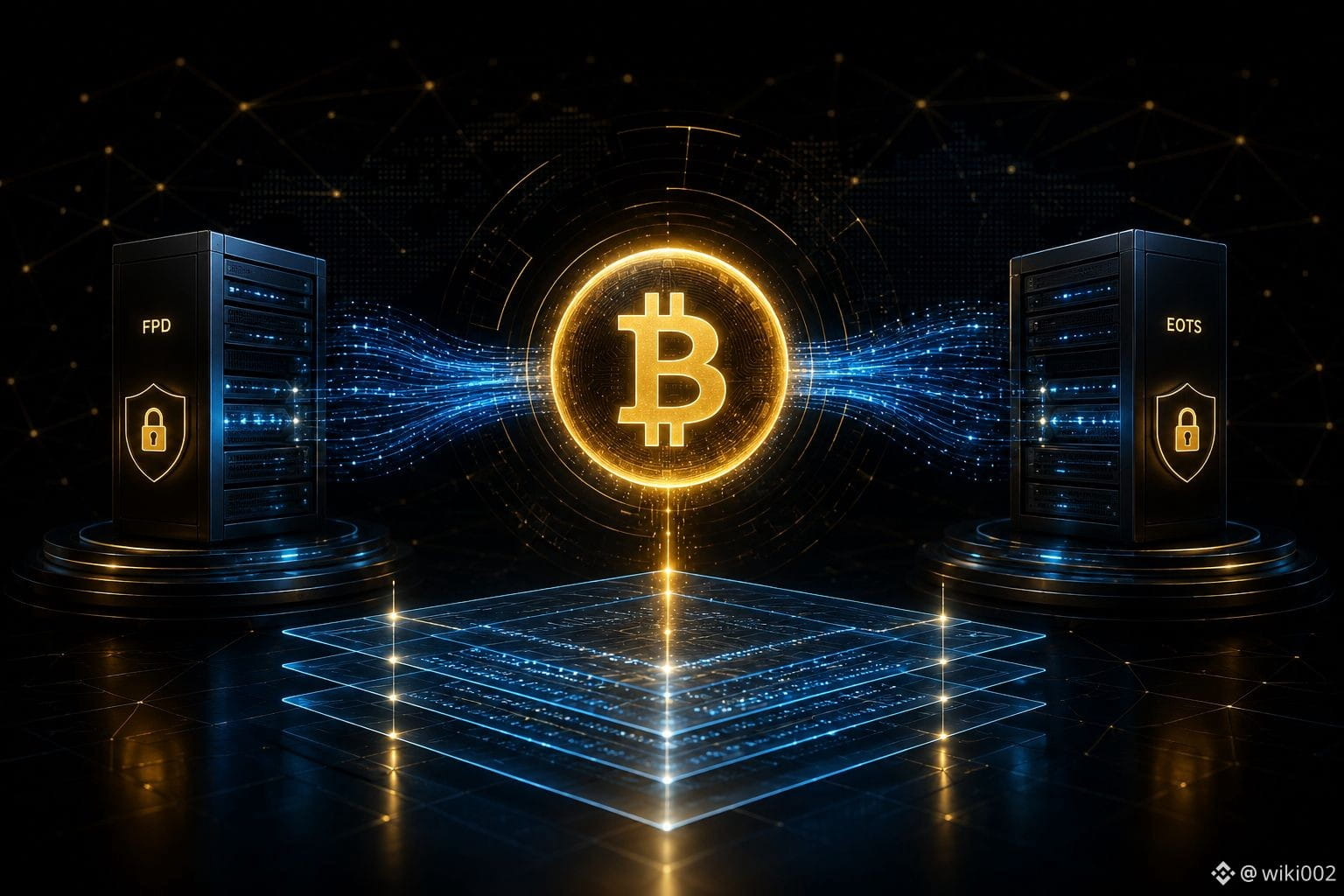
The detail that changed my perspective is the separation between the Finality Provider Daemon and the EOTS manager. One determines when a vote should be produced. The other independently determines whether producing that signature is still valid. They intentionally preserve different operational state, creating two independent checks before a new signature can exist.
The deeper implication goes beyond cryptography. Babylon is protecting decision history alongside private keys. A key proves who signed a message. Historical signing state determines whether signing that message is still legitimate. Those are different security guarantees, yet both are required to make Slashing-resistant infrastructure reliable.
The Trade-off is equally important. As Bitcoin staking grows, protocol security increasingly depends on operational correctness. State recovery, authenticated communication, and disciplined infrastructure become part of the trust model rather than implementation details.
If Bitcoin staking continues evolving in this direction, should we evaluate security only by economic stake, or also by the quality of the systems that preserve cryptographic correctness before a signature is ever created?💭
$BTC $ETH @Binance_Square_Official
#Bitcoin
#BTCStaking
#BlockchainInfrastructure
@BabylonLabs_io #baby $BABY
Before writing this post, I challenged one assumption I had about Babylon.
I used to think slashing was mainly about punishing malicious Finality Providers. After studying the implementation, I came away with a different conclusion. Babylon spends just as much engineering effort preventing honest operators from creating unsafe signatures during recovery as it does detecting malicious behavior.
That is one of the protocol's strongest architectural decisions. Instead of assuming perfect infrastructure, it assumes crashes, software bugs, delayed RPC responses, and interupted upgrades are inevitable. The objective is not simply to identify invalid behavior after it happens, but to reduce the conditions under which it can happen at all.
The detail that changed my perspective is the separation between the Finality Provider Daemon and the EOTS manager. One determines when a vote should be produced. The other independently determines whether producing that signature is still valid. They intentionally preserve different operational state, creating two independent checks before a new signature can exist.
The deeper implication goes beyond cryptography. Babylon is protecting decision history alongside private keys. A key proves who signed a message. Historical signing state determines whether signing that message is still legitimate. Those are different security guarantees, yet both are required to make Slashing-resistant infrastructure reliable.
The Trade-off is equally important. As Bitcoin staking grows, protocol security increasingly depends on operational correctness. State recovery, authenticated communication, and disciplined infrastructure become part of the trust model rather than implementation details.
If Bitcoin staking continues evolving in this direction, should we evaluate security only by economic stake, or also by the quality of the systems that preserve cryptographic correctness before a signature is ever created?💭
$BTC $ETH @Binance Square Official
#Bitcoin
#BTCStaking
#BlockchainInfrastructure
Before writing this post, I challenged one assumption I had about Babylon.
I used to think slashing was mainly about punishing malicious Finality Providers. After studying the implementation, I came away with a different conclusion. Babylon spends just as much engineering effort preventing honest operators from creating unsafe signatures during recovery as it does detecting malicious behavior.
That is one of the protocol's strongest architectural decisions. Instead of assuming perfect infrastructure, it assumes crashes, software bugs, delayed RPC responses, and interupted upgrades are inevitable. The objective is not simply to identify invalid behavior after it happens, but to reduce the conditions under which it can happen at all.
The detail that changed my perspective is the separation between the Finality Provider Daemon and the EOTS manager. One determines when a vote should be produced. The other independently determines whether producing that signature is still valid. They intentionally preserve different operational state, creating two independent checks before a new signature can exist.
The deeper implication goes beyond cryptography. Babylon is protecting decision history alongside private keys. A key proves who signed a message. Historical signing state determines whether signing that message is still legitimate. Those are different security guarantees, yet both are required to make Slashing-resistant infrastructure reliable.
The Trade-off is equally important. As Bitcoin staking grows, protocol security increasingly depends on operational correctness. State recovery, authenticated communication, and disciplined infrastructure become part of the trust model rather than implementation details.
If Bitcoin staking continues evolving in this direction, should we evaluate security only by economic stake, or also by the quality of the systems that preserve cryptographic correctness before a signature is ever created?💭
$BTC $ETH @Binance Square Official
#Bitcoin
#BTCStaking
#BlockchainInfrastructure
67
26
335

go check $BABY and @babylonlabs_io
🚀 Unlocking BTC's Full Potential with @BabylonLabs_io 🚀
Bitcoin isn't just a store of value anymore—it's actively securing the future of Web3. Through native, trustless BTC staking, Babylon enables Bitcoin holders to earn yield while bolstering the security of Proof-of-Stake networks, all without giving up custody of their assets. 🔒
This brings unprecedented liquidity and utility to the world’s largest cryptocurrency. As ecosystem integrations grow, the bridge between Bitcoin's security and PoS scalability is stronger than ever.
Are you staking your BTC yet, or holding for the long run? Let's discuss in the comments! 👇
#BinanceSquare #Bitcoin #Babylon #DeFi #BTCStaking
go check $BABY and @BabylonLabs_io
🚀 Unlocking BTC's Full Potential with @BabylonLabs_io 🚀
Bitcoin isn't just a store of value anymore—it's actively securing the future of Web3. Through native, trustless BTC staking, Babylon enables Bitcoin holders to earn yield while bolstering the security of Proof-of-Stake networks, all without giving up custody of their assets. 🔒
This brings unprecedented liquidity and utility to the world’s largest cryptocurrency. As ecosystem integrations grow, the bridge between Bitcoin's security and PoS scalability is stronger than ever.
Are you staking your BTC yet, or holding for the long run? Let's discuss in the comments! 👇
#BinanceSquare #Bitcoin #Babylon #DeFi #BTCStaking
🚀 Unlocking BTC's Full Potential with @BabylonLabs_io 🚀
Bitcoin isn't just a store of value anymore—it's actively securing the future of Web3. Through native, trustless BTC staking, Babylon enables Bitcoin holders to earn yield while bolstering the security of Proof-of-Stake networks, all without giving up custody of their assets. 🔒
This brings unprecedented liquidity and utility to the world’s largest cryptocurrency. As ecosystem integrations grow, the bridge between Bitcoin's security and PoS scalability is stronger than ever.
Are you staking your BTC yet, or holding for the long run? Let's discuss in the comments! 👇
#BinanceSquare #Bitcoin #Babylon #DeFi #BTCStaking
57
·
--
资金追踪|Babylon BTC质押 $BABY N/A
单刀直入 看 Babylon 的 BTC 质押数据。先看锁了多少币。
协议 TVL 当前 未查到,这是锁在 Babylon 金库里的 BTC 总量。TVL 越高,说明越多 BTC 持有者愿意把币锁进去赚收益。Phase-1 Cap-1 最初限额 1000 BTC,瞬间秒满,说明需求真实存在。
$BABY 现价 未查到,24h N/A,最高 未查到,最低 未查到,振幅 N/A 个百分点。流通市值 未披露,FDV 未披露,24h 成交 未披露。
质押收益方面,币安此前推出过 Babylon BTC 质押活动,年化最高 2.5 个点的 BABY 奖励。收益率相比其他 DeFi 不算高,但安全性是 BTC 链上自托管,不存在合约被黑的风险。
TVL 增长看三个指标:新增质押量、解锁量、净流入。净流入持续为正说明资金在进场,转负说明获利盘在撤。
方向看明白了,节奏自己掌握。
#baby #Babylon #BTCStaking @BabylonLabs_io
资金追踪|Babylon BTC质押 $BABY N/A
单刀直入 看 Babylon 的 BTC 质押数据。先看锁了多少币。
协议 TVL 当前 未查到,这是锁在 Babylon 金库里的 BTC 总量。TVL 越高,说明越多 BTC 持有者愿意把币锁进去赚收益。Phase-1 Cap-1 最初限额 1000 BTC,瞬间秒满,说明需求真实存在。
$BABY 现价 未查到,24h N/A,最高 未查到,最低 未查到,振幅 N/A 个百分点。流通市值 未披露,FDV 未披露,24h 成交 未披露。
质押收益方面,币安此前推出过 Babylon BTC 质押活动,年化最高 2.5 个点的 BABY 奖励。收益率相比其他 DeFi 不算高,但安全性是 BTC 链上自托管,不存在合约被黑的风险。
TVL 增长看三个指标:新增质押量、解锁量、净流入。净流入持续为正说明资金在进场,转负说明获利盘在撤。
方向看明白了,节奏自己掌握。
#baby #Babylon #BTCStaking @BabylonLabs_io
单刀直入 看 Babylon 的 BTC 质押数据。先看锁了多少币。
协议 TVL 当前 未查到,这是锁在 Babylon 金库里的 BTC 总量。TVL 越高,说明越多 BTC 持有者愿意把币锁进去赚收益。Phase-1 Cap-1 最初限额 1000 BTC,瞬间秒满,说明需求真实存在。
$BABY 现价 未查到,24h N/A,最高 未查到,最低 未查到,振幅 N/A 个百分点。流通市值 未披露,FDV 未披露,24h 成交 未披露。
质押收益方面,币安此前推出过 Babylon BTC 质押活动,年化最高 2.5 个点的 BABY 奖励。收益率相比其他 DeFi 不算高,但安全性是 BTC 链上自托管,不存在合约被黑的风险。
TVL 增长看三个指标:新增质押量、解锁量、净流入。净流入持续为正说明资金在进场,转负说明获利盘在撤。
方向看明白了,节奏自己掌握。
#baby #Babylon #BTCStaking @BabylonLabs_io
48

·
--
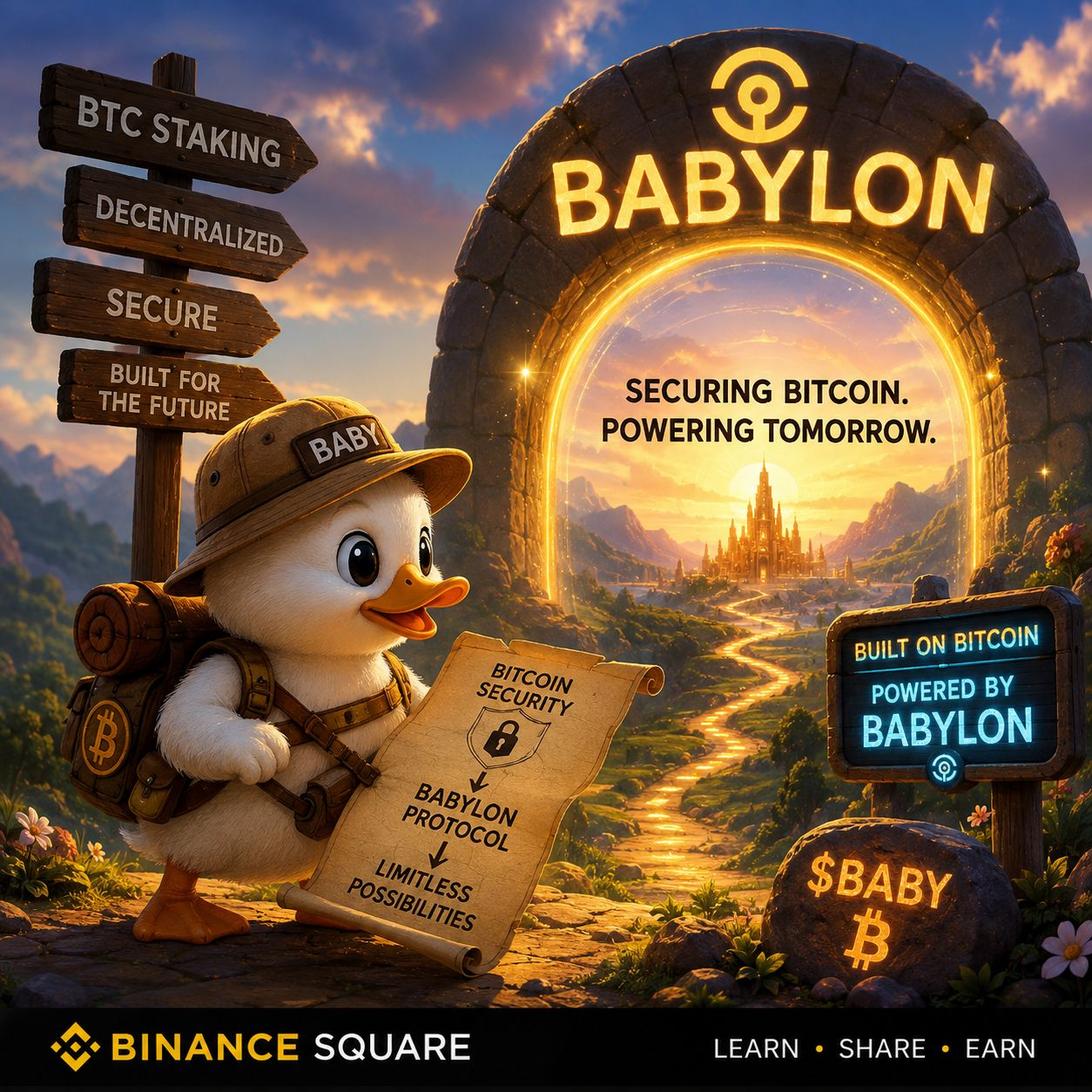
#baby $BABY Not every opportunity makes noise.
Some of the strongest innovations work quietly in the background—building security before chasing attention.
That's why I'm watching @babylonlabs_io . Instead of trying to replace Bitcoin, it unlocks new possibilities while respecting what makes Bitcoin valuable: trust, decentralization, and resilience.
The next big chapter in crypto may not belong to the loudest project—it may belong to the one creating the strongest foundation.
Patience often beats hype. 📈
$BABY $BTC
#Babylon #Web3 #blockchains #BTCStaking
#baby $BABY Not every opportunity makes noise.
Some of the strongest innovations work quietly in the background—building security before chasing attention.
That's why I'm watching @BabylonLabs_io . Instead of trying to replace Bitcoin, it unlocks new possibilities while respecting what makes Bitcoin valuable: trust, decentralization, and resilience.
The next big chapter in crypto may not belong to the loudest project—it may belong to the one creating the strongest foundation.
Patience often beats hype. 📈
$BABY $BTC
#Babylon #Web3 #blockchains #BTCStaking
Some of the strongest innovations work quietly in the background—building security before chasing attention.
That's why I'm watching @BabylonLabs_io . Instead of trying to replace Bitcoin, it unlocks new possibilities while respecting what makes Bitcoin valuable: trust, decentralization, and resilience.
The next big chapter in crypto may not belong to the loudest project—it may belong to the one creating the strongest foundation.
Patience often beats hype. 📈
$BABY $BTC
#Babylon #Web3 #blockchains #BTCStaking
23
14
151

·
--
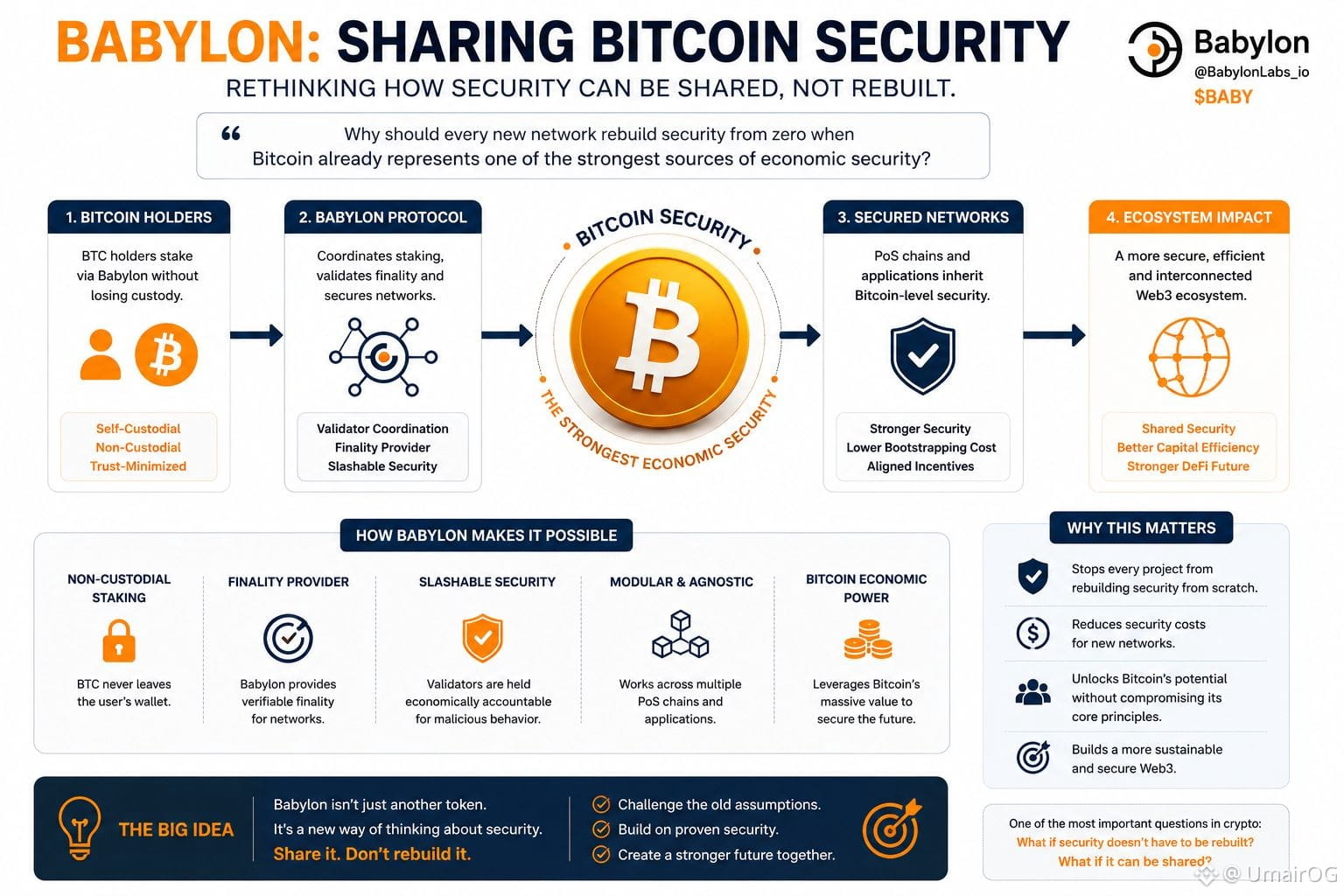
Most crypto discussions begin with price.
Lately, I've been trying to begin somewhere else.
I asked myself a simple question: if Bitcoin already represents one of the strongest sources of economic security in crypto, why should every new network rebuild that security from zero?
That question is what led me to Babylon.
The more I read, the less I viewed BABY as another token competing for attention. I started seeing Babylon as an attempt to rethink how security itself can be shared instead of endlessly recreated.
Whether this approach becomes a long-term standard is still an open question. Markets will decide that over time.
But I believe the projects worth studying are the ones that challenge an assumption everyone else has accepted for years.
For me, Babylon is one of those projects, and that's why BABY remains on my research list rather than just my watchlist.
What's one assumption about crypto that you think the industry should question more often?
@babylonlabs_io $BABY
#BABY #Babylon #Bitcoin #BTC☀ #BTCStaking #CryptoResearch
Most crypto discussions begin with price.
Lately, I've been trying to begin somewhere else.
I asked myself a simple question: if Bitcoin already represents one of the strongest sources of economic security in crypto, why should every new network rebuild that security from zero?
That question is what led me to Babylon.
The more I read, the less I viewed BABY as another token competing for attention. I started seeing Babylon as an attempt to rethink how security itself can be shared instead of endlessly recreated.
Whether this approach becomes a long-term standard is still an open question. Markets will decide that over time.
But I believe the projects worth studying are the ones that challenge an assumption everyone else has accepted for years.
For me, Babylon is one of those projects, and that's why BABY remains on my research list rather than just my watchlist.
What's one assumption about crypto that you think the industry should question more often?
@BabylonLabs_io $BABY
#BABY #Babylon #Bitcoin #BTC☀ #BTCStaking #CryptoResearch
Lately, I've been trying to begin somewhere else.
I asked myself a simple question: if Bitcoin already represents one of the strongest sources of economic security in crypto, why should every new network rebuild that security from zero?
That question is what led me to Babylon.
The more I read, the less I viewed BABY as another token competing for attention. I started seeing Babylon as an attempt to rethink how security itself can be shared instead of endlessly recreated.
Whether this approach becomes a long-term standard is still an open question. Markets will decide that over time.
But I believe the projects worth studying are the ones that challenge an assumption everyone else has accepted for years.
For me, Babylon is one of those projects, and that's why BABY remains on my research list rather than just my watchlist.
What's one assumption about crypto that you think the industry should question more often?
@BabylonLabs_io $BABY
#BABY #Babylon #Bitcoin #BTC☀ #BTCStaking #CryptoResearch
2
2
102

Last winter I got rear-ended on an on-ramp and gave my insurer a quick account that afternoon. Two weeks later an adjuster called for the recorded statement and made me repeat it slower, circling back to details like where my hands were. My version held up because it was true.
A coworker who padded his claim on the same road wasn't so lucky. His timing shifted enough the second time that the adjuster caught it.
Optimistic accountability in crypto has the same problem: it depends on someone catching the drift before the challenge window closes.
Babylon skips the watcher; its finality providers incriminate themselves through math. Each one commits public randomness through the EOTS manager for every future block height it intends to vote on.
Vote on two blocks at the same height and reusing that randomness is unavoidable. The two signatures combine to extract the provider's private key, a property of the signature scheme. Anyone can submit the slashing transaction; voting power hits zero, and tombstoning is permanent.
Self-critique: that permanence is where it gets uncomfortable. The protocol is lenient toward honest downtime, an offline provider isn't punished for going quiet, but not toward accidental equivocation.
EOTS can't tell a deliberate double-sign from an honest one caused by a botched failover or a software bug. Both produce the same two conflicting signatures, and both get tombstoned permanently, without appeal.
My adjuster could ask follow-up questions and weigh intent; this math only sees the collision. Staking providers already sell anti-slashing tooling to cover that gap, rather than trust the protocol to forgive it.
Babylon removes trust from one failure mode: deliberate equivocation, not every way a provider can fail. $BABY should be evaluated based on which failure mode a mechanism actually removes trust from, not just the claim that slashing makes it trustless.
#baby #BTCStaking #bitcoin @babylonlabs_io $IDOL $BTW
Last winter I got rear-ended on an on-ramp and gave my insurer a quick account that afternoon. Two weeks later an adjuster called for the recorded statement and made me repeat it slower, circling back to details like where my hands were. My version held up because it was true.
A coworker who padded his claim on the same road wasn't so lucky. His timing shifted enough the second time that the adjuster caught it.
Optimistic accountability in crypto has the same problem: it depends on someone catching the drift before the challenge window closes.
Babylon skips the watcher; its finality providers incriminate themselves through math. Each one commits public randomness through the EOTS manager for every future block height it intends to vote on.
Vote on two blocks at the same height and reusing that randomness is unavoidable. The two signatures combine to extract the provider's private key, a property of the signature scheme. Anyone can submit the slashing transaction; voting power hits zero, and tombstoning is permanent.
Self-critique: that permanence is where it gets uncomfortable. The protocol is lenient toward honest downtime, an offline provider isn't punished for going quiet, but not toward accidental equivocation.
EOTS can't tell a deliberate double-sign from an honest one caused by a botched failover or a software bug. Both produce the same two conflicting signatures, and both get tombstoned permanently, without appeal.
My adjuster could ask follow-up questions and weigh intent; this math only sees the collision. Staking providers already sell anti-slashing tooling to cover that gap, rather than trust the protocol to forgive it.
Babylon removes trust from one failure mode: deliberate equivocation, not every way a provider can fail. $BABY should be evaluated based on which failure mode a mechanism actually removes trust from, not just the claim that slashing makes it trustless.
#baby #BTCStaking #bitcoin @BabylonLabs_io $IDOL $BTW
A coworker who padded his claim on the same road wasn't so lucky. His timing shifted enough the second time that the adjuster caught it.
Optimistic accountability in crypto has the same problem: it depends on someone catching the drift before the challenge window closes.
Babylon skips the watcher; its finality providers incriminate themselves through math. Each one commits public randomness through the EOTS manager for every future block height it intends to vote on.
Vote on two blocks at the same height and reusing that randomness is unavoidable. The two signatures combine to extract the provider's private key, a property of the signature scheme. Anyone can submit the slashing transaction; voting power hits zero, and tombstoning is permanent.
Self-critique: that permanence is where it gets uncomfortable. The protocol is lenient toward honest downtime, an offline provider isn't punished for going quiet, but not toward accidental equivocation.
EOTS can't tell a deliberate double-sign from an honest one caused by a botched failover or a software bug. Both produce the same two conflicting signatures, and both get tombstoned permanently, without appeal.
My adjuster could ask follow-up questions and weigh intent; this math only sees the collision. Staking providers already sell anti-slashing tooling to cover that gap, rather than trust the protocol to forgive it.
Babylon removes trust from one failure mode: deliberate equivocation, not every way a provider can fail. $BABY should be evaluated based on which failure mode a mechanism actually removes trust from, not just the claim that slashing makes it trustless.
#baby #BTCStaking #bitcoin @BabylonLabs_io $IDOL $BTW

5
2
169
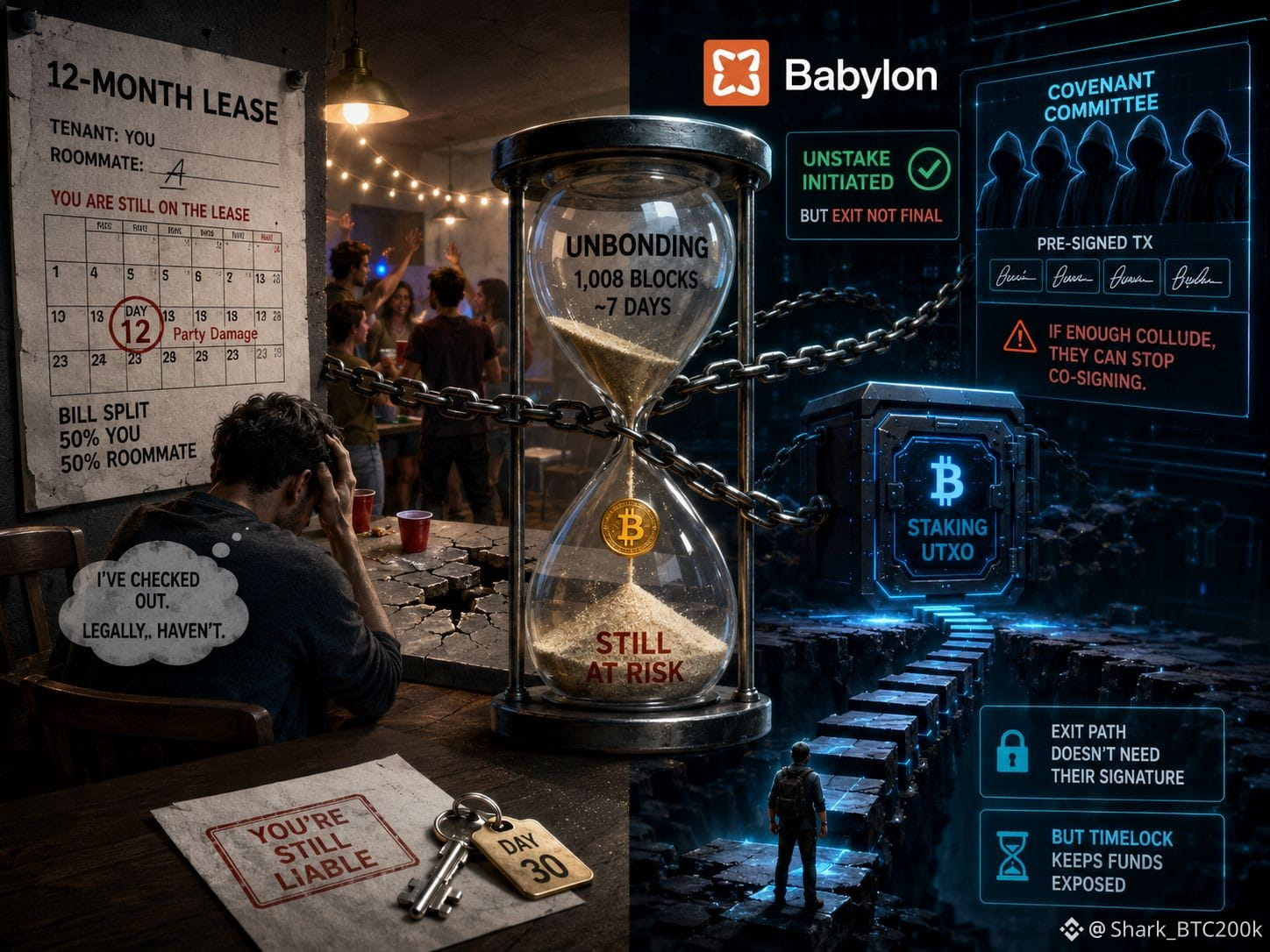
Two years ago, my roommate and I signed a twelve-month lease. When I found a new place, I gave the landlord the required thirty days notice, but my name stayed on the lease until day thirty. On day twelve, my roommate threw a party that cracked the kitchen counter, and the landlord split the bill between both names still on it. I had checked out mentally. Legally, I had not.
The same pattern shows up in staking. People click unstake and move the funds into the safe column in their head immediately, without checking whether the protocol can still reach that money until unbonding finishes. Starting an exit is not the same as completing one, and whatever the other party does during that gap still lands on you.
@babylonlabs_io 's staking UTXO gives a staker an exit path that never needs the finality provider's signature, since the spending conditions simply omit that key. The covenant committee's signatures, including a pre-signed copy of the future unbonding transaction, get collected before the stake goes active, so by the time a staker wants out, only their own signature is missing. Even so, the unbonding output does not open right away: Babylon currently sets that floor at 1,008 blocks, about seven days, during which BTC can still be slashed if the finality provider double signs first.
Self-critique: that seven day window is day twelve of the lease again. A dashboard that marks unbonding as done the moment someone clicks exit invites people to feel safe before the mechanics agree.
There is a second thing worth naming: the covenant committee is a specific, named set of signers standing in for something Bitcoin cannot yet do natively, and the documentation itself admits that if enough of them turned dishonest together, they could simply stop cosigning new requests. Self-custodial does not mean no one else is involved.
$BABY should be evaluated based on whether the exposure window and the committee's role get surfaced to a staker in the moment, not only on whether the slashing cryptography holds up in the abstract.
#BTCStaking #baby $BLESS $HOME
Two years ago, my roommate and I signed a twelve-month lease. When I found a new place, I gave the landlord the required thirty days notice, but my name stayed on the lease until day thirty. On day twelve, my roommate threw a party that cracked the kitchen counter, and the landlord split the bill between both names still on it. I had checked out mentally. Legally, I had not.
The same pattern shows up in staking. People click unstake and move the funds into the safe column in their head immediately, without checking whether the protocol can still reach that money until unbonding finishes. Starting an exit is not the same as completing one, and whatever the other party does during that gap still lands on you.
@BabylonLabs_io 's staking UTXO gives a staker an exit path that never needs the finality provider's signature, since the spending conditions simply omit that key. The covenant committee's signatures, including a pre-signed copy of the future unbonding transaction, get collected before the stake goes active, so by the time a staker wants out, only their own signature is missing. Even so, the unbonding output does not open right away: Babylon currently sets that floor at 1,008 blocks, about seven days, during which BTC can still be slashed if the finality provider double signs first.
Self-critique: that seven day window is day twelve of the lease again. A dashboard that marks unbonding as done the moment someone clicks exit invites people to feel safe before the mechanics agree.
There is a second thing worth naming: the covenant committee is a specific, named set of signers standing in for something Bitcoin cannot yet do natively, and the documentation itself admits that if enough of them turned dishonest together, they could simply stop cosigning new requests. Self-custodial does not mean no one else is involved.
$BABY should be evaluated based on whether the exposure window and the committee's role get surfaced to a staker in the moment, not only on whether the slashing cryptography holds up in the abstract.
#BTCStaking #baby $BLESS $HOME
The same pattern shows up in staking. People click unstake and move the funds into the safe column in their head immediately, without checking whether the protocol can still reach that money until unbonding finishes. Starting an exit is not the same as completing one, and whatever the other party does during that gap still lands on you.
@BabylonLabs_io 's staking UTXO gives a staker an exit path that never needs the finality provider's signature, since the spending conditions simply omit that key. The covenant committee's signatures, including a pre-signed copy of the future unbonding transaction, get collected before the stake goes active, so by the time a staker wants out, only their own signature is missing. Even so, the unbonding output does not open right away: Babylon currently sets that floor at 1,008 blocks, about seven days, during which BTC can still be slashed if the finality provider double signs first.
Self-critique: that seven day window is day twelve of the lease again. A dashboard that marks unbonding as done the moment someone clicks exit invites people to feel safe before the mechanics agree.
There is a second thing worth naming: the covenant committee is a specific, named set of signers standing in for something Bitcoin cannot yet do natively, and the documentation itself admits that if enough of them turned dishonest together, they could simply stop cosigning new requests. Self-custodial does not mean no one else is involved.
$BABY should be evaluated based on whether the exposure window and the committee's role get surfaced to a staker in the moment, not only on whether the slashing cryptography holds up in the abstract.
#BTCStaking #baby $BLESS $HOME
11
2
421

·
--
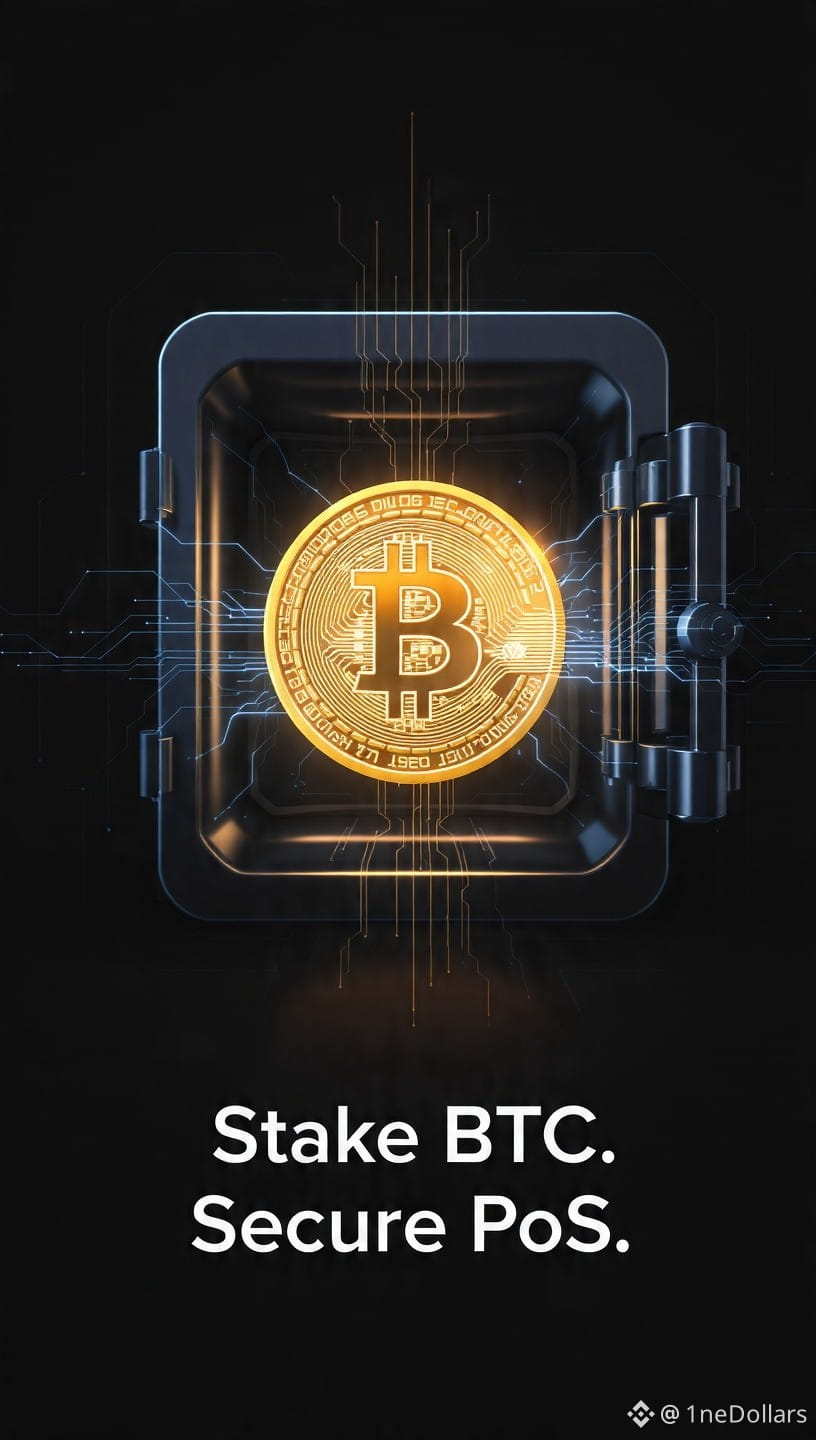
🚨 $200 Guaranteed BABY Rewards + 1,990,000 BABY Prize Pool
Bitcoin is finally earning yield — without giving up custody.
@babylonlabs_io just launched Trustless Bitcoin Vaults (TBV):
Stake NATIVE BTC on Bitcoin. No wrapping. No bridges.
Your BTC helps secure PoS chains and you earn rewards.
Here’s how YOU can earn:
1. Complete the campaign tasks daily
2. Post original content about Babylon TBV
3. All eligible creators get guaranteed BABY rewards up to $200
The prize pool grows with us:
Top 15 creators share 239,000
Everyone else shares 1,751,000
Total Pool: 1,990,000 🔥
The more creators join, the bigger the pool unlocks.
Less than 25% joined = 60% unlock | Over 50% joined = 100% unlock
If you believe Bitcoin should be more than just "digital gold",
this is your chance to earn while spreading the word.
Who’s posting today? Drop your post below 👇
$BABY #baby #Bitcoin #BTCStaking
{spot}(BABYUSDT)
🚨 $200 Guaranteed BABY Rewards + 1,990,000 BABY Prize Pool
Bitcoin is finally earning yield — without giving up custody.
@BabylonLabs_io just launched Trustless Bitcoin Vaults (TBV):
Stake NATIVE BTC on Bitcoin. No wrapping. No bridges.
Your BTC helps secure PoS chains and you earn rewards.
Here’s how YOU can earn:
1. Complete the campaign tasks daily
2. Post original content about Babylon TBV
3. All eligible creators get guaranteed BABY rewards up to $200
The prize pool grows with us:
Top 15 creators share 239,000
Everyone else shares 1,751,000
Total Pool: 1,990,000 🔥
The more creators join, the bigger the pool unlocks.
Less than 25% joined = 60% unlock | Over 50% joined = 100% unlock
If you believe Bitcoin should be more than just "digital gold",
this is your chance to earn while spreading the word.
Who’s posting today? Drop your post below 👇
$BABY #baby #Bitcoin #BTCStaking
Bitcoin is finally earning yield — without giving up custody.
@BabylonLabs_io just launched Trustless Bitcoin Vaults (TBV):
Stake NATIVE BTC on Bitcoin. No wrapping. No bridges.
Your BTC helps secure PoS chains and you earn rewards.
Here’s how YOU can earn:
1. Complete the campaign tasks daily
2. Post original content about Babylon TBV
3. All eligible creators get guaranteed BABY rewards up to $200
The prize pool grows with us:
Top 15 creators share 239,000
Everyone else shares 1,751,000
Total Pool: 1,990,000 🔥
The more creators join, the bigger the pool unlocks.
Less than 25% joined = 60% unlock | Over 50% joined = 100% unlock
If you believe Bitcoin should be more than just "digital gold",
this is your chance to earn while spreading the word.
Who’s posting today? Drop your post below 👇
$BABY #baby #Bitcoin #BTCStaking
4
1
114
Vérifié
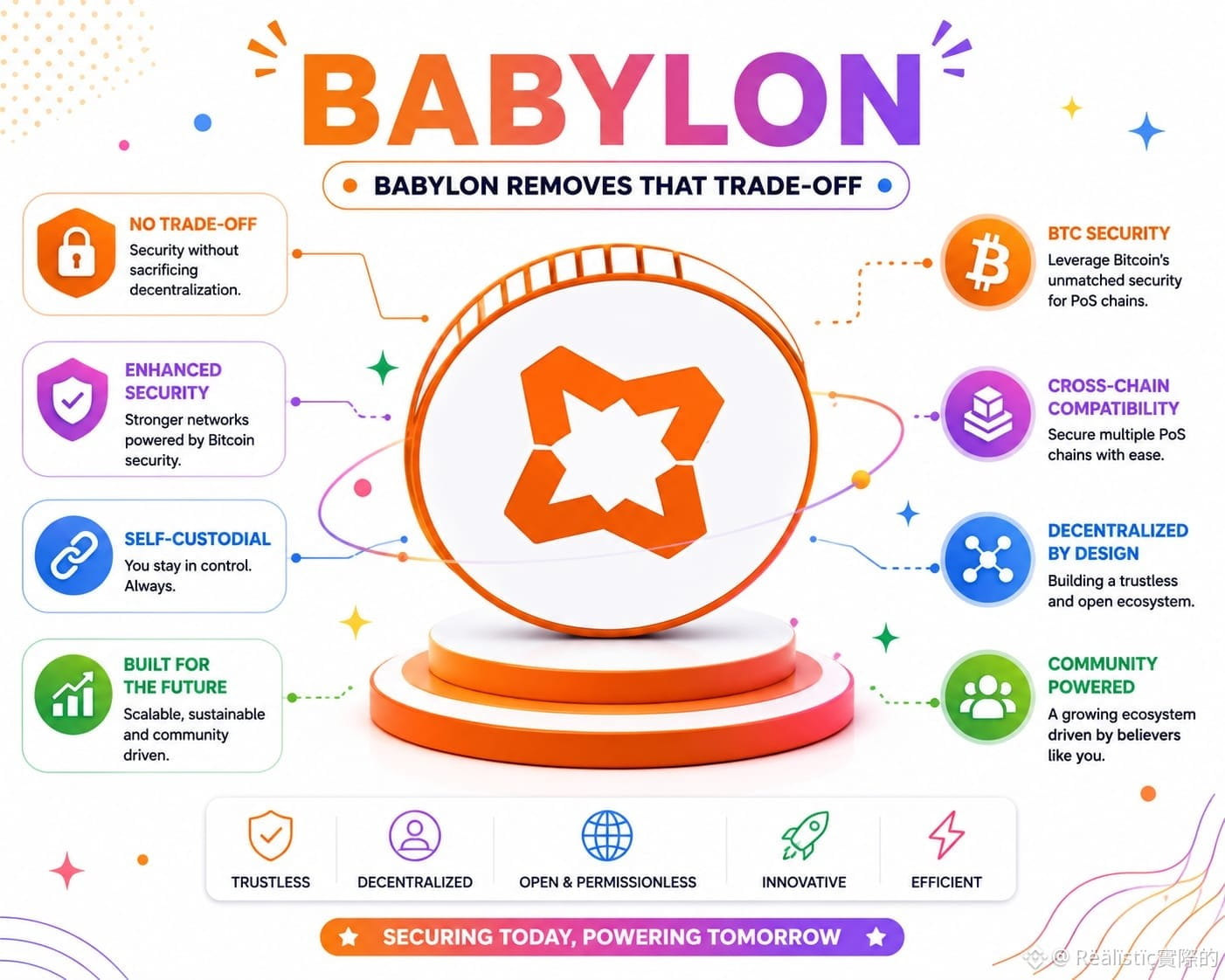
For years Bitcoin has been viewed primarily as a store of value an asset that sits securely in self custody while other blockchain ecosystems compete for capital and security.
That's why "Babylon $BABY " caught my attention.
Instead of asking Bitcoin holders to wrap bridge or hand over custody of their BTC Babylon is building a framework that allows "self custodial BTC staking directly on the Bitcoin network". The idea is simple but powerful let Bitcoin's economic security help protect Proof of Stake ecosystems without compromising ownership of BTC.
This shifts the conversation from "How do I earn yield?" to "How can Bitcoin become productive while remaining trust minimized?"
$BABY What I find most interesting isn't just the technology it's the potential network effect. If more PoS chains can leverage Bitcoin backed security it could reshape how blockchain ecosystems think about decentralization and security.
Of course every emerging protocol still needs to prove itself through adoption reliable execution and long term developer support. That's what I'll be watching closely over the coming months.
For me, the biggest opportunities often come from understanding the infrastructure before the market fully recognizes its value.
💬 If Bitcoin can secure multiple blockchain ecosystems without leaving self custody could this become one of the most important infrastructure upgrades in crypto?
#baby #Web3 #Bitcoin #BTCStaking @babylonlabs_io #BinanceSquareFamily
$BTC
{future}(BABYUSDT)
For years Bitcoin has been viewed primarily as a store of value an asset that sits securely in self custody while other blockchain ecosystems compete for capital and security.
That's why "Babylon $BABY " caught my attention.
Instead of asking Bitcoin holders to wrap bridge or hand over custody of their BTC Babylon is building a framework that allows "self custodial BTC staking directly on the Bitcoin network". The idea is simple but powerful let Bitcoin's economic security help protect Proof of Stake ecosystems without compromising ownership of BTC.
This shifts the conversation from "How do I earn yield?" to "How can Bitcoin become productive while remaining trust minimized?"
$BABY What I find most interesting isn't just the technology it's the potential network effect. If more PoS chains can leverage Bitcoin backed security it could reshape how blockchain ecosystems think about decentralization and security.
Of course every emerging protocol still needs to prove itself through adoption reliable execution and long term developer support. That's what I'll be watching closely over the coming months.
For me, the biggest opportunities often come from understanding the infrastructure before the market fully recognizes its value.
💬 If Bitcoin can secure multiple blockchain ecosystems without leaving self custody could this become one of the most important infrastructure upgrades in crypto?
#baby #Web3 #Bitcoin #BTCStaking @BabylonLabs_io #BinanceSquareFamily
$BTC
That's why "Babylon $BABY " caught my attention.
Instead of asking Bitcoin holders to wrap bridge or hand over custody of their BTC Babylon is building a framework that allows "self custodial BTC staking directly on the Bitcoin network". The idea is simple but powerful let Bitcoin's economic security help protect Proof of Stake ecosystems without compromising ownership of BTC.
This shifts the conversation from "How do I earn yield?" to "How can Bitcoin become productive while remaining trust minimized?"
$BABY What I find most interesting isn't just the technology it's the potential network effect. If more PoS chains can leverage Bitcoin backed security it could reshape how blockchain ecosystems think about decentralization and security.
Of course every emerging protocol still needs to prove itself through adoption reliable execution and long term developer support. That's what I'll be watching closely over the coming months.
For me, the biggest opportunities often come from understanding the infrastructure before the market fully recognizes its value.
💬 If Bitcoin can secure multiple blockchain ecosystems without leaving self custody could this become one of the most important infrastructure upgrades in crypto?
#baby #Web3 #Bitcoin #BTCStaking @BabylonLabs_io #BinanceSquareFamily
$BTC
19
25
479

Vérifié
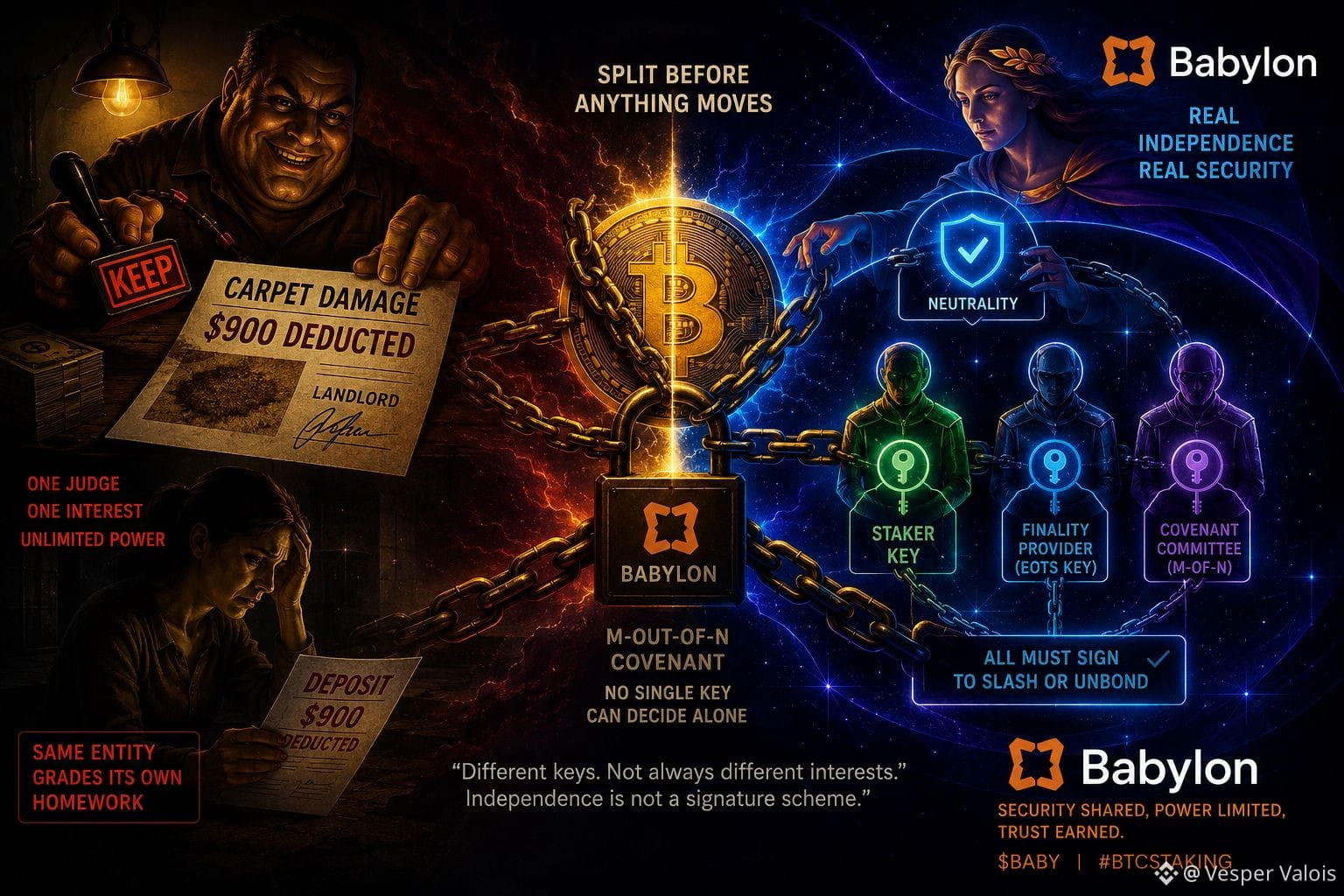
When a friend of mine moved out of her rental last year, the property manager kept $900 of her deposit for "carpet damage." There was no independent inspector, no move-in photos on file, nothing but his own walkthrough three days after she left. The person deciding how much damage existed was the same person who got to keep whatever he didn't return. She only saw most of that money again after she mentioned small claims court in an email.
That's the same pattern that shows up in staking and restaking. Slashing is supposed to be decided by someone neutral, not the staker or the operator being penalized. But in most designs, that neutrality is only enforced at the level of separate keys or addresses. Nothing in the cryptography stops the people behind those keys from being the same operation wearing two hats. A check can look procedurally separate while functionally grading its own homework.
@babylonlabs_io splits every stake across three distinct keys before anything can move: the staker, the Finality Provider identified by its EOTS key, and a Covenant Committee that must co-sign as an M-out-of-N multisig before slashing or early unbonding can execute. The staking script is invalid on its face if any of those keys repeat within a single stake.
Self-critique: that uniqueness rule is a cryptographic guarantee, not an organizational one. It proves no single key plays two roles. It cannot prove that the N committee seats are held by N genuinely separate parties rather than affiliated operators or shared infrastructure quietly holding several seats at once. My friend's landlord could have brought in a second signature on that damage report too, as long as it came from someone who owed him favors. A different name on the form isn't the same as a different interest in the outcome, and no signature scheme can tell you who is actually sitting behind a key.
$BABY should be evaluated based on the real independence of who holds those covenant seats, not just on whether their keys are technically distinct from one another.
#BTCStaking #baby $KOMA $BANK
When a friend of mine moved out of her rental last year, the property manager kept $900 of her deposit for "carpet damage." There was no independent inspector, no move-in photos on file, nothing but his own walkthrough three days after she left. The person deciding how much damage existed was the same person who got to keep whatever he didn't return. She only saw most of that money again after she mentioned small claims court in an email.
That's the same pattern that shows up in staking and restaking. Slashing is supposed to be decided by someone neutral, not the staker or the operator being penalized. But in most designs, that neutrality is only enforced at the level of separate keys or addresses. Nothing in the cryptography stops the people behind those keys from being the same operation wearing two hats. A check can look procedurally separate while functionally grading its own homework.
@BabylonLabs_io splits every stake across three distinct keys before anything can move: the staker, the Finality Provider identified by its EOTS key, and a Covenant Committee that must co-sign as an M-out-of-N multisig before slashing or early unbonding can execute. The staking script is invalid on its face if any of those keys repeat within a single stake.
Self-critique: that uniqueness rule is a cryptographic guarantee, not an organizational one. It proves no single key plays two roles. It cannot prove that the N committee seats are held by N genuinely separate parties rather than affiliated operators or shared infrastructure quietly holding several seats at once. My friend's landlord could have brought in a second signature on that damage report too, as long as it came from someone who owed him favors. A different name on the form isn't the same as a different interest in the outcome, and no signature scheme can tell you who is actually sitting behind a key.
$BABY should be evaluated based on the real independence of who holds those covenant seats, not just on whether their keys are technically distinct from one another.
#BTCStaking #baby $KOMA $BANK
That's the same pattern that shows up in staking and restaking. Slashing is supposed to be decided by someone neutral, not the staker or the operator being penalized. But in most designs, that neutrality is only enforced at the level of separate keys or addresses. Nothing in the cryptography stops the people behind those keys from being the same operation wearing two hats. A check can look procedurally separate while functionally grading its own homework.
@BabylonLabs_io splits every stake across three distinct keys before anything can move: the staker, the Finality Provider identified by its EOTS key, and a Covenant Committee that must co-sign as an M-out-of-N multisig before slashing or early unbonding can execute. The staking script is invalid on its face if any of those keys repeat within a single stake.
Self-critique: that uniqueness rule is a cryptographic guarantee, not an organizational one. It proves no single key plays two roles. It cannot prove that the N committee seats are held by N genuinely separate parties rather than affiliated operators or shared infrastructure quietly holding several seats at once. My friend's landlord could have brought in a second signature on that damage report too, as long as it came from someone who owed him favors. A different name on the form isn't the same as a different interest in the outcome, and no signature scheme can tell you who is actually sitting behind a key.
$BABY should be evaluated based on the real independence of who holds those covenant seats, not just on whether their keys are technically distinct from one another.
#BTCStaking #baby $KOMA $BANK
16
8
188

·
--
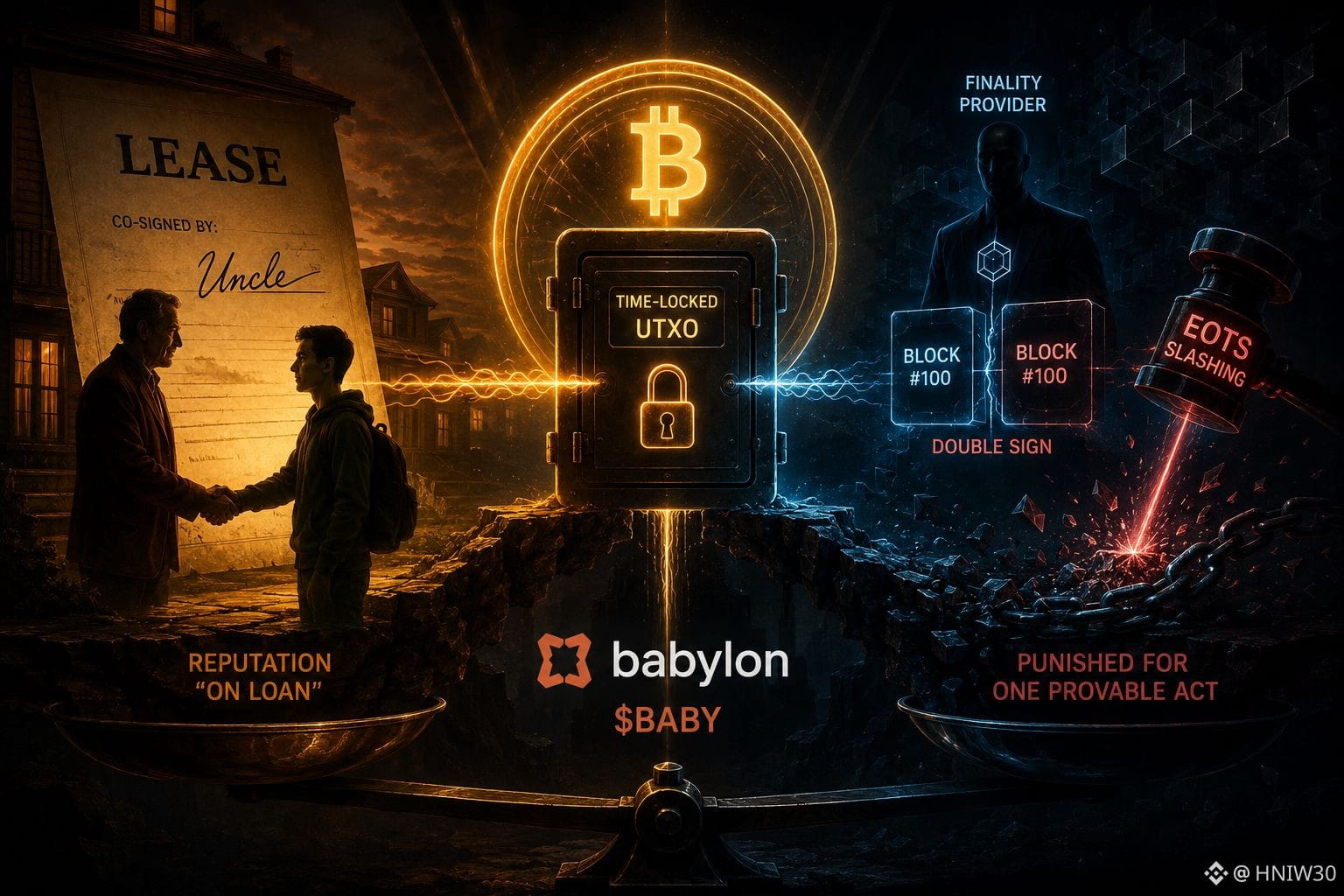
When I was twenty-three, my first landlord refused to hand me a lease on my own signature. I had a steady job but no credit history behind me, nothing on paper to point to.
My uncle sat across from the property manager and co-signed. Afterward he told me flatly: I'm not paying your rent, but if you skip it, I'm the one they call first. He never gave me his reputation. He attached it to mine, on his own terms, for a limited stretch of time.
Crypto has the same pattern. It calls this shared security: one system lending its economic weight to a younger one without giving up ownership.
Babylon ( @babylonlabs_io ) applies that logic to Bitcoin itself. A staker locks BTC inside a staking transaction built with Bitcoin script, a time-locked UTXO that never leaves their own wallet. No bridge, no wrapped token, no custodian holding the keys.
That locked value gets delegated to a Finality Provider, an entity that votes on blocks for the Bitcoin Supercharged Network it secures. If the provider double signs two conflicting blocks, Extractable One-Time Signatures let anyone reconstruct its private key from those two signatures and submit a slashing transaction, enforced by Bitcoin script rather than a custodian's word.
My uncle's signature carried judgment, not just liability. He had watched me hold a job and pay back small debts. If I skipped rent, he could call my parents, sue me, or simply refuse to vouch for me again. That is broad and adjustable trust.
Extractable One-Time Signatures cover something narrower: a provider is only punished for one provable act, double signing. One that is slow, careless, or quietly complicit in a bad governance vote never trips the mechanism at all. Bitcoin's weight guards against a single failure mode, silent on the rest.
$BABY should be evaluated based on how completely Babylon's slashing conditions cover a young network's real failure modes, not just on how much Bitcoin it has managed to attract.
#baby #BTCStaking $GIGGLE $IDOL
When I was twenty-three, my first landlord refused to hand me a lease on my own signature. I had a steady job but no credit history behind me, nothing on paper to point to.
My uncle sat across from the property manager and co-signed. Afterward he told me flatly: I'm not paying your rent, but if you skip it, I'm the one they call first. He never gave me his reputation. He attached it to mine, on his own terms, for a limited stretch of time.
Crypto has the same pattern. It calls this shared security: one system lending its economic weight to a younger one without giving up ownership.
Babylon ( @BabylonLabs_io ) applies that logic to Bitcoin itself. A staker locks BTC inside a staking transaction built with Bitcoin script, a time-locked UTXO that never leaves their own wallet. No bridge, no wrapped token, no custodian holding the keys.
That locked value gets delegated to a Finality Provider, an entity that votes on blocks for the Bitcoin Supercharged Network it secures. If the provider double signs two conflicting blocks, Extractable One-Time Signatures let anyone reconstruct its private key from those two signatures and submit a slashing transaction, enforced by Bitcoin script rather than a custodian's word.
My uncle's signature carried judgment, not just liability. He had watched me hold a job and pay back small debts. If I skipped rent, he could call my parents, sue me, or simply refuse to vouch for me again. That is broad and adjustable trust.
Extractable One-Time Signatures cover something narrower: a provider is only punished for one provable act, double signing. One that is slow, careless, or quietly complicit in a bad governance vote never trips the mechanism at all. Bitcoin's weight guards against a single failure mode, silent on the rest.
$BABY should be evaluated based on how completely Babylon's slashing conditions cover a young network's real failure modes, not just on how much Bitcoin it has managed to attract.
#baby #BTCStaking $GIGGLE $IDOL
My uncle sat across from the property manager and co-signed. Afterward he told me flatly: I'm not paying your rent, but if you skip it, I'm the one they call first. He never gave me his reputation. He attached it to mine, on his own terms, for a limited stretch of time.
Crypto has the same pattern. It calls this shared security: one system lending its economic weight to a younger one without giving up ownership.
Babylon ( @BabylonLabs_io ) applies that logic to Bitcoin itself. A staker locks BTC inside a staking transaction built with Bitcoin script, a time-locked UTXO that never leaves their own wallet. No bridge, no wrapped token, no custodian holding the keys.
That locked value gets delegated to a Finality Provider, an entity that votes on blocks for the Bitcoin Supercharged Network it secures. If the provider double signs two conflicting blocks, Extractable One-Time Signatures let anyone reconstruct its private key from those two signatures and submit a slashing transaction, enforced by Bitcoin script rather than a custodian's word.
My uncle's signature carried judgment, not just liability. He had watched me hold a job and pay back small debts. If I skipped rent, he could call my parents, sue me, or simply refuse to vouch for me again. That is broad and adjustable trust.
Extractable One-Time Signatures cover something narrower: a provider is only punished for one provable act, double signing. One that is slow, careless, or quietly complicit in a bad governance vote never trips the mechanism at all. Bitcoin's weight guards against a single failure mode, silent on the rest.
$BABY should be evaluated based on how completely Babylon's slashing conditions cover a young network's real failure modes, not just on how much Bitcoin it has managed to attract.
#baby #BTCStaking $GIGGLE $IDOL
274
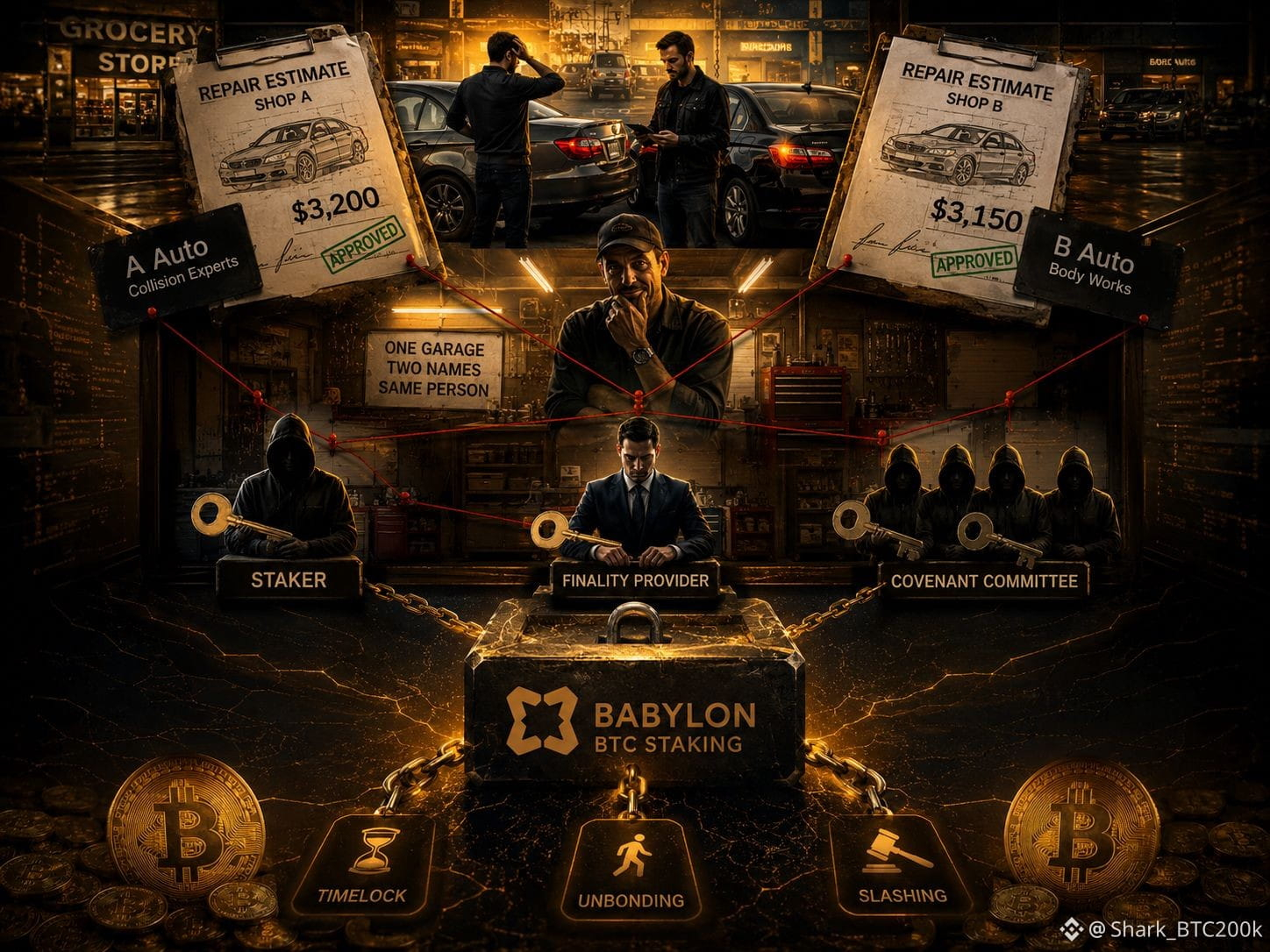
A few years back I rear-ended someone in a parking lot, barely a dent. My insurer required two independent repair estimates, so no garage could inflate the number unchecked. The tow driver handed me two business cards. I got quotes from both on different letterheads. Later a friend mentioned both shops were run by one guy under two business names. My independent second opinion was one person pricing his own estimate twice.
DeFi security has the same pattern. N separate keys get treated as N independent decision makers: a multisig treasury, a decentralized oracle committee, and KYC rules requiring unrelated co-signers. If two keys trace back to one operator, the real security threshold is lower than everyone believes, and nothing on-chain flags it, since every key still looks distinct.
Babylon's Bitcoin staking output can only be spent through three Taproot script paths, timelock, unbonding, and slashing, splitting authority between the staker, the finality provider, and a covenant committee threshold. That spec bans overlap between StakerPk, FinalityProviderPk, and each CovenantPk. If two roles resolve to the same key, the script is invalid, closing off the easy version of the two-garage problem.
Self-critique: the rule only checks keys are byte-for-byte different, not that the people behind them are unrelated. A covenant member and a finality provider, or two covenant members, could hold distinct keys while being the same operator, and the script would accept it without complaint. That's the same gap that let my mechanic run two business names out of one garage. He never needed a second workshop, just paperwork that looked different enough that nobody asked who owned it.
$BABY should be evaluated based on whether that constraint meaningfully raises the real cost of collusion between staker, finality provider, and covenant signers, not just whether a no-duplicate-keys rule makes the design look trustless on paper.
#BTCStaking @babylonlabs_io #baby $KOMA $BANK
A few years back I rear-ended someone in a parking lot, barely a dent. My insurer required two independent repair estimates, so no garage could inflate the number unchecked. The tow driver handed me two business cards. I got quotes from both on different letterheads. Later a friend mentioned both shops were run by one guy under two business names. My independent second opinion was one person pricing his own estimate twice.
DeFi security has the same pattern. N separate keys get treated as N independent decision makers: a multisig treasury, a decentralized oracle committee, and KYC rules requiring unrelated co-signers. If two keys trace back to one operator, the real security threshold is lower than everyone believes, and nothing on-chain flags it, since every key still looks distinct.
Babylon's Bitcoin staking output can only be spent through three Taproot script paths, timelock, unbonding, and slashing, splitting authority between the staker, the finality provider, and a covenant committee threshold. That spec bans overlap between StakerPk, FinalityProviderPk, and each CovenantPk. If two roles resolve to the same key, the script is invalid, closing off the easy version of the two-garage problem.
Self-critique: the rule only checks keys are byte-for-byte different, not that the people behind them are unrelated. A covenant member and a finality provider, or two covenant members, could hold distinct keys while being the same operator, and the script would accept it without complaint. That's the same gap that let my mechanic run two business names out of one garage. He never needed a second workshop, just paperwork that looked different enough that nobody asked who owned it.
$BABY should be evaluated based on whether that constraint meaningfully raises the real cost of collusion between staker, finality provider, and covenant signers, not just whether a no-duplicate-keys rule makes the design look trustless on paper.
#BTCStaking @BabylonLabs_io #baby $KOMA $BANK
DeFi security has the same pattern. N separate keys get treated as N independent decision makers: a multisig treasury, a decentralized oracle committee, and KYC rules requiring unrelated co-signers. If two keys trace back to one operator, the real security threshold is lower than everyone believes, and nothing on-chain flags it, since every key still looks distinct.
Babylon's Bitcoin staking output can only be spent through three Taproot script paths, timelock, unbonding, and slashing, splitting authority between the staker, the finality provider, and a covenant committee threshold. That spec bans overlap between StakerPk, FinalityProviderPk, and each CovenantPk. If two roles resolve to the same key, the script is invalid, closing off the easy version of the two-garage problem.
Self-critique: the rule only checks keys are byte-for-byte different, not that the people behind them are unrelated. A covenant member and a finality provider, or two covenant members, could hold distinct keys while being the same operator, and the script would accept it without complaint. That's the same gap that let my mechanic run two business names out of one garage. He never needed a second workshop, just paperwork that looked different enough that nobody asked who owned it.
$BABY should be evaluated based on whether that constraint meaningfully raises the real cost of collusion between staker, finality provider, and covenant signers, not just whether a no-duplicate-keys rule makes the design look trustless on paper.
#BTCStaking @BabylonLabs_io #baby $KOMA $BANK
4
147

·
--
Haussier
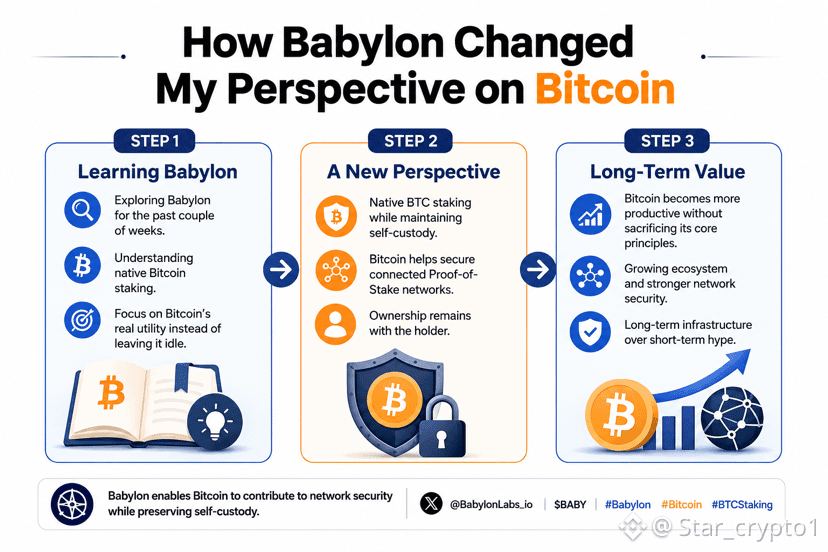
I've been testing @babylonlabs_io with a small amount of my Bitcoin over the past couple of weeks, mainly to understand how native BTC staking works in practice. What really changed my perspective wasn't just the staking process—it was realizing that Bitcoin can contribute to network security while remaining in self-custody. Before exploring Babylon, I always assumed BTC had to remain completely idle unless I was willing to give up control or move it elsewhere. Babylon introduced a different approach by allowing Bitcoin to help secure connected Proof-of-Stake networks without compromising ownership. That shift in thinking impressed me the most. Instead of simply creating another staking product, Babylon is building infrastructure that expands Bitcoin's real-world utility while preserving its core principles. I'm excited to see how the ecosystem continues to grow. @babylonlabs_io $BABY #Babylon
#bitcoin
#BTCStaking
#baby
#baby $BABY $BTC
I've been testing @BabylonLabs_io with a small amount of my Bitcoin over the past couple of weeks, mainly to understand how native BTC staking works in practice. What really changed my perspective wasn't just the staking process—it was realizing that Bitcoin can contribute to network security while remaining in self-custody. Before exploring Babylon, I always assumed BTC had to remain completely idle unless I was willing to give up control or move it elsewhere. Babylon introduced a different approach by allowing Bitcoin to help secure connected Proof-of-Stake networks without compromising ownership. That shift in thinking impressed me the most. Instead of simply creating another staking product, Babylon is building infrastructure that expands Bitcoin's real-world utility while preserving its core principles. I'm excited to see how the ecosystem continues to grow. @BabylonLabs_io $BABY #Babylon
#bitcoin
#BTCStaking
#baby
#baby $BABY $BTC
#bitcoin
#BTCStaking
#baby
#baby $BABY $BTC
1
1
70
Connectez-vous pour découvrir plus de contenu
Rejoignez la communauté mondiale des adeptes de cryptomonnaies sur Binance Square
⚡️ Suviez les dernières informations importantes sur les cryptomonnaies.
💬 Jugé digne de confiance par la plus grande plateforme d’échange de cryptomonnaies au monde.
👍 Découvrez les connaissances que partagent les créateurs vérifiés.
Adresse e-mail/Nº de téléphone
Sujets d’actualité
1
#FedProposesPaymentStablecoinRules
0 vues
2 mentions
2
#ChinaMayLetAlibabaByteDanceBuyNvidiaChips
1,734 vues
126 mentions
3
#USChinaRelease$30BTariffCutProductLists
143 vues
13 mentions
4
#SKoreaFSCConsidersVirtualAssetMarketMaker
2,959 vues
133 mentions
5
#ChinaIndustrialProfitGrowthSlowsFourthMonth
3,703 vues
151 mentions
6
#BitwiseFilesFinalNEARSpotETFProspectus
112,420 vues
1,670 mentions
7
#BitgetHackerMoves$83MStolenXRP
38,566 vues
176 mentions
8
#SOLSpotETFWeeklyInflow$188M
24,527 vues
139 mentions
9
#DogecoinETFsPostBiggestWeekSinceLaunch
65,533 vues
1,095 mentions
10
#StrategyStriveAdd2305BitcoinThisWeek
163,409 vues
2,356 mentions