

#alphafamily
alphafamily
44,445 vues
128 mentions
Populaire
Récents

#afghanistantalibanreportedlybanscryptona #AlphaFamily
🇦🇫 أفغانستان: طالبان يُفترض أنها تتجه إلى حظر العملة الرقمية على مستوى البلاد
تشير تقارير إلى أن سلطات طالبان في أفغانستان قد تحركت لفرض حظر على مستوى البلاد على العملات الرقمية، ما قد يؤدي إلى إخضاع نشاط البلاد في مجال العملات المشفرة لمنع صارم.
قد تؤثر هذه الخطوة المزعومة على الأفراد والتجار والبورصات والشركات المشاركة في شراء أو بيع أو تحويل أو استخدام الأصول الرقمية مثل بيتكوين وإيثريوم وتيثر (USDT) وغيرها من العملات المشفرة.
🔹 ما الذي يتم الإبلاغ عنه؟
• قد تواجه تجارة العملات المشفرة والأنشطة المرتبطة بها قيودًا على مستوى البلاد.
• قد لا يُسمح لمستخدمي وتجار العملات المشفرة المحليين بمواصلة العمل بشكل علني.
• قد تخضع الشركات التي تيسر إجراء معاملات العملات المشفرة أيضًا لتدابير إنفاذ.
• قد تحد القيود كذلك من الوصول إلى أسواق الأصول الرقمية الدولية للمستخدمين الأفغان.
• يأتي هذا التطور بعد قيود سابقة ومداهمات/حملات قمع على نشاط العملات المشفرة في أجزاء من أفغانستان.
متابعة من فضلكم
$TUT
{future}(TUTUSDT)
#afghanistantalibanreportedlybanscryptona #AlphaFamily
🇦🇫 أفغانستان: طالبان يُفترض أنها تتجه إلى حظر العملة الرقمية على مستوى البلاد
تشير تقارير إلى أن سلطات طالبان في أفغانستان قد تحركت لفرض حظر على مستوى البلاد على العملات الرقمية، ما قد يؤدي إلى إخضاع نشاط البلاد في مجال العملات المشفرة لمنع صارم.
قد تؤثر هذه الخطوة المزعومة على الأفراد والتجار والبورصات والشركات المشاركة في شراء أو بيع أو تحويل أو استخدام الأصول الرقمية مثل بيتكوين وإيثريوم وتيثر (USDT) وغيرها من العملات المشفرة.
🔹 ما الذي يتم الإبلاغ عنه؟
• قد تواجه تجارة العملات المشفرة والأنشطة المرتبطة بها قيودًا على مستوى البلاد.
• قد لا يُسمح لمستخدمي وتجار العملات المشفرة المحليين بمواصلة العمل بشكل علني.
• قد تخضع الشركات التي تيسر إجراء معاملات العملات المشفرة أيضًا لتدابير إنفاذ.
• قد تحد القيود كذلك من الوصول إلى أسواق الأصول الرقمية الدولية للمستخدمين الأفغان.
• يأتي هذا التطور بعد قيود سابقة ومداهمات/حملات قمع على نشاط العملات المشفرة في أجزاء من أفغانستان.
متابعة من فضلكم
$TUT
🇦🇫 أفغانستان: طالبان يُفترض أنها تتجه إلى حظر العملة الرقمية على مستوى البلاد
تشير تقارير إلى أن سلطات طالبان في أفغانستان قد تحركت لفرض حظر على مستوى البلاد على العملات الرقمية، ما قد يؤدي إلى إخضاع نشاط البلاد في مجال العملات المشفرة لمنع صارم.
قد تؤثر هذه الخطوة المزعومة على الأفراد والتجار والبورصات والشركات المشاركة في شراء أو بيع أو تحويل أو استخدام الأصول الرقمية مثل بيتكوين وإيثريوم وتيثر (USDT) وغيرها من العملات المشفرة.
🔹 ما الذي يتم الإبلاغ عنه؟
• قد تواجه تجارة العملات المشفرة والأنشطة المرتبطة بها قيودًا على مستوى البلاد.
• قد لا يُسمح لمستخدمي وتجار العملات المشفرة المحليين بمواصلة العمل بشكل علني.
• قد تخضع الشركات التي تيسر إجراء معاملات العملات المشفرة أيضًا لتدابير إنفاذ.
• قد تحد القيود كذلك من الوصول إلى أسواق الأصول الرقمية الدولية للمستخدمين الأفغان.
• يأتي هذا التطور بعد قيود سابقة ومداهمات/حملات قمع على نشاط العملات المشفرة في أجزاء من أفغانستان.
متابعة من فضلكم
$TUT

1
85

·
--
Haussier
Vérifié
#afghanistantalibanreportedlybanscryptonationwide #AlphaFamily
🇦🇫 Afghanistan: Taliban Reportedly Moves to Ban Cryptocurrency Nationwide
Reports indicate that Afghanistan’s Taliban authorities have reportedly moved to impose a nationwide ban on cryptocurrency, potentially bringing the country’s crypto activity under strict prohibition.
The reported move could affect individuals, traders, exchanges, and businesses involved in buying, selling, transferring, or using digital assets such as Bitcoin, Ethereum, Tether (USDT), and other cryptocurrencies.
🔹 What is being reported?
• Cryptocurrency trading and related activities could face nationwide restrictions.
• Local crypto users and traders may no longer be permitted to operate openly.
• Businesses facilitating crypto transactions could also come under enforcement measures.
• The restrictions could further limit access to international digital-asset markets for Afghan users.
• The development comes after previous restrictions and crackdowns on cryptocurrency activity in parts of Afghanistan.
🔹 Why does it matter?
Afghanistan has faced significant economic and financial restrictions, including limited access to international banking services. For some people, cryptocurrencies have provided an alternative method for cross-border transfers, savings, remittances, and accessing digital financial services.
A nationwide prohibition could therefore have consequences beyond crypto trading, particularly for people who rely on digital assets to move money or protect savings amid economic uncertainty.
⚠️ Important: The wording "reportedly" is important here. Details surrounding the scope, legal basis, enforcement mechanisms, and effective date of any nationwide crypto ban should be verified against official Taliban announcements and multiple independent sources before treating the measure as fully confirmed.
$TUT
{future}(TUTUSDT)
$TAC
{future}(TACUSDT)
$LAB
{future}(LABUSDT)
#afghanistantalibanreportedlybanscryptonationwide #AlphaFamily
🇦🇫 Afghanistan: Taliban Reportedly Moves to Ban Cryptocurrency Nationwide
Reports indicate that Afghanistan’s Taliban authorities have reportedly moved to impose a nationwide ban on cryptocurrency, potentially bringing the country’s crypto activity under strict prohibition.
The reported move could affect individuals, traders, exchanges, and businesses involved in buying, selling, transferring, or using digital assets such as Bitcoin, Ethereum, Tether (USDT), and other cryptocurrencies.
🔹 What is being reported?
• Cryptocurrency trading and related activities could face nationwide restrictions.
• Local crypto users and traders may no longer be permitted to operate openly.
• Businesses facilitating crypto transactions could also come under enforcement measures.
• The restrictions could further limit access to international digital-asset markets for Afghan users.
• The development comes after previous restrictions and crackdowns on cryptocurrency activity in parts of Afghanistan.
🔹 Why does it matter?
Afghanistan has faced significant economic and financial restrictions, including limited access to international banking services. For some people, cryptocurrencies have provided an alternative method for cross-border transfers, savings, remittances, and accessing digital financial services.
A nationwide prohibition could therefore have consequences beyond crypto trading, particularly for people who rely on digital assets to move money or protect savings amid economic uncertainty.
⚠️ Important: The wording "reportedly" is important here. Details surrounding the scope, legal basis, enforcement mechanisms, and effective date of any nationwide crypto ban should be verified against official Taliban announcements and multiple independent sources before treating the measure as fully confirmed.
$TUT
$TAC
$LAB
🇦🇫 Afghanistan: Taliban Reportedly Moves to Ban Cryptocurrency Nationwide
Reports indicate that Afghanistan’s Taliban authorities have reportedly moved to impose a nationwide ban on cryptocurrency, potentially bringing the country’s crypto activity under strict prohibition.
The reported move could affect individuals, traders, exchanges, and businesses involved in buying, selling, transferring, or using digital assets such as Bitcoin, Ethereum, Tether (USDT), and other cryptocurrencies.
🔹 What is being reported?
• Cryptocurrency trading and related activities could face nationwide restrictions.
• Local crypto users and traders may no longer be permitted to operate openly.
• Businesses facilitating crypto transactions could also come under enforcement measures.
• The restrictions could further limit access to international digital-asset markets for Afghan users.
• The development comes after previous restrictions and crackdowns on cryptocurrency activity in parts of Afghanistan.
🔹 Why does it matter?
Afghanistan has faced significant economic and financial restrictions, including limited access to international banking services. For some people, cryptocurrencies have provided an alternative method for cross-border transfers, savings, remittances, and accessing digital financial services.
A nationwide prohibition could therefore have consequences beyond crypto trading, particularly for people who rely on digital assets to move money or protect savings amid economic uncertainty.
⚠️ Important: The wording "reportedly" is important here. Details surrounding the scope, legal basis, enforcement mechanisms, and effective date of any nationwide crypto ban should be verified against official Taliban announcements and multiple independent sources before treating the measure as fully confirmed.
$TUT
$TAC
$LAB

1
4
2.1k
Article
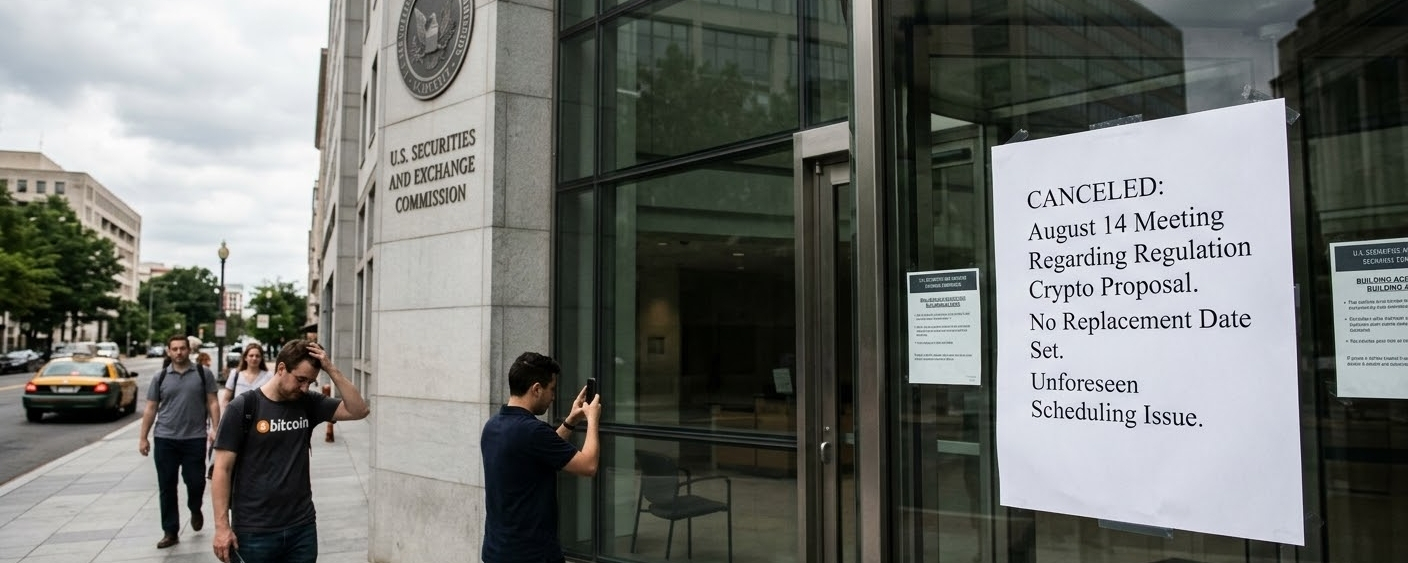
SEC Cancels Crypto Rulemaking MeetingThe U.S. Securities and Exchange Commission has abruptly canceled its August 14 meeting that was expected to advance its long-awaited “Regulation Crypto” proposal. The SEC cited an “unforeseen scheduling issue” and has not announced a replacement date.
The meeting was expected to address proposed exemptions that could make it easier for certain crypto companies and startups to raise capital through token-based offerings without facing the full burden of traditional securities registration. The SEC was also expected to discuss its proposed “innovation exemption” for tokenized securities.
The cancellation comes as Congress has also stalled on the CLARITY Act, a major bill designed to establish clearer rules for the U.S. digital-asset market. The Senate has postponed action until September, leaving both legislative and regulatory efforts in limbo.
For the crypto industry, the delay means continued uncertainty around token fundraising, regulatory exemptions and the future structure of digital-asset markets in the United States. Investors and crypto companies will now wait for the SEC to announce a new meeting date and clarify whether the proposed framework will move forward.
#SECCancelsCryptoRulemakingMeeting #AlphaFamily
SEC Cancels Crypto Rulemaking Meeting
The U.S. Securities and Exchange Commission has abruptly canceled its August 14 meeting that was expected to advance its long-awaited “Regulation Crypto” proposal. The SEC cited an “unforeseen scheduling issue” and has not announced a replacement date.
The meeting was expected to address proposed exemptions that could make it easier for certain crypto companies and startups to raise capital through token-based offerings without facing the full burden of traditional securities registration. The SEC was also expected to discuss its proposed “innovation exemption” for tokenized securities.
The cancellation comes as Congress has also stalled on the CLARITY Act, a major bill designed to establish clearer rules for the U.S. digital-asset market. The Senate has postponed action until September, leaving both legislative and regulatory efforts in limbo.
For the crypto industry, the delay means continued uncertainty around token fundraising, regulatory exemptions and the future structure of digital-asset markets in the United States. Investors and crypto companies will now wait for the SEC to announce a new meeting date and clarify whether the proposed framework will move forward.
#SECCancelsCryptoRulemakingMeeting #AlphaFamily
The meeting was expected to address proposed exemptions that could make it easier for certain crypto companies and startups to raise capital through token-based offerings without facing the full burden of traditional securities registration. The SEC was also expected to discuss its proposed “innovation exemption” for tokenized securities.
The cancellation comes as Congress has also stalled on the CLARITY Act, a major bill designed to establish clearer rules for the U.S. digital-asset market. The Senate has postponed action until September, leaving both legislative and regulatory efforts in limbo.
For the crypto industry, the delay means continued uncertainty around token fundraising, regulatory exemptions and the future structure of digital-asset markets in the United States. Investors and crypto companies will now wait for the SEC to announce a new meeting date and clarify whether the proposed framework will move forward.
#SECCancelsCryptoRulemakingMeeting #AlphaFamily
82

·
--
🔥 CAPITAL CAPITULATION 🔥
TESLA SHORTS: 29% → 8% THE SQUEEZE IS ACCELERATING.
INSTITUTIONAL MELTDOWN:
THE MASSACRE: 14 days. 21% short interest evaporated. TSLA +38% off correction lows. Reclaiming key moving averages. Record volume. Bears completely overwhelmed.
THE DRIVERS:
Gamma Squeeze → Options gamma flips → Market makers forced to buy
Short covering → Margin calls triggering liquidations
Rotation → Capital flowing back to mega-tech growth
THE REALITY CHECK: Volatility is the new normal. Key test = Can $TSLA hold $260+ resistance level? Incoming macro data (CPI) will determine the next major leg.
PRO ANALYSIS: The technical bounce is confirmed. Sustainment depends entirely on upcoming delivery numbers.
RISK LINK: Growth rotation = Liquidity rising. Money moves from covered shorts → High beta equities.
#AlphaFamily PLAYBOOK: TSLA→ The primary engine. NVDA→ Tech leader momentum. AI proxy. PLTR→ Small cap explosion. High growth narrative.
The liquidation has catalyzed. 👇
TSLA, NVDA, PLTR #trading #GrowthStocks #CPIdata #NVIDIA #ShortSqueeze
Not Financial Advice New to Trading? Stay Disciplined
🔥 CAPITAL CAPITULATION 🔥
TESLA SHORTS: 29% → 8% THE SQUEEZE IS ACCELERATING.
INSTITUTIONAL MELTDOWN:
THE MASSACRE: 14 days. 21% short interest evaporated. TSLA +38% off correction lows. Reclaiming key moving averages. Record volume. Bears completely overwhelmed.
THE DRIVERS:
Gamma Squeeze → Options gamma flips → Market makers forced to buy
Short covering → Margin calls triggering liquidations
Rotation → Capital flowing back to mega-tech growth
THE REALITY CHECK: Volatility is the new normal. Key test = Can $TSLA hold $260+ resistance level? Incoming macro data (CPI) will determine the next major leg.
PRO ANALYSIS: The technical bounce is confirmed. Sustainment depends entirely on upcoming delivery numbers.
RISK LINK: Growth rotation = Liquidity rising. Money moves from covered shorts → High beta equities.
#AlphaFamily PLAYBOOK: TSLA→ The primary engine. NVDA→ Tech leader momentum. AI proxy. PLTR→ Small cap explosion. High growth narrative.
The liquidation has catalyzed. 👇
TSLA, NVDA, PLTR #trading #GrowthStocks #CPIdata #NVIDIA #ShortSqueeze
Not Financial Advice New to Trading? Stay Disciplined
TESLA SHORTS: 29% → 8% THE SQUEEZE IS ACCELERATING.
INSTITUTIONAL MELTDOWN:
THE MASSACRE: 14 days. 21% short interest evaporated. TSLA +38% off correction lows. Reclaiming key moving averages. Record volume. Bears completely overwhelmed.
THE DRIVERS:
Gamma Squeeze → Options gamma flips → Market makers forced to buy
Short covering → Margin calls triggering liquidations
Rotation → Capital flowing back to mega-tech growth
THE REALITY CHECK: Volatility is the new normal. Key test = Can $TSLA hold $260+ resistance level? Incoming macro data (CPI) will determine the next major leg.
PRO ANALYSIS: The technical bounce is confirmed. Sustainment depends entirely on upcoming delivery numbers.
RISK LINK: Growth rotation = Liquidity rising. Money moves from covered shorts → High beta equities.
#AlphaFamily PLAYBOOK: TSLA→ The primary engine. NVDA→ Tech leader momentum. AI proxy. PLTR→ Small cap explosion. High growth narrative.
The liquidation has catalyzed. 👇
TSLA, NVDA, PLTR #trading #GrowthStocks #CPIdata #NVIDIA #ShortSqueeze
Not Financial Advice New to Trading? Stay Disciplined

2
167


·
--
🚨 $AKE IS STILL GOING PARABOLIC 🚀🔥
+130% in 24H — the momentum is getting WILD! 📈
AKE just pushed above $0.0114 after a massive breakout, and traders are watching the next move closely. 👀
🟢 Hold above $0.011 → bulls stay in control
🚀 Break higher → fresh highs could come fast
🔴 Lose support → expect a sharp pullback ⚠️
After a move this explosive, volatility is EVERYTHING. Don’t chase blindly.
$AKE holders — are you HOLDING or TAKING PROFITS? 👇🔥
#AKE #Crypto #Altcoins #AlphaFamily
🚨 $AKE IS STILL GOING PARABOLIC 🚀🔥
+130% in 24H — the momentum is getting WILD! 📈
AKE just pushed above $0.0114 after a massive breakout, and traders are watching the next move closely. 👀
🟢 Hold above $0.011 → bulls stay in control
🚀 Break higher → fresh highs could come fast
🔴 Lose support → expect a sharp pullback ⚠️
After a move this explosive, volatility is EVERYTHING. Don’t chase blindly.
$AKE holders — are you HOLDING or TAKING PROFITS? 👇🔥
#AKE #Crypto #Altcoins #AlphaFamily
+130% in 24H — the momentum is getting WILD! 📈
AKE just pushed above $0.0114 after a massive breakout, and traders are watching the next move closely. 👀
🟢 Hold above $0.011 → bulls stay in control
🚀 Break higher → fresh highs could come fast
🔴 Lose support → expect a sharp pullback ⚠️
After a move this explosive, volatility is EVERYTHING. Don’t chase blindly.
$AKE holders — are you HOLDING or TAKING PROFITS? 👇🔥
#AKE #Crypto #Altcoins #AlphaFamily
Long
54%
shot
46%
28 Votes • Vote fermé
2
1.7k
Vérifié

Article
ProCap Files Bitcoin Treasury Discount ETF: Why This Could Change the Way Investors Trade Bitcoin Treasury Companies
#procapfilesbitcointreasurydiscountetf #AlphaFamily
ProCap Financial is once again putting the spotlight on one of the most interesting problems in the Bitcoin treasury market: what happens when a company owns a large amount of Bitcoin, but its stock trades at a significant discount to the value of the assets sitting on its balance sheet? The latest development around a proposed Bitcoin Treasury Discount ETF is important because it takes the idea of discounted Bitcoin treasury companies beyond a single corporate balance sheet and potentially turns it into an investable market strategy.
The story starts with ProCap Financial, the Bitcoin-focused company associated with Anthony Pompliano. ProCap was created with a strategy built around accumulating Bitcoin as a primary treasury reserve asset while also developing financial and media-related businesses. The company has repeatedly described Bitcoin as a long-term reserve asset because of its fixed supply, scarcity and global liquidity. Its stated treasury strategy also allows it to make opportunistic purchases when market conditions suggest Bitcoin is undervalued.
But owning Bitcoin is only one part of the equation. The bigger question for shareholders is how much they are actually paying for that Bitcoin exposure through the company's stock. This is where the concept of mNAV, or market-value-to-net-asset-value, becomes extremely important. If a company owns $100 million worth of Bitcoin but the market values the company at only $70 million after accounting for relevant liabilities, investors are effectively buying exposure to those assets at a discount. That discount can create a completely different investment opportunity from simply buying Bitcoin itself.
ProCap has already been actively addressing this issue. In March 2026, the company announced that it had purchased another 450 Bitcoin, bringing its holdings to 5,457 BTC at that time. At the same time, ProCap said it had repurchased more than 782,000 shares over the preceding 10 days because its stock was trading at a significant discount to NAV. The company said the buybacks had already helped narrow the NAV discount and that it intended to continue repurchasing shares while the discount remained significant.
That strategy is important because a company can potentially increase the economic value represented by each remaining share when it buys back its own stock below the value of the assets attributable to that share. In simple terms, imagine a company has $100 million of net assets and 10 million shares, giving each share $10 of underlying asset value. If the market price falls to $7 and the company has enough liquidity to repurchase shares at that price, buying those shares can reduce the number of shares outstanding without spending $10 of underlying asset value for every share removed. The remaining shareholders can therefore own a larger percentage of the underlying assets.
This is the basic economic logic behind trying to close an mNAV discount, and it is one reason Bitcoin treasury companies have become increasingly interesting to investors. They are not simply passive Bitcoin holders. Their capital structure, share count, debt, financing activities and ability to issue or repurchase shares can all influence the amount of Bitcoin exposure represented by each individual share.
The proposed Bitcoin Treasury Discount ETF takes that idea one step further. Instead of asking investors to identify a single company trading below the value of its Bitcoin holdings, an ETF can potentially package exposure to a group or strategy centered around Bitcoin treasury companies trading at discounts. That creates a new way to think about the growing corporate Bitcoin treasury sector.
The timing is especially interesting because the Bitcoin treasury-company market has become much larger and more complicated. ProCap itself was created through a roughly $1 billion merger structure and raised hundreds of millions of dollars in capital to pursue its Bitcoin strategy. Reuters reported that the company initially targeted up to $1 billion in Bitcoin holdings and planned to generate additional revenue through financial activities involving its Bitcoin reserves.
This model is different from simply holding Bitcoin in a wallet. A Bitcoin treasury company introduces an additional layer between the investor and Bitcoin. Investors own equity in the company, and the company's balance sheet contains Bitcoin, cash, debt and other assets and liabilities. Because of that structure, the stock can trade above or below the estimated value of its Bitcoin holdings.
That premium-or-discount dynamic is what makes the ETF concept potentially powerful.
If treasury companies trade at large discounts during periods of fear, an ETF designed around those discounts could theoretically provide exposure to companies whose market prices are substantially below their underlying Bitcoin-related asset values. If those discounts later narrow, shareholders could potentially benefit from both the movement in Bitcoin-related assets and the re-rating of the companies themselves.
But there is an important catch: a discount does not automatically mean a stock is cheap.
The market may assign a discount for a reason. Investors have to consider debt, operating expenses, dilution, management decisions, financing structures, preferred securities, convertible notes and the possibility that the company's Bitcoin holdings could fall sharply. A company holding $300 million of Bitcoin is not necessarily worth $300 million to common shareholders if it also carries significant obligations.
ProCap's latest financial figures demonstrate exactly why investors need to look beyond the headline Bitcoin number. For the first half of 2026, ProCap reported a net loss of approximately $172.8 million and recorded an unrealized loss of about $154.8 million on its digital assets. As of June 30, 2026, the company reported 5,355 Bitcoin with a fair value of approximately $313.4 million. It also had approximately $99.6 million of convertible notes outstanding and around $15.3 million in cash and cash equivalents.
Those numbers show the double-edged nature of a Bitcoin treasury strategy. When Bitcoin rises, the balance sheet can benefit enormously. When Bitcoin falls, the same concentration can create large unrealized losses. The stock can therefore experience much greater volatility than a traditional company with diversified operating cash flows.
There is also a financing risk. Convertible debt can provide capital for Bitcoin accumulation, but it creates obligations and can introduce future dilution depending on the terms. ProCap's filings show that its outstanding convertible notes had a principal amount of roughly $99.6 million as of June 30, 2026, while certain holder repurchase rights could become exercisable beginning in 2027.
This is why a Bitcoin treasury discount strategy cannot simply look at the number of Bitcoin held. The quality of the balance sheet matters just as much.
Another fascinating part of the story is ProCap's willingness to use Bitcoin itself to support shareholder-value strategies. In June 2026, reports indicated that ProCap sold 52 Bitcoin to fund a share-buyback program. That move attracted attention because it demonstrated that the company was willing to reduce its Bitcoin position when management believed repurchasing discounted equity could create greater value for shareholders.
At first glance, selling Bitcoin sounds contradictory for a Bitcoin treasury company. But from a capital-allocation perspective, it can make sense if the company's shares are trading far below the value of the assets backing them. The key question becomes: which action creates more value for the remaining shareholders, buying more Bitcoin or buying back deeply discounted shares?
That is exactly the type of capital-allocation decision that makes Bitcoin treasury companies different from traditional ETFs.
A conventional spot Bitcoin ETF attempts to track the price of Bitcoin itself. A Bitcoin treasury-company ETF can behave very differently because investors are exposed to corporate balance sheets, management decisions, capital structures and equity-market sentiment. A discount-focused strategy adds another layer by targeting the difference between the market value of these companies and the value of the assets they control.
The potential opportunity is obvious during periods when investors become overly pessimistic about Bitcoin treasury companies. Suppose Bitcoin remains stable while a treasury company's stock falls sharply because of concerns about dilution, liquidity or broader equity-market weakness. The company's mNAV could fall substantially. If management has sufficient liquidity and the ability to repurchase shares, it may be able to exploit that discount. If the market later recognizes the underlying value, the discount can narrow.
But the reverse is also possible.
A company can trade at a discount for a very long time. Bitcoin can fall. Debt can become more expensive. Shareholders can face dilution. Management can make poor capital-allocation decisions. And the discount can actually widen rather than disappear.
That is why an ETF built around the Bitcoin treasury discount theme would need a clearly defined methodology. Investors would want to know exactly how companies are selected, how mNAV is calculated, how debt is treated, how Bitcoin holdings are valued, how frequently the portfolio is rebalanced and what happens when a company no longer meets the required discount threshold.
The broader significance goes beyond ProCap itself. Corporate Bitcoin adoption is evolving from a simple "buy and hold Bitcoin" narrative into a sophisticated capital-markets strategy. Companies are experimenting with debt, equity issuance, preferred securities, derivatives, staking-related opportunities, covered calls, share repurchases and other mechanisms to increase the economic value of their Bitcoin reserves.
ProCap's own filings describe a treasury policy centered on Bitcoin while maintaining sufficient cash for working capital and contractual requirements. Its strategy also contemplates using option-based strategies such as covered calls to generate yield from Bitcoin holdings, although those strategies can introduce additional risks and may result in Bitcoin being sold if options are exercised.
That makes the Bitcoin treasury sector increasingly similar to a new asset-management category rather than simply a collection of companies holding BTC.
There is also an important psychological element. When Bitcoin is strongly bullish, investors may be willing to pay a premium for treasury companies because they expect management to keep accumulating Bitcoin and potentially increase BTC exposure per share. During bearish periods, however, the same stocks can be punished much harder because investors begin worrying about financing, dilution and debt.
The result is a market where sentiment can cause the stock price to move substantially away from the value of the underlying Bitcoin.
That disconnect is precisely what the discount ETF concept is attempting to capture.
For Bitcoin investors, the development is worth watching because it could create another bridge between traditional equity markets and the crypto market. Instead of asking investors to directly hold Bitcoin or buy a conventional spot ETF, a strategy based on discounted treasury companies could give investors exposure to businesses whose equity valuations are influenced by their Bitcoin reserves.
For institutional investors, the concept could be even more interesting. A diversified basket can reduce the company-specific risk associated with betting everything on one treasury company. Instead of relying entirely on ProCap, investors could potentially gain exposure to a broader collection of firms with different levels of Bitcoin holdings, debt, liquidity and management strategies.
Still, investors should not confuse "discount" with "guaranteed upside." The discount exists because the market is pricing risk. The entire thesis depends on whether that risk is eventually resolved, whether Bitcoin appreciates, whether management can allocate capital effectively and whether the market decides to narrow the valuation gap.
ProCap's history already provides an example of how aggressively management is willing to attack the discount. The company previously announced significant debt reduction and share repurchases, while continuing to accumulate Bitcoin. In February 2026, ProCap reported 5,007 BTC, approximately $72 million in cash and $100 million in outstanding convertible notes after reducing its convertible-note position from roughly $235 million. At that time, the company reported an mNAV of 0.6x, meaning the market valuation was substantially below the value attributed to its Bitcoin-related assets under its stated calculation.
That is the core narrative behind the latest ETF filing: Bitcoin treasury companies can sometimes become mispriced, and those mispricings themselves may become an investable strategy.
The bigger question now is whether the market is ready to treat mNAV discounts as a distinct asset class.
If more Bitcoin treasury companies begin trading below the value of their underlying assets, financial products designed specifically around those discounts could attract significant attention. If the strategy works, it could encourage treasury companies to become more aggressive with share repurchases, balance-sheet management and other mechanisms designed to narrow the gap between equity value and Bitcoin-backed asset value.
On the other hand, if discounts persist because investors distrust the capital structures or believe Bitcoin treasury companies carry excessive financial risk, an ETF could simply package a group of cheap-looking stocks without solving the underlying problem.
That distinction is critical.
The future of this strategy will probably depend on three things: Bitcoin's long-term price performance, the financial discipline of treasury-company management teams, and investor confidence in the valuation methodologies used to calculate mNAV.
For ProCap specifically, the evolution is worth following closely. The company is no longer simply trying to accumulate Bitcoin. It is increasingly operating at the intersection of Bitcoin, public equities, capital markets and financial engineering. Its strategy shows how a Bitcoin treasury can become an active capital-allocation machine rather than a passive corporate wallet.
And that may be the most important takeaway from the Bitcoin Treasury Discount ETF story.
The next phase of the corporate Bitcoin market may not be about who owns the most Bitcoin. It could be about who manages the relationship between Bitcoin holdings, equity valuation, debt, dilution and shareholder value most effectively.
If the ETF can turn that valuation gap into a systematic investment strategy, it could introduce a completely new way for traditional-market investors to gain exposure to the Bitcoin treasury phenomenon.
But the risks are just as real as the opportunity. Bitcoin remains volatile, treasury companies can carry significant financial obligations, and a stock trading below its net asset value can remain discounted for much longer than investors expect. The ETF concept may therefore be bullish for the broader Bitcoin treasury narrative, but it does not remove the fundamental risks of the underlying assets.
Ultimately, this is another sign that Bitcoin is moving deeper into traditional capital markets. What started as companies simply putting BTC on their balance sheets is becoming a much more sophisticated financial ecosystem involving equity discounts, NAV premiums, debt management, buybacks, derivatives and potentially ETFs designed specifically around these valuation differences.
If this trend continues, Bitcoin treasury companies could become an entire investment category of their own.
And ProCap is clearly positioning itself right in the middle of that experiment.
$ACE
{future}(ACEUSDT)
$AKE
{future}(AKEUSDT)
$VELVET
{future}(VELVETUSDT)
ProCap Files Bitcoin Treasury Discount ETF: Why This Could Change the Way Investors Trade Bitcoin
Treasury Companies
#procapfilesbitcointreasurydiscountetf #AlphaFamily
ProCap Financial is once again putting the spotlight on one of the most interesting problems in the Bitcoin treasury market: what happens when a company owns a large amount of Bitcoin, but its stock trades at a significant discount to the value of the assets sitting on its balance sheet? The latest development around a proposed Bitcoin Treasury Discount ETF is important because it takes the idea of discounted Bitcoin treasury companies beyond a single corporate balance sheet and potentially turns it into an investable market strategy.
The story starts with ProCap Financial, the Bitcoin-focused company associated with Anthony Pompliano. ProCap was created with a strategy built around accumulating Bitcoin as a primary treasury reserve asset while also developing financial and media-related businesses. The company has repeatedly described Bitcoin as a long-term reserve asset because of its fixed supply, scarcity and global liquidity. Its stated treasury strategy also allows it to make opportunistic purchases when market conditions suggest Bitcoin is undervalued.
But owning Bitcoin is only one part of the equation. The bigger question for shareholders is how much they are actually paying for that Bitcoin exposure through the company's stock. This is where the concept of mNAV, or market-value-to-net-asset-value, becomes extremely important. If a company owns $100 million worth of Bitcoin but the market values the company at only $70 million after accounting for relevant liabilities, investors are effectively buying exposure to those assets at a discount. That discount can create a completely different investment opportunity from simply buying Bitcoin itself.
ProCap has already been actively addressing this issue. In March 2026, the company announced that it had purchased another 450 Bitcoin, bringing its holdings to 5,457 BTC at that time. At the same time, ProCap said it had repurchased more than 782,000 shares over the preceding 10 days because its stock was trading at a significant discount to NAV. The company said the buybacks had already helped narrow the NAV discount and that it intended to continue repurchasing shares while the discount remained significant.
That strategy is important because a company can potentially increase the economic value represented by each remaining share when it buys back its own stock below the value of the assets attributable to that share. In simple terms, imagine a company has $100 million of net assets and 10 million shares, giving each share $10 of underlying asset value. If the market price falls to $7 and the company has enough liquidity to repurchase shares at that price, buying those shares can reduce the number of shares outstanding without spending $10 of underlying asset value for every share removed. The remaining shareholders can therefore own a larger percentage of the underlying assets.
This is the basic economic logic behind trying to close an mNAV discount, and it is one reason Bitcoin treasury companies have become increasingly interesting to investors. They are not simply passive Bitcoin holders. Their capital structure, share count, debt, financing activities and ability to issue or repurchase shares can all influence the amount of Bitcoin exposure represented by each individual share.
The proposed Bitcoin Treasury Discount ETF takes that idea one step further. Instead of asking investors to identify a single company trading below the value of its Bitcoin holdings, an ETF can potentially package exposure to a group or strategy centered around Bitcoin treasury companies trading at discounts. That creates a new way to think about the growing corporate Bitcoin treasury sector.
The timing is especially interesting because the Bitcoin treasury-company market has become much larger and more complicated. ProCap itself was created through a roughly $1 billion merger structure and raised hundreds of millions of dollars in capital to pursue its Bitcoin strategy. Reuters reported that the company initially targeted up to $1 billion in Bitcoin holdings and planned to generate additional revenue through financial activities involving its Bitcoin reserves.
This model is different from simply holding Bitcoin in a wallet. A Bitcoin treasury company introduces an additional layer between the investor and Bitcoin. Investors own equity in the company, and the company's balance sheet contains Bitcoin, cash, debt and other assets and liabilities. Because of that structure, the stock can trade above or below the estimated value of its Bitcoin holdings.
That premium-or-discount dynamic is what makes the ETF concept potentially powerful.
If treasury companies trade at large discounts during periods of fear, an ETF designed around those discounts could theoretically provide exposure to companies whose market prices are substantially below their underlying Bitcoin-related asset values. If those discounts later narrow, shareholders could potentially benefit from both the movement in Bitcoin-related assets and the re-rating of the companies themselves.
But there is an important catch: a discount does not automatically mean a stock is cheap.
The market may assign a discount for a reason. Investors have to consider debt, operating expenses, dilution, management decisions, financing structures, preferred securities, convertible notes and the possibility that the company's Bitcoin holdings could fall sharply. A company holding $300 million of Bitcoin is not necessarily worth $300 million to common shareholders if it also carries significant obligations.
ProCap's latest financial figures demonstrate exactly why investors need to look beyond the headline Bitcoin number. For the first half of 2026, ProCap reported a net loss of approximately $172.8 million and recorded an unrealized loss of about $154.8 million on its digital assets. As of June 30, 2026, the company reported 5,355 Bitcoin with a fair value of approximately $313.4 million. It also had approximately $99.6 million of convertible notes outstanding and around $15.3 million in cash and cash equivalents.
Those numbers show the double-edged nature of a Bitcoin treasury strategy. When Bitcoin rises, the balance sheet can benefit enormously. When Bitcoin falls, the same concentration can create large unrealized losses. The stock can therefore experience much greater volatility than a traditional company with diversified operating cash flows.
There is also a financing risk. Convertible debt can provide capital for Bitcoin accumulation, but it creates obligations and can introduce future dilution depending on the terms. ProCap's filings show that its outstanding convertible notes had a principal amount of roughly $99.6 million as of June 30, 2026, while certain holder repurchase rights could become exercisable beginning in 2027.
This is why a Bitcoin treasury discount strategy cannot simply look at the number of Bitcoin held. The quality of the balance sheet matters just as much.
Another fascinating part of the story is ProCap's willingness to use Bitcoin itself to support shareholder-value strategies. In June 2026, reports indicated that ProCap sold 52 Bitcoin to fund a share-buyback program. That move attracted attention because it demonstrated that the company was willing to reduce its Bitcoin position when management believed repurchasing discounted equity could create greater value for shareholders.
At first glance, selling Bitcoin sounds contradictory for a Bitcoin treasury company. But from a capital-allocation perspective, it can make sense if the company's shares are trading far below the value of the assets backing them. The key question becomes: which action creates more value for the remaining shareholders, buying more Bitcoin or buying back deeply discounted shares?
That is exactly the type of capital-allocation decision that makes Bitcoin treasury companies different from traditional ETFs.
A conventional spot Bitcoin ETF attempts to track the price of Bitcoin itself. A Bitcoin treasury-company ETF can behave very differently because investors are exposed to corporate balance sheets, management decisions, capital structures and equity-market sentiment. A discount-focused strategy adds another layer by targeting the difference between the market value of these companies and the value of the assets they control.
The potential opportunity is obvious during periods when investors become overly pessimistic about Bitcoin treasury companies. Suppose Bitcoin remains stable while a treasury company's stock falls sharply because of concerns about dilution, liquidity or broader equity-market weakness. The company's mNAV could fall substantially. If management has sufficient liquidity and the ability to repurchase shares, it may be able to exploit that discount. If the market later recognizes the underlying value, the discount can narrow.
But the reverse is also possible.
A company can trade at a discount for a very long time. Bitcoin can fall. Debt can become more expensive. Shareholders can face dilution. Management can make poor capital-allocation decisions. And the discount can actually widen rather than disappear.
That is why an ETF built around the Bitcoin treasury discount theme would need a clearly defined methodology. Investors would want to know exactly how companies are selected, how mNAV is calculated, how debt is treated, how Bitcoin holdings are valued, how frequently the portfolio is rebalanced and what happens when a company no longer meets the required discount threshold.
The broader significance goes beyond ProCap itself. Corporate Bitcoin adoption is evolving from a simple "buy and hold Bitcoin" narrative into a sophisticated capital-markets strategy. Companies are experimenting with debt, equity issuance, preferred securities, derivatives, staking-related opportunities, covered calls, share repurchases and other mechanisms to increase the economic value of their Bitcoin reserves.
ProCap's own filings describe a treasury policy centered on Bitcoin while maintaining sufficient cash for working capital and contractual requirements. Its strategy also contemplates using option-based strategies such as covered calls to generate yield from Bitcoin holdings, although those strategies can introduce additional risks and may result in Bitcoin being sold if options are exercised.
That makes the Bitcoin treasury sector increasingly similar to a new asset-management category rather than simply a collection of companies holding BTC.
There is also an important psychological element. When Bitcoin is strongly bullish, investors may be willing to pay a premium for treasury companies because they expect management to keep accumulating Bitcoin and potentially increase BTC exposure per share. During bearish periods, however, the same stocks can be punished much harder because investors begin worrying about financing, dilution and debt.
The result is a market where sentiment can cause the stock price to move substantially away from the value of the underlying Bitcoin.
That disconnect is precisely what the discount ETF concept is attempting to capture.
For Bitcoin investors, the development is worth watching because it could create another bridge between traditional equity markets and the crypto market. Instead of asking investors to directly hold Bitcoin or buy a conventional spot ETF, a strategy based on discounted treasury companies could give investors exposure to businesses whose equity valuations are influenced by their Bitcoin reserves.
For institutional investors, the concept could be even more interesting. A diversified basket can reduce the company-specific risk associated with betting everything on one treasury company. Instead of relying entirely on ProCap, investors could potentially gain exposure to a broader collection of firms with different levels of Bitcoin holdings, debt, liquidity and management strategies.
Still, investors should not confuse "discount" with "guaranteed upside." The discount exists because the market is pricing risk. The entire thesis depends on whether that risk is eventually resolved, whether Bitcoin appreciates, whether management can allocate capital effectively and whether the market decides to narrow the valuation gap.
ProCap's history already provides an example of how aggressively management is willing to attack the discount. The company previously announced significant debt reduction and share repurchases, while continuing to accumulate Bitcoin. In February 2026, ProCap reported 5,007 BTC, approximately $72 million in cash and $100 million in outstanding convertible notes after reducing its convertible-note position from roughly $235 million. At that time, the company reported an mNAV of 0.6x, meaning the market valuation was substantially below the value attributed to its Bitcoin-related assets under its stated calculation.
That is the core narrative behind the latest ETF filing: Bitcoin treasury companies can sometimes become mispriced, and those mispricings themselves may become an investable strategy.
The bigger question now is whether the market is ready to treat mNAV discounts as a distinct asset class.
If more Bitcoin treasury companies begin trading below the value of their underlying assets, financial products designed specifically around those discounts could attract significant attention. If the strategy works, it could encourage treasury companies to become more aggressive with share repurchases, balance-sheet management and other mechanisms designed to narrow the gap between equity value and Bitcoin-backed asset value.
On the other hand, if discounts persist because investors distrust the capital structures or believe Bitcoin treasury companies carry excessive financial risk, an ETF could simply package a group of cheap-looking stocks without solving the underlying problem.
That distinction is critical.
The future of this strategy will probably depend on three things: Bitcoin's long-term price performance, the financial discipline of treasury-company management teams, and investor confidence in the valuation methodologies used to calculate mNAV.
For ProCap specifically, the evolution is worth following closely. The company is no longer simply trying to accumulate Bitcoin. It is increasingly operating at the intersection of Bitcoin, public equities, capital markets and financial engineering. Its strategy shows how a Bitcoin treasury can become an active capital-allocation machine rather than a passive corporate wallet.
And that may be the most important takeaway from the Bitcoin Treasury Discount ETF story.
The next phase of the corporate Bitcoin market may not be about who owns the most Bitcoin. It could be about who manages the relationship between Bitcoin holdings, equity valuation, debt, dilution and shareholder value most effectively.
If the ETF can turn that valuation gap into a systematic investment strategy, it could introduce a completely new way for traditional-market investors to gain exposure to the Bitcoin treasury phenomenon.
But the risks are just as real as the opportunity. Bitcoin remains volatile, treasury companies can carry significant financial obligations, and a stock trading below its net asset value can remain discounted for much longer than investors expect. The ETF concept may therefore be bullish for the broader Bitcoin treasury narrative, but it does not remove the fundamental risks of the underlying assets.
Ultimately, this is another sign that Bitcoin is moving deeper into traditional capital markets. What started as companies simply putting BTC on their balance sheets is becoming a much more sophisticated financial ecosystem involving equity discounts, NAV premiums, debt management, buybacks, derivatives and potentially ETFs designed specifically around these valuation differences.
If this trend continues, Bitcoin treasury companies could become an entire investment category of their own.
And ProCap is clearly positioning itself right in the middle of that experiment.
$ACE
$AKE
$VELVET
#procapfilesbitcointreasurydiscountetf #AlphaFamily
ProCap Financial is once again putting the spotlight on one of the most interesting problems in the Bitcoin treasury market: what happens when a company owns a large amount of Bitcoin, but its stock trades at a significant discount to the value of the assets sitting on its balance sheet? The latest development around a proposed Bitcoin Treasury Discount ETF is important because it takes the idea of discounted Bitcoin treasury companies beyond a single corporate balance sheet and potentially turns it into an investable market strategy.
The story starts with ProCap Financial, the Bitcoin-focused company associated with Anthony Pompliano. ProCap was created with a strategy built around accumulating Bitcoin as a primary treasury reserve asset while also developing financial and media-related businesses. The company has repeatedly described Bitcoin as a long-term reserve asset because of its fixed supply, scarcity and global liquidity. Its stated treasury strategy also allows it to make opportunistic purchases when market conditions suggest Bitcoin is undervalued.
But owning Bitcoin is only one part of the equation. The bigger question for shareholders is how much they are actually paying for that Bitcoin exposure through the company's stock. This is where the concept of mNAV, or market-value-to-net-asset-value, becomes extremely important. If a company owns $100 million worth of Bitcoin but the market values the company at only $70 million after accounting for relevant liabilities, investors are effectively buying exposure to those assets at a discount. That discount can create a completely different investment opportunity from simply buying Bitcoin itself.
ProCap has already been actively addressing this issue. In March 2026, the company announced that it had purchased another 450 Bitcoin, bringing its holdings to 5,457 BTC at that time. At the same time, ProCap said it had repurchased more than 782,000 shares over the preceding 10 days because its stock was trading at a significant discount to NAV. The company said the buybacks had already helped narrow the NAV discount and that it intended to continue repurchasing shares while the discount remained significant.
That strategy is important because a company can potentially increase the economic value represented by each remaining share when it buys back its own stock below the value of the assets attributable to that share. In simple terms, imagine a company has $100 million of net assets and 10 million shares, giving each share $10 of underlying asset value. If the market price falls to $7 and the company has enough liquidity to repurchase shares at that price, buying those shares can reduce the number of shares outstanding without spending $10 of underlying asset value for every share removed. The remaining shareholders can therefore own a larger percentage of the underlying assets.
This is the basic economic logic behind trying to close an mNAV discount, and it is one reason Bitcoin treasury companies have become increasingly interesting to investors. They are not simply passive Bitcoin holders. Their capital structure, share count, debt, financing activities and ability to issue or repurchase shares can all influence the amount of Bitcoin exposure represented by each individual share.
The proposed Bitcoin Treasury Discount ETF takes that idea one step further. Instead of asking investors to identify a single company trading below the value of its Bitcoin holdings, an ETF can potentially package exposure to a group or strategy centered around Bitcoin treasury companies trading at discounts. That creates a new way to think about the growing corporate Bitcoin treasury sector.
The timing is especially interesting because the Bitcoin treasury-company market has become much larger and more complicated. ProCap itself was created through a roughly $1 billion merger structure and raised hundreds of millions of dollars in capital to pursue its Bitcoin strategy. Reuters reported that the company initially targeted up to $1 billion in Bitcoin holdings and planned to generate additional revenue through financial activities involving its Bitcoin reserves.
This model is different from simply holding Bitcoin in a wallet. A Bitcoin treasury company introduces an additional layer between the investor and Bitcoin. Investors own equity in the company, and the company's balance sheet contains Bitcoin, cash, debt and other assets and liabilities. Because of that structure, the stock can trade above or below the estimated value of its Bitcoin holdings.
That premium-or-discount dynamic is what makes the ETF concept potentially powerful.
If treasury companies trade at large discounts during periods of fear, an ETF designed around those discounts could theoretically provide exposure to companies whose market prices are substantially below their underlying Bitcoin-related asset values. If those discounts later narrow, shareholders could potentially benefit from both the movement in Bitcoin-related assets and the re-rating of the companies themselves.
But there is an important catch: a discount does not automatically mean a stock is cheap.
The market may assign a discount for a reason. Investors have to consider debt, operating expenses, dilution, management decisions, financing structures, preferred securities, convertible notes and the possibility that the company's Bitcoin holdings could fall sharply. A company holding $300 million of Bitcoin is not necessarily worth $300 million to common shareholders if it also carries significant obligations.
ProCap's latest financial figures demonstrate exactly why investors need to look beyond the headline Bitcoin number. For the first half of 2026, ProCap reported a net loss of approximately $172.8 million and recorded an unrealized loss of about $154.8 million on its digital assets. As of June 30, 2026, the company reported 5,355 Bitcoin with a fair value of approximately $313.4 million. It also had approximately $99.6 million of convertible notes outstanding and around $15.3 million in cash and cash equivalents.
Those numbers show the double-edged nature of a Bitcoin treasury strategy. When Bitcoin rises, the balance sheet can benefit enormously. When Bitcoin falls, the same concentration can create large unrealized losses. The stock can therefore experience much greater volatility than a traditional company with diversified operating cash flows.
There is also a financing risk. Convertible debt can provide capital for Bitcoin accumulation, but it creates obligations and can introduce future dilution depending on the terms. ProCap's filings show that its outstanding convertible notes had a principal amount of roughly $99.6 million as of June 30, 2026, while certain holder repurchase rights could become exercisable beginning in 2027.
This is why a Bitcoin treasury discount strategy cannot simply look at the number of Bitcoin held. The quality of the balance sheet matters just as much.
Another fascinating part of the story is ProCap's willingness to use Bitcoin itself to support shareholder-value strategies. In June 2026, reports indicated that ProCap sold 52 Bitcoin to fund a share-buyback program. That move attracted attention because it demonstrated that the company was willing to reduce its Bitcoin position when management believed repurchasing discounted equity could create greater value for shareholders.
At first glance, selling Bitcoin sounds contradictory for a Bitcoin treasury company. But from a capital-allocation perspective, it can make sense if the company's shares are trading far below the value of the assets backing them. The key question becomes: which action creates more value for the remaining shareholders, buying more Bitcoin or buying back deeply discounted shares?
That is exactly the type of capital-allocation decision that makes Bitcoin treasury companies different from traditional ETFs.
A conventional spot Bitcoin ETF attempts to track the price of Bitcoin itself. A Bitcoin treasury-company ETF can behave very differently because investors are exposed to corporate balance sheets, management decisions, capital structures and equity-market sentiment. A discount-focused strategy adds another layer by targeting the difference between the market value of these companies and the value of the assets they control.
The potential opportunity is obvious during periods when investors become overly pessimistic about Bitcoin treasury companies. Suppose Bitcoin remains stable while a treasury company's stock falls sharply because of concerns about dilution, liquidity or broader equity-market weakness. The company's mNAV could fall substantially. If management has sufficient liquidity and the ability to repurchase shares, it may be able to exploit that discount. If the market later recognizes the underlying value, the discount can narrow.
But the reverse is also possible.
A company can trade at a discount for a very long time. Bitcoin can fall. Debt can become more expensive. Shareholders can face dilution. Management can make poor capital-allocation decisions. And the discount can actually widen rather than disappear.
That is why an ETF built around the Bitcoin treasury discount theme would need a clearly defined methodology. Investors would want to know exactly how companies are selected, how mNAV is calculated, how debt is treated, how Bitcoin holdings are valued, how frequently the portfolio is rebalanced and what happens when a company no longer meets the required discount threshold.
The broader significance goes beyond ProCap itself. Corporate Bitcoin adoption is evolving from a simple "buy and hold Bitcoin" narrative into a sophisticated capital-markets strategy. Companies are experimenting with debt, equity issuance, preferred securities, derivatives, staking-related opportunities, covered calls, share repurchases and other mechanisms to increase the economic value of their Bitcoin reserves.
ProCap's own filings describe a treasury policy centered on Bitcoin while maintaining sufficient cash for working capital and contractual requirements. Its strategy also contemplates using option-based strategies such as covered calls to generate yield from Bitcoin holdings, although those strategies can introduce additional risks and may result in Bitcoin being sold if options are exercised.
That makes the Bitcoin treasury sector increasingly similar to a new asset-management category rather than simply a collection of companies holding BTC.
There is also an important psychological element. When Bitcoin is strongly bullish, investors may be willing to pay a premium for treasury companies because they expect management to keep accumulating Bitcoin and potentially increase BTC exposure per share. During bearish periods, however, the same stocks can be punished much harder because investors begin worrying about financing, dilution and debt.
The result is a market where sentiment can cause the stock price to move substantially away from the value of the underlying Bitcoin.
That disconnect is precisely what the discount ETF concept is attempting to capture.
For Bitcoin investors, the development is worth watching because it could create another bridge between traditional equity markets and the crypto market. Instead of asking investors to directly hold Bitcoin or buy a conventional spot ETF, a strategy based on discounted treasury companies could give investors exposure to businesses whose equity valuations are influenced by their Bitcoin reserves.
For institutional investors, the concept could be even more interesting. A diversified basket can reduce the company-specific risk associated with betting everything on one treasury company. Instead of relying entirely on ProCap, investors could potentially gain exposure to a broader collection of firms with different levels of Bitcoin holdings, debt, liquidity and management strategies.
Still, investors should not confuse "discount" with "guaranteed upside." The discount exists because the market is pricing risk. The entire thesis depends on whether that risk is eventually resolved, whether Bitcoin appreciates, whether management can allocate capital effectively and whether the market decides to narrow the valuation gap.
ProCap's history already provides an example of how aggressively management is willing to attack the discount. The company previously announced significant debt reduction and share repurchases, while continuing to accumulate Bitcoin. In February 2026, ProCap reported 5,007 BTC, approximately $72 million in cash and $100 million in outstanding convertible notes after reducing its convertible-note position from roughly $235 million. At that time, the company reported an mNAV of 0.6x, meaning the market valuation was substantially below the value attributed to its Bitcoin-related assets under its stated calculation.
That is the core narrative behind the latest ETF filing: Bitcoin treasury companies can sometimes become mispriced, and those mispricings themselves may become an investable strategy.
The bigger question now is whether the market is ready to treat mNAV discounts as a distinct asset class.
If more Bitcoin treasury companies begin trading below the value of their underlying assets, financial products designed specifically around those discounts could attract significant attention. If the strategy works, it could encourage treasury companies to become more aggressive with share repurchases, balance-sheet management and other mechanisms designed to narrow the gap between equity value and Bitcoin-backed asset value.
On the other hand, if discounts persist because investors distrust the capital structures or believe Bitcoin treasury companies carry excessive financial risk, an ETF could simply package a group of cheap-looking stocks without solving the underlying problem.
That distinction is critical.
The future of this strategy will probably depend on three things: Bitcoin's long-term price performance, the financial discipline of treasury-company management teams, and investor confidence in the valuation methodologies used to calculate mNAV.
For ProCap specifically, the evolution is worth following closely. The company is no longer simply trying to accumulate Bitcoin. It is increasingly operating at the intersection of Bitcoin, public equities, capital markets and financial engineering. Its strategy shows how a Bitcoin treasury can become an active capital-allocation machine rather than a passive corporate wallet.
And that may be the most important takeaway from the Bitcoin Treasury Discount ETF story.
The next phase of the corporate Bitcoin market may not be about who owns the most Bitcoin. It could be about who manages the relationship between Bitcoin holdings, equity valuation, debt, dilution and shareholder value most effectively.
If the ETF can turn that valuation gap into a systematic investment strategy, it could introduce a completely new way for traditional-market investors to gain exposure to the Bitcoin treasury phenomenon.
But the risks are just as real as the opportunity. Bitcoin remains volatile, treasury companies can carry significant financial obligations, and a stock trading below its net asset value can remain discounted for much longer than investors expect. The ETF concept may therefore be bullish for the broader Bitcoin treasury narrative, but it does not remove the fundamental risks of the underlying assets.
Ultimately, this is another sign that Bitcoin is moving deeper into traditional capital markets. What started as companies simply putting BTC on their balance sheets is becoming a much more sophisticated financial ecosystem involving equity discounts, NAV premiums, debt management, buybacks, derivatives and potentially ETFs designed specifically around these valuation differences.
If this trend continues, Bitcoin treasury companies could become an entire investment category of their own.
And ProCap is clearly positioning itself right in the middle of that experiment.
$ACE
$AKE
$VELVET
1
2.9k
Article
SEC Cancels Crypto Investment Contract Rules Meeting#seccancelscryptoinvestmentcontractrulesmeeting #AlphaFamily
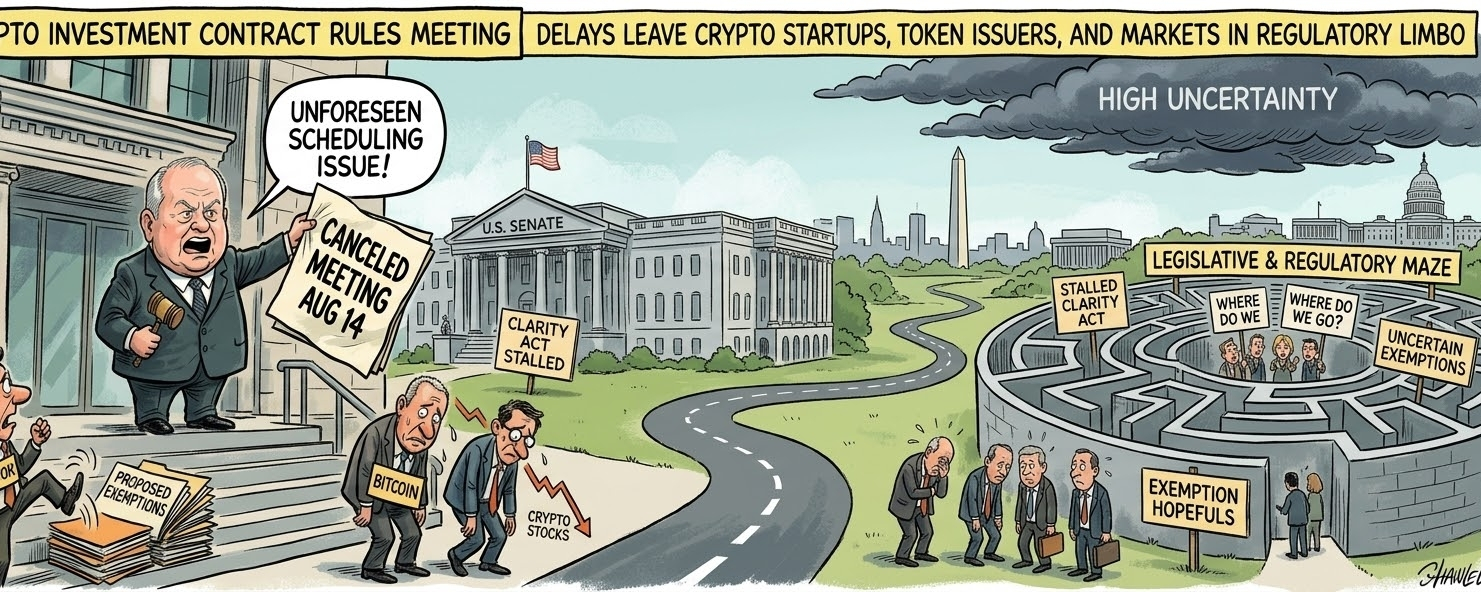
The U.S. Securities and Exchange Commission (SEC) abruptly canceled its scheduled August 14 meeting that was expected to consider new rules for certain crypto investment contracts. The agency cited an “unforeseen scheduling issue” and has not announced a new date.
The proposal was expected to create a more tailored regulatory framework for certain crypto fundraising activities, potentially giving startups exemptions or alternative paths from traditional securities registration requirements. The delay leaves crypto companies operating under existing registration and exemption rules for now.
The cancellation also comes as the U.S. Senate has delayed action on the CLARITY Act, which aims to establish a broader federal framework for digital assets. With both legislative and regulatory efforts facing delays, uncertainty around crypto fundraising and token regulation remains high.
For the crypto market, the development is a short-term setback for hopes of faster regulatory clarity, although the SEC has indicated that its broader efforts toward clearer digital-asset rules remain ongoing.
$ACE
{future}(ACEUSDT)
$VELVET
{future}(VELVETUSDT)
$BEAT
{future}(BEATUSDT)
SEC Cancels Crypto Investment Contract Rules Meeting
#seccancelscryptoinvestmentcontractrulesmeeting #AlphaFamily
The U.S. Securities and Exchange Commission (SEC) abruptly canceled its scheduled August 14 meeting that was expected to consider new rules for certain crypto investment contracts. The agency cited an “unforeseen scheduling issue” and has not announced a new date.
The proposal was expected to create a more tailored regulatory framework for certain crypto fundraising activities, potentially giving startups exemptions or alternative paths from traditional securities registration requirements. The delay leaves crypto companies operating under existing registration and exemption rules for now.
The cancellation also comes as the U.S. Senate has delayed action on the CLARITY Act, which aims to establish a broader federal framework for digital assets. With both legislative and regulatory efforts facing delays, uncertainty around crypto fundraising and token regulation remains high.
For the crypto market, the development is a short-term setback for hopes of faster regulatory clarity, although the SEC has indicated that its broader efforts toward clearer digital-asset rules remain ongoing.
$ACE
$VELVET
$BEAT
The U.S. Securities and Exchange Commission (SEC) abruptly canceled its scheduled August 14 meeting that was expected to consider new rules for certain crypto investment contracts. The agency cited an “unforeseen scheduling issue” and has not announced a new date.
The proposal was expected to create a more tailored regulatory framework for certain crypto fundraising activities, potentially giving startups exemptions or alternative paths from traditional securities registration requirements. The delay leaves crypto companies operating under existing registration and exemption rules for now.
The cancellation also comes as the U.S. Senate has delayed action on the CLARITY Act, which aims to establish a broader federal framework for digital assets. With both legislative and regulatory efforts facing delays, uncertainty around crypto fundraising and token regulation remains high.
For the crypto market, the development is a short-term setback for hopes of faster regulatory clarity, although the SEC has indicated that its broader efforts toward clearer digital-asset rules remain ongoing.
$ACE
$VELVET
$BEAT
42

#TapestryFallsNearly15%OnEarnings
📊 | TAPESTRY CAI 15% APÓS GUIDANCE FRACO
A Tapestry caiu quase 15% após a empresa divulgar resultados fortes do quarto trimestre fiscal, mas apresentar uma orientação para o ano fiscal de 2027 mais fraca do que o esperado. A ação chegou a cair até 16,9% durante o pregão, atingindo a mínima de seis meses.
🔍 O QUE OS NÚMEROS MOSTRAM:
A Tapestry, empresa-mãe da Coach e da Kate Spade, reportou receita trimestral de cerca de US$ 1,88 bilhão, alta de 9% na comparação anual, enquanto os lucros ajustados atingiram US$ 1,32 por ação, superando a estimativa de US$ 1,28 dos analistas.
A Coach permaneceu como principal motor de crescimento, com as vendas subindo cerca de 14%, enquanto a Kate Spade enfrentou uma queda de 7% nas vendas durante o trimestre. Os investidores estão cada vez mais preocupados de que a fraqueza da Kate Spade possa pesar no crescimento geral da Tapestry.
📌 O QUE PREOCUPA O MERCADO:
Para o ano fiscal de 2027, a Tapestry espera receita entre US$ 8,4 bilhões e US$ 8,5 bilhões e lucros ajustados entre US$ 7,80 e US$ 7,90 por ação. A previsão de receita ficou um pouco abaixo das expectativas de Wall Street, o que desencadeou a forte liquidação, apesar da superação nos lucros.
⚡ A REAÇÃO DO MERCADO:
A reação mostra que os investidores estão indo além de resultados positivos do passado e focando fortemente no crescimento futuro. O momento da Coach segue forte, mas o desempenho da Kate Spade e a perspectiva geral da empresa para 2027 serão fatores-chave para a ação da Tapestry daqui para frente.
#AlphaFamily
📊 ATIVOS NO RADAR:
$VELVET
$TUT
$AKE
#TapestryFallsNearly15%OnEarnings
📊 | TAPESTRY CAI 15% APÓS GUIDANCE FRACO
A Tapestry caiu quase 15% após a empresa divulgar resultados fortes do quarto trimestre fiscal, mas apresentar uma orientação para o ano fiscal de 2027 mais fraca do que o esperado. A ação chegou a cair até 16,9% durante o pregão, atingindo a mínima de seis meses.
🔍 O QUE OS NÚMEROS MOSTRAM:
A Tapestry, empresa-mãe da Coach e da Kate Spade, reportou receita trimestral de cerca de US$ 1,88 bilhão, alta de 9% na comparação anual, enquanto os lucros ajustados atingiram US$ 1,32 por ação, superando a estimativa de US$ 1,28 dos analistas.
A Coach permaneceu como principal motor de crescimento, com as vendas subindo cerca de 14%, enquanto a Kate Spade enfrentou uma queda de 7% nas vendas durante o trimestre. Os investidores estão cada vez mais preocupados de que a fraqueza da Kate Spade possa pesar no crescimento geral da Tapestry.
📌 O QUE PREOCUPA O MERCADO:
Para o ano fiscal de 2027, a Tapestry espera receita entre US$ 8,4 bilhões e US$ 8,5 bilhões e lucros ajustados entre US$ 7,80 e US$ 7,90 por ação. A previsão de receita ficou um pouco abaixo das expectativas de Wall Street, o que desencadeou a forte liquidação, apesar da superação nos lucros.
⚡ A REAÇÃO DO MERCADO:
A reação mostra que os investidores estão indo além de resultados positivos do passado e focando fortemente no crescimento futuro. O momento da Coach segue forte, mas o desempenho da Kate Spade e a perspectiva geral da empresa para 2027 serão fatores-chave para a ação da Tapestry daqui para frente.
#AlphaFamily
📊 ATIVOS NO RADAR:
$VELVET
$TUT
$AKE
📊 | TAPESTRY CAI 15% APÓS GUIDANCE FRACO
A Tapestry caiu quase 15% após a empresa divulgar resultados fortes do quarto trimestre fiscal, mas apresentar uma orientação para o ano fiscal de 2027 mais fraca do que o esperado. A ação chegou a cair até 16,9% durante o pregão, atingindo a mínima de seis meses.
🔍 O QUE OS NÚMEROS MOSTRAM:
A Tapestry, empresa-mãe da Coach e da Kate Spade, reportou receita trimestral de cerca de US$ 1,88 bilhão, alta de 9% na comparação anual, enquanto os lucros ajustados atingiram US$ 1,32 por ação, superando a estimativa de US$ 1,28 dos analistas.
A Coach permaneceu como principal motor de crescimento, com as vendas subindo cerca de 14%, enquanto a Kate Spade enfrentou uma queda de 7% nas vendas durante o trimestre. Os investidores estão cada vez mais preocupados de que a fraqueza da Kate Spade possa pesar no crescimento geral da Tapestry.
📌 O QUE PREOCUPA O MERCADO:
Para o ano fiscal de 2027, a Tapestry espera receita entre US$ 8,4 bilhões e US$ 8,5 bilhões e lucros ajustados entre US$ 7,80 e US$ 7,90 por ação. A previsão de receita ficou um pouco abaixo das expectativas de Wall Street, o que desencadeou a forte liquidação, apesar da superação nos lucros.
⚡ A REAÇÃO DO MERCADO:
A reação mostra que os investidores estão indo além de resultados positivos do passado e focando fortemente no crescimento futuro. O momento da Coach segue forte, mas o desempenho da Kate Spade e a perspectiva geral da empresa para 2027 serão fatores-chave para a ação da Tapestry daqui para frente.
#AlphaFamily
📊 ATIVOS NO RADAR:
$VELVET
$TUT
$AKE
1
130

·
--
$LUNC
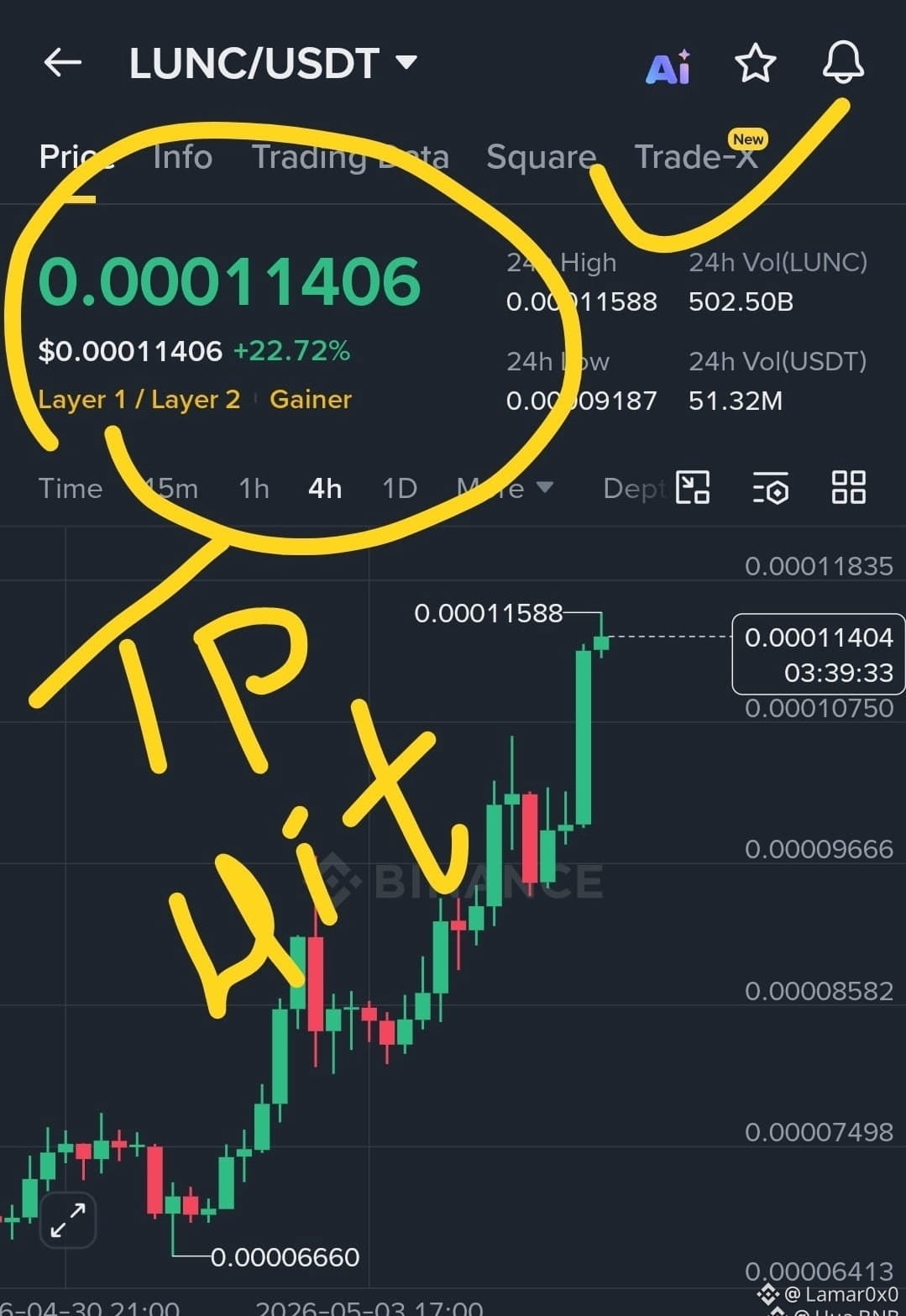
BOOM! 💥 ANOTHER DAY, ANOTHER PROFIT! 🤑🙌
Just a few moments ago, I shared the setup, and BOOM—targets smashed! 🎯🔥 If you followed my lead on $LUNC, you’re currently sitting on some juicy profits! 💰🤤
THE RESULTS:
✅ TP 1 HIT!
✅ TP 2 HIT! 🚀
📈 Captured a solid +20% move while others were still doubting!
Congratulations to my Loyal Alpha Family who trusted the vision and secured the bag! 🥂💎 We don’t gamble here, we trade with precision. 🧠✨
⚠️ MISSED THE MOVE? Stop watching from the sidelines and being the last to know. The next big opportunity is already loading... ⏳🔥
🔗 STAY CONNECTED. Follow me now and turn on notifications so you don't miss the next winning signal! 👇
#LUNC #BullishMomentum #ProfitBooked #AlphaFamily #Bullish
$LUNC
BOOM! 💥 ANOTHER DAY, ANOTHER PROFIT! 🤑🙌
Just a few moments ago, I shared the setup, and BOOM—targets smashed! 🎯🔥 If you followed my lead on $LUNC , you’re currently sitting on some juicy profits! 💰🤤
THE RESULTS:
✅ TP 1 HIT!
✅ TP 2 HIT! 🚀
📈 Captured a solid +20% move while others were still doubting!
Congratulations to my Loyal Alpha Family who trusted the vision and secured the bag! 🥂💎 We don’t gamble here, we trade with precision. 🧠✨
⚠️ MISSED THE MOVE? Stop watching from the sidelines and being the last to know. The next big opportunity is already loading... ⏳🔥
🔗 STAY CONNECTED. Follow me now and turn on notifications so you don't miss the next winning signal! 👇
#LUNC #BullishMomentum #ProfitBooked #AlphaFamily #Bullish
BOOM! 💥 ANOTHER DAY, ANOTHER PROFIT! 🤑🙌
Just a few moments ago, I shared the setup, and BOOM—targets smashed! 🎯🔥 If you followed my lead on $LUNC , you’re currently sitting on some juicy profits! 💰🤤
THE RESULTS:
✅ TP 1 HIT!
✅ TP 2 HIT! 🚀
📈 Captured a solid +20% move while others were still doubting!
Congratulations to my Loyal Alpha Family who trusted the vision and secured the bag! 🥂💎 We don’t gamble here, we trade with precision. 🧠✨
⚠️ MISSED THE MOVE? Stop watching from the sidelines and being the last to know. The next big opportunity is already loading... ⏳🔥
🔗 STAY CONNECTED. Follow me now and turn on notifications so you don't miss the next winning signal! 👇
#LUNC #BullishMomentum #ProfitBooked #AlphaFamily #Bullish
3
221
·
--
🚨 CFTC WARNING: Prediction-Market Incentives Under the Microscope
The CFTC is warning prediction-market platforms that some trading incentive filings aren’t meeting the agency’s procedural and substantive expectations.
The concern is bigger than promotions.
Poorly designed incentives can encourage artificial volume, wash trading, manipulation, and conflicts of interest. Platforms need to clearly explain how these programs work and what safeguards are in place to prevent abuse.
For platforms like Kalshi and Polymarket, this is another sign that regulatory scrutiny is moving higher as prediction markets grow.
Incentives can bring traders and liquidity, but if they create distorted activity, the same mechanism designed to grow a market can undermine its credibility.
The next phase of prediction markets may be less about attracting users at any cost and more about proving that the activity is genuine, transparent, and properly monitored.
Regulation could increase costs for platforms, but stronger compliance may also help prediction markets gain more legitimacy with regulators and traditional finance.
The real question is:
Can prediction markets scale massive liquidity without creating incentives that distort the market itself? 👀
#CFTC #PredictionMarkets #Kalshi #PolymarketWalletKeyLeak #crypto #Trading #AlphaFamily
$APR
{future}(APRUSDT)
$BR
{future}(BRUSDT)
$KAITO
{spot}(KAITOUSDT)
🚨 CFTC WARNING: Prediction-Market Incentives Under the Microscope
The CFTC is warning prediction-market platforms that some trading incentive filings aren’t meeting the agency’s procedural and substantive expectations.
The concern is bigger than promotions.
Poorly designed incentives can encourage artificial volume, wash trading, manipulation, and conflicts of interest. Platforms need to clearly explain how these programs work and what safeguards are in place to prevent abuse.
For platforms like Kalshi and Polymarket, this is another sign that regulatory scrutiny is moving higher as prediction markets grow.
Incentives can bring traders and liquidity, but if they create distorted activity, the same mechanism designed to grow a market can undermine its credibility.
The next phase of prediction markets may be less about attracting users at any cost and more about proving that the activity is genuine, transparent, and properly monitored.
Regulation could increase costs for platforms, but stronger compliance may also help prediction markets gain more legitimacy with regulators and traditional finance.
The real question is:
Can prediction markets scale massive liquidity without creating incentives that distort the market itself? 👀
#CFTC #PredictionMarkets #Kalshi #PolymarketWalletKeyLeak #crypto #Trading #AlphaFamily
$APR
$BR
$KAITO
The CFTC is warning prediction-market platforms that some trading incentive filings aren’t meeting the agency’s procedural and substantive expectations.
The concern is bigger than promotions.
Poorly designed incentives can encourage artificial volume, wash trading, manipulation, and conflicts of interest. Platforms need to clearly explain how these programs work and what safeguards are in place to prevent abuse.
For platforms like Kalshi and Polymarket, this is another sign that regulatory scrutiny is moving higher as prediction markets grow.
Incentives can bring traders and liquidity, but if they create distorted activity, the same mechanism designed to grow a market can undermine its credibility.
The next phase of prediction markets may be less about attracting users at any cost and more about proving that the activity is genuine, transparent, and properly monitored.
Regulation could increase costs for platforms, but stronger compliance may also help prediction markets gain more legitimacy with regulators and traditional finance.
The real question is:
Can prediction markets scale massive liquidity without creating incentives that distort the market itself? 👀
#CFTC #PredictionMarkets #Kalshi #PolymarketWalletKeyLeak #crypto #Trading #AlphaFamily
$APR
$BR
$KAITO
Long
33%
shot
60%
🫴
7%
15 Votes • Vote fermé
1
1.4k

Vérifié
#tapestryfallsnearly15%onearnings
📉 Designer Disaster: Why Tapestry Just Tanked 15%! 👜
The elite fashion world operates on its own timeline—wrapping up their fiscal Q4 while the rest of the market is just hitting Q2. But a premium calendar couldn't shield Tapestry (the powerhouse behind Coach & Kate Spade) from a brutal reality check this earnings season.
While Coach put in the heavy lifting to hold the line, plummeting sales from Kate Spade became a massive anchor, triggering a relentless wave of panic selling among traditional investors! 💔🛍️
The takeaway for smart money?
Let the shopping malls keep the designer bags. As crypto traders, we know where true, rewarding volatility lives. Stick to your crypto charts, block out the stock market noise, and HODL the digital bags that actually have the potential to build generational wealth! 🚀💸
(Disclaimer: Not financial advice. Always Do Your Own Research!)
#AlphaFamily #Tapestry #LuxuryFashion #stockmarket
$VELVET
{future}(VELVETUSDT)
$CROSS
{future}(CROSSUSDT)
$TPR.US
{stock_us}(TPR.US)
#tapestryfallsnearly15%onearnings
📉 Designer Disaster: Why Tapestry Just Tanked 15%! 👜
The elite fashion world operates on its own timeline—wrapping up their fiscal Q4 while the rest of the market is just hitting Q2. But a premium calendar couldn't shield Tapestry (the powerhouse behind Coach & Kate Spade) from a brutal reality check this earnings season.
While Coach put in the heavy lifting to hold the line, plummeting sales from Kate Spade became a massive anchor, triggering a relentless wave of panic selling among traditional investors! 💔🛍️
The takeaway for smart money?
Let the shopping malls keep the designer bags. As crypto traders, we know where true, rewarding volatility lives. Stick to your crypto charts, block out the stock market noise, and HODL the digital bags that actually have the potential to build generational wealth! 🚀💸
(Disclaimer: Not financial advice. Always Do Your Own Research!)
#AlphaFamily #Tapestry #LuxuryFashion #stockmarket
$VELVET
$CROSS
$TPR.US
📉 Designer Disaster: Why Tapestry Just Tanked 15%! 👜
The elite fashion world operates on its own timeline—wrapping up their fiscal Q4 while the rest of the market is just hitting Q2. But a premium calendar couldn't shield Tapestry (the powerhouse behind Coach & Kate Spade) from a brutal reality check this earnings season.
While Coach put in the heavy lifting to hold the line, plummeting sales from Kate Spade became a massive anchor, triggering a relentless wave of panic selling among traditional investors! 💔🛍️
The takeaway for smart money?
Let the shopping malls keep the designer bags. As crypto traders, we know where true, rewarding volatility lives. Stick to your crypto charts, block out the stock market noise, and HODL the digital bags that actually have the potential to build generational wealth! 🚀💸
(Disclaimer: Not financial advice. Always Do Your Own Research!)
#AlphaFamily #Tapestry #LuxuryFashion #stockmarket
$VELVET
$CROSS
$TPR.US

1
2.5k
Connectez-vous pour découvrir plus de contenu
Rejoignez la communauté mondiale des adeptes de cryptomonnaies sur Binance Square
⚡️ Suviez les dernières informations importantes sur les cryptomonnaies.
💬 Jugé digne de confiance par la plus grande plateforme d’échange de cryptomonnaies au monde.
👍 Découvrez les connaissances que partagent les créateurs vérifiés.
Adresse e-mail/Nº de téléphone
Sujets d’actualité
1
#AnthropicIPOProspectusCouldValueItOver$2T
308 vues
25 mentions
2
#HackersDrainOver12.4MXRPFromDCENTWallets
3,402 vues
145 mentions
3
#SECSaysDecentralizedTokenBuybacksNotInvestmentContracts
98 vues
5 mentions
4
#UKFCAWinsCourtOrderToRecover851400Pounds
58,328 vues
1,052 mentions
5
#ChainlinkLaunchesCCIP2WithEnterpriseVerification
67,875 vues
1,185 mentions
6
#GoldFallsTo$4144
22,312 vues
181 mentions
7
#QNTFallsOver40%FromMorningHigh
117,801 vues
1,563 mentions
8
#USDTAdds845900HoldersInPast7Days
34,423 vues
600 mentions
9
#KospiFalls2.7%SamsungSKHynixDropOver5%
44,394 vues
704 mentions
10
#BitgetCEOConfirms$388MStolenInHack
6,242 vues
45 mentions