

#arifalpha
arifalpha
46,191 vues
1,005 mentions
Populaire
Récents

·
--

Article
What Are Stock-Paired Memes? How Tokenized Stocks Become Trading PairsIntroduction
Tokenized stocks are becoming a currency for crypto speculation. On Robinhood Chain and Solana, traders can exchange memes against tokens tracking equities or ETFs, bringing stock exposure into the pricing of a speculative asset.
The distinction is where each ecosystem starts. Robinhood Chain developed an early cluster of stock-pair launchpads. Solana already had xStocks trading and lending integrations before StonkFun brought renewed attention to token launches. The contest is whether these experiments create lasting liquidity for tokenized equities.
What Exactly Is a Stock-Paired Meme?
A stock-paired meme trades against a tokenized security in a liquidity pool. In a MEME/NVDA-token pool, the quote expresses how many NVIDIA-tracking tokens buy one MEME. The stock token is the quote asset; it does not become a shareholding entitlement attached to MEME.
The pricing relationship is:
MEME dollar price = MEME/stock-token exchange rate × stock-token dollar price.
For a hypothetical example, a 20% rise against the quote token combined with a 10% decline in that token’s dollar price produces an 8% dollar gain, before costs: 1.20 × 0.90 − 1. The reverse also matters: MEME can fall despite a rising stock market.
This relationship describes quoted prices. Actual exit proceeds depend on liquidity, fees and slippage.
Why It Matters Now
By late July 2026, LONG and Bankr were supporting stock-paired launches on Robinhood Chain, while Pons was preparing custom pairs for V2. Pons V2 subsequently went live and was operating by early September. Creators could build a meme around a familiar company and use its stock token as the asset traders exchanged against it.
On September 5–6, 2026, StonkFun integrated with Raydium LaunchLab, bringing fresh attention to the format on Solana. Its SPYx-paired STONK token had a market capitalization of roughly $140 million in a CoinGecko snapshot cited at around 4:30 p.m. Eastern Time on September 6, 2026. That valuation reflects demand for STONK; it does not mean $140 million of ETF assets entered its liquidity pool.
LaunchLab lets new tokens begin trading on a bonding curve and moves their liquidity into a Raydium AMM once they reach a graduation threshold. For creators, this connects token issuance with an established trading venue. Whether traders stay depends on the liquidity and interest each launch can sustain.
What Makes the Two Ecosystems Different?
1. Stock-Focused Infrastructure Versus an Existing DeFi Network
Robinhood describes its Arbitrum-based Layer 2 as infrastructure for financial services and tokenized assets. Its Stock Tokens sit at the center of that positioning.
Solana’s xStocks launched on June 30, 2025, with exchange distribution and trading access through Raydium and Jupiter. Kamino added collateral support for selected xStocks shortly after launch; this did not mean every xStock could be used to borrow on launch day. Stock tokens therefore had trading and collateral uses before the latest launchpad attention. This supports the case for an established application base; it does not establish a current liquidity lead for every stock.
2. Similar Exposure Does Not Mean Identical Rights
Robinhood Stock Tokens are debt securities issued by Robinhood Assets (Jersey) Limited. They provide economic exposure without rights in the underlying companies. xStocks have 1:1 underlying-asset backing, but Kraken’s disclosure likewise states that holders do not own the underlying shares or receive shareholder voting rights.
3. Thin Supply Can Distort the Quote Asset
Over the August 30, 2026 weekend, BONER-related activity reportedly concentrated more than half of Robinhood Chain’s tokenized HIMS supply and briefly pushed its price to $132.64 in thin trading, against the underlying stock’s $28.84 Friday close. The distortion concerned the onchain instrument.
When replenishment and arbitrage are constrained, especially outside underlying-market hours, a thin stock token can diverge from its reference asset. The resulting premium can inflate a meme’s displayed dollar valuation and unwind independently of its popularity.
What Trend Does It Represent?
Tokenization is expanding from holding financial exposure to using it inside applications. Sustainable launches could generate recurring trading demand and fees. The weaker outcome is circular speculation: thin quote assets amplify valuations, rising valuations attract activity, and both contract when attention fades.
Conclusion
Robinhood Chain demonstrates early breadth in stock-pair experimentation; Solana brings an established xStocks application base to the launchpad opportunity. Watch liquidity outside headline tokens, repeat users, net stock-token issuance, pool concentration and premiums after normal market trading resumes. Persistent depth would strengthen the adoption thesis. Activity that disappears with a few meme rallies would weaken it.
#TokenizedStocks #CryptoTrading #ArifAlpha #CryptoEducation
What Are Stock-Paired Memes? How Tokenized Stocks Become Trading Pairs
Introduction
Tokenized stocks are becoming a currency for crypto speculation. On Robinhood Chain and Solana, traders can exchange memes against tokens tracking equities or ETFs, bringing stock exposure into the pricing of a speculative asset.
The distinction is where each ecosystem starts. Robinhood Chain developed an early cluster of stock-pair launchpads. Solana already had xStocks trading and lending integrations before StonkFun brought renewed attention to token launches. The contest is whether these experiments create lasting liquidity for tokenized equities.
What Exactly Is a Stock-Paired Meme?
A stock-paired meme trades against a tokenized security in a liquidity pool. In a MEME/NVDA-token pool, the quote expresses how many NVIDIA-tracking tokens buy one MEME. The stock token is the quote asset; it does not become a shareholding entitlement attached to MEME.
The pricing relationship is:
MEME dollar price = MEME/stock-token exchange rate × stock-token dollar price.
For a hypothetical example, a 20% rise against the quote token combined with a 10% decline in that token’s dollar price produces an 8% dollar gain, before costs: 1.20 × 0.90 − 1. The reverse also matters: MEME can fall despite a rising stock market.
This relationship describes quoted prices. Actual exit proceeds depend on liquidity, fees and slippage.
Why It Matters Now
By late July 2026, LONG and Bankr were supporting stock-paired launches on Robinhood Chain, while Pons was preparing custom pairs for V2. Pons V2 subsequently went live and was operating by early September. Creators could build a meme around a familiar company and use its stock token as the asset traders exchanged against it.
On September 5–6, 2026, StonkFun integrated with Raydium LaunchLab, bringing fresh attention to the format on Solana. Its SPYx-paired STONK token had a market capitalization of roughly $140 million in a CoinGecko snapshot cited at around 4:30 p.m. Eastern Time on September 6, 2026. That valuation reflects demand for STONK; it does not mean $140 million of ETF assets entered its liquidity pool.
LaunchLab lets new tokens begin trading on a bonding curve and moves their liquidity into a Raydium AMM once they reach a graduation threshold. For creators, this connects token issuance with an established trading venue. Whether traders stay depends on the liquidity and interest each launch can sustain.
What Makes the Two Ecosystems Different?
1. Stock-Focused Infrastructure Versus an Existing DeFi Network
Robinhood describes its Arbitrum-based Layer 2 as infrastructure for financial services and tokenized assets. Its Stock Tokens sit at the center of that positioning.
Solana’s xStocks launched on June 30, 2025, with exchange distribution and trading access through Raydium and Jupiter. Kamino added collateral support for selected xStocks shortly after launch; this did not mean every xStock could be used to borrow on launch day. Stock tokens therefore had trading and collateral uses before the latest launchpad attention. This supports the case for an established application base; it does not establish a current liquidity lead for every stock.
2. Similar Exposure Does Not Mean Identical Rights
Robinhood Stock Tokens are debt securities issued by Robinhood Assets (Jersey) Limited. They provide economic exposure without rights in the underlying companies. xStocks have 1:1 underlying-asset backing, but Kraken’s disclosure likewise states that holders do not own the underlying shares or receive shareholder voting rights.
3. Thin Supply Can Distort the Quote Asset
Over the August 30, 2026 weekend, BONER-related activity reportedly concentrated more than half of Robinhood Chain’s tokenized HIMS supply and briefly pushed its price to $132.64 in thin trading, against the underlying stock’s $28.84 Friday close. The distortion concerned the onchain instrument.
When replenishment and arbitrage are constrained, especially outside underlying-market hours, a thin stock token can diverge from its reference asset. The resulting premium can inflate a meme’s displayed dollar valuation and unwind independently of its popularity.
What Trend Does It Represent?
Tokenization is expanding from holding financial exposure to using it inside applications. Sustainable launches could generate recurring trading demand and fees. The weaker outcome is circular speculation: thin quote assets amplify valuations, rising valuations attract activity, and both contract when attention fades.
Conclusion
Robinhood Chain demonstrates early breadth in stock-pair experimentation; Solana brings an established xStocks application base to the launchpad opportunity. Watch liquidity outside headline tokens, repeat users, net stock-token issuance, pool concentration and premiums after normal market trading resumes. Persistent depth would strengthen the adoption thesis. Activity that disappears with a few meme rallies would weaken it.
#TokenizedStocks #CryptoTrading #ArifAlpha #CryptoEducation
Tokenized stocks are becoming a currency for crypto speculation. On Robinhood Chain and Solana, traders can exchange memes against tokens tracking equities or ETFs, bringing stock exposure into the pricing of a speculative asset.
The distinction is where each ecosystem starts. Robinhood Chain developed an early cluster of stock-pair launchpads. Solana already had xStocks trading and lending integrations before StonkFun brought renewed attention to token launches. The contest is whether these experiments create lasting liquidity for tokenized equities.
What Exactly Is a Stock-Paired Meme?
A stock-paired meme trades against a tokenized security in a liquidity pool. In a MEME/NVDA-token pool, the quote expresses how many NVIDIA-tracking tokens buy one MEME. The stock token is the quote asset; it does not become a shareholding entitlement attached to MEME.
The pricing relationship is:
MEME dollar price = MEME/stock-token exchange rate × stock-token dollar price.
For a hypothetical example, a 20% rise against the quote token combined with a 10% decline in that token’s dollar price produces an 8% dollar gain, before costs: 1.20 × 0.90 − 1. The reverse also matters: MEME can fall despite a rising stock market.
This relationship describes quoted prices. Actual exit proceeds depend on liquidity, fees and slippage.
Why It Matters Now
By late July 2026, LONG and Bankr were supporting stock-paired launches on Robinhood Chain, while Pons was preparing custom pairs for V2. Pons V2 subsequently went live and was operating by early September. Creators could build a meme around a familiar company and use its stock token as the asset traders exchanged against it.
On September 5–6, 2026, StonkFun integrated with Raydium LaunchLab, bringing fresh attention to the format on Solana. Its SPYx-paired STONK token had a market capitalization of roughly $140 million in a CoinGecko snapshot cited at around 4:30 p.m. Eastern Time on September 6, 2026. That valuation reflects demand for STONK; it does not mean $140 million of ETF assets entered its liquidity pool.
LaunchLab lets new tokens begin trading on a bonding curve and moves their liquidity into a Raydium AMM once they reach a graduation threshold. For creators, this connects token issuance with an established trading venue. Whether traders stay depends on the liquidity and interest each launch can sustain.
What Makes the Two Ecosystems Different?
1. Stock-Focused Infrastructure Versus an Existing DeFi Network
Robinhood describes its Arbitrum-based Layer 2 as infrastructure for financial services and tokenized assets. Its Stock Tokens sit at the center of that positioning.
Solana’s xStocks launched on June 30, 2025, with exchange distribution and trading access through Raydium and Jupiter. Kamino added collateral support for selected xStocks shortly after launch; this did not mean every xStock could be used to borrow on launch day. Stock tokens therefore had trading and collateral uses before the latest launchpad attention. This supports the case for an established application base; it does not establish a current liquidity lead for every stock.
2. Similar Exposure Does Not Mean Identical Rights
Robinhood Stock Tokens are debt securities issued by Robinhood Assets (Jersey) Limited. They provide economic exposure without rights in the underlying companies. xStocks have 1:1 underlying-asset backing, but Kraken’s disclosure likewise states that holders do not own the underlying shares or receive shareholder voting rights.
3. Thin Supply Can Distort the Quote Asset
Over the August 30, 2026 weekend, BONER-related activity reportedly concentrated more than half of Robinhood Chain’s tokenized HIMS supply and briefly pushed its price to $132.64 in thin trading, against the underlying stock’s $28.84 Friday close. The distortion concerned the onchain instrument.
When replenishment and arbitrage are constrained, especially outside underlying-market hours, a thin stock token can diverge from its reference asset. The resulting premium can inflate a meme’s displayed dollar valuation and unwind independently of its popularity.
What Trend Does It Represent?
Tokenization is expanding from holding financial exposure to using it inside applications. Sustainable launches could generate recurring trading demand and fees. The weaker outcome is circular speculation: thin quote assets amplify valuations, rising valuations attract activity, and both contract when attention fades.
Conclusion
Robinhood Chain demonstrates early breadth in stock-pair experimentation; Solana brings an established xStocks application base to the launchpad opportunity. Watch liquidity outside headline tokens, repeat users, net stock-token issuance, pool concentration and premiums after normal market trading resumes. Persistent depth would strengthen the adoption thesis. Activity that disappears with a few meme rallies would weaken it.
#TokenizedStocks #CryptoTrading #ArifAlpha #CryptoEducation
85
·
--

Article
The Agentic Economy: Why Crypto May Become the Default Payment Channel for Artificial IntelligenceArtificial intelligence is rapidly evolving from an information-providing tool into a system capable of taking action.
Meanwhile, blockchain technology is evolving from speculation into a programmable financial infrastructure capable of supporting entirely new forms of economic activity.
The combination of these two technologies is creating something unprecedented: an economic system composed of autonomous AI agents , in which AI agents can negotiate, trade, and settle value without human intervention.
Artificial intelligence provides the intelligence, while blockchain provides the economic foundation.
In the future, it may no longer be humans clicking the "Pay" button, but software agents trading with other software agents in real-time.
The Rise of the Agent Economy
Today's AI systems are already capable of performing tasks once thought to be uniquely human. The next step is achieving autonomous operation.
Modern AI agents are increasingly capable of the following:
Book travelContract negotiation and pricingProcure dataHire specialized agentsPay for compute resourcesSettle micropaymentsManage ongoing workflows
As these systems become increasingly automated, requiring manual approval for every trade becomes a major bottleneck.
Software runs at machine speed, whereas manual approval processes do not.
As a result, there is a growing demand for economic infrastructure specifically designed for autonomous agents.
Why Traditional Payment Methods Fail
Global payment systems are designed for people, not for software.
Credit cards, bank transfers, the ACH network, and traditional payment processing methods rely on human intervention at every step. While effective for consumer transactions, they fall short when applied to machine-to-machine transactions.
Traditional payment systems typically have the following characteristics:
Too slow, with settlement times ranging from a few seconds to several days.Too costly for high-frequency, low-value transactions.Dependent on account creation, identity verification, and manual approval processes.Optimized around human-machine interaction rather than autonomous execution.
Imagine an AI agent making hundreds of API calls, data purchases, or service requests per minute.
Under traditional payment systems, transaction fees can quickly exceed the transaction value, while settlement delays undermine agents' ability to operate in real-time.
This economic model simply does not work.
Enter Agentic Payments
Agent payments represent a new paradigm where AI agents can initiate and execute transactions within predefined rules set by humans or organizations.
May include:
Spending LimitsBudget AllocationApproval ThresholdsUsage RestrictionsCompliance Requirements
Within these boundaries, agents can operate independently.
Each agent is assigned a wallet, enabling it to discover services, negotiate prices, complete payments, and proceed with tasks without having to wait for human approval at every step.
This transforms the payment process from manual operation to programmable operation.
Why Cryptocurrency Is a Natural Fit
Blockchain-based payment systems address many of the challenges faced by autonomous agents.
Programmable Money
Smart contracts allow payments to be directly linked to outcomes and conditions.
Agents can:
Make payment only after delivery of goods is confirmed.Make continuous streaming payments based on resource consumptionAutomatically execute escrow agreementsExecute contract conditions without intermediaries
Money itself has also become part of the software logic.
Internet-Scale Micropayments
Modern blockchains and Layer 2 networks provide:
Near real-time settlementExtremely low transaction costsSub-cent payment capability
This makes entirely new business models possible.
Agents only need to pay fractions of a cent to access an API call, a piece of data, or a moment of compute power—something that is economically impractical in traditional payment systems.
Global License-Free Access
Autonomous agents are not constrained by geographic location.
Blockchain networks enable cross-border transactions without the need for local banking relationships or complex payment integrations.
An AI agent in one country can seamlessly trade with service providers anywhere in the world.
Stablecoins Make Spending More Convenient
Volatility has always been seen as a challenge facing cryptocurrency payments.
Stablecoins (such as USDC) help solve this problem by providing predictable value while retaining the benefits of blockchain infrastructure.
For agents, stablecoins provide a practical medium of exchange, acting more like digital cash rather than speculative assets.
Infrastructure Has Taken Shape
While the vision of autonomous economic agents may sound like futuristic technology, its underlying infrastructure is already being built.
Several key developments are accelerating this transition:
Coinbase's x402 standard is reviving HTTP 402 ("Payment Required") to enable native internet payments.AI Agents can increasingly pay directly for API access permissions, content, and digital services.AWS Bedrock integration is supporting transactional AI workflows.Embedded wallets on Base simplify agent ownership and spending.Protocols like Circle Nanopayments and Nevermined are creating machine-to-machine commerce frameworks.Major fintech and payment companies are actively exploring AI-native wallet experiences.
Once-experimental infrastructure is steadily moving toward production deployment.
Economic Opportunities
The emergence of autonomous agents may create entirely new markets and business models.
Everything Based on Usage
In addition to fixed subscription models, services can also monetize through the following methods:
Pay-per-searchPay-per-inferencePay-per-API requestPay-per-data retrieval
Every interaction can be measured using economic indicators.
Agent-to-Agent Market
Specialized AI agents may begin purchasing services from one another.
An agent responsible for research can hire another agent for data collection. Customer service representatives can purchase translation services from language agent agencies.
These interactions create self-organizing digital markets that operate continuously without human intervention.
Immense Economic Scalability
Unlike human employees, autonomous agents can operate 24 hours a day, 7 days a week.
Millions (or even eventually billions) of traders can trade simultaneously, thereby creating an entirely new layer of economic activity.
Composable Financial Workflows
Blockchain infrastructure enables agents to combine multiple financial primitives into an automated workflow.
agents can seamlessly integrate:
PaymentsEscrow systemsLending protocolsGovernance mechanismsFinancial managementDecentralized organizations
In this paradigm, the blockchain becomes the trustless execution layer for AI-driven decisions.
Challenges Remain
Despite the strong momentum, significant challenges remain to be addressed before agentic commerce sees widespread adoption.
Key areas include:
Security and spending controlsAgent identity and accountabilityRegulatory clarity and liability frameworksFiat-to-crypto deposits and withdrawalsCross-chain interoperability
Encouragingly, some solutions have already emerged through the following approaches:
Permissioned and tiered wallet architecturesProgrammatic compliance systemsHybrid fiat-crypto payment railsCross-chain infrastructure and standards
This technology is still in its early stages, but the direction of its development is becoming increasingly clear.
The Big Picture
The agent economy needs a form of currency that circulates at machine speed.
As AI agents become independent economic actors, the financial infrastructure supporting them must possess the following characteristics:
InstantProgrammableGlobalAutonomous
This is precisely where the unique advantage of blockchain and stablecoins lies.
Cryptocurrency may not only become part of the rise of artificial intelligence, but could also serve as the settlement layer for an autonomous machine economy.
AI provides intelligence.
Blockchain provides the economic foundation.
In the future, it may not necessarily be humans clicking the "Pay" button.
It could be autonomous agents directly negotiating, trading, and settling value on-chain.
The remaining question is simple:
Will the number of AI agents surpass online human users first, or will the number of AI agent wallets surpass human wallets first?
#CryptoEducation #Web3Education #ArifAlpha
The Agentic Economy: Why Crypto May Become the Default Payment Channel for Artificial Intelligence
Artificial intelligence is rapidly evolving from an information-providing tool into a system capable of taking action.
Meanwhile, blockchain technology is evolving from speculation into a programmable financial infrastructure capable of supporting entirely new forms of economic activity.
The combination of these two technologies is creating something unprecedented: an economic system composed of autonomous AI agents , in which AI agents can negotiate, trade, and settle value without human intervention.
Artificial intelligence provides the intelligence, while blockchain provides the economic foundation.
In the future, it may no longer be humans clicking the "Pay" button, but software agents trading with other software agents in real-time.
The Rise of the Agent Economy
Today's AI systems are already capable of performing tasks once thought to be uniquely human. The next step is achieving autonomous operation.
Modern AI agents are increasingly capable of the following:
Book travelContract negotiation and pricingProcure dataHire specialized agentsPay for compute resourcesSettle micropaymentsManage ongoing workflows
As these systems become increasingly automated, requiring manual approval for every trade becomes a major bottleneck.
Software runs at machine speed, whereas manual approval processes do not.
As a result, there is a growing demand for economic infrastructure specifically designed for autonomous agents.
Why Traditional Payment Methods Fail
Global payment systems are designed for people, not for software.
Credit cards, bank transfers, the ACH network, and traditional payment processing methods rely on human intervention at every step. While effective for consumer transactions, they fall short when applied to machine-to-machine transactions.
Traditional payment systems typically have the following characteristics:
Too slow, with settlement times ranging from a few seconds to several days.Too costly for high-frequency, low-value transactions.Dependent on account creation, identity verification, and manual approval processes.Optimized around human-machine interaction rather than autonomous execution.
Imagine an AI agent making hundreds of API calls, data purchases, or service requests per minute.
Under traditional payment systems, transaction fees can quickly exceed the transaction value, while settlement delays undermine agents' ability to operate in real-time.
This economic model simply does not work.
Enter Agentic Payments
Agent payments represent a new paradigm where AI agents can initiate and execute transactions within predefined rules set by humans or organizations.
May include:
Spending LimitsBudget AllocationApproval ThresholdsUsage RestrictionsCompliance Requirements
Within these boundaries, agents can operate independently.
Each agent is assigned a wallet, enabling it to discover services, negotiate prices, complete payments, and proceed with tasks without having to wait for human approval at every step.
This transforms the payment process from manual operation to programmable operation.
Why Cryptocurrency Is a Natural Fit
Blockchain-based payment systems address many of the challenges faced by autonomous agents.
Programmable Money
Smart contracts allow payments to be directly linked to outcomes and conditions.
Agents can:
Make payment only after delivery of goods is confirmed.Make continuous streaming payments based on resource consumptionAutomatically execute escrow agreementsExecute contract conditions without intermediaries
Money itself has also become part of the software logic.
Internet-Scale Micropayments
Modern blockchains and Layer 2 networks provide:
Near real-time settlementExtremely low transaction costsSub-cent payment capability
This makes entirely new business models possible.
Agents only need to pay fractions of a cent to access an API call, a piece of data, or a moment of compute power—something that is economically impractical in traditional payment systems.
Global License-Free Access
Autonomous agents are not constrained by geographic location.
Blockchain networks enable cross-border transactions without the need for local banking relationships or complex payment integrations.
An AI agent in one country can seamlessly trade with service providers anywhere in the world.
Stablecoins Make Spending More Convenient
Volatility has always been seen as a challenge facing cryptocurrency payments.
Stablecoins (such as USDC) help solve this problem by providing predictable value while retaining the benefits of blockchain infrastructure.
For agents, stablecoins provide a practical medium of exchange, acting more like digital cash rather than speculative assets.
Infrastructure Has Taken Shape
While the vision of autonomous economic agents may sound like futuristic technology, its underlying infrastructure is already being built.
Several key developments are accelerating this transition:
Coinbase's x402 standard is reviving HTTP 402 ("Payment Required") to enable native internet payments.AI Agents can increasingly pay directly for API access permissions, content, and digital services.AWS Bedrock integration is supporting transactional AI workflows.Embedded wallets on Base simplify agent ownership and spending.Protocols like Circle Nanopayments and Nevermined are creating machine-to-machine commerce frameworks.Major fintech and payment companies are actively exploring AI-native wallet experiences.
Once-experimental infrastructure is steadily moving toward production deployment.
Economic Opportunities
The emergence of autonomous agents may create entirely new markets and business models.
Everything Based on Usage
In addition to fixed subscription models, services can also monetize through the following methods:
Pay-per-searchPay-per-inferencePay-per-API requestPay-per-data retrieval
Every interaction can be measured using economic indicators.
Agent-to-Agent Market
Specialized AI agents may begin purchasing services from one another.
An agent responsible for research can hire another agent for data collection. Customer service representatives can purchase translation services from language agent agencies.
These interactions create self-organizing digital markets that operate continuously without human intervention.
Immense Economic Scalability
Unlike human employees, autonomous agents can operate 24 hours a day, 7 days a week.
Millions (or even eventually billions) of traders can trade simultaneously, thereby creating an entirely new layer of economic activity.
Composable Financial Workflows
Blockchain infrastructure enables agents to combine multiple financial primitives into an automated workflow.
agents can seamlessly integrate:
PaymentsEscrow systemsLending protocolsGovernance mechanismsFinancial managementDecentralized organizations
In this paradigm, the blockchain becomes the trustless execution layer for AI-driven decisions.
Challenges Remain
Despite the strong momentum, significant challenges remain to be addressed before agentic commerce sees widespread adoption.
Key areas include:
Security and spending controlsAgent identity and accountabilityRegulatory clarity and liability frameworksFiat-to-crypto deposits and withdrawalsCross-chain interoperability
Encouragingly, some solutions have already emerged through the following approaches:
Permissioned and tiered wallet architecturesProgrammatic compliance systemsHybrid fiat-crypto payment railsCross-chain infrastructure and standards
This technology is still in its early stages, but the direction of its development is becoming increasingly clear.
The Big Picture
The agent economy needs a form of currency that circulates at machine speed.
As AI agents become independent economic actors, the financial infrastructure supporting them must possess the following characteristics:
InstantProgrammableGlobalAutonomous
This is precisely where the unique advantage of blockchain and stablecoins lies.
Cryptocurrency may not only become part of the rise of artificial intelligence, but could also serve as the settlement layer for an autonomous machine economy.
AI provides intelligence.
Blockchain provides the economic foundation.
In the future, it may not necessarily be humans clicking the "Pay" button.
It could be autonomous agents directly negotiating, trading, and settling value on-chain.
The remaining question is simple:
Will the number of AI agents surpass online human users first, or will the number of AI agent wallets surpass human wallets first?
#CryptoEducation #Web3Education #ArifAlpha
Meanwhile, blockchain technology is evolving from speculation into a programmable financial infrastructure capable of supporting entirely new forms of economic activity.
The combination of these two technologies is creating something unprecedented: an economic system composed of autonomous AI agents , in which AI agents can negotiate, trade, and settle value without human intervention.
Artificial intelligence provides the intelligence, while blockchain provides the economic foundation.
In the future, it may no longer be humans clicking the "Pay" button, but software agents trading with other software agents in real-time.
The Rise of the Agent Economy
Today's AI systems are already capable of performing tasks once thought to be uniquely human. The next step is achieving autonomous operation.
Modern AI agents are increasingly capable of the following:
Book travelContract negotiation and pricingProcure dataHire specialized agentsPay for compute resourcesSettle micropaymentsManage ongoing workflows
As these systems become increasingly automated, requiring manual approval for every trade becomes a major bottleneck.
Software runs at machine speed, whereas manual approval processes do not.
As a result, there is a growing demand for economic infrastructure specifically designed for autonomous agents.
Why Traditional Payment Methods Fail
Global payment systems are designed for people, not for software.
Credit cards, bank transfers, the ACH network, and traditional payment processing methods rely on human intervention at every step. While effective for consumer transactions, they fall short when applied to machine-to-machine transactions.
Traditional payment systems typically have the following characteristics:
Too slow, with settlement times ranging from a few seconds to several days.Too costly for high-frequency, low-value transactions.Dependent on account creation, identity verification, and manual approval processes.Optimized around human-machine interaction rather than autonomous execution.
Imagine an AI agent making hundreds of API calls, data purchases, or service requests per minute.
Under traditional payment systems, transaction fees can quickly exceed the transaction value, while settlement delays undermine agents' ability to operate in real-time.
This economic model simply does not work.
Enter Agentic Payments
Agent payments represent a new paradigm where AI agents can initiate and execute transactions within predefined rules set by humans or organizations.
May include:
Spending LimitsBudget AllocationApproval ThresholdsUsage RestrictionsCompliance Requirements
Within these boundaries, agents can operate independently.
Each agent is assigned a wallet, enabling it to discover services, negotiate prices, complete payments, and proceed with tasks without having to wait for human approval at every step.
This transforms the payment process from manual operation to programmable operation.
Why Cryptocurrency Is a Natural Fit
Blockchain-based payment systems address many of the challenges faced by autonomous agents.
Programmable Money
Smart contracts allow payments to be directly linked to outcomes and conditions.
Agents can:
Make payment only after delivery of goods is confirmed.Make continuous streaming payments based on resource consumptionAutomatically execute escrow agreementsExecute contract conditions without intermediaries
Money itself has also become part of the software logic.
Internet-Scale Micropayments
Modern blockchains and Layer 2 networks provide:
Near real-time settlementExtremely low transaction costsSub-cent payment capability
This makes entirely new business models possible.
Agents only need to pay fractions of a cent to access an API call, a piece of data, or a moment of compute power—something that is economically impractical in traditional payment systems.
Global License-Free Access
Autonomous agents are not constrained by geographic location.
Blockchain networks enable cross-border transactions without the need for local banking relationships or complex payment integrations.
An AI agent in one country can seamlessly trade with service providers anywhere in the world.
Stablecoins Make Spending More Convenient
Volatility has always been seen as a challenge facing cryptocurrency payments.
Stablecoins (such as USDC) help solve this problem by providing predictable value while retaining the benefits of blockchain infrastructure.
For agents, stablecoins provide a practical medium of exchange, acting more like digital cash rather than speculative assets.
Infrastructure Has Taken Shape
While the vision of autonomous economic agents may sound like futuristic technology, its underlying infrastructure is already being built.
Several key developments are accelerating this transition:
Coinbase's x402 standard is reviving HTTP 402 ("Payment Required") to enable native internet payments.AI Agents can increasingly pay directly for API access permissions, content, and digital services.AWS Bedrock integration is supporting transactional AI workflows.Embedded wallets on Base simplify agent ownership and spending.Protocols like Circle Nanopayments and Nevermined are creating machine-to-machine commerce frameworks.Major fintech and payment companies are actively exploring AI-native wallet experiences.
Once-experimental infrastructure is steadily moving toward production deployment.
Economic Opportunities
The emergence of autonomous agents may create entirely new markets and business models.
Everything Based on Usage
In addition to fixed subscription models, services can also monetize through the following methods:
Pay-per-searchPay-per-inferencePay-per-API requestPay-per-data retrieval
Every interaction can be measured using economic indicators.
Agent-to-Agent Market
Specialized AI agents may begin purchasing services from one another.
An agent responsible for research can hire another agent for data collection. Customer service representatives can purchase translation services from language agent agencies.
These interactions create self-organizing digital markets that operate continuously without human intervention.
Immense Economic Scalability
Unlike human employees, autonomous agents can operate 24 hours a day, 7 days a week.
Millions (or even eventually billions) of traders can trade simultaneously, thereby creating an entirely new layer of economic activity.
Composable Financial Workflows
Blockchain infrastructure enables agents to combine multiple financial primitives into an automated workflow.
agents can seamlessly integrate:
PaymentsEscrow systemsLending protocolsGovernance mechanismsFinancial managementDecentralized organizations
In this paradigm, the blockchain becomes the trustless execution layer for AI-driven decisions.
Challenges Remain
Despite the strong momentum, significant challenges remain to be addressed before agentic commerce sees widespread adoption.
Key areas include:
Security and spending controlsAgent identity and accountabilityRegulatory clarity and liability frameworksFiat-to-crypto deposits and withdrawalsCross-chain interoperability
Encouragingly, some solutions have already emerged through the following approaches:
Permissioned and tiered wallet architecturesProgrammatic compliance systemsHybrid fiat-crypto payment railsCross-chain infrastructure and standards
This technology is still in its early stages, but the direction of its development is becoming increasingly clear.
The Big Picture
The agent economy needs a form of currency that circulates at machine speed.
As AI agents become independent economic actors, the financial infrastructure supporting them must possess the following characteristics:
InstantProgrammableGlobalAutonomous
This is precisely where the unique advantage of blockchain and stablecoins lies.
Cryptocurrency may not only become part of the rise of artificial intelligence, but could also serve as the settlement layer for an autonomous machine economy.
AI provides intelligence.
Blockchain provides the economic foundation.
In the future, it may not necessarily be humans clicking the "Pay" button.
It could be autonomous agents directly negotiating, trading, and settling value on-chain.
The remaining question is simple:
Will the number of AI agents surpass online human users first, or will the number of AI agent wallets surpass human wallets first?
#CryptoEducation #Web3Education #ArifAlpha
75
·
--

Article
NEAR: Trading Volume Is Growing, But Can That Growth Actually Create Token Value?NEAR is going through an important transformation.
It started as a high-performance Layer 1 focused on scalability, low fees and fast transactions. Today, the bigger story is becoming Chain Abstraction + Cross-Chain Infrastructure + AI Agents.
That sounds powerful, but there is one question investors should not ignore:
Is NEAR becoming more useful, or is NEAR becoming more valuable?
Those two things are not always the same.
▪️ 1. NEAR is moving beyond the traditional Layer 1 race
Competing purely on speed and low transaction fees has become difficult.
Solana, Sui, Aptos and Ethereum Layer 2 networks already offer strong performance.
NEAR’s response is Chain Abstraction.
The idea is simple: users should not have to worry about which blockchain they are using, which bridge they need, where liquidity is located, or which Gas token they need.
They simply specify what they want, while the infrastructure handles the complexity in the background.
This is where NEAR Intents becomes important.
According to the provided analysis, NEAR Intents has processed more than $13 billion in cross-chain settlement volume.
That is impressive.
But volume alone does not tell us how much economic value NEAR itself captures.
▪️ 2. The $13B question is actually about revenue
This is probably the most important part of the thesis.
In the 30 days leading up to September 1, NEAR-related products generated approximately $3.48 million in total fees.
However, after payments to solvers, partners, applications and other participants, the reported net protocol fees were around $757,500.
This creates an important distinction:
High transaction volume ≠ high protocol revenue ≠ high token value.
Cross-chain infrastructure requires liquidity providers, market makers, solvers and applications.
They all need to capture part of the economics.
So the real question for NEAR investors is:
As Intents volume grows, does NEAR’s own share of the economics grow with it?
That is the metric I would watch much more closely than headline transaction volume.
▪️ 3. AI gives NEAR another major growth opportunity
NEAR is also positioning itself around AI agents.
The vision includes autonomous agents that can hold assets, make payments, interact with blockchains and execute transactions.
This makes the combination with Chain Abstraction particularly interesting.
Imagine an AI agent that needs to purchase a service or move capital across multiple chains.
Instead of manually selecting networks, bridges and liquidity pools, the agent could simply express an intent and let the infrastructure handle execution.
That is a potentially large market.
NEAR also has a credible technical background behind its AI narrative. Co-founder Illia Polosukhin was involved in the Transformer research that became foundational to modern AI.
But there is still a major gap:
AI adoption has to become commercial revenue.
Having AI teams, partnerships and products does not automatically mean sustainable cash flow.
And even if the AI ecosystem succeeds, investors still need to ask:
Does that success create direct demand for NEAR tokens?
▪️ 4. Tokenomics are improving
There are some positive developments here.
NEAR’s maximum annual inflation has reportedly been reduced from 5% to approximately 2.5%.
Developer Gas rebates have also been removed, while transaction fee burning has been expanded.
The analysis also points to experimentation with using product revenue for token repurchases, with more than 1 million NEAR tokens reportedly repurchased.
Another positive factor is supply structure.
Approximately 1.305 billion NEAR tokens are already in circulation, meaning future concentrated unlock pressure appears relatively limited compared with newer Layer 1 projects.
But there is an important distinction:
Lower inflation does not automatically mean deflation.
NEAR still needs enough fee generation and other value-capture mechanisms to offset new token issuance over time.
▪️ 5. The ecosystem is active, but leadership is not established
NEAR clearly has activity.
The provided analysis cites approximately 40 million monthly active users and more than 8 million average daily transactions in its 2024 review.
August 2026 developer data cited in the analysis shows around 1,231 developers and 79,400 code commits.
However, these numbers need context.
User metrics can include automated activity, accounts and incentivized interactions, so they should not automatically be interpreted as millions of highly engaged economic users.
Developer activity is also meaningful, but NEAR still trails Ethereum considerably and remains behind Solana in important areas such as liquidity and consumer application momentum.
So I would describe NEAR as:
Technically credible, strategically interesting, but not yet a dominant market leader.
▪️ 6. What I would watch next
For me, these are the key metrics:
□ NEAR Intents net revenue
Is revenue growing alongside settlement volume?
□ Revenue capture ratio
How much of the total fees actually stays with the protocol?
□ Real user retention
Are users returning without heavy incentives?
□ Stablecoin and TVL growth
Is genuine capital entering the ecosystem?
□ AI commercial revenue
Are AI products producing sustainable business activity?
□ Token demand
Do Intents and AI activity actually require NEAR?
□ Burns + buybacks vs issuance
Can value capture eventually offset new token supply?
🔎 Final Takeaway
NEAR’s story is no longer simply:
“We are a fast Layer 1.”
The bigger bet is that NEAR can become infrastructure connecting multiple blockchains, AI agents, payments and automated transactions.
That gives NEAR significant upside optionality.
But the investment thesis still needs proof.
The biggest challenge is not whether NEAR can build impressive technology.
It is whether that technology can create a strong economic flywheel:
More usage → more protocol revenue → more token demand/burns/buybacks → stronger token economics.
Until that loop becomes clearly established, I would view NEAR as a high-beta, high-execution-risk infrastructure bet, rather than an already-proven core asset.
The technology story is interesting.
Now the market needs to see the money story.
#NEAR #CryptoAnalysis #Blockchain #ArifAlpha
NEAR: Trading Volume Is Growing, But Can That Growth Actually Create Token Value?
NEAR is going through an important transformation.
It started as a high-performance Layer 1 focused on scalability, low fees and fast transactions. Today, the bigger story is becoming Chain Abstraction + Cross-Chain Infrastructure + AI Agents.
That sounds powerful, but there is one question investors should not ignore:
Is NEAR becoming more useful, or is NEAR becoming more valuable?
Those two things are not always the same.
▪️ 1. NEAR is moving beyond the traditional Layer 1 race
Competing purely on speed and low transaction fees has become difficult.
Solana, Sui, Aptos and Ethereum Layer 2 networks already offer strong performance.
NEAR’s response is Chain Abstraction.
The idea is simple: users should not have to worry about which blockchain they are using, which bridge they need, where liquidity is located, or which Gas token they need.
They simply specify what they want, while the infrastructure handles the complexity in the background.
This is where NEAR Intents becomes important.
According to the provided analysis, NEAR Intents has processed more than $13 billion in cross-chain settlement volume.
That is impressive.
But volume alone does not tell us how much economic value NEAR itself captures.
▪️ 2. The $13B question is actually about revenue
This is probably the most important part of the thesis.
In the 30 days leading up to September 1, NEAR-related products generated approximately $3.48 million in total fees.
However, after payments to solvers, partners, applications and other participants, the reported net protocol fees were around $757,500.
This creates an important distinction:
High transaction volume ≠ high protocol revenue ≠ high token value.
Cross-chain infrastructure requires liquidity providers, market makers, solvers and applications.
They all need to capture part of the economics.
So the real question for NEAR investors is:
As Intents volume grows, does NEAR’s own share of the economics grow with it?
That is the metric I would watch much more closely than headline transaction volume.
▪️ 3. AI gives NEAR another major growth opportunity
NEAR is also positioning itself around AI agents.
The vision includes autonomous agents that can hold assets, make payments, interact with blockchains and execute transactions.
This makes the combination with Chain Abstraction particularly interesting.
Imagine an AI agent that needs to purchase a service or move capital across multiple chains.
Instead of manually selecting networks, bridges and liquidity pools, the agent could simply express an intent and let the infrastructure handle execution.
That is a potentially large market.
NEAR also has a credible technical background behind its AI narrative. Co-founder Illia Polosukhin was involved in the Transformer research that became foundational to modern AI.
But there is still a major gap:
AI adoption has to become commercial revenue.
Having AI teams, partnerships and products does not automatically mean sustainable cash flow.
And even if the AI ecosystem succeeds, investors still need to ask:
Does that success create direct demand for NEAR tokens?
▪️ 4. Tokenomics are improving
There are some positive developments here.
NEAR’s maximum annual inflation has reportedly been reduced from 5% to approximately 2.5%.
Developer Gas rebates have also been removed, while transaction fee burning has been expanded.
The analysis also points to experimentation with using product revenue for token repurchases, with more than 1 million NEAR tokens reportedly repurchased.
Another positive factor is supply structure.
Approximately 1.305 billion NEAR tokens are already in circulation, meaning future concentrated unlock pressure appears relatively limited compared with newer Layer 1 projects.
But there is an important distinction:
Lower inflation does not automatically mean deflation.
NEAR still needs enough fee generation and other value-capture mechanisms to offset new token issuance over time.
▪️ 5. The ecosystem is active, but leadership is not established
NEAR clearly has activity.
The provided analysis cites approximately 40 million monthly active users and more than 8 million average daily transactions in its 2024 review.
August 2026 developer data cited in the analysis shows around 1,231 developers and 79,400 code commits.
However, these numbers need context.
User metrics can include automated activity, accounts and incentivized interactions, so they should not automatically be interpreted as millions of highly engaged economic users.
Developer activity is also meaningful, but NEAR still trails Ethereum considerably and remains behind Solana in important areas such as liquidity and consumer application momentum.
So I would describe NEAR as:
Technically credible, strategically interesting, but not yet a dominant market leader.
▪️ 6. What I would watch next
For me, these are the key metrics:
□ NEAR Intents net revenue
Is revenue growing alongside settlement volume?
□ Revenue capture ratio
How much of the total fees actually stays with the protocol?
□ Real user retention
Are users returning without heavy incentives?
□ Stablecoin and TVL growth
Is genuine capital entering the ecosystem?
□ AI commercial revenue
Are AI products producing sustainable business activity?
□ Token demand
Do Intents and AI activity actually require NEAR?
□ Burns + buybacks vs issuance
Can value capture eventually offset new token supply?
🔎 Final Takeaway
NEAR’s story is no longer simply:
“We are a fast Layer 1.”
The bigger bet is that NEAR can become infrastructure connecting multiple blockchains, AI agents, payments and automated transactions.
That gives NEAR significant upside optionality.
But the investment thesis still needs proof.
The biggest challenge is not whether NEAR can build impressive technology.
It is whether that technology can create a strong economic flywheel:
More usage → more protocol revenue → more token demand/burns/buybacks → stronger token economics.
Until that loop becomes clearly established, I would view NEAR as a high-beta, high-execution-risk infrastructure bet, rather than an already-proven core asset.
The technology story is interesting.
Now the market needs to see the money story.
#NEAR #CryptoAnalysis #Blockchain #ArifAlpha
It started as a high-performance Layer 1 focused on scalability, low fees and fast transactions. Today, the bigger story is becoming Chain Abstraction + Cross-Chain Infrastructure + AI Agents.
That sounds powerful, but there is one question investors should not ignore:
Is NEAR becoming more useful, or is NEAR becoming more valuable?
Those two things are not always the same.
▪️ 1. NEAR is moving beyond the traditional Layer 1 race
Competing purely on speed and low transaction fees has become difficult.
Solana, Sui, Aptos and Ethereum Layer 2 networks already offer strong performance.
NEAR’s response is Chain Abstraction.
The idea is simple: users should not have to worry about which blockchain they are using, which bridge they need, where liquidity is located, or which Gas token they need.
They simply specify what they want, while the infrastructure handles the complexity in the background.
This is where NEAR Intents becomes important.
According to the provided analysis, NEAR Intents has processed more than $13 billion in cross-chain settlement volume.
That is impressive.
But volume alone does not tell us how much economic value NEAR itself captures.
▪️ 2. The $13B question is actually about revenue
This is probably the most important part of the thesis.
In the 30 days leading up to September 1, NEAR-related products generated approximately $3.48 million in total fees.
However, after payments to solvers, partners, applications and other participants, the reported net protocol fees were around $757,500.
This creates an important distinction:
High transaction volume ≠ high protocol revenue ≠ high token value.
Cross-chain infrastructure requires liquidity providers, market makers, solvers and applications.
They all need to capture part of the economics.
So the real question for NEAR investors is:
As Intents volume grows, does NEAR’s own share of the economics grow with it?
That is the metric I would watch much more closely than headline transaction volume.
▪️ 3. AI gives NEAR another major growth opportunity
NEAR is also positioning itself around AI agents.
The vision includes autonomous agents that can hold assets, make payments, interact with blockchains and execute transactions.
This makes the combination with Chain Abstraction particularly interesting.
Imagine an AI agent that needs to purchase a service or move capital across multiple chains.
Instead of manually selecting networks, bridges and liquidity pools, the agent could simply express an intent and let the infrastructure handle execution.
That is a potentially large market.
NEAR also has a credible technical background behind its AI narrative. Co-founder Illia Polosukhin was involved in the Transformer research that became foundational to modern AI.
But there is still a major gap:
AI adoption has to become commercial revenue.
Having AI teams, partnerships and products does not automatically mean sustainable cash flow.
And even if the AI ecosystem succeeds, investors still need to ask:
Does that success create direct demand for NEAR tokens?
▪️ 4. Tokenomics are improving
There are some positive developments here.
NEAR’s maximum annual inflation has reportedly been reduced from 5% to approximately 2.5%.
Developer Gas rebates have also been removed, while transaction fee burning has been expanded.
The analysis also points to experimentation with using product revenue for token repurchases, with more than 1 million NEAR tokens reportedly repurchased.
Another positive factor is supply structure.
Approximately 1.305 billion NEAR tokens are already in circulation, meaning future concentrated unlock pressure appears relatively limited compared with newer Layer 1 projects.
But there is an important distinction:
Lower inflation does not automatically mean deflation.
NEAR still needs enough fee generation and other value-capture mechanisms to offset new token issuance over time.
▪️ 5. The ecosystem is active, but leadership is not established
NEAR clearly has activity.
The provided analysis cites approximately 40 million monthly active users and more than 8 million average daily transactions in its 2024 review.
August 2026 developer data cited in the analysis shows around 1,231 developers and 79,400 code commits.
However, these numbers need context.
User metrics can include automated activity, accounts and incentivized interactions, so they should not automatically be interpreted as millions of highly engaged economic users.
Developer activity is also meaningful, but NEAR still trails Ethereum considerably and remains behind Solana in important areas such as liquidity and consumer application momentum.
So I would describe NEAR as:
Technically credible, strategically interesting, but not yet a dominant market leader.
▪️ 6. What I would watch next
For me, these are the key metrics:
□ NEAR Intents net revenue
Is revenue growing alongside settlement volume?
□ Revenue capture ratio
How much of the total fees actually stays with the protocol?
□ Real user retention
Are users returning without heavy incentives?
□ Stablecoin and TVL growth
Is genuine capital entering the ecosystem?
□ AI commercial revenue
Are AI products producing sustainable business activity?
□ Token demand
Do Intents and AI activity actually require NEAR?
□ Burns + buybacks vs issuance
Can value capture eventually offset new token supply?
🔎 Final Takeaway
NEAR’s story is no longer simply:
“We are a fast Layer 1.”
The bigger bet is that NEAR can become infrastructure connecting multiple blockchains, AI agents, payments and automated transactions.
That gives NEAR significant upside optionality.
But the investment thesis still needs proof.
The biggest challenge is not whether NEAR can build impressive technology.
It is whether that technology can create a strong economic flywheel:
More usage → more protocol revenue → more token demand/burns/buybacks → stronger token economics.
Until that loop becomes clearly established, I would view NEAR as a high-beta, high-execution-risk infrastructure bet, rather than an already-proven core asset.
The technology story is interesting.
Now the market needs to see the money story.
#NEAR #CryptoAnalysis #Blockchain #ArifAlpha
108
·
--

Article
$100 Oil, Priced-In Hike: Why Crypto Is Deleveraging Ahead of CPICrypto markets are entering an important macro week.
The September rate hike is now largely priced in, but the bigger question for risk assets is no longer simply what the Fed does.
The bigger question is:
Can oil stay above $100?
Brent crude moving above $100 has pushed inflation expectations and long-term bond yields higher. At the same time, crypto flows have weakened, leverage has declined, and options are showing a more defensive market structure.
This does not necessarily mean a major bearish trend has started.
It looks more like defensive consolidation with volatility gradually increasing.
■ 1. Oil Has Become the Bigger Macro Variable
Strong payroll data pushed expectations for tighter monetary policy higher, while geopolitical tensions around the Strait of Hormuz pushed Brent above $100.
That combination matters because expensive energy can keep inflation elevated.
The US 10Y yield moving above 4.8% adds another layer of pressure. Higher yields generally make risk assets less attractive because investors can earn better returns from relatively safer assets.
But there is an important distinction:
The September rate hike is already largely priced in.
So another hike itself may not create a major shock.
The bigger risk is oil remaining above $100 for an extended period.
If Brent pulls back, inflation expectations could ease and pressure on yields could decline.
That would create a much more supportive environment for BTC and other risk assets.
■ 2. Crypto Flows Are Losing Momentum
One of the most interesting developments this week is the simultaneous weakness in two important liquidity channels:
• Spot ETF flows turned negative.
• Stablecoin net issuance also moved negative.
The combined outflow was relatively small, below $500M, but the direction is important.
For several weeks, ETF demand had been providing a marginal bid to Bitcoin.
When that bid disappears, price has to rely more heavily on existing positioning.
This helps explain why BTC has struggled to establish a strong upside move.
■ 3. Leverage Is Coming Out of the Market
Open interest also declined.
BTC market capitalization was down around 2.2% from the previous Friday, while USD-denominated OI fell roughly 3.2%.
The OI/market-cap ratio moved toward 0.034, below the mid-August level around 0.038.
In simple terms:
Traders are reducing leverage.
This is not automatically bearish.
Actually, there can be a positive side to deleveraging.
When excessive leverage leaves the market, the probability of another large liquidation cascade can decrease.
The problem is that leverage leaving the market also means there is currently less aggressive capital pushing prices higher.
So the market becomes quieter, but also more sensitive to the next macro catalyst.
■ 4. Options Are Saying “Be Careful”
Bitcoin volatility has started to increase.
DVOL moved from around 38 to approximately 40.2 while BTC remained relatively range-bound.
That combination is worth watching.
Normally, a stable price with rising implied volatility suggests that traders are paying more for protection against a larger future move.
The put side of the options market has also repriced faster than the call side.
However, 25D risk reversals remain close to neutral.
So this is not strong evidence of an imminent crash.
It is better interpreted as:
The market is becoming more defensive and preparing for larger movement.
■ 5. Why BTC Has Not Collapsed
Despite the macro pressure, BTC has not experienced an additional major discount.
BTC’s two-week decline has broadly tracked equities.
That is important.
If BTC were collapsing significantly faster than traditional risk assets, it would suggest crypto-specific stress.
Instead, the current behavior looks more like a macro-driven risk-off environment.
The marginal buyer has stepped back.
Leverage has already been reduced.
Forced selling appears relatively limited.
And there is not enough fresh demand to create a strong upside breakout.
That is why I would describe the current structure as:
Defensive consolidation, not yet a confirmed trend reversal.
■ 6. The Interesting Part: Alts Are Outperforming BTC
One unusual development is happening underneath the BTC weakness.
BTC was down around 1.7% over the week, while TOTAL3 gained approximately 1.3%.
BTC dominance also declined around 0.7 percentage points.
This means capital has been rotating toward altcoins even while Bitcoin was under pressure.
The sequencing is particularly interesting.
During BTC’s weakness, TOTAL3 continued showing relative strength.
That tells us the alt market has not completely lost risk appetite.
But there is an important condition.
BTC must hold its consolidation structure.
If BTC remains stable, BTC dominance could continue moving toward support around 58, potentially giving alts more room to outperform.
■ 7. CPI Is the Next Major Gate
This is where everything comes together.
A softer-than-expected CPI could reduce pressure on Treasury yields and rate expectations.
That could support BTC, weaken BTC dominance and allow the current altcoin resilience to continue.
But a hotter CPI creates the opposite setup.
Higher inflation expectations could push yields higher again.
If BTC simultaneously loses its key consolidation support, the current altcoin resilience could disappear quickly.
So I would watch the reaction rather than simply the CPI number itself.
Soft CPI + BTC holds support = constructive
Hot CPI + BTC breaks support = defensive/risk-off
■ My Market Take
The current market does not look like a clean bullish breakout environment.
But it also does not yet look like a confirmed major bearish reversal.
The key variables are:
■ Oil: Does Brent remain above $100?
■ Yields: Does the US 10Y continue climbing above 4.8%?
■ Flows: Do ETF and stablecoin outflows continue?
■ Leverage: Does OI keep falling?
■ BTC: Can price hold its consolidation range?
■ BTC.D: Can dominance continue declining?
■ CPI: Does inflation provide relief or add another layer of pressure?
For me, oil is currently the macro variable to watch first, while CPI is the immediate catalyst.
If oil retreats and CPI comes in soft, the market could quickly shift from defensive consolidation toward risk-on positioning.
If oil stays above $100 and CPI is hot, the pressure on yields and crypto could increase.
Until that confirmation arrives, the cleaner approach is to respect the range, avoid excessive leverage and let price action confirm the next direction.
#Bitcoin #CryptoMarket #CPI #ArifAlpha
{spot}(BTCUSDT)
{future}(BZUSDT)
$100 Oil, Priced-In Hike: Why Crypto Is Deleveraging Ahead of CPI
Crypto markets are entering an important macro week.
The September rate hike is now largely priced in, but the bigger question for risk assets is no longer simply what the Fed does.
The bigger question is:
Can oil stay above $100?
Brent crude moving above $100 has pushed inflation expectations and long-term bond yields higher. At the same time, crypto flows have weakened, leverage has declined, and options are showing a more defensive market structure.
This does not necessarily mean a major bearish trend has started.
It looks more like defensive consolidation with volatility gradually increasing.
■ 1. Oil Has Become the Bigger Macro Variable
Strong payroll data pushed expectations for tighter monetary policy higher, while geopolitical tensions around the Strait of Hormuz pushed Brent above $100.
That combination matters because expensive energy can keep inflation elevated.
The US 10Y yield moving above 4.8% adds another layer of pressure. Higher yields generally make risk assets less attractive because investors can earn better returns from relatively safer assets.
But there is an important distinction:
The September rate hike is already largely priced in.
So another hike itself may not create a major shock.
The bigger risk is oil remaining above $100 for an extended period.
If Brent pulls back, inflation expectations could ease and pressure on yields could decline.
That would create a much more supportive environment for BTC and other risk assets.
■ 2. Crypto Flows Are Losing Momentum
One of the most interesting developments this week is the simultaneous weakness in two important liquidity channels:
• Spot ETF flows turned negative.
• Stablecoin net issuance also moved negative.
The combined outflow was relatively small, below $500M, but the direction is important.
For several weeks, ETF demand had been providing a marginal bid to Bitcoin.
When that bid disappears, price has to rely more heavily on existing positioning.
This helps explain why BTC has struggled to establish a strong upside move.
■ 3. Leverage Is Coming Out of the Market
Open interest also declined.
BTC market capitalization was down around 2.2% from the previous Friday, while USD-denominated OI fell roughly 3.2%.
The OI/market-cap ratio moved toward 0.034, below the mid-August level around 0.038.
In simple terms:
Traders are reducing leverage.
This is not automatically bearish.
Actually, there can be a positive side to deleveraging.
When excessive leverage leaves the market, the probability of another large liquidation cascade can decrease.
The problem is that leverage leaving the market also means there is currently less aggressive capital pushing prices higher.
So the market becomes quieter, but also more sensitive to the next macro catalyst.
■ 4. Options Are Saying “Be Careful”
Bitcoin volatility has started to increase.
DVOL moved from around 38 to approximately 40.2 while BTC remained relatively range-bound.
That combination is worth watching.
Normally, a stable price with rising implied volatility suggests that traders are paying more for protection against a larger future move.
The put side of the options market has also repriced faster than the call side.
However, 25D risk reversals remain close to neutral.
So this is not strong evidence of an imminent crash.
It is better interpreted as:
The market is becoming more defensive and preparing for larger movement.
■ 5. Why BTC Has Not Collapsed
Despite the macro pressure, BTC has not experienced an additional major discount.
BTC’s two-week decline has broadly tracked equities.
That is important.
If BTC were collapsing significantly faster than traditional risk assets, it would suggest crypto-specific stress.
Instead, the current behavior looks more like a macro-driven risk-off environment.
The marginal buyer has stepped back.
Leverage has already been reduced.
Forced selling appears relatively limited.
And there is not enough fresh demand to create a strong upside breakout.
That is why I would describe the current structure as:
Defensive consolidation, not yet a confirmed trend reversal.
■ 6. The Interesting Part: Alts Are Outperforming BTC
One unusual development is happening underneath the BTC weakness.
BTC was down around 1.7% over the week, while TOTAL3 gained approximately 1.3%.
BTC dominance also declined around 0.7 percentage points.
This means capital has been rotating toward altcoins even while Bitcoin was under pressure.
The sequencing is particularly interesting.
During BTC’s weakness, TOTAL3 continued showing relative strength.
That tells us the alt market has not completely lost risk appetite.
But there is an important condition.
BTC must hold its consolidation structure.
If BTC remains stable, BTC dominance could continue moving toward support around 58, potentially giving alts more room to outperform.
■ 7. CPI Is the Next Major Gate
This is where everything comes together.
A softer-than-expected CPI could reduce pressure on Treasury yields and rate expectations.
That could support BTC, weaken BTC dominance and allow the current altcoin resilience to continue.
But a hotter CPI creates the opposite setup.
Higher inflation expectations could push yields higher again.
If BTC simultaneously loses its key consolidation support, the current altcoin resilience could disappear quickly.
So I would watch the reaction rather than simply the CPI number itself.
Soft CPI + BTC holds support = constructive
Hot CPI + BTC breaks support = defensive/risk-off
■ My Market Take
The current market does not look like a clean bullish breakout environment.
But it also does not yet look like a confirmed major bearish reversal.
The key variables are:
■ Oil: Does Brent remain above $100?
■ Yields: Does the US 10Y continue climbing above 4.8%?
■ Flows: Do ETF and stablecoin outflows continue?
■ Leverage: Does OI keep falling?
■ BTC: Can price hold its consolidation range?
■ BTC.D: Can dominance continue declining?
■ CPI: Does inflation provide relief or add another layer of pressure?
For me, oil is currently the macro variable to watch first, while CPI is the immediate catalyst.
If oil retreats and CPI comes in soft, the market could quickly shift from defensive consolidation toward risk-on positioning.
If oil stays above $100 and CPI is hot, the pressure on yields and crypto could increase.
Until that confirmation arrives, the cleaner approach is to respect the range, avoid excessive leverage and let price action confirm the next direction.
#Bitcoin #CryptoMarket #CPI #ArifAlpha
The September rate hike is now largely priced in, but the bigger question for risk assets is no longer simply what the Fed does.
The bigger question is:
Can oil stay above $100?
Brent crude moving above $100 has pushed inflation expectations and long-term bond yields higher. At the same time, crypto flows have weakened, leverage has declined, and options are showing a more defensive market structure.
This does not necessarily mean a major bearish trend has started.
It looks more like defensive consolidation with volatility gradually increasing.
■ 1. Oil Has Become the Bigger Macro Variable
Strong payroll data pushed expectations for tighter monetary policy higher, while geopolitical tensions around the Strait of Hormuz pushed Brent above $100.
That combination matters because expensive energy can keep inflation elevated.
The US 10Y yield moving above 4.8% adds another layer of pressure. Higher yields generally make risk assets less attractive because investors can earn better returns from relatively safer assets.
But there is an important distinction:
The September rate hike is already largely priced in.
So another hike itself may not create a major shock.
The bigger risk is oil remaining above $100 for an extended period.
If Brent pulls back, inflation expectations could ease and pressure on yields could decline.
That would create a much more supportive environment for BTC and other risk assets.
■ 2. Crypto Flows Are Losing Momentum
One of the most interesting developments this week is the simultaneous weakness in two important liquidity channels:
• Spot ETF flows turned negative.
• Stablecoin net issuance also moved negative.
The combined outflow was relatively small, below $500M, but the direction is important.
For several weeks, ETF demand had been providing a marginal bid to Bitcoin.
When that bid disappears, price has to rely more heavily on existing positioning.
This helps explain why BTC has struggled to establish a strong upside move.
■ 3. Leverage Is Coming Out of the Market
Open interest also declined.
BTC market capitalization was down around 2.2% from the previous Friday, while USD-denominated OI fell roughly 3.2%.
The OI/market-cap ratio moved toward 0.034, below the mid-August level around 0.038.
In simple terms:
Traders are reducing leverage.
This is not automatically bearish.
Actually, there can be a positive side to deleveraging.
When excessive leverage leaves the market, the probability of another large liquidation cascade can decrease.
The problem is that leverage leaving the market also means there is currently less aggressive capital pushing prices higher.
So the market becomes quieter, but also more sensitive to the next macro catalyst.
■ 4. Options Are Saying “Be Careful”
Bitcoin volatility has started to increase.
DVOL moved from around 38 to approximately 40.2 while BTC remained relatively range-bound.
That combination is worth watching.
Normally, a stable price with rising implied volatility suggests that traders are paying more for protection against a larger future move.
The put side of the options market has also repriced faster than the call side.
However, 25D risk reversals remain close to neutral.
So this is not strong evidence of an imminent crash.
It is better interpreted as:
The market is becoming more defensive and preparing for larger movement.
■ 5. Why BTC Has Not Collapsed
Despite the macro pressure, BTC has not experienced an additional major discount.
BTC’s two-week decline has broadly tracked equities.
That is important.
If BTC were collapsing significantly faster than traditional risk assets, it would suggest crypto-specific stress.
Instead, the current behavior looks more like a macro-driven risk-off environment.
The marginal buyer has stepped back.
Leverage has already been reduced.
Forced selling appears relatively limited.
And there is not enough fresh demand to create a strong upside breakout.
That is why I would describe the current structure as:
Defensive consolidation, not yet a confirmed trend reversal.
■ 6. The Interesting Part: Alts Are Outperforming BTC
One unusual development is happening underneath the BTC weakness.
BTC was down around 1.7% over the week, while TOTAL3 gained approximately 1.3%.
BTC dominance also declined around 0.7 percentage points.
This means capital has been rotating toward altcoins even while Bitcoin was under pressure.
The sequencing is particularly interesting.
During BTC’s weakness, TOTAL3 continued showing relative strength.
That tells us the alt market has not completely lost risk appetite.
But there is an important condition.
BTC must hold its consolidation structure.
If BTC remains stable, BTC dominance could continue moving toward support around 58, potentially giving alts more room to outperform.
■ 7. CPI Is the Next Major Gate
This is where everything comes together.
A softer-than-expected CPI could reduce pressure on Treasury yields and rate expectations.
That could support BTC, weaken BTC dominance and allow the current altcoin resilience to continue.
But a hotter CPI creates the opposite setup.
Higher inflation expectations could push yields higher again.
If BTC simultaneously loses its key consolidation support, the current altcoin resilience could disappear quickly.
So I would watch the reaction rather than simply the CPI number itself.
Soft CPI + BTC holds support = constructive
Hot CPI + BTC breaks support = defensive/risk-off
■ My Market Take
The current market does not look like a clean bullish breakout environment.
But it also does not yet look like a confirmed major bearish reversal.
The key variables are:
■ Oil: Does Brent remain above $100?
■ Yields: Does the US 10Y continue climbing above 4.8%?
■ Flows: Do ETF and stablecoin outflows continue?
■ Leverage: Does OI keep falling?
■ BTC: Can price hold its consolidation range?
■ BTC.D: Can dominance continue declining?
■ CPI: Does inflation provide relief or add another layer of pressure?
For me, oil is currently the macro variable to watch first, while CPI is the immediate catalyst.
If oil retreats and CPI comes in soft, the market could quickly shift from defensive consolidation toward risk-on positioning.
If oil stays above $100 and CPI is hot, the pressure on yields and crypto could increase.
Until that confirmation arrives, the cleaner approach is to respect the range, avoid excessive leverage and let price action confirm the next direction.
#Bitcoin #CryptoMarket #CPI #ArifAlpha
153
·
--
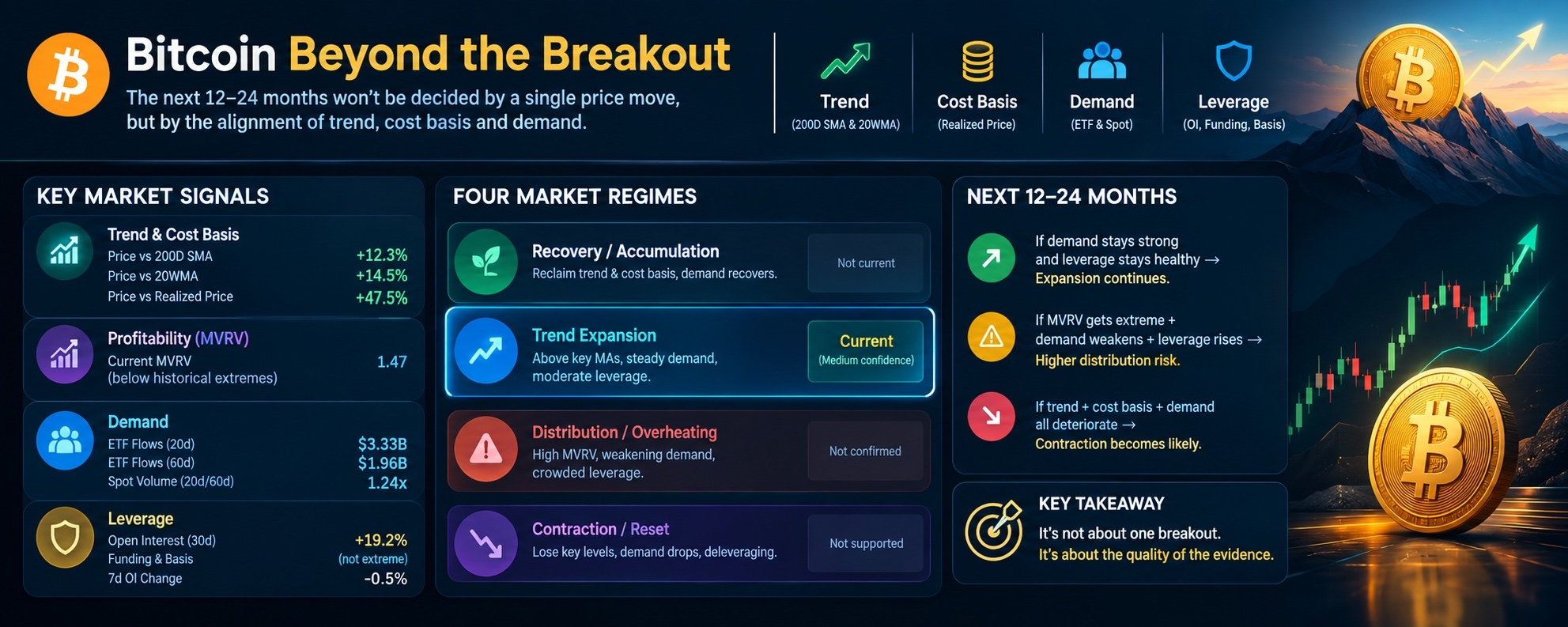
Article
Bitcoin Beyond the Breakout: What Could Define the Next 12–24 Months?A Bitcoin breakout can create a lot of excitement, but a breakout alone does not tell us what type of market we are entering.
The more important question is:
Is Bitcoin’s price strength being supported by a sustainable trend, a healthy investor cost basis, and genuine demand?
When these three layers move together, a breakout becomes more meaningful.
When price rises while demand weakens and leverage becomes excessive, the same breakout can turn into a false move or distribution phase.
So instead of focusing only on price, let’s look at the broader market structure.
■ 1. Start With the Long-Term Trend
Two important structural references are:
• 200-Day SMA
• 20-Week Moving Average
These are not simply entry or exit indicators. They help us understand Bitcoin’s broader market regime.
As of September 8, Bitcoin was trading around $78,446.
At that point, BTC was approximately:
• 12.3% above the 200D SMA
• 14.5% above the 20WMA
• 47.5% above Realized Price
This combination is important.
If Bitcoin were only above one moving average, the move could still be interpreted as a simple recovery or short-term breakout.
But when BTC remains above the 200D SMA, 20WMA and Realized Price, the structural picture becomes considerably stronger.
That is why the current market can reasonably be classified as Trend Expansion.
However, Trend Expansion does not mean Bitcoin must move straight higher.
Even a strong expansion phase can experience sharp corrections and periods of consolidation.
■ 2. Realized Price: Understanding Investor Cost Basis
Realized Price can be viewed as a broad estimate of Bitcoin’s aggregate on-chain cost basis.
In simple terms:
It helps us understand the approximate level at which the market acquired its BTC.
When Bitcoin trades comfortably above Realized Price, the aggregate market is generally sitting on unrealized profit.
When BTC falls below Realized Price and remains there, broader market stress tends to increase.
Currently, Bitcoin is significantly above Realized Price.
That makes the present structure very different from major contraction periods such as 2018–19 or 2022–23.
The key takeaway is:
Price above long-term trend + price above aggregate cost basis = stronger structural conditions.
But this is not a guarantee of future returns.
■ 3. What Is MVRV Telling Us?
MVRV can be thought of as Bitcoin’s profitability temperature gauge.
Current MVRV is approximately 1.47.
The important point is that this is not an historically extreme level.
The research shows approximately:
• Expanding historical median: 1.69
• 90th-percentile reference: 2.80
• 2017 peak: approximately 4.72
• 2021 peak: approximately 3.96
This creates an interesting picture.
Bitcoin’s long-term structure is relatively strong, but aggregate profitability has not yet reached historical overheating levels.
In other words:
The trend is strong, but MVRV is not currently signaling extreme euphoria.
That supports the expansion narrative, although it does not eliminate the possibility of a future market top.
■ 4. The Bigger Question: Where Is the Demand Coming From?
A price increase becomes more convincing when actual demand supports it.
One of the key demand indicators in this framework is U.S. spot Bitcoin ETF flows.
Over the latest 20 trading sessions, U.S. spot Bitcoin ETF flows were approximately $3.33 billion positive.
Over the latest 60 sessions, flows were approximately $1.96 billion positive.
The interesting part is that the shorter 20-session window is stronger.
That suggests recent ETF demand has improved.
However, ETF flows should not be treated as the entire Bitcoin demand picture.
They represent only one visible group of buyers.
That is why broader spot-market participation also matters.
■ 5. Spot Volume Provides Additional Confirmation
The latest 20-day median of tracked BTC spot volume was approximately 1.24x the preceding 60-day median.
Using the median is useful because it reduces the impact of one unusually large event-driven volume spike.
So the current picture is not simply:
“Bitcoin went up.”
Instead, we have:
Price strength + positive ETF demand + stronger spot participation.
When these factors align, the quality of the move becomes more convincing than price alone would suggest.
This is one of the reasons the current market is better described as Trend Expansion rather than simply calling it a breakout.
■ 6. But We Cannot Ignore Leverage
This is where the derivatives market becomes important.
Leverage is not automatically bullish or bearish.
A useful way to think about it is:
Demand supports the trend. Leverage determines how fragile that trend may be.
Current data shows that Open Interest increased approximately 19.2% over 30 days.
However, the 7-day change was approximately -0.5%.
That suggests there has not been an aggressive short-term acceleration in leverage.
Funding and futures basis also remained away from clear extreme zones within their respective 90-day ranges.
That does not currently provide strong evidence of excessive leverage or extreme euphoria.
There is, however, an important limitation.
The available venue-specific OI history is only around one month long.
That is not enough to establish a strong long-term historical comparison.
This is one of the main reasons the overall market classification has medium rather than high confidence.
■ 7. The Four-Regime Framework
To understand where Bitcoin could move over the next 12–24 months, it helps to think in four possible market regimes.
■ Recovery / Accumulation
In this phase, Bitcoin is reclaiming Realized Price and long-term trend references.
Demand begins recovering from weak levels.
ETF flows stabilize.
Spot participation improves.
Leverage generally remains moderate.
This is not the current data read.
■ Trend Expansion
This is the regime that currently fits the data best.
The ideal combination is:
• BTC remains above the 20WMA
• BTC remains above the 200D SMA
• BTC remains above Realized Price
• ETF demand remains persistent
• Spot participation remains healthy
• Leverage increases without becoming extreme
Current data broadly aligns with this structure.
Current read: Trend Expansion, medium confidence.
■ Distribution / Overheating
This is where risk management becomes increasingly important.
Price can remain strong while the underlying market becomes unhealthy.
Warning signs would include:
• MVRV reaching historical extremes
• ETF or spot demand weakening
• Open Interest rising aggressively
• Funding becoming crowded
• Futures basis becoming excessive
One of the more dangerous combinations is:
Rising price + weakening demand + increasing leverage.
That can indicate that derivatives positioning is becoming more important than genuine spot demand.
■ Contraction / Reset
This phase becomes more relevant if Bitcoin loses important structural levels.
For example:
• 200D SMA breaks
• 20WMA breaks
• Realized Price breaks
• ETF flows deteriorate
• Spot participation declines
• Deleveraging pressure increases
One red candle is not enough to confirm contraction.
What matters is whether multiple evidence layers deteriorate together.
■ 8. The Most Important Lesson: Look at Structure, Not Just Price
One common mistake among traders is allowing a single indicator to determine the entire market view.
“RSI is overbought.”
“Bitcoin broke resistance.”
“Funding is positive.”
“Open Interest is rising.”
Each of these observations may be useful, but none provides the complete picture.
A better framework is sequential.
Step 1: Check the trend.
Where is BTC relative to the 200D SMA and 20WMA?
Step 2: Check the cost basis.
Is Bitcoin above or below Realized Price?
Step 3: Check demand.
Are ETF flows and spot activity supporting the move?
Step 4: Check leverage.
Are OI, funding, basis and perpetual activity healthy or becoming excessive?
This order matters.
Do not start with leverage.
First understand the structure, then verify demand, and finally use derivatives data to assess fragility.
■ 9. What Should We Monitor Over the Next 12–24 Months?
For a longer-term Bitcoin market dashboard, I would focus on:
□ BTC vs 200D SMA
□ BTC vs 20WMA
□ BTC vs Realized Price
□ MVRV trend
□ U.S. spot BTC ETF flows
□ Aggregate spot volume
□ Open Interest
□ Funding rates
□ Futures basis
□ Price vs demand divergence
If Bitcoin continues rising while demand remains persistent and leverage stays controlled, the expansion structure becomes healthier.
If MVRV approaches extreme levels while ETF and spot demand weaken and leverage becomes crowded, distribution risk increases.
And if Bitcoin loses its long-term trend and Realized Price while demand deteriorates at the same time, the probability of a broader contraction/reset becomes much stronger.
■ Final Takeaway
Bitcoin’s next major market phase will not be decided by a single breakout candle.
The real signal is alignment.
What is the trend saying?
What is investor cost basis saying?
Is genuine demand supporting the move?
And how leveraged is the derivatives market?
Based on the September 2026 data, the broader picture currently favors Trend Expansion.
Bitcoin remains above its long-term trend references and Realized Price. ETF demand is constructive, spot participation has improved, and leverage is not yet showing a clear extreme.
However, confidence remains medium because long-term Open Interest history is limited.
That means the smarter approach is not simply to chase the breakout.
Watch what happens after the breakout.
If trend + cost basis + demand remain aligned, the expansion can remain structurally healthy.
If price continues higher while demand weakens and leverage overheats, caution becomes increasingly important.
And if trend, cost basis and demand all deteriorate together, that is when a genuine regime change deserves serious attention.
The next 12–24 months may be defined less by Bitcoin’s next headline breakout and more by the quality of the evidence supporting it.
#Bitcoin #BTC #CryptoMarket #ArifAlpha
Bitcoin Beyond the Breakout: What Could Define the Next 12–24 Months?
A Bitcoin breakout can create a lot of excitement, but a breakout alone does not tell us what type of market we are entering.
The more important question is:
Is Bitcoin’s price strength being supported by a sustainable trend, a healthy investor cost basis, and genuine demand?
When these three layers move together, a breakout becomes more meaningful.
When price rises while demand weakens and leverage becomes excessive, the same breakout can turn into a false move or distribution phase.
So instead of focusing only on price, let’s look at the broader market structure.
■ 1. Start With the Long-Term Trend
Two important structural references are:
• 200-Day SMA
• 20-Week Moving Average
These are not simply entry or exit indicators. They help us understand Bitcoin’s broader market regime.
As of September 8, Bitcoin was trading around $78,446.
At that point, BTC was approximately:
• 12.3% above the 200D SMA
• 14.5% above the 20WMA
• 47.5% above Realized Price
This combination is important.
If Bitcoin were only above one moving average, the move could still be interpreted as a simple recovery or short-term breakout.
But when BTC remains above the 200D SMA, 20WMA and Realized Price, the structural picture becomes considerably stronger.
That is why the current market can reasonably be classified as Trend Expansion.
However, Trend Expansion does not mean Bitcoin must move straight higher.
Even a strong expansion phase can experience sharp corrections and periods of consolidation.
■ 2. Realized Price: Understanding Investor Cost Basis
Realized Price can be viewed as a broad estimate of Bitcoin’s aggregate on-chain cost basis.
In simple terms:
It helps us understand the approximate level at which the market acquired its BTC.
When Bitcoin trades comfortably above Realized Price, the aggregate market is generally sitting on unrealized profit.
When BTC falls below Realized Price and remains there, broader market stress tends to increase.
Currently, Bitcoin is significantly above Realized Price.
That makes the present structure very different from major contraction periods such as 2018–19 or 2022–23.
The key takeaway is:
Price above long-term trend + price above aggregate cost basis = stronger structural conditions.
But this is not a guarantee of future returns.
■ 3. What Is MVRV Telling Us?
MVRV can be thought of as Bitcoin’s profitability temperature gauge.
Current MVRV is approximately 1.47.
The important point is that this is not an historically extreme level.
The research shows approximately:
• Expanding historical median: 1.69
• 90th-percentile reference: 2.80
• 2017 peak: approximately 4.72
• 2021 peak: approximately 3.96
This creates an interesting picture.
Bitcoin’s long-term structure is relatively strong, but aggregate profitability has not yet reached historical overheating levels.
In other words:
The trend is strong, but MVRV is not currently signaling extreme euphoria.
That supports the expansion narrative, although it does not eliminate the possibility of a future market top.
■ 4. The Bigger Question: Where Is the Demand Coming From?
A price increase becomes more convincing when actual demand supports it.
One of the key demand indicators in this framework is U.S. spot Bitcoin ETF flows.
Over the latest 20 trading sessions, U.S. spot Bitcoin ETF flows were approximately $3.33 billion positive.
Over the latest 60 sessions, flows were approximately $1.96 billion positive.
The interesting part is that the shorter 20-session window is stronger.
That suggests recent ETF demand has improved.
However, ETF flows should not be treated as the entire Bitcoin demand picture.
They represent only one visible group of buyers.
That is why broader spot-market participation also matters.
■ 5. Spot Volume Provides Additional Confirmation
The latest 20-day median of tracked BTC spot volume was approximately 1.24x the preceding 60-day median.
Using the median is useful because it reduces the impact of one unusually large event-driven volume spike.
So the current picture is not simply:
“Bitcoin went up.”
Instead, we have:
Price strength + positive ETF demand + stronger spot participation.
When these factors align, the quality of the move becomes more convincing than price alone would suggest.
This is one of the reasons the current market is better described as Trend Expansion rather than simply calling it a breakout.
■ 6. But We Cannot Ignore Leverage
This is where the derivatives market becomes important.
Leverage is not automatically bullish or bearish.
A useful way to think about it is:
Demand supports the trend. Leverage determines how fragile that trend may be.
Current data shows that Open Interest increased approximately 19.2% over 30 days.
However, the 7-day change was approximately -0.5%.
That suggests there has not been an aggressive short-term acceleration in leverage.
Funding and futures basis also remained away from clear extreme zones within their respective 90-day ranges.
That does not currently provide strong evidence of excessive leverage or extreme euphoria.
There is, however, an important limitation.
The available venue-specific OI history is only around one month long.
That is not enough to establish a strong long-term historical comparison.
This is one of the main reasons the overall market classification has medium rather than high confidence.
■ 7. The Four-Regime Framework
To understand where Bitcoin could move over the next 12–24 months, it helps to think in four possible market regimes.
■ Recovery / Accumulation
In this phase, Bitcoin is reclaiming Realized Price and long-term trend references.
Demand begins recovering from weak levels.
ETF flows stabilize.
Spot participation improves.
Leverage generally remains moderate.
This is not the current data read.
■ Trend Expansion
This is the regime that currently fits the data best.
The ideal combination is:
• BTC remains above the 20WMA
• BTC remains above the 200D SMA
• BTC remains above Realized Price
• ETF demand remains persistent
• Spot participation remains healthy
• Leverage increases without becoming extreme
Current data broadly aligns with this structure.
Current read: Trend Expansion, medium confidence.
■ Distribution / Overheating
This is where risk management becomes increasingly important.
Price can remain strong while the underlying market becomes unhealthy.
Warning signs would include:
• MVRV reaching historical extremes
• ETF or spot demand weakening
• Open Interest rising aggressively
• Funding becoming crowded
• Futures basis becoming excessive
One of the more dangerous combinations is:
Rising price + weakening demand + increasing leverage.
That can indicate that derivatives positioning is becoming more important than genuine spot demand.
■ Contraction / Reset
This phase becomes more relevant if Bitcoin loses important structural levels.
For example:
• 200D SMA breaks
• 20WMA breaks
• Realized Price breaks
• ETF flows deteriorate
• Spot participation declines
• Deleveraging pressure increases
One red candle is not enough to confirm contraction.
What matters is whether multiple evidence layers deteriorate together.
■ 8. The Most Important Lesson: Look at Structure, Not Just Price
One common mistake among traders is allowing a single indicator to determine the entire market view.
“RSI is overbought.”
“Bitcoin broke resistance.”
“Funding is positive.”
“Open Interest is rising.”
Each of these observations may be useful, but none provides the complete picture.
A better framework is sequential.
Step 1: Check the trend.
Where is BTC relative to the 200D SMA and 20WMA?
Step 2: Check the cost basis.
Is Bitcoin above or below Realized Price?
Step 3: Check demand.
Are ETF flows and spot activity supporting the move?
Step 4: Check leverage.
Are OI, funding, basis and perpetual activity healthy or becoming excessive?
This order matters.
Do not start with leverage.
First understand the structure, then verify demand, and finally use derivatives data to assess fragility.
■ 9. What Should We Monitor Over the Next 12–24 Months?
For a longer-term Bitcoin market dashboard, I would focus on:
□ BTC vs 200D SMA
□ BTC vs 20WMA
□ BTC vs Realized Price
□ MVRV trend
□ U.S. spot BTC ETF flows
□ Aggregate spot volume
□ Open Interest
□ Funding rates
□ Futures basis
□ Price vs demand divergence
If Bitcoin continues rising while demand remains persistent and leverage stays controlled, the expansion structure becomes healthier.
If MVRV approaches extreme levels while ETF and spot demand weaken and leverage becomes crowded, distribution risk increases.
And if Bitcoin loses its long-term trend and Realized Price while demand deteriorates at the same time, the probability of a broader contraction/reset becomes much stronger.
■ Final Takeaway
Bitcoin’s next major market phase will not be decided by a single breakout candle.
The real signal is alignment.
What is the trend saying?
What is investor cost basis saying?
Is genuine demand supporting the move?
And how leveraged is the derivatives market?
Based on the September 2026 data, the broader picture currently favors Trend Expansion.
Bitcoin remains above its long-term trend references and Realized Price. ETF demand is constructive, spot participation has improved, and leverage is not yet showing a clear extreme.
However, confidence remains medium because long-term Open Interest history is limited.
That means the smarter approach is not simply to chase the breakout.
Watch what happens after the breakout.
If trend + cost basis + demand remain aligned, the expansion can remain structurally healthy.
If price continues higher while demand weakens and leverage overheats, caution becomes increasingly important.
And if trend, cost basis and demand all deteriorate together, that is when a genuine regime change deserves serious attention.
The next 12–24 months may be defined less by Bitcoin’s next headline breakout and more by the quality of the evidence supporting it.
#Bitcoin #BTC #CryptoMarket #ArifAlpha
The more important question is:
Is Bitcoin’s price strength being supported by a sustainable trend, a healthy investor cost basis, and genuine demand?
When these three layers move together, a breakout becomes more meaningful.
When price rises while demand weakens and leverage becomes excessive, the same breakout can turn into a false move or distribution phase.
So instead of focusing only on price, let’s look at the broader market structure.
■ 1. Start With the Long-Term Trend
Two important structural references are:
• 200-Day SMA
• 20-Week Moving Average
These are not simply entry or exit indicators. They help us understand Bitcoin’s broader market regime.
As of September 8, Bitcoin was trading around $78,446.
At that point, BTC was approximately:
• 12.3% above the 200D SMA
• 14.5% above the 20WMA
• 47.5% above Realized Price
This combination is important.
If Bitcoin were only above one moving average, the move could still be interpreted as a simple recovery or short-term breakout.
But when BTC remains above the 200D SMA, 20WMA and Realized Price, the structural picture becomes considerably stronger.
That is why the current market can reasonably be classified as Trend Expansion.
However, Trend Expansion does not mean Bitcoin must move straight higher.
Even a strong expansion phase can experience sharp corrections and periods of consolidation.
■ 2. Realized Price: Understanding Investor Cost Basis
Realized Price can be viewed as a broad estimate of Bitcoin’s aggregate on-chain cost basis.
In simple terms:
It helps us understand the approximate level at which the market acquired its BTC.
When Bitcoin trades comfortably above Realized Price, the aggregate market is generally sitting on unrealized profit.
When BTC falls below Realized Price and remains there, broader market stress tends to increase.
Currently, Bitcoin is significantly above Realized Price.
That makes the present structure very different from major contraction periods such as 2018–19 or 2022–23.
The key takeaway is:
Price above long-term trend + price above aggregate cost basis = stronger structural conditions.
But this is not a guarantee of future returns.
■ 3. What Is MVRV Telling Us?
MVRV can be thought of as Bitcoin’s profitability temperature gauge.
Current MVRV is approximately 1.47.
The important point is that this is not an historically extreme level.
The research shows approximately:
• Expanding historical median: 1.69
• 90th-percentile reference: 2.80
• 2017 peak: approximately 4.72
• 2021 peak: approximately 3.96
This creates an interesting picture.
Bitcoin’s long-term structure is relatively strong, but aggregate profitability has not yet reached historical overheating levels.
In other words:
The trend is strong, but MVRV is not currently signaling extreme euphoria.
That supports the expansion narrative, although it does not eliminate the possibility of a future market top.
■ 4. The Bigger Question: Where Is the Demand Coming From?
A price increase becomes more convincing when actual demand supports it.
One of the key demand indicators in this framework is U.S. spot Bitcoin ETF flows.
Over the latest 20 trading sessions, U.S. spot Bitcoin ETF flows were approximately $3.33 billion positive.
Over the latest 60 sessions, flows were approximately $1.96 billion positive.
The interesting part is that the shorter 20-session window is stronger.
That suggests recent ETF demand has improved.
However, ETF flows should not be treated as the entire Bitcoin demand picture.
They represent only one visible group of buyers.
That is why broader spot-market participation also matters.
■ 5. Spot Volume Provides Additional Confirmation
The latest 20-day median of tracked BTC spot volume was approximately 1.24x the preceding 60-day median.
Using the median is useful because it reduces the impact of one unusually large event-driven volume spike.
So the current picture is not simply:
“Bitcoin went up.”
Instead, we have:
Price strength + positive ETF demand + stronger spot participation.
When these factors align, the quality of the move becomes more convincing than price alone would suggest.
This is one of the reasons the current market is better described as Trend Expansion rather than simply calling it a breakout.
■ 6. But We Cannot Ignore Leverage
This is where the derivatives market becomes important.
Leverage is not automatically bullish or bearish.
A useful way to think about it is:
Demand supports the trend. Leverage determines how fragile that trend may be.
Current data shows that Open Interest increased approximately 19.2% over 30 days.
However, the 7-day change was approximately -0.5%.
That suggests there has not been an aggressive short-term acceleration in leverage.
Funding and futures basis also remained away from clear extreme zones within their respective 90-day ranges.
That does not currently provide strong evidence of excessive leverage or extreme euphoria.
There is, however, an important limitation.
The available venue-specific OI history is only around one month long.
That is not enough to establish a strong long-term historical comparison.
This is one of the main reasons the overall market classification has medium rather than high confidence.
■ 7. The Four-Regime Framework
To understand where Bitcoin could move over the next 12–24 months, it helps to think in four possible market regimes.
■ Recovery / Accumulation
In this phase, Bitcoin is reclaiming Realized Price and long-term trend references.
Demand begins recovering from weak levels.
ETF flows stabilize.
Spot participation improves.
Leverage generally remains moderate.
This is not the current data read.
■ Trend Expansion
This is the regime that currently fits the data best.
The ideal combination is:
• BTC remains above the 20WMA
• BTC remains above the 200D SMA
• BTC remains above Realized Price
• ETF demand remains persistent
• Spot participation remains healthy
• Leverage increases without becoming extreme
Current data broadly aligns with this structure.
Current read: Trend Expansion, medium confidence.
■ Distribution / Overheating
This is where risk management becomes increasingly important.
Price can remain strong while the underlying market becomes unhealthy.
Warning signs would include:
• MVRV reaching historical extremes
• ETF or spot demand weakening
• Open Interest rising aggressively
• Funding becoming crowded
• Futures basis becoming excessive
One of the more dangerous combinations is:
Rising price + weakening demand + increasing leverage.
That can indicate that derivatives positioning is becoming more important than genuine spot demand.
■ Contraction / Reset
This phase becomes more relevant if Bitcoin loses important structural levels.
For example:
• 200D SMA breaks
• 20WMA breaks
• Realized Price breaks
• ETF flows deteriorate
• Spot participation declines
• Deleveraging pressure increases
One red candle is not enough to confirm contraction.
What matters is whether multiple evidence layers deteriorate together.
■ 8. The Most Important Lesson: Look at Structure, Not Just Price
One common mistake among traders is allowing a single indicator to determine the entire market view.
“RSI is overbought.”
“Bitcoin broke resistance.”
“Funding is positive.”
“Open Interest is rising.”
Each of these observations may be useful, but none provides the complete picture.
A better framework is sequential.
Step 1: Check the trend.
Where is BTC relative to the 200D SMA and 20WMA?
Step 2: Check the cost basis.
Is Bitcoin above or below Realized Price?
Step 3: Check demand.
Are ETF flows and spot activity supporting the move?
Step 4: Check leverage.
Are OI, funding, basis and perpetual activity healthy or becoming excessive?
This order matters.
Do not start with leverage.
First understand the structure, then verify demand, and finally use derivatives data to assess fragility.
■ 9. What Should We Monitor Over the Next 12–24 Months?
For a longer-term Bitcoin market dashboard, I would focus on:
□ BTC vs 200D SMA
□ BTC vs 20WMA
□ BTC vs Realized Price
□ MVRV trend
□ U.S. spot BTC ETF flows
□ Aggregate spot volume
□ Open Interest
□ Funding rates
□ Futures basis
□ Price vs demand divergence
If Bitcoin continues rising while demand remains persistent and leverage stays controlled, the expansion structure becomes healthier.
If MVRV approaches extreme levels while ETF and spot demand weaken and leverage becomes crowded, distribution risk increases.
And if Bitcoin loses its long-term trend and Realized Price while demand deteriorates at the same time, the probability of a broader contraction/reset becomes much stronger.
■ Final Takeaway
Bitcoin’s next major market phase will not be decided by a single breakout candle.
The real signal is alignment.
What is the trend saying?
What is investor cost basis saying?
Is genuine demand supporting the move?
And how leveraged is the derivatives market?
Based on the September 2026 data, the broader picture currently favors Trend Expansion.
Bitcoin remains above its long-term trend references and Realized Price. ETF demand is constructive, spot participation has improved, and leverage is not yet showing a clear extreme.
However, confidence remains medium because long-term Open Interest history is limited.
That means the smarter approach is not simply to chase the breakout.
Watch what happens after the breakout.
If trend + cost basis + demand remain aligned, the expansion can remain structurally healthy.
If price continues higher while demand weakens and leverage overheats, caution becomes increasingly important.
And if trend, cost basis and demand all deteriorate together, that is when a genuine regime change deserves serious attention.
The next 12–24 months may be defined less by Bitcoin’s next headline breakout and more by the quality of the evidence supporting it.
#Bitcoin #BTC #CryptoMarket #ArifAlpha
99
·
--
US Treasury Doubles Bond Buyback Caps: BTC & ETH ke liye kya signal hai?
US Treasury ka expanded bond buyback framework 9 September se effective ho gaya hai. Per-operation cap $2B se barh kar kam az kam $4B ho gaya hai.
🔹 Breakdown
▪️ Liquidity & Yields: Treasury buybacks ka objective market liquidity aur Treasury market functioning ko support karna hai. Agar long-term bond yields par pressure kam hota hai, financial conditions crypto ke liye relatively supportive ho sakti hain.
▪️ BTC: Bitcoin pehle hi expectations par $69K ke upar rally kar chuka tha. Ab important point yeh hai ke actual buybacks yields ko sustainably lower karte hain ya nahi.
▪️ ETH: ETH ne BTC se stronger reaction diya hai. Agar liquidity conditions improve hoti hain, ETH jaise higher-beta assets ko additional upside mil sakti hai.
▪️ Major Risk: Oil prices se inflationary pressure barqarar raha to lower yields ka benefit limited ho sakta hai. Isliye sirf Treasury buybacks ko bullish trigger samajhna risky hai.
📌 My Take
Buyback caps ka double hona short-term liquidity-positive signal hai, lekin real confirmation bond yields, inflation data aur overall financial conditions se milegi.
BTC aur ETH ke liye key question simple hai:
Kya Treasury buybacks actual yields ko sustainably lower karenge, ya market already is news ko price-in kar chuka hai?
#Bitcoin #Ethereum #ArifAlpha
US Treasury Doubles Bond Buyback Caps: BTC & ETH ke liye kya signal hai?
US Treasury ka expanded bond buyback framework 9 September se effective ho gaya hai. Per-operation cap $2B se barh kar kam az kam $4B ho gaya hai.
🔹 Breakdown
▪️ Liquidity & Yields: Treasury buybacks ka objective market liquidity aur Treasury market functioning ko support karna hai. Agar long-term bond yields par pressure kam hota hai, financial conditions crypto ke liye relatively supportive ho sakti hain.
▪️ BTC: Bitcoin pehle hi expectations par $69K ke upar rally kar chuka tha. Ab important point yeh hai ke actual buybacks yields ko sustainably lower karte hain ya nahi.
▪️ ETH: ETH ne BTC se stronger reaction diya hai. Agar liquidity conditions improve hoti hain, ETH jaise higher-beta assets ko additional upside mil sakti hai.
▪️ Major Risk: Oil prices se inflationary pressure barqarar raha to lower yields ka benefit limited ho sakta hai. Isliye sirf Treasury buybacks ko bullish trigger samajhna risky hai.
📌 My Take
Buyback caps ka double hona short-term liquidity-positive signal hai, lekin real confirmation bond yields, inflation data aur overall financial conditions se milegi.
BTC aur ETH ke liye key question simple hai:
Kya Treasury buybacks actual yields ko sustainably lower karenge, ya market already is news ko price-in kar chuka hai?
#Bitcoin #Ethereum #ArifAlpha
US Treasury ka expanded bond buyback framework 9 September se effective ho gaya hai. Per-operation cap $2B se barh kar kam az kam $4B ho gaya hai.
🔹 Breakdown
▪️ Liquidity & Yields: Treasury buybacks ka objective market liquidity aur Treasury market functioning ko support karna hai. Agar long-term bond yields par pressure kam hota hai, financial conditions crypto ke liye relatively supportive ho sakti hain.
▪️ BTC: Bitcoin pehle hi expectations par $69K ke upar rally kar chuka tha. Ab important point yeh hai ke actual buybacks yields ko sustainably lower karte hain ya nahi.
▪️ ETH: ETH ne BTC se stronger reaction diya hai. Agar liquidity conditions improve hoti hain, ETH jaise higher-beta assets ko additional upside mil sakti hai.
▪️ Major Risk: Oil prices se inflationary pressure barqarar raha to lower yields ka benefit limited ho sakta hai. Isliye sirf Treasury buybacks ko bullish trigger samajhna risky hai.
📌 My Take
Buyback caps ka double hona short-term liquidity-positive signal hai, lekin real confirmation bond yields, inflation data aur overall financial conditions se milegi.
BTC aur ETH ke liye key question simple hai:
Kya Treasury buybacks actual yields ko sustainably lower karenge, ya market already is news ko price-in kar chuka hai?
#Bitcoin #Ethereum #ArifAlpha
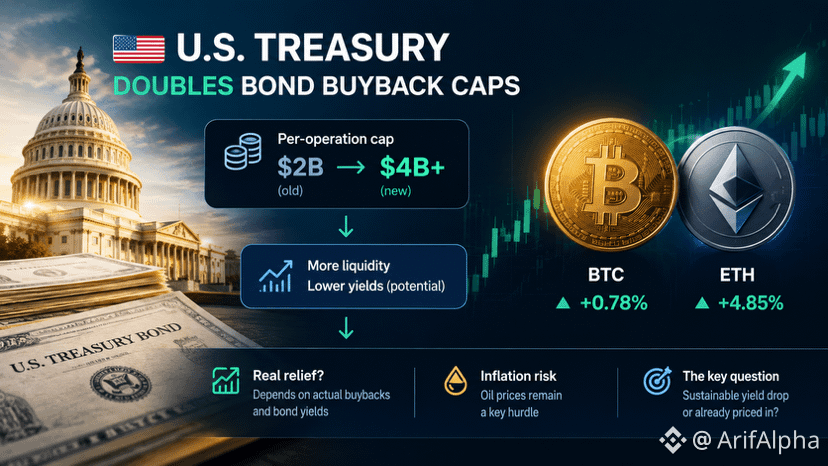
80
·
--
🔴 Bitcoin Below $80K: CPI Could Decide the Next Move
Bitcoin is trading around $79.5K, losing the $80K level as stronger U.S. jobs data increased expectations of tighter monetary policy.
📌 Key Breakdown
▪️ U.S. Jobs: August payrolls came in at 162K vs ~55K expected.
▪️ Rate-Hike Bets: Markets priced roughly 60% probability of a 25 bps hike for September 16.
▪️ ETF Demand: U.S. spot BTC ETFs still recorded $987M net inflows, showing institutional demand has not disappeared.
▪️ Support: $77K–$78K is the key downside zone.
▪️ Resistance: $80K–$82K remains the recovery barrier.
🎯 CPI Is the Next Major Catalyst
With U.S. CPI due September 11, BTC could see significant volatility.
Hot CPI:
→ Higher rate expectations
→ More pressure on BTC
→ $77K support comes into focus
Soft CPI:
→ Rate-hike pressure may ease
→ Risk appetite could improve
→ BTC may challenge $80K–$82K again
🔎 What I’m Watching
The important question is not simply whether CPI beats or misses expectations.
The real signal will be Bitcoin’s price reaction.
📈 Above $82K and holding: recovery structure strengthens.
📉 Below $77K: bearish pressure increases.
CPI + Fed expectations + ETF flows + price reaction will be the combination to watch.
#Bitcoin #CryptoAnalysis #ArifAlpha
🔴 Bitcoin Below $80K: CPI Could Decide the Next Move
Bitcoin is trading around $79.5K, losing the $80K level as stronger U.S. jobs data increased expectations of tighter monetary policy.
📌 Key Breakdown
▪️ U.S. Jobs: August payrolls came in at 162K vs ~55K expected.
▪️ Rate-Hike Bets: Markets priced roughly 60% probability of a 25 bps hike for September 16.
▪️ ETF Demand: U.S. spot BTC ETFs still recorded $987M net inflows, showing institutional demand has not disappeared.
▪️ Support: $77K–$78K is the key downside zone.
▪️ Resistance: $80K–$82K remains the recovery barrier.
🎯 CPI Is the Next Major Catalyst
With U.S. CPI due September 11, BTC could see significant volatility.
Hot CPI:
→ Higher rate expectations
→ More pressure on BTC
→ $77K support comes into focus
Soft CPI:
→ Rate-hike pressure may ease
→ Risk appetite could improve
→ BTC may challenge $80K–$82K again
🔎 What I’m Watching
The important question is not simply whether CPI beats or misses expectations.
The real signal will be Bitcoin’s price reaction.
📈 Above $82K and holding: recovery structure strengthens.
📉 Below $77K: bearish pressure increases.
CPI + Fed expectations + ETF flows + price reaction will be the combination to watch.
#Bitcoin #CryptoAnalysis #ArifAlpha
Bitcoin is trading around $79.5K, losing the $80K level as stronger U.S. jobs data increased expectations of tighter monetary policy.
📌 Key Breakdown
▪️ U.S. Jobs: August payrolls came in at 162K vs ~55K expected.
▪️ Rate-Hike Bets: Markets priced roughly 60% probability of a 25 bps hike for September 16.
▪️ ETF Demand: U.S. spot BTC ETFs still recorded $987M net inflows, showing institutional demand has not disappeared.
▪️ Support: $77K–$78K is the key downside zone.
▪️ Resistance: $80K–$82K remains the recovery barrier.
🎯 CPI Is the Next Major Catalyst
With U.S. CPI due September 11, BTC could see significant volatility.
Hot CPI:
→ Higher rate expectations
→ More pressure on BTC
→ $77K support comes into focus
Soft CPI:
→ Rate-hike pressure may ease
→ Risk appetite could improve
→ BTC may challenge $80K–$82K again
🔎 What I’m Watching
The important question is not simply whether CPI beats or misses expectations.
The real signal will be Bitcoin’s price reaction.
📈 Above $82K and holding: recovery structure strengthens.
📉 Below $77K: bearish pressure increases.
CPI + Fed expectations + ETF flows + price reaction will be the combination to watch.
#Bitcoin #CryptoAnalysis #ArifAlpha

95
·
--
Vérifié
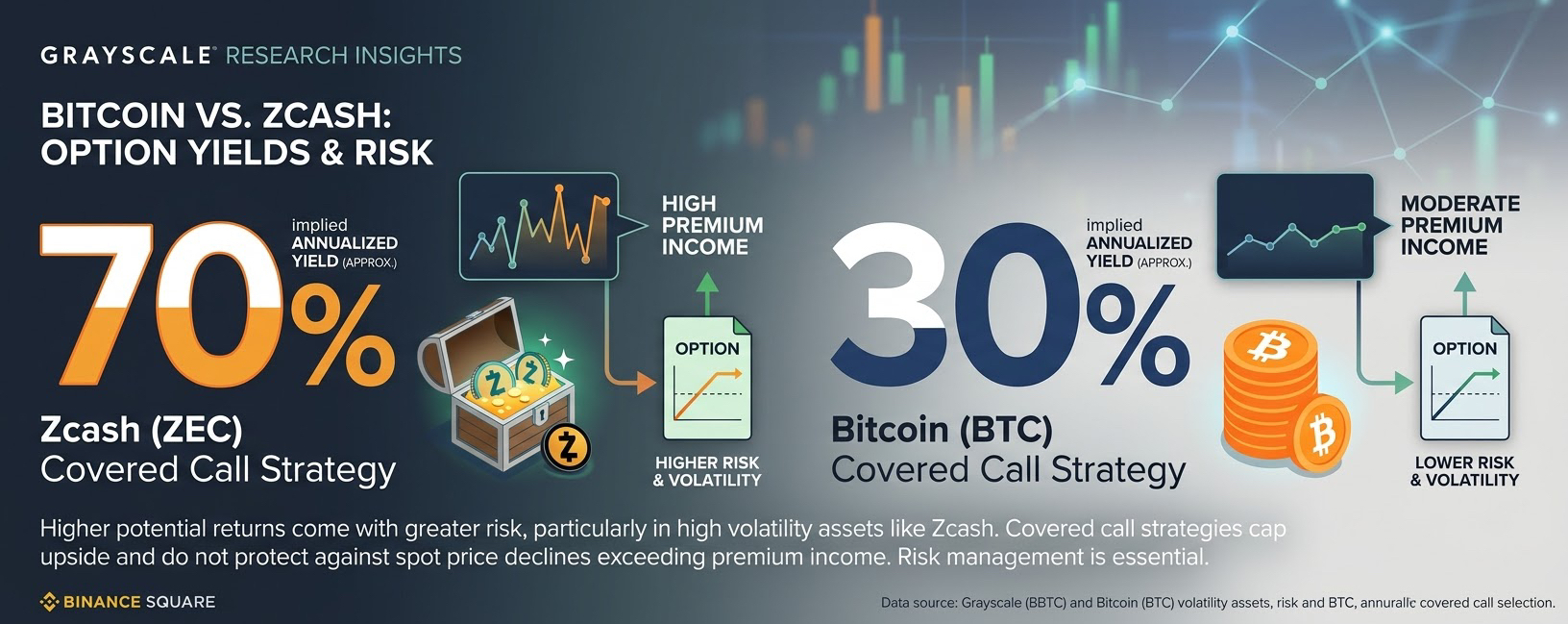
Article
High Yield vs. Tail Risk: Decoding Grayscale’s Options Insights on BTC and ZECGrayscale’s Head of Research, Zach Pandl, recently outlined a compelling comparison regarding volatility and options yield profiles between Bitcoin (BTC) and Zcash (ZEC). While high-yield derivatives strategies sound attractive, understanding the underlying volatility and risk trade-offs is essential for crypto investors.
1. Volatility Dynamics: Digital Gold vs. Small-Cap Assets
Bitcoin (BTC): As BTC matures into a mainstream asset, its price volatility has compressed significantly. Early in its lifespan, realized annualized volatility sat near 125%. Over the past year, however, it has dropped to an average of ~40%—placing BTC’s risk profile closer to high-growth Mega-Cap tech stocks like the "Magnificent Seven".
Zcash (ZEC): ZEC carries a market capitalization roughly 1% that of Bitcoin. Due to its smaller liquidity pool and market structure, ZEC’s annualized volatility over the past year averaged approximately 140%.
2. Covered Call Yield Generation
Volatility directly impacts option premium pricing: Higher Volatility = Higher Option Premiums.
The ZEC Covered Call: Writing covered call options on ZEC yields an estimated ~70% annualized return from option premiums alone.
The BTC Covered Call: The same covered call setup on Bitcoin yields ~30% annualized due to its lower option implied volatility.
3. Strategic Risk Assessment: The Covered Call Dilemma
While a 70% APY headline figure is enticing, covered call strategies carry explicit downside structural risks:
Uncapped Downside Exposure: A covered call involves holding the underlying spot asset while selling call options. If ZEC’s spot price plunges beyond the premium collected (e.g., drops 35% in a single market crash), the overall portfolio still incurs a net principal loss.
Capped Upside: If ZEC undergoes a sharp upward rally, your upside gains are capped at the strike price plus the premium received.
Alternative Structural Plays: For defined risk-reward parameters, directional options (such as buying long Calls for upside or long Puts for downside protection) offer asymmetric payoffs without total spot drawdown risks.
#CryptoTrading #OptionsStrategy #ArifAlpha
High Yield vs. Tail Risk: Decoding Grayscale’s Options Insights on BTC and ZEC
Grayscale’s Head of Research, Zach Pandl, recently outlined a compelling comparison regarding volatility and options yield profiles between Bitcoin (BTC) and Zcash (ZEC). While high-yield derivatives strategies sound attractive, understanding the underlying volatility and risk trade-offs is essential for crypto investors.
1. Volatility Dynamics: Digital Gold vs. Small-Cap Assets
Bitcoin (BTC): As BTC matures into a mainstream asset, its price volatility has compressed significantly. Early in its lifespan, realized annualized volatility sat near 125%. Over the past year, however, it has dropped to an average of ~40%—placing BTC’s risk profile closer to high-growth Mega-Cap tech stocks like the "Magnificent Seven".
Zcash (ZEC): ZEC carries a market capitalization roughly 1% that of Bitcoin. Due to its smaller liquidity pool and market structure, ZEC’s annualized volatility over the past year averaged approximately 140%.
2. Covered Call Yield Generation
Volatility directly impacts option premium pricing: Higher Volatility = Higher Option Premiums.
The ZEC Covered Call: Writing covered call options on ZEC yields an estimated ~70% annualized return from option premiums alone.
The BTC Covered Call: The same covered call setup on Bitcoin yields ~30% annualized due to its lower option implied volatility.
3. Strategic Risk Assessment: The Covered Call Dilemma
While a 70% APY headline figure is enticing, covered call strategies carry explicit downside structural risks:
Uncapped Downside Exposure: A covered call involves holding the underlying spot asset while selling call options. If ZEC’s spot price plunges beyond the premium collected (e.g., drops 35% in a single market crash), the overall portfolio still incurs a net principal loss.
Capped Upside: If ZEC undergoes a sharp upward rally, your upside gains are capped at the strike price plus the premium received.
Alternative Structural Plays: For defined risk-reward parameters, directional options (such as buying long Calls for upside or long Puts for downside protection) offer asymmetric payoffs without total spot drawdown risks.
#CryptoTrading #OptionsStrategy #ArifAlpha
1. Volatility Dynamics: Digital Gold vs. Small-Cap Assets
Bitcoin (BTC): As BTC matures into a mainstream asset, its price volatility has compressed significantly. Early in its lifespan, realized annualized volatility sat near 125%. Over the past year, however, it has dropped to an average of ~40%—placing BTC’s risk profile closer to high-growth Mega-Cap tech stocks like the "Magnificent Seven".
Zcash (ZEC): ZEC carries a market capitalization roughly 1% that of Bitcoin. Due to its smaller liquidity pool and market structure, ZEC’s annualized volatility over the past year averaged approximately 140%.
2. Covered Call Yield Generation
Volatility directly impacts option premium pricing: Higher Volatility = Higher Option Premiums.
The ZEC Covered Call: Writing covered call options on ZEC yields an estimated ~70% annualized return from option premiums alone.
The BTC Covered Call: The same covered call setup on Bitcoin yields ~30% annualized due to its lower option implied volatility.
3. Strategic Risk Assessment: The Covered Call Dilemma
While a 70% APY headline figure is enticing, covered call strategies carry explicit downside structural risks:
Uncapped Downside Exposure: A covered call involves holding the underlying spot asset while selling call options. If ZEC’s spot price plunges beyond the premium collected (e.g., drops 35% in a single market crash), the overall portfolio still incurs a net principal loss.
Capped Upside: If ZEC undergoes a sharp upward rally, your upside gains are capped at the strike price plus the premium received.
Alternative Structural Plays: For defined risk-reward parameters, directional options (such as buying long Calls for upside or long Puts for downside protection) offer asymmetric payoffs without total spot drawdown risks.
#CryptoTrading #OptionsStrategy #ArifAlpha
155
·
--
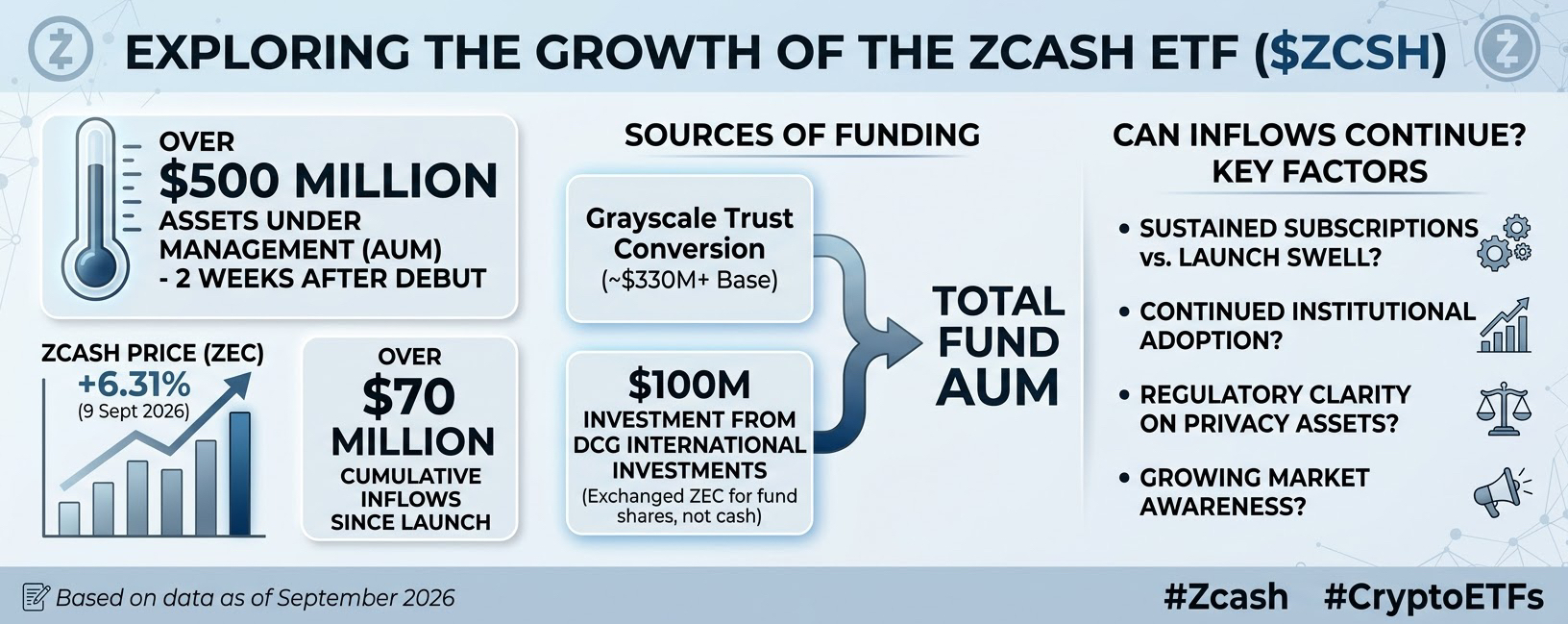
Article
Zcash ETF Crosses $500M AUM: organic Demand or Strategic Allocation?Grayscale’s Zcash ETF ($ZCSH) reached a milestone by crossing $500M in Assets Under Management (AUM) just two weeks post-launch. Coupled with $ZEC gaining solid upward momentum, privacy-focused assets are capturing serious market attention.
A deeper look into the capital composition highlights critical factors driving this growth and outlines what needs to happen to sustain momentum.
Capital Breakdown: Real Inflows vs. Internal Conversion
To assess long-term sustainability, we must separate organic retail/institutional demand from structural re-allocations:
DCG In-Kind Allocation ($100M): DCG International Investments converted existing ZEC holdings directly intoZCSH shares. While this expands the fund’s overall AUM base without selling pressure, it represents an asset restructuring rather than new fiat entering the market.
Trust Conversion (~$330M+ Base): The primary baseline for AUM stems from Grayscale converting its existing 9-year-old Zcash Trust into the spot ETF structure.
* Cumulative Cash Inflows ($70M+): True net-new buying demand stands at over $70M in subscriptions over the first fortnight.
Can the Inflow Velocity Continue?
The initial launch surge is a standard characteristic of major crypto ETP debuts. Transitioning from launch momentum to sustained institutional adoption depends on three core catalysts:
1. Privacy Thesis Shift: Institutional investors are increasingly viewing zero-knowledge privacy protocols as foundational infrastructure rather than pure regulatory liabilities.
2. Secondary Market Liquidity: Continued net inflows require tight bid-ask spreads and deep order books on traditional venues like NYSE Arca.
3. Supply Squeeze Dynamics: As $ZEC is locked into the custodian vault to back ETF shares, liquid circulating exchange supply tightens, magnifying market impact on positive flow days.
Market Perspective
The $100M DCG commitment acts as a strong vote of confidence from major industry backers, anchoring the fund's initial liquidity. However, the key metric to monitor over the coming quarters is daily net cash creation units. Constant, smaller-scale daily cash creations will signal broad-based advisory and retail adoption, proving $ZCSH can function as a long-term engine for Zcash demand.
#Zcash #CryptoETFs #ArifAlpha
Zcash ETF Crosses $500M AUM: organic Demand or Strategic Allocation?
Grayscale’s Zcash ETF ($ZCSH) reached a milestone by crossing $500M in Assets Under Management (AUM) just two weeks post-launch. Coupled with $ZEC gaining solid upward momentum, privacy-focused assets are capturing serious market attention.
A deeper look into the capital composition highlights critical factors driving this growth and outlines what needs to happen to sustain momentum.
Capital Breakdown: Real Inflows vs. Internal Conversion
To assess long-term sustainability, we must separate organic retail/institutional demand from structural re-allocations:
DCG In-Kind Allocation ($100M): DCG International Investments converted existing ZEC holdings directly intoZCSH shares. While this expands the fund’s overall AUM base without selling pressure, it represents an asset restructuring rather than new fiat entering the market.
Trust Conversion (~$330M+ Base): The primary baseline for AUM stems from Grayscale converting its existing 9-year-old Zcash Trust into the spot ETF structure.
* Cumulative Cash Inflows ($70M+): True net-new buying demand stands at over $70M in subscriptions over the first fortnight.
Can the Inflow Velocity Continue?
The initial launch surge is a standard characteristic of major crypto ETP debuts. Transitioning from launch momentum to sustained institutional adoption depends on three core catalysts:
1. Privacy Thesis Shift: Institutional investors are increasingly viewing zero-knowledge privacy protocols as foundational infrastructure rather than pure regulatory liabilities.
2. Secondary Market Liquidity: Continued net inflows require tight bid-ask spreads and deep order books on traditional venues like NYSE Arca.
3. Supply Squeeze Dynamics: As $ZEC is locked into the custodian vault to back ETF shares, liquid circulating exchange supply tightens, magnifying market impact on positive flow days.
Market Perspective
The $100M DCG commitment acts as a strong vote of confidence from major industry backers, anchoring the fund's initial liquidity. However, the key metric to monitor over the coming quarters is daily net cash creation units. Constant, smaller-scale daily cash creations will signal broad-based advisory and retail adoption, proving $ZCSH can function as a long-term engine for Zcash demand.
#Zcash #CryptoETFs #ArifAlpha
A deeper look into the capital composition highlights critical factors driving this growth and outlines what needs to happen to sustain momentum.
Capital Breakdown: Real Inflows vs. Internal Conversion
To assess long-term sustainability, we must separate organic retail/institutional demand from structural re-allocations:
DCG In-Kind Allocation ($100M): DCG International Investments converted existing ZEC holdings directly intoZCSH shares. While this expands the fund’s overall AUM base without selling pressure, it represents an asset restructuring rather than new fiat entering the market.
Trust Conversion (~$330M+ Base): The primary baseline for AUM stems from Grayscale converting its existing 9-year-old Zcash Trust into the spot ETF structure.
* Cumulative Cash Inflows ($70M+): True net-new buying demand stands at over $70M in subscriptions over the first fortnight.
Can the Inflow Velocity Continue?
The initial launch surge is a standard characteristic of major crypto ETP debuts. Transitioning from launch momentum to sustained institutional adoption depends on three core catalysts:
1. Privacy Thesis Shift: Institutional investors are increasingly viewing zero-knowledge privacy protocols as foundational infrastructure rather than pure regulatory liabilities.
2. Secondary Market Liquidity: Continued net inflows require tight bid-ask spreads and deep order books on traditional venues like NYSE Arca.
3. Supply Squeeze Dynamics: As $ZEC is locked into the custodian vault to back ETF shares, liquid circulating exchange supply tightens, magnifying market impact on positive flow days.
Market Perspective
The $100M DCG commitment acts as a strong vote of confidence from major industry backers, anchoring the fund's initial liquidity. However, the key metric to monitor over the coming quarters is daily net cash creation units. Constant, smaller-scale daily cash creations will signal broad-based advisory and retail adoption, proving $ZCSH can function as a long-term engine for Zcash demand.
#Zcash #CryptoETFs #ArifAlpha
127
·
--
Article
Gold Is Rebounding, but the FOMO Is Gone: How XAUT Fits a Portfolio Now 🥇Gold’s 2026 journey has delivered an important lesson for investors:
Even a traditional safe-haven asset can become dangerous when investors chase momentum.
After rising sharply and attracting significant speculative demand, gold experienced a major correction before partially recovering. The rebound may look attractive, but the bigger question is not simply:
“Will gold go higher?”
The more important questions are:
• What role should gold play in a portfolio today?
• Is the current rebound strong enough to confirm a new trend?
• Should existing holders rebalance or continue holding?
• Should non-holders enter now—or wait for confirmation?
• And finally, is XAUT the right way to obtain crypto-native gold exposure?
Let's break it down.
🟡 1. Gold's 2026 Journey: From FOMO to Reality
Gold started 2026 with powerful momentum.
In January, gold gained approximately 14.1%, while options activity, volatility and momentum trading amplified demand. Global gold ETFs added around 120 tonnes, while the market recorded multiple new highs.
At that stage, gold was no longer being purchased only as long-term insurance.
It was increasingly becoming a momentum trade.
And that distinction matters.
When too many investors enter an asset because the price is rising, the market becomes vulnerable to a sharp reversal.
That is exactly what happened.
Gold subsequently experienced a significant correction as several macro factors moved against it:
• Higher real yields
• A stronger US dollar
• Cross-asset liquidity pressure
• CTA deleveraging
• Technical support failures
• ETF outflows
Gold fell around 12% in March, while ETFs reportedly shed approximately 84 tonnes.
The important lesson:
A safe-haven asset can still be sold aggressively when investors need liquidity.
Safe haven does not mean “cannot fall.”
📉 2. Why Did Gold Correct?
Gold doesn't generate cash flow or interest.
Therefore, its relative attractiveness depends heavily on the opportunity cost of holding it.
🔹 Real Yields
When real yields rise, interest-bearing assets become relatively more attractive.
The US 10-year real yield was approximately 2.44% on August 31, compared with around 1.94% at the beginning of January.
That represents a considerably more restrictive environment for a non-yielding asset such as gold.
🔹 The US Dollar
Gold is priced globally in US dollars.
A stronger dollar can create additional pressure on gold because it becomes relatively more expensive for non-dollar buyers.
During August, however, the broad trade-weighted dollar weakened by roughly 0.8% between July 31 and August 28.
That provided some support for gold.
🔹 ETF Flows
Investment flows are another important confirmation signal.
Gold ETFs added approximately 23 tonnes in July, suggesting that institutional demand had started improving.
However, flows alone aren't enough to confirm a sustained bull market.
🔄 3. August Recovery: Reversal or Just a Bounce?
This is where investors need to be careful.
Gold's rebound is constructive—but a rebound is not automatically a new bull trend.
Three things need to work together:
Price + Macro + Flows
If gold rises while:
• Real yields decline
• The dollar weakens
• ETF demand increases
• Central-bank demand remains supportive
then the probability of a sustainable move becomes stronger.
But if gold rises while real yields remain elevated and ETF demand remains inconsistent, the market may simply be experiencing a technical recovery.
Therefore:
Don't confuse recovery with confirmation.
The price chart tells us what is happening.
Macro and flows help explain why it is happening and whether it can continue.
🏦 4. Gold Still Has a Strategic Role
A volatile gold price cycle does not necessarily destroy the long-term investment thesis.
Gold can still serve several portfolio functions.
① Diversification
Gold can behave differently from stocks, bonds and cryptocurrencies.
This can become particularly valuable when traditional stock-bond correlations become unstable.
② Inflation & Currency Protection
Gold is often viewed as protection against long-term monetary debasement and certain inflationary environments.
However, there is an important caveat:
Inflation combined with rising real yields can actually pressure gold in the short term.
③ Geopolitical & Fiscal Insurance
During periods of geopolitical uncertainty, fiscal stress or concerns about sovereign credit, investors may increase exposure to hard assets.
But even here, gold isn't guaranteed to rise immediately.
During a liquidity crisis, investors can sell almost anything to raise cash.
📊 5. How Much Gold Should a Portfolio Hold?
This is where allocation becomes more important than prediction.
Historical portfolio testing from January 2020 through August 2026 showed that adding gold to diversified portfolios could improve certain risk metrics.
For example, adding gold to a traditional 60/40 stock-bond portfolio reduced annualized volatility from approximately:
11.28% → 10.78%
A crypto-heavy portfolio consisting of:
50% BTC + 30% ETH + 20% cash
also experienced lower volatility when gold was introduced.
Volatility declined from approximately:
54.56% → 49.28%
More importantly, gold helped reduce portfolio drawdown and improved the return-to-volatility relationship.
But this does not mean:
“Everyone should buy 10% gold.”
The percentages are sensitivity tests—not universal recommendations.
A better framework is:
Determine the portfolio's required gold exposure first.
Then rebalance toward that target.
🧠 6. Rebalance vs Buy: The Decision Framework
Different investors should approach the current rebound differently.
🟢 Existing Holder — Above Target Allocation
If gold has grown beyond your predetermined portfolio allocation, a rebound may provide an opportunity to rebalance.
The objective isn't necessarily to sell because gold is going down.
The objective is to maintain your desired risk exposure.
🟡 Existing Holder — Within Target Allocation
If your gold allocation remains within your target range, there may be little reason to react emotionally to short-term price movements.
Your diversification thesis may still be intact.
🔴 Holder Who Bought Because of FOMO
This is a different situation.
If your original reason for buying was:
“Gold keeps going up, so I don't want to miss it.”
then you may not actually have an investment thesis.
You have a momentum position.
That's an important distinction.
🟢 Non-Holder With Poor Diversification
If your portfolio is heavily concentrated in risk assets, gold may provide useful diversification.
But the decision should be based on portfolio construction, not fear of missing the rebound.
🔴 Non-Holder Chasing the Recovery
This is where investors need the most discipline.
Buying simply because:
“Gold has already bounced, so I need to enter now.”
is classic FOMO.
A better approach is to define an allocation target and consider entering gradually rather than trying to predict the exact bottom or top.
🪙 7. Where Does XAUT Fit?
This brings us to XAUT, Tether Gold.
XAUT provides a crypto-native way to obtain exposure to physical gold.
Conceptually, it combines:
Gold exposure + blockchain infrastructure + crypto-market accessibility
Each XAUT token represents an interest in one fine troy ounce of gold held in allocated form.
This makes XAUT fundamentally different from simply holding a cryptocurrency whose price is correlated with gold.
The underlying thesis is still:
“I want exposure to gold.”
The blockchain simply becomes the mechanism through which that exposure is represented and transferred.
⚠️ 8. But XAUT Is Not the Same as Holding Physical Gold
This distinction is extremely important.
When you buy XAUT, you're not eliminating risk.
You're changing the type of risk.
With physical bullion, investors primarily think about:
• Storage
• Security
• Insurance
• Transportation
• Authenticity
• Dealer spreads
With XAUT, additional considerations appear:
• Issuer risk
• Custody arrangements
• Redemption conditions
• Administrative controls
• Blockchain/network risk
• Exchange/venue liquidity
• Premium or discount to underlying gold
• Potential tracking differences
Therefore:
A bullish gold thesis does not automatically mean XAUT is the best instrument for every investor.
🔍 9. The Key Difference: Gold Thesis vs XAUT Thesis
Think about the investment decision as two separate layers.
Layer 1 — Gold Thesis
“Gold should have a role in my portfolio because I want diversification, inflation protection or geopolitical insurance.”
Layer 2 — Vehicle Selection
“XAUT is an efficient way for me to obtain that gold exposure because I prefer a crypto-native, transferable asset.”
The first decision should come before the second.
Don't start with:
“XAUT is pumping—should I buy?”
Start with:
“Do I need gold exposure in my portfolio?”
Then decide which vehicle makes sense.
📈 10. What Should Investors Watch Next?
Instead of watching only the gold price, monitor a combination of indicators.
🟢 Bullish Confirmation
A stronger setup would involve:
Gold ↑
Real yields ↓
Dollar ↓
ETF demand ↑
Central-bank demand →/↑
When several of these signals align, the probability of a sustainable recovery improves.
🔴 Warning Signs
Be more cautious if:
Gold ↑
Real yields ↑
Dollar ↑
ETF flows ↓
That could indicate that price is rising without strong macro confirmation.
🎯 Final Takeaway
The biggest lesson from gold's 2026 cycle isn't simply whether gold will reach another all-time high.
It's about how investors behave around strong narratives.
Gold can be a strategic diversifier.
But chasing a rapidly rising safe-haven asset can turn a long-term allocation into a short-term speculative trade.
For investors considering XAUT, the framework is simple:
1️⃣ Define why you need gold.
2️⃣ Decide your target portfolio allocation.
3️⃣ Avoid buying purely because of a rebound.
4️⃣ Monitor real yields, the dollar and ETF flows.
5️⃣ Understand the additional risks introduced by tokenized gold.
6️⃣ Rebalance according to your target—not your emotions.
The key question isn't:
“Is gold going up?”
It's:
“What role should gold—and potentially XAUT—play in my portfolio?”
Gold may be recovering, but the smartest allocation decision is still the one based on portfolio structure rather than FOMO.
#Gold #XAUT #CryptoInvesting #ArifAlpha
Gold Is Rebounding, but the FOMO Is Gone: How XAUT Fits a Portfolio Now 🥇
Gold’s 2026 journey has delivered an important lesson for investors:
Even a traditional safe-haven asset can become dangerous when investors chase momentum.
After rising sharply and attracting significant speculative demand, gold experienced a major correction before partially recovering. The rebound may look attractive, but the bigger question is not simply:
“Will gold go higher?”
The more important questions are:
• What role should gold play in a portfolio today?
• Is the current rebound strong enough to confirm a new trend?
• Should existing holders rebalance or continue holding?
• Should non-holders enter now—or wait for confirmation?
• And finally, is XAUT the right way to obtain crypto-native gold exposure?
Let's break it down.
🟡 1. Gold's 2026 Journey: From FOMO to Reality
Gold started 2026 with powerful momentum.
In January, gold gained approximately 14.1%, while options activity, volatility and momentum trading amplified demand. Global gold ETFs added around 120 tonnes, while the market recorded multiple new highs.
At that stage, gold was no longer being purchased only as long-term insurance.
It was increasingly becoming a momentum trade.
And that distinction matters.
When too many investors enter an asset because the price is rising, the market becomes vulnerable to a sharp reversal.
That is exactly what happened.
Gold subsequently experienced a significant correction as several macro factors moved against it:
• Higher real yields
• A stronger US dollar
• Cross-asset liquidity pressure
• CTA deleveraging
• Technical support failures
• ETF outflows
Gold fell around 12% in March, while ETFs reportedly shed approximately 84 tonnes.
The important lesson:
A safe-haven asset can still be sold aggressively when investors need liquidity.
Safe haven does not mean “cannot fall.”
📉 2. Why Did Gold Correct?
Gold doesn't generate cash flow or interest.
Therefore, its relative attractiveness depends heavily on the opportunity cost of holding it.
🔹 Real Yields
When real yields rise, interest-bearing assets become relatively more attractive.
The US 10-year real yield was approximately 2.44% on August 31, compared with around 1.94% at the beginning of January.
That represents a considerably more restrictive environment for a non-yielding asset such as gold.
🔹 The US Dollar
Gold is priced globally in US dollars.
A stronger dollar can create additional pressure on gold because it becomes relatively more expensive for non-dollar buyers.
During August, however, the broad trade-weighted dollar weakened by roughly 0.8% between July 31 and August 28.
That provided some support for gold.
🔹 ETF Flows
Investment flows are another important confirmation signal.
Gold ETFs added approximately 23 tonnes in July, suggesting that institutional demand had started improving.
However, flows alone aren't enough to confirm a sustained bull market.
🔄 3. August Recovery: Reversal or Just a Bounce?
This is where investors need to be careful.
Gold's rebound is constructive—but a rebound is not automatically a new bull trend.
Three things need to work together:
Price + Macro + Flows
If gold rises while:
• Real yields decline
• The dollar weakens
• ETF demand increases
• Central-bank demand remains supportive
then the probability of a sustainable move becomes stronger.
But if gold rises while real yields remain elevated and ETF demand remains inconsistent, the market may simply be experiencing a technical recovery.
Therefore:
Don't confuse recovery with confirmation.
The price chart tells us what is happening.
Macro and flows help explain why it is happening and whether it can continue.
🏦 4. Gold Still Has a Strategic Role
A volatile gold price cycle does not necessarily destroy the long-term investment thesis.
Gold can still serve several portfolio functions.
① Diversification
Gold can behave differently from stocks, bonds and cryptocurrencies.
This can become particularly valuable when traditional stock-bond correlations become unstable.
② Inflation & Currency Protection
Gold is often viewed as protection against long-term monetary debasement and certain inflationary environments.
However, there is an important caveat:
Inflation combined with rising real yields can actually pressure gold in the short term.
③ Geopolitical & Fiscal Insurance
During periods of geopolitical uncertainty, fiscal stress or concerns about sovereign credit, investors may increase exposure to hard assets.
But even here, gold isn't guaranteed to rise immediately.
During a liquidity crisis, investors can sell almost anything to raise cash.
📊 5. How Much Gold Should a Portfolio Hold?
This is where allocation becomes more important than prediction.
Historical portfolio testing from January 2020 through August 2026 showed that adding gold to diversified portfolios could improve certain risk metrics.
For example, adding gold to a traditional 60/40 stock-bond portfolio reduced annualized volatility from approximately:
11.28% → 10.78%
A crypto-heavy portfolio consisting of:
50% BTC + 30% ETH + 20% cash
also experienced lower volatility when gold was introduced.
Volatility declined from approximately:
54.56% → 49.28%
More importantly, gold helped reduce portfolio drawdown and improved the return-to-volatility relationship.
But this does not mean:
“Everyone should buy 10% gold.”
The percentages are sensitivity tests—not universal recommendations.
A better framework is:
Determine the portfolio's required gold exposure first.
Then rebalance toward that target.
🧠 6. Rebalance vs Buy: The Decision Framework
Different investors should approach the current rebound differently.
🟢 Existing Holder — Above Target Allocation
If gold has grown beyond your predetermined portfolio allocation, a rebound may provide an opportunity to rebalance.
The objective isn't necessarily to sell because gold is going down.
The objective is to maintain your desired risk exposure.
🟡 Existing Holder — Within Target Allocation
If your gold allocation remains within your target range, there may be little reason to react emotionally to short-term price movements.
Your diversification thesis may still be intact.
🔴 Holder Who Bought Because of FOMO
This is a different situation.
If your original reason for buying was:
“Gold keeps going up, so I don't want to miss it.”
then you may not actually have an investment thesis.
You have a momentum position.
That's an important distinction.
🟢 Non-Holder With Poor Diversification
If your portfolio is heavily concentrated in risk assets, gold may provide useful diversification.
But the decision should be based on portfolio construction, not fear of missing the rebound.
🔴 Non-Holder Chasing the Recovery
This is where investors need the most discipline.
Buying simply because:
“Gold has already bounced, so I need to enter now.”
is classic FOMO.
A better approach is to define an allocation target and consider entering gradually rather than trying to predict the exact bottom or top.
🪙 7. Where Does XAUT Fit?
This brings us to XAUT, Tether Gold.
XAUT provides a crypto-native way to obtain exposure to physical gold.
Conceptually, it combines:
Gold exposure + blockchain infrastructure + crypto-market accessibility
Each XAUT token represents an interest in one fine troy ounce of gold held in allocated form.
This makes XAUT fundamentally different from simply holding a cryptocurrency whose price is correlated with gold.
The underlying thesis is still:
“I want exposure to gold.”
The blockchain simply becomes the mechanism through which that exposure is represented and transferred.
⚠️ 8. But XAUT Is Not the Same as Holding Physical Gold
This distinction is extremely important.
When you buy XAUT, you're not eliminating risk.
You're changing the type of risk.
With physical bullion, investors primarily think about:
• Storage
• Security
• Insurance
• Transportation
• Authenticity
• Dealer spreads
With XAUT, additional considerations appear:
• Issuer risk
• Custody arrangements
• Redemption conditions
• Administrative controls
• Blockchain/network risk
• Exchange/venue liquidity
• Premium or discount to underlying gold
• Potential tracking differences
Therefore:
A bullish gold thesis does not automatically mean XAUT is the best instrument for every investor.
🔍 9. The Key Difference: Gold Thesis vs XAUT Thesis
Think about the investment decision as two separate layers.
Layer 1 — Gold Thesis
“Gold should have a role in my portfolio because I want diversification, inflation protection or geopolitical insurance.”
Layer 2 — Vehicle Selection
“XAUT is an efficient way for me to obtain that gold exposure because I prefer a crypto-native, transferable asset.”
The first decision should come before the second.
Don't start with:
“XAUT is pumping—should I buy?”
Start with:
“Do I need gold exposure in my portfolio?”
Then decide which vehicle makes sense.
📈 10. What Should Investors Watch Next?
Instead of watching only the gold price, monitor a combination of indicators.
🟢 Bullish Confirmation
A stronger setup would involve:
Gold ↑
Real yields ↓
Dollar ↓
ETF demand ↑
Central-bank demand →/↑
When several of these signals align, the probability of a sustainable recovery improves.
🔴 Warning Signs
Be more cautious if:
Gold ↑
Real yields ↑
Dollar ↑
ETF flows ↓
That could indicate that price is rising without strong macro confirmation.
🎯 Final Takeaway
The biggest lesson from gold's 2026 cycle isn't simply whether gold will reach another all-time high.
It's about how investors behave around strong narratives.
Gold can be a strategic diversifier.
But chasing a rapidly rising safe-haven asset can turn a long-term allocation into a short-term speculative trade.
For investors considering XAUT, the framework is simple:
1️⃣ Define why you need gold.
2️⃣ Decide your target portfolio allocation.
3️⃣ Avoid buying purely because of a rebound.
4️⃣ Monitor real yields, the dollar and ETF flows.
5️⃣ Understand the additional risks introduced by tokenized gold.
6️⃣ Rebalance according to your target—not your emotions.
The key question isn't:
“Is gold going up?”
It's:
“What role should gold—and potentially XAUT—play in my portfolio?”
Gold may be recovering, but the smartest allocation decision is still the one based on portfolio structure rather than FOMO.
#Gold #XAUT #CryptoInvesting #ArifAlpha
Even a traditional safe-haven asset can become dangerous when investors chase momentum.
After rising sharply and attracting significant speculative demand, gold experienced a major correction before partially recovering. The rebound may look attractive, but the bigger question is not simply:
“Will gold go higher?”
The more important questions are:
• What role should gold play in a portfolio today?
• Is the current rebound strong enough to confirm a new trend?
• Should existing holders rebalance or continue holding?
• Should non-holders enter now—or wait for confirmation?
• And finally, is XAUT the right way to obtain crypto-native gold exposure?
Let's break it down.
🟡 1. Gold's 2026 Journey: From FOMO to Reality
Gold started 2026 with powerful momentum.
In January, gold gained approximately 14.1%, while options activity, volatility and momentum trading amplified demand. Global gold ETFs added around 120 tonnes, while the market recorded multiple new highs.
At that stage, gold was no longer being purchased only as long-term insurance.
It was increasingly becoming a momentum trade.
And that distinction matters.
When too many investors enter an asset because the price is rising, the market becomes vulnerable to a sharp reversal.
That is exactly what happened.
Gold subsequently experienced a significant correction as several macro factors moved against it:
• Higher real yields
• A stronger US dollar
• Cross-asset liquidity pressure
• CTA deleveraging
• Technical support failures
• ETF outflows
Gold fell around 12% in March, while ETFs reportedly shed approximately 84 tonnes.
The important lesson:
A safe-haven asset can still be sold aggressively when investors need liquidity.
Safe haven does not mean “cannot fall.”
📉 2. Why Did Gold Correct?
Gold doesn't generate cash flow or interest.
Therefore, its relative attractiveness depends heavily on the opportunity cost of holding it.
🔹 Real Yields
When real yields rise, interest-bearing assets become relatively more attractive.
The US 10-year real yield was approximately 2.44% on August 31, compared with around 1.94% at the beginning of January.
That represents a considerably more restrictive environment for a non-yielding asset such as gold.
🔹 The US Dollar
Gold is priced globally in US dollars.
A stronger dollar can create additional pressure on gold because it becomes relatively more expensive for non-dollar buyers.
During August, however, the broad trade-weighted dollar weakened by roughly 0.8% between July 31 and August 28.
That provided some support for gold.
🔹 ETF Flows
Investment flows are another important confirmation signal.
Gold ETFs added approximately 23 tonnes in July, suggesting that institutional demand had started improving.
However, flows alone aren't enough to confirm a sustained bull market.
🔄 3. August Recovery: Reversal or Just a Bounce?
This is where investors need to be careful.
Gold's rebound is constructive—but a rebound is not automatically a new bull trend.
Three things need to work together:
Price + Macro + Flows
If gold rises while:
• Real yields decline
• The dollar weakens
• ETF demand increases
• Central-bank demand remains supportive
then the probability of a sustainable move becomes stronger.
But if gold rises while real yields remain elevated and ETF demand remains inconsistent, the market may simply be experiencing a technical recovery.
Therefore:
Don't confuse recovery with confirmation.
The price chart tells us what is happening.
Macro and flows help explain why it is happening and whether it can continue.
🏦 4. Gold Still Has a Strategic Role
A volatile gold price cycle does not necessarily destroy the long-term investment thesis.
Gold can still serve several portfolio functions.
① Diversification
Gold can behave differently from stocks, bonds and cryptocurrencies.
This can become particularly valuable when traditional stock-bond correlations become unstable.
② Inflation & Currency Protection
Gold is often viewed as protection against long-term monetary debasement and certain inflationary environments.
However, there is an important caveat:
Inflation combined with rising real yields can actually pressure gold in the short term.
③ Geopolitical & Fiscal Insurance
During periods of geopolitical uncertainty, fiscal stress or concerns about sovereign credit, investors may increase exposure to hard assets.
But even here, gold isn't guaranteed to rise immediately.
During a liquidity crisis, investors can sell almost anything to raise cash.
📊 5. How Much Gold Should a Portfolio Hold?
This is where allocation becomes more important than prediction.
Historical portfolio testing from January 2020 through August 2026 showed that adding gold to diversified portfolios could improve certain risk metrics.
For example, adding gold to a traditional 60/40 stock-bond portfolio reduced annualized volatility from approximately:
11.28% → 10.78%
A crypto-heavy portfolio consisting of:
50% BTC + 30% ETH + 20% cash
also experienced lower volatility when gold was introduced.
Volatility declined from approximately:
54.56% → 49.28%
More importantly, gold helped reduce portfolio drawdown and improved the return-to-volatility relationship.
But this does not mean:
“Everyone should buy 10% gold.”
The percentages are sensitivity tests—not universal recommendations.
A better framework is:
Determine the portfolio's required gold exposure first.
Then rebalance toward that target.
🧠 6. Rebalance vs Buy: The Decision Framework
Different investors should approach the current rebound differently.
🟢 Existing Holder — Above Target Allocation
If gold has grown beyond your predetermined portfolio allocation, a rebound may provide an opportunity to rebalance.
The objective isn't necessarily to sell because gold is going down.
The objective is to maintain your desired risk exposure.
🟡 Existing Holder — Within Target Allocation
If your gold allocation remains within your target range, there may be little reason to react emotionally to short-term price movements.
Your diversification thesis may still be intact.
🔴 Holder Who Bought Because of FOMO
This is a different situation.
If your original reason for buying was:
“Gold keeps going up, so I don't want to miss it.”
then you may not actually have an investment thesis.
You have a momentum position.
That's an important distinction.
🟢 Non-Holder With Poor Diversification
If your portfolio is heavily concentrated in risk assets, gold may provide useful diversification.
But the decision should be based on portfolio construction, not fear of missing the rebound.
🔴 Non-Holder Chasing the Recovery
This is where investors need the most discipline.
Buying simply because:
“Gold has already bounced, so I need to enter now.”
is classic FOMO.
A better approach is to define an allocation target and consider entering gradually rather than trying to predict the exact bottom or top.
🪙 7. Where Does XAUT Fit?
This brings us to XAUT, Tether Gold.
XAUT provides a crypto-native way to obtain exposure to physical gold.
Conceptually, it combines:
Gold exposure + blockchain infrastructure + crypto-market accessibility
Each XAUT token represents an interest in one fine troy ounce of gold held in allocated form.
This makes XAUT fundamentally different from simply holding a cryptocurrency whose price is correlated with gold.
The underlying thesis is still:
“I want exposure to gold.”
The blockchain simply becomes the mechanism through which that exposure is represented and transferred.
⚠️ 8. But XAUT Is Not the Same as Holding Physical Gold
This distinction is extremely important.
When you buy XAUT, you're not eliminating risk.
You're changing the type of risk.
With physical bullion, investors primarily think about:
• Storage
• Security
• Insurance
• Transportation
• Authenticity
• Dealer spreads
With XAUT, additional considerations appear:
• Issuer risk
• Custody arrangements
• Redemption conditions
• Administrative controls
• Blockchain/network risk
• Exchange/venue liquidity
• Premium or discount to underlying gold
• Potential tracking differences
Therefore:
A bullish gold thesis does not automatically mean XAUT is the best instrument for every investor.
🔍 9. The Key Difference: Gold Thesis vs XAUT Thesis
Think about the investment decision as two separate layers.
Layer 1 — Gold Thesis
“Gold should have a role in my portfolio because I want diversification, inflation protection or geopolitical insurance.”
Layer 2 — Vehicle Selection
“XAUT is an efficient way for me to obtain that gold exposure because I prefer a crypto-native, transferable asset.”
The first decision should come before the second.
Don't start with:
“XAUT is pumping—should I buy?”
Start with:
“Do I need gold exposure in my portfolio?”
Then decide which vehicle makes sense.
📈 10. What Should Investors Watch Next?
Instead of watching only the gold price, monitor a combination of indicators.
🟢 Bullish Confirmation
A stronger setup would involve:
Gold ↑
Real yields ↓
Dollar ↓
ETF demand ↑
Central-bank demand →/↑
When several of these signals align, the probability of a sustainable recovery improves.
🔴 Warning Signs
Be more cautious if:
Gold ↑
Real yields ↑
Dollar ↑
ETF flows ↓
That could indicate that price is rising without strong macro confirmation.
🎯 Final Takeaway
The biggest lesson from gold's 2026 cycle isn't simply whether gold will reach another all-time high.
It's about how investors behave around strong narratives.
Gold can be a strategic diversifier.
But chasing a rapidly rising safe-haven asset can turn a long-term allocation into a short-term speculative trade.
For investors considering XAUT, the framework is simple:
1️⃣ Define why you need gold.
2️⃣ Decide your target portfolio allocation.
3️⃣ Avoid buying purely because of a rebound.
4️⃣ Monitor real yields, the dollar and ETF flows.
5️⃣ Understand the additional risks introduced by tokenized gold.
6️⃣ Rebalance according to your target—not your emotions.
The key question isn't:
“Is gold going up?”
It's:
“What role should gold—and potentially XAUT—play in my portfolio?”
Gold may be recovering, but the smartest allocation decision is still the one based on portfolio structure rather than FOMO.
#Gold #XAUT #CryptoInvesting #ArifAlpha
67
·
--
🚨 BITCOIN WEEK AHEAD: 3 MACRO SIGNALS TO WATCH
Bitcoin enters a potentially volatile week as US markets reopen after the Labor Day holiday. The next few sessions could be heavily influenced by inflation data, Treasury activity, and fresh ETF flows.
🔹 1. US PPI — September 10
Producer Price Index will give the market an early read on inflation pressure.
→ Hot PPI: Rate-cut expectations may weaken → BTC pressure
→ Cool PPI: Rate-cut hopes strengthen → BTC could benefit
🔹 2. US CPI — September 11
This is likely the main macro event of the week. CPI will directly influence expectations for the Fed's September 15–16 meeting.
→ Lower-than-expected inflation = potentially bullish for BTC
→ Higher-than-expected inflation = potentially bearish
🔹 3. Bitcoin ETF Flows — Fresh Buying
After the holiday, watch whether capital returns to spot Bitcoin ETFs.
Strong inflows would signal renewed institutional demand and could reinforce any bullish reaction to softer inflation.
💡 My Market Read:
The setup is all about inflation → Fed expectations → liquidity → BTC demand.
If PPI and CPI come in softer and ETF inflows accelerate, Bitcoin could get a strong macro tailwind.
But if inflation surprises to the upside while ETF flows remain weak, BTC may face renewed selling pressure.
📌 Key dates:
September 10 → PPI
September 11 → CPI
September 15–16 → FOMC Meeting
This is a week where macro data could dictate Bitcoin's next major move.
#Bitcoin #Crypto #ArifAlpha
🚨 BITCOIN WEEK AHEAD: 3 MACRO SIGNALS TO WATCH
Bitcoin enters a potentially volatile week as US markets reopen after the Labor Day holiday. The next few sessions could be heavily influenced by inflation data, Treasury activity, and fresh ETF flows.
🔹 1. US PPI — September 10
Producer Price Index will give the market an early read on inflation pressure.
→ Hot PPI: Rate-cut expectations may weaken → BTC pressure
→ Cool PPI: Rate-cut hopes strengthen → BTC could benefit
🔹 2. US CPI — September 11
This is likely the main macro event of the week. CPI will directly influence expectations for the Fed's September 15–16 meeting.
→ Lower-than-expected inflation = potentially bullish for BTC
→ Higher-than-expected inflation = potentially bearish
🔹 3. Bitcoin ETF Flows — Fresh Buying
After the holiday, watch whether capital returns to spot Bitcoin ETFs.
Strong inflows would signal renewed institutional demand and could reinforce any bullish reaction to softer inflation.
💡 My Market Read:
The setup is all about inflation → Fed expectations → liquidity → BTC demand.
If PPI and CPI come in softer and ETF inflows accelerate, Bitcoin could get a strong macro tailwind.
But if inflation surprises to the upside while ETF flows remain weak, BTC may face renewed selling pressure.
📌 Key dates:
September 10 → PPI
September 11 → CPI
September 15–16 → FOMC Meeting
This is a week where macro data could dictate Bitcoin's next major move.
#Bitcoin #Crypto #ArifAlpha
Bitcoin enters a potentially volatile week as US markets reopen after the Labor Day holiday. The next few sessions could be heavily influenced by inflation data, Treasury activity, and fresh ETF flows.
🔹 1. US PPI — September 10
Producer Price Index will give the market an early read on inflation pressure.
→ Hot PPI: Rate-cut expectations may weaken → BTC pressure
→ Cool PPI: Rate-cut hopes strengthen → BTC could benefit
🔹 2. US CPI — September 11
This is likely the main macro event of the week. CPI will directly influence expectations for the Fed's September 15–16 meeting.
→ Lower-than-expected inflation = potentially bullish for BTC
→ Higher-than-expected inflation = potentially bearish
🔹 3. Bitcoin ETF Flows — Fresh Buying
After the holiday, watch whether capital returns to spot Bitcoin ETFs.
Strong inflows would signal renewed institutional demand and could reinforce any bullish reaction to softer inflation.
💡 My Market Read:
The setup is all about inflation → Fed expectations → liquidity → BTC demand.
If PPI and CPI come in softer and ETF inflows accelerate, Bitcoin could get a strong macro tailwind.
But if inflation surprises to the upside while ETF flows remain weak, BTC may face renewed selling pressure.
📌 Key dates:
September 10 → PPI
September 11 → CPI
September 15–16 → FOMC Meeting
This is a week where macro data could dictate Bitcoin's next major move.
#Bitcoin #Crypto #ArifAlpha
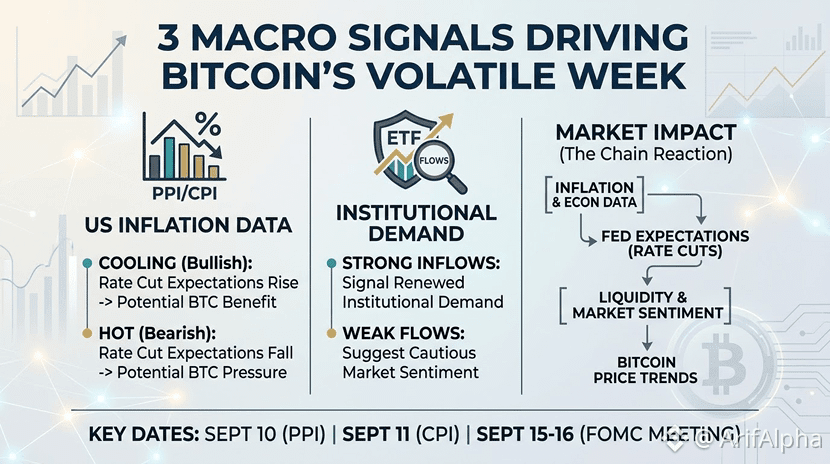
68
·
--
🚨 Blockchain Security Has a New Emergency Brake
Between August 20–31, multiple Layer-1 networks faced security concerns severe enough to pause block production and on-chain transfers.
Here’s the bigger picture 👇
🔹 Cronos (CRO)
An attacker manipulated the thinly traded TONIC token on Tectonic and borrowed an estimated $75M against inflated collateral. Only around $6M reached Ethereum before validators intervened. Cronos later restored the chain to its pre-exploit state.
🔹 Fogo (FOGO)
Around 400M FOGO — more than 10% of circulating supply — reached an attacker, prompting the network to pause.
🔹 Ontology (ONT)
Blocks were temporarily suspended for a security review. No confirmed exploit or asset loss was reported.
🔹 Injective (INJ)
Block production was also temporarily halted amid unconfirmed exploit claims.
🔹 BounceBit (BB)
Following its own security incident, the project ultimately moved away from its standalone chain toward BNB Chain.
📊 The Real Issue: Security vs. Decentralization
Chain halts can be an effective emergency brake. They can prevent attackers from moving more funds and give validators time to investigate.
But there is a serious trade-off:
A network-wide halt affects everyone.
Deposits, withdrawals, bridges and time-sensitive smart contracts can all stop — including for users who had nothing to do with the exploit.
Cronos also highlighted an even bigger question:
What happens when protecting the network requires changing finalized transaction history?
🧠 My Take
These incidents show that blockchain security isn't only about smart-contract code.
It is also about:
• Validator coordination
• Emergency governance
• Oracle & liquidity risks
• Bridge security
• Token-market manipulation
• The ability — and willingness — to stop the chain
The next generation of L1s may be judged not only by TPS and fees, but by how gracefully they handle the worst-case scenario.
Security isn't just about stopping the attacker.
It's about protecting the ecosystem without destroying user trust.
#CryptoSecurity #ArifAlpha
🚨 Blockchain Security Has a New Emergency Brake
Between August 20–31, multiple Layer-1 networks faced security concerns severe enough to pause block production and on-chain transfers.
Here’s the bigger picture 👇
🔹 Cronos (CRO)
An attacker manipulated the thinly traded TONIC token on Tectonic and borrowed an estimated $75M against inflated collateral. Only around $6M reached Ethereum before validators intervened. Cronos later restored the chain to its pre-exploit state.
🔹 Fogo (FOGO)
Around 400M FOGO — more than 10% of circulating supply — reached an attacker, prompting the network to pause.
🔹 Ontology (ONT)
Blocks were temporarily suspended for a security review. No confirmed exploit or asset loss was reported.
🔹 Injective (INJ)
Block production was also temporarily halted amid unconfirmed exploit claims.
🔹 BounceBit (BB)
Following its own security incident, the project ultimately moved away from its standalone chain toward BNB Chain.
📊 The Real Issue: Security vs. Decentralization
Chain halts can be an effective emergency brake. They can prevent attackers from moving more funds and give validators time to investigate.
But there is a serious trade-off:
A network-wide halt affects everyone.
Deposits, withdrawals, bridges and time-sensitive smart contracts can all stop — including for users who had nothing to do with the exploit.
Cronos also highlighted an even bigger question:
What happens when protecting the network requires changing finalized transaction history?
🧠 My Take
These incidents show that blockchain security isn't only about smart-contract code.
It is also about:
• Validator coordination
• Emergency governance
• Oracle & liquidity risks
• Bridge security
• Token-market manipulation
• The ability — and willingness — to stop the chain
The next generation of L1s may be judged not only by TPS and fees, but by how gracefully they handle the worst-case scenario.
Security isn't just about stopping the attacker.
It's about protecting the ecosystem without destroying user trust.
#CryptoSecurity #ArifAlpha
Between August 20–31, multiple Layer-1 networks faced security concerns severe enough to pause block production and on-chain transfers.
Here’s the bigger picture 👇
🔹 Cronos (CRO)
An attacker manipulated the thinly traded TONIC token on Tectonic and borrowed an estimated $75M against inflated collateral. Only around $6M reached Ethereum before validators intervened. Cronos later restored the chain to its pre-exploit state.
🔹 Fogo (FOGO)
Around 400M FOGO — more than 10% of circulating supply — reached an attacker, prompting the network to pause.
🔹 Ontology (ONT)
Blocks were temporarily suspended for a security review. No confirmed exploit or asset loss was reported.
🔹 Injective (INJ)
Block production was also temporarily halted amid unconfirmed exploit claims.
🔹 BounceBit (BB)
Following its own security incident, the project ultimately moved away from its standalone chain toward BNB Chain.
📊 The Real Issue: Security vs. Decentralization
Chain halts can be an effective emergency brake. They can prevent attackers from moving more funds and give validators time to investigate.
But there is a serious trade-off:
A network-wide halt affects everyone.
Deposits, withdrawals, bridges and time-sensitive smart contracts can all stop — including for users who had nothing to do with the exploit.
Cronos also highlighted an even bigger question:
What happens when protecting the network requires changing finalized transaction history?
🧠 My Take
These incidents show that blockchain security isn't only about smart-contract code.
It is also about:
• Validator coordination
• Emergency governance
• Oracle & liquidity risks
• Bridge security
• Token-market manipulation
• The ability — and willingness — to stop the chain
The next generation of L1s may be judged not only by TPS and fees, but by how gracefully they handle the worst-case scenario.
Security isn't just about stopping the attacker.
It's about protecting the ecosystem without destroying user trust.
#CryptoSecurity #ArifAlpha

1
638
·
--
Bitcoin Faces a New Macro Test: Hawkish Fed + ETF Outflows
Bitcoin’s recent strength is facing an important macro challenge as markets reassess the Federal Reserve’s next move.
🔹 1. Warsh’s Hawkish Message
Fed Chair Kevin Warsh emphasized that inflation remains above the Fed’s 2% target and that financial conditions may not be restrictive enough.
Although he did not announce a September decision, markets reacted quickly.
📊 September 25 bps hike odds:
35.7% → ~57%
That shift pushed Bitcoin from above $80K toward $77K, while US equities also weakened.
🔹 2. Bitcoin ETF Flows Reversed
The same session brought another warning signal.
Spot Bitcoin ETFs recorded approximately $201.9M in net outflows on August 28, ending a streak of 9 consecutive inflow days.
Those nine days had attracted roughly $3.04B in net inflows.
This doesn't prove that Warsh’s speech directly caused the ETF selling, but the timing is important:
Hawkish Fed expectations + weaker ETF demand = short-term pressure on BTC
🔹 3. The $80K Level Is Now Critical
The next major test for Bitcoin is whether it can reclaim and hold $80K.
If ETF inflows return and BTC moves back above $80K with strong volume, it could signal that institutional demand is absorbing the macro pressure.
But if ETF outflows continue while rate-hike expectations remain elevated, Bitcoin could remain under pressure and revisit lower support zones.
My Take 📌
The key story isn't simply “Bitcoin fell.”
The bigger question is:
Can institutional ETF demand overcome a more hawkish Fed environment?
September could provide the answer.
#Bitcoin #CryptoMarket #ArifAlpha
Bitcoin Faces a New Macro Test: Hawkish Fed + ETF Outflows
Bitcoin’s recent strength is facing an important macro challenge as markets reassess the Federal Reserve’s next move.
🔹 1. Warsh’s Hawkish Message
Fed Chair Kevin Warsh emphasized that inflation remains above the Fed’s 2% target and that financial conditions may not be restrictive enough.
Although he did not announce a September decision, markets reacted quickly.
📊 September 25 bps hike odds:
35.7% → ~57%
That shift pushed Bitcoin from above $80K toward $77K, while US equities also weakened.
🔹 2. Bitcoin ETF Flows Reversed
The same session brought another warning signal.
Spot Bitcoin ETFs recorded approximately $201.9M in net outflows on August 28, ending a streak of 9 consecutive inflow days.
Those nine days had attracted roughly $3.04B in net inflows.
This doesn't prove that Warsh’s speech directly caused the ETF selling, but the timing is important:
Hawkish Fed expectations + weaker ETF demand = short-term pressure on BTC
🔹 3. The $80K Level Is Now Critical
The next major test for Bitcoin is whether it can reclaim and hold $80K.
If ETF inflows return and BTC moves back above $80K with strong volume, it could signal that institutional demand is absorbing the macro pressure.
But if ETF outflows continue while rate-hike expectations remain elevated, Bitcoin could remain under pressure and revisit lower support zones.
My Take 📌
The key story isn't simply “Bitcoin fell.”
The bigger question is:
Can institutional ETF demand overcome a more hawkish Fed environment?
September could provide the answer.
#Bitcoin #CryptoMarket #ArifAlpha
Bitcoin’s recent strength is facing an important macro challenge as markets reassess the Federal Reserve’s next move.
🔹 1. Warsh’s Hawkish Message
Fed Chair Kevin Warsh emphasized that inflation remains above the Fed’s 2% target and that financial conditions may not be restrictive enough.
Although he did not announce a September decision, markets reacted quickly.
📊 September 25 bps hike odds:
35.7% → ~57%
That shift pushed Bitcoin from above $80K toward $77K, while US equities also weakened.
🔹 2. Bitcoin ETF Flows Reversed
The same session brought another warning signal.
Spot Bitcoin ETFs recorded approximately $201.9M in net outflows on August 28, ending a streak of 9 consecutive inflow days.
Those nine days had attracted roughly $3.04B in net inflows.
This doesn't prove that Warsh’s speech directly caused the ETF selling, but the timing is important:
Hawkish Fed expectations + weaker ETF demand = short-term pressure on BTC
🔹 3. The $80K Level Is Now Critical
The next major test for Bitcoin is whether it can reclaim and hold $80K.
If ETF inflows return and BTC moves back above $80K with strong volume, it could signal that institutional demand is absorbing the macro pressure.
But if ETF outflows continue while rate-hike expectations remain elevated, Bitcoin could remain under pressure and revisit lower support zones.
My Take 📌
The key story isn't simply “Bitcoin fell.”
The bigger question is:
Can institutional ETF demand overcome a more hawkish Fed environment?
September could provide the answer.
#Bitcoin #CryptoMarket #ArifAlpha

89
·
--
Article
ZEC’s Post-Ironwood Rally: Is the Breakout More Than Market Beta?Executive Summary
Zcash (ZEC) has delivered one of the strongest moves in the crypto market following the activation of the Ironwood upgrade. From July 28 through August 25, ZEC gained approximately 64.9%, significantly outperforming Bitcoin (+22.8%) and Ethereum (+27.1%).
At first glance, this looks like a clear breakout driven by renewed interest in Zcash. But price alone is not enough to confirm a sustainable trend.
A deeper analysis reveals a more complicated picture:
Price performance: Strongly bullish and substantially ahead of BTC and ETH.Trading volume: Increased dramatically, indicating much greater market participation.Orchard migration: Approximately 86% of the activation balance has migrated, showing strong execution of Ironwood’s immediate objective.Shielded activity: Increased sharply, but migration-related transactions make it difficult to distinguish genuine adoption from operational activity.Derivatives: Dollar-denominated open interest increased substantially, but ZEC-denominated exposure grew only modestly.Funding: Positive but not yet extreme, suggesting leverage exists without clear evidence of excessive crowding.ETF access: The ZEC ETF listing broadens access, but one trading day is insufficient to prove sustained institutional demand.
The key question is therefore no longer “Did ZEC break out?”
It clearly did.
The more important question is:
Can ZEC maintain its relative strength after the Ironwood migration effect and broader crypto-market momentum begin to fade?
1. ZEC Has Clearly Outperformed the Broader Market
The strongest evidence supporting the breakout is ZEC’s relative performance.
From Ironwood activation on July 28 to August 25:
ZEC therefore generated nearly three times Bitcoin’s return during the same period.
The divergence became even more obvious during the week from August 18 to August 25:
ZEC: +51.0%BTC: +21.3%ETH: +27.4%
This is important because it suggests that ZEC was not simply moving upward because the entire crypto market was bullish.
There was clearly a ZEC-specific momentum component.
However, there is an important warning.
ZEC reached an event-window closing high of approximately $848.64 on August 23, before falling to $767.88 on August 25.
That represents roughly a 9.5% decline from the peak.
What does this tell us?
The first phase of the breakout has already happened.
The next phase is about holding the breakout.
If ZEC/BTC and ZEC/ETH continue to outperform after the broader market cools down, the argument for a structural repricing becomes much stronger.
If ZEC begins losing its relative strength and simply follows BTC lower, then the move may have been primarily momentum-driven.
2. Ironwood Migration: A Major Execution Milestone
One of the biggest developments behind the ZEC narrative is the migration of funds from the sealed Orchard pool.
At Ironwood activation, approximately 3.599 million ZEC were held in the relevant Orchard balance.
By August 25, that figure had fallen to roughly 504,437 ZEC.
That means approximately:
3.599M − 0.504M = 3.095M ZEC
had migrated.
In percentage terms, approximately:
86% of the activation Orchard balance had migrated.
This is a significant operational achievement.
It indicates that the network successfully executed a major transition following the protocol’s emergency response.
But there is an important distinction:
Migration ≠ Adoption
Moving ZEC from one pool to another does not automatically mean:
More users entered Zcash.New investors bought ZEC.Privacy usage increased permanently.Network demand structurally increased.
The migration demonstrates execution, not necessarily organic adoption.
This distinction is extremely important when analyzing the current rally.
3. Shielded Activity Has Exploded — But the Data Needs Context
Another major development is the increase in shielded-related activity.
Before Ironwood activation, shielding and deshielding transactions averaged approximately:
63 transactions per day
After activation, the average increased to approximately:
1,087 transactions per day
And by August 25, the seven-day average had reached approximately:
1,481 transactions per day
That is a dramatic increase.
At first glance, this appears extremely bullish.
However, the problem is that the current transaction data includes migration-related activity.
Therefore, we cannot simply conclude:
“Shielded transactions increased, therefore Zcash adoption exploded.”
That conclusion would be premature.
The more important test comes after the migration activity declines.
The real adoption signal
If shielded activity remains elevated even after Orchard migration slows, that would provide much stronger evidence that users are actually using Zcash’s privacy functionality.
In other words:
Migration activity → temporary spike
versus
Recurring shielded usage → sustainable adoption
The second is what the market ultimately needs to see.
4. Shielded Supply Provides Another Important Signal
Total shielded value across Sprout, Sapling, Orchard and Ironwood was approximately:
4.80 million ZEC
That represents roughly:
28.4% of reported ZEC supply
This demonstrates that a meaningful portion of ZEC remains within shielded environments.
However, again, the number should not be interpreted as a direct measure of active users.
A large shielded balance does not necessarily mean those coins are actively transacting.
Therefore, investors should distinguish between:
Shielded supply
and
Shielded economic activity.
The second metric is much more useful for determining whether network usage is genuinely expanding.
5. Trading Volume Supports the Breakout
One of the strongest market-based confirmations is the increase in trading activity.
CoinGecko-tracked total volume averaged approximately:
$1.07 billion per day
over the latest seven-day period.
Compare that with the pre-Ironwood 30-day median of approximately:
$289 million per day
That means reported volume was roughly:
3.7× higher
than the previous baseline.
This is significant.
A price breakout accompanied by substantially higher trading activity is generally more convincing than a price move occurring on thin liquidity.
It suggests that the market is paying considerably more attention to ZEC.
However, volume should still be treated carefully.
Tracker-reported volume is not the same thing as audited market-wide exchange turnover.
Therefore:
Higher volume = stronger participation
but not necessarily:
Higher volume = permanent demand.
The important question is whether elevated volume persists once the immediate Ironwood narrative becomes less dominant.
6. Open Interest: The Most Misleading Number
Derivatives data provides one of the most interesting parts of the analysis.
Dollar-denominated open interest increased from approximately:
$236M → $426M
between Ironwood activation and August 25.
That represents an increase of roughly:
80.6%
At first glance, that looks like a massive increase in leveraged positioning.
But there is another way to measure it.
When open interest is measured in ZEC contracts, the increase was only approximately:
3.6%
This changes the interpretation considerably.
Why?
Because ZEC itself increased substantially in price.
When the price of ZEC rises, the USD value of existing contracts automatically increases, even if the actual number of outstanding ZEC contracts barely changes.
Simple example
Imagine traders hold:
1 million ZEC of open positions
At $200:
1M × $200 = $200M
If ZEC rises to $400 while traders still hold exactly 1 million ZEC:
1M × $400 = $400M
Dollar OI has doubled.
But traders did not double their actual ZEC exposure.
This is essentially what the current data is highlighting.
The takeaway
The 80.6% increase in dollar OI looks dramatic.
But the much smaller 3.6% increase in ZEC-denominated OI suggests that the majority of the increase came from price appreciation rather than an equivalent expansion in outstanding contracts.
This is an important distinction when evaluating whether fresh leverage is driving the breakout.
7. Funding Rate: Bullish, But Not Yet Extreme
Funding remained positive.
The seven-day average was approximately:
0.83 basis points per regular interval
Positive funding means long positions were generally paying shorts.
This indicates that bullish positioning existed in the derivatives market.
But the funding level was not extreme enough by itself to demonstrate severe leverage overcrowding.
This is important because extremely positive funding during a parabolic rally can create significant liquidation risk.
For example:
Price rises → traders become increasingly bullish → leverage increases → funding becomes extreme → small pullback triggers long liquidations → forced selling accelerates.
The current data does not provide strong evidence that ZEC has reached that extreme stage.
However, funding should continue to be monitored.
8. The ZEC ETF Adds a New Demand Channel
Another major development arrived on August 25, when the Zcash ETF began trading on NYSE Arca following the conversion of an existing investment trust.
This gives traditional brokerage investors another way to obtain exposure to ZEC.
That is potentially important because ETFs can broaden access beyond users who directly trade cryptocurrency.
But there is a critical point:
ETF listing does not automatically equal new capital.
Because the product was created through the conversion of an existing investment trust, the first day of trading should not automatically be interpreted as a massive wave of fresh institutional demand.
The market needs more data.
What matters now is:
Continued ETF inflowsAssets under management growthTrading volumeInstitutional participationWhether demand persists after the initial launch attention
If those metrics continue improving, the ETF narrative becomes considerably more meaningful.
9. Five Signals That Could Confirm the Breakout
The current ZEC setup can be evaluated through five major confirmation signals.
① Relative Strength
The most important technical confirmation is whether ZEC continues outperforming BTC and ETH.
Watch:
ZEC/BTC
and
ZEC/ETH
If these ratios continue trending higher, ZEC is demonstrating genuine relative strength.
If they collapse while BTC remains stable, the ZEC-specific narrative may be weakening.
② Sustainable Trading Volume
The current volume expansion is encouraging.
But the ideal scenario is not one enormous volume spike.
The stronger signal would be:
consistently elevated volume over multiple weeks.
That would suggest continuing market participation rather than short-term event speculation.
③ Coin-Denominated Open Interest
For ZEC derivatives, coin-denominated OI may provide a cleaner picture than USD OI.
If:
Price ↑ + ZEC OI ↑
then new positions may be entering the market.
But if:
Price ↑ + USD OI ↑ + ZEC OI remains relatively flat
then much of the OI increase may simply be a result of the higher ZEC price.
④ Funding Pressure
Positive funding is not automatically bearish.
Moderately positive funding can simply indicate healthy bullish positioning.
The risk increases if:
Funding ↑ sharply + ZEC OI ↑ rapidly + price becomes parabolic
That combination would suggest increasing leverage and potential liquidation vulnerability.
⑤ Post-Migration Privacy Usage
This may ultimately become the most important fundamental signal.
Once the majority of Orchard migration is complete, the market should watch whether shielded activity remains elevated.
The ideal confirmation would be:
Migration slows → shielded activity remains high → recurring shielded transfers increase
That would provide stronger evidence that Ironwood has generated lasting network utility rather than merely facilitating a one-time operational transition.
10. Bullish Scenario vs. Risk Scenario
🟢 Bullish Confirmation
The breakout becomes significantly more convincing if:
ZEC continues outperforming BTC and ETH.Trading volume remains well above the pre-Ironwood baseline.ETF demand continues expanding.Shielded activity remains elevated after migration slows.ZEC-denominated OI begins increasing alongside price.Funding remains positive but controlled.ZEC holds the breakout structure after the initial pullback.
This combination would suggest that the rally is transitioning from an event-driven move into a fundamental repricing.
🔴 Risk Scenario
The breakout becomes vulnerable if:
ZEC loses its relative strength against BTC.Volume rapidly collapses.Shielded activity falls back toward pre-Ironwood levels.ETF demand fails to develop.Leverage increases rapidly while funding becomes extreme.Price continues falling below important breakout levels.
In that situation, the August rally could increasingly resemble a momentum and event-driven trade rather than a sustainable long-term repricing.
Final Analysis
ZEC's post-Ironwood rally is clearly more significant than a simple market-beta move.
A 64.9% gain versus 22.8% for BTC and 27.1% for ETH demonstrates substantial relative strength.
At the same time, the network has successfully completed approximately 86% of the relevant Orchard migration, while reported trading activity has expanded dramatically.
But several parts of the bullish thesis remain unconfirmed.
The biggest uncertainty is adoption.
Current shielded activity is elevated, but migration itself contributes to that activity. Similarly, the increase in dollar-denominated open interest looks impressive until it is adjusted for ZEC's much higher price.
Therefore, the market is now moving into a confirmation phase.
The first phase was:
Ironwood → migration → attention → price breakout
The next phase needs to be:
Post-migration → recurring privacy usage → sustained volume → continued relative strength → durable demand
That distinction will determine whether ZEC's breakout becomes a lasting structural repricing or gradually fades as the event-driven momentum disappears.
Bottom Line
ZEC has already proved that it can outperform the broader crypto market.
Now it needs to prove that the network's real usage and recurring demand can catch up with the price.
That is the key test for the next stage of the ZEC cycle.
#ZEC #CryptoAnalysis #Zcash #ArifAlpha
{spot}(ZECUSDT)
ZEC’s Post-Ironwood Rally: Is the Breakout More Than Market Beta?
Executive Summary
Zcash (ZEC) has delivered one of the strongest moves in the crypto market following the activation of the Ironwood upgrade. From July 28 through August 25, ZEC gained approximately 64.9%, significantly outperforming Bitcoin (+22.8%) and Ethereum (+27.1%).
At first glance, this looks like a clear breakout driven by renewed interest in Zcash. But price alone is not enough to confirm a sustainable trend.
A deeper analysis reveals a more complicated picture:
Price performance: Strongly bullish and substantially ahead of BTC and ETH.Trading volume: Increased dramatically, indicating much greater market participation.Orchard migration: Approximately 86% of the activation balance has migrated, showing strong execution of Ironwood’s immediate objective.Shielded activity: Increased sharply, but migration-related transactions make it difficult to distinguish genuine adoption from operational activity.Derivatives: Dollar-denominated open interest increased substantially, but ZEC-denominated exposure grew only modestly.Funding: Positive but not yet extreme, suggesting leverage exists without clear evidence of excessive crowding.ETF access: The ZEC ETF listing broadens access, but one trading day is insufficient to prove sustained institutional demand.
The key question is therefore no longer “Did ZEC break out?”
It clearly did.
The more important question is:
Can ZEC maintain its relative strength after the Ironwood migration effect and broader crypto-market momentum begin to fade?
1. ZEC Has Clearly Outperformed the Broader Market
The strongest evidence supporting the breakout is ZEC’s relative performance.
From Ironwood activation on July 28 to August 25:
ZEC therefore generated nearly three times Bitcoin’s return during the same period.
The divergence became even more obvious during the week from August 18 to August 25:
ZEC: +51.0%BTC: +21.3%ETH: +27.4%
This is important because it suggests that ZEC was not simply moving upward because the entire crypto market was bullish.
There was clearly a ZEC-specific momentum component.
However, there is an important warning.
ZEC reached an event-window closing high of approximately $848.64 on August 23, before falling to $767.88 on August 25.
That represents roughly a 9.5% decline from the peak.
What does this tell us?
The first phase of the breakout has already happened.
The next phase is about holding the breakout.
If ZEC/BTC and ZEC/ETH continue to outperform after the broader market cools down, the argument for a structural repricing becomes much stronger.
If ZEC begins losing its relative strength and simply follows BTC lower, then the move may have been primarily momentum-driven.
2. Ironwood Migration: A Major Execution Milestone
One of the biggest developments behind the ZEC narrative is the migration of funds from the sealed Orchard pool.
At Ironwood activation, approximately 3.599 million ZEC were held in the relevant Orchard balance.
By August 25, that figure had fallen to roughly 504,437 ZEC.
That means approximately:
3.599M − 0.504M = 3.095M ZEC
had migrated.
In percentage terms, approximately:
86% of the activation Orchard balance had migrated.
This is a significant operational achievement.
It indicates that the network successfully executed a major transition following the protocol’s emergency response.
But there is an important distinction:
Migration ≠ Adoption
Moving ZEC from one pool to another does not automatically mean:
More users entered Zcash.New investors bought ZEC.Privacy usage increased permanently.Network demand structurally increased.
The migration demonstrates execution, not necessarily organic adoption.
This distinction is extremely important when analyzing the current rally.
3. Shielded Activity Has Exploded — But the Data Needs Context
Another major development is the increase in shielded-related activity.
Before Ironwood activation, shielding and deshielding transactions averaged approximately:
63 transactions per day
After activation, the average increased to approximately:
1,087 transactions per day
And by August 25, the seven-day average had reached approximately:
1,481 transactions per day
That is a dramatic increase.
At first glance, this appears extremely bullish.
However, the problem is that the current transaction data includes migration-related activity.
Therefore, we cannot simply conclude:
“Shielded transactions increased, therefore Zcash adoption exploded.”
That conclusion would be premature.
The more important test comes after the migration activity declines.
The real adoption signal
If shielded activity remains elevated even after Orchard migration slows, that would provide much stronger evidence that users are actually using Zcash’s privacy functionality.
In other words:
Migration activity → temporary spike
versus
Recurring shielded usage → sustainable adoption
The second is what the market ultimately needs to see.
4. Shielded Supply Provides Another Important Signal
Total shielded value across Sprout, Sapling, Orchard and Ironwood was approximately:
4.80 million ZEC
That represents roughly:
28.4% of reported ZEC supply
This demonstrates that a meaningful portion of ZEC remains within shielded environments.
However, again, the number should not be interpreted as a direct measure of active users.
A large shielded balance does not necessarily mean those coins are actively transacting.
Therefore, investors should distinguish between:
Shielded supply
and
Shielded economic activity.
The second metric is much more useful for determining whether network usage is genuinely expanding.
5. Trading Volume Supports the Breakout
One of the strongest market-based confirmations is the increase in trading activity.
CoinGecko-tracked total volume averaged approximately:
$1.07 billion per day
over the latest seven-day period.
Compare that with the pre-Ironwood 30-day median of approximately:
$289 million per day
That means reported volume was roughly:
3.7× higher
than the previous baseline.
This is significant.
A price breakout accompanied by substantially higher trading activity is generally more convincing than a price move occurring on thin liquidity.
It suggests that the market is paying considerably more attention to ZEC.
However, volume should still be treated carefully.
Tracker-reported volume is not the same thing as audited market-wide exchange turnover.
Therefore:
Higher volume = stronger participation
but not necessarily:
Higher volume = permanent demand.
The important question is whether elevated volume persists once the immediate Ironwood narrative becomes less dominant.
6. Open Interest: The Most Misleading Number
Derivatives data provides one of the most interesting parts of the analysis.
Dollar-denominated open interest increased from approximately:
$236M → $426M
between Ironwood activation and August 25.
That represents an increase of roughly:
80.6%
At first glance, that looks like a massive increase in leveraged positioning.
But there is another way to measure it.
When open interest is measured in ZEC contracts, the increase was only approximately:
3.6%
This changes the interpretation considerably.
Why?
Because ZEC itself increased substantially in price.
When the price of ZEC rises, the USD value of existing contracts automatically increases, even if the actual number of outstanding ZEC contracts barely changes.
Simple example
Imagine traders hold:
1 million ZEC of open positions
At $200:
1M × $200 = $200M
If ZEC rises to $400 while traders still hold exactly 1 million ZEC:
1M × $400 = $400M
Dollar OI has doubled.
But traders did not double their actual ZEC exposure.
This is essentially what the current data is highlighting.
The takeaway
The 80.6% increase in dollar OI looks dramatic.
But the much smaller 3.6% increase in ZEC-denominated OI suggests that the majority of the increase came from price appreciation rather than an equivalent expansion in outstanding contracts.
This is an important distinction when evaluating whether fresh leverage is driving the breakout.
7. Funding Rate: Bullish, But Not Yet Extreme
Funding remained positive.
The seven-day average was approximately:
0.83 basis points per regular interval
Positive funding means long positions were generally paying shorts.
This indicates that bullish positioning existed in the derivatives market.
But the funding level was not extreme enough by itself to demonstrate severe leverage overcrowding.
This is important because extremely positive funding during a parabolic rally can create significant liquidation risk.
For example:
Price rises → traders become increasingly bullish → leverage increases → funding becomes extreme → small pullback triggers long liquidations → forced selling accelerates.
The current data does not provide strong evidence that ZEC has reached that extreme stage.
However, funding should continue to be monitored.
8. The ZEC ETF Adds a New Demand Channel
Another major development arrived on August 25, when the Zcash ETF began trading on NYSE Arca following the conversion of an existing investment trust.
This gives traditional brokerage investors another way to obtain exposure to ZEC.
That is potentially important because ETFs can broaden access beyond users who directly trade cryptocurrency.
But there is a critical point:
ETF listing does not automatically equal new capital.
Because the product was created through the conversion of an existing investment trust, the first day of trading should not automatically be interpreted as a massive wave of fresh institutional demand.
The market needs more data.
What matters now is:
Continued ETF inflowsAssets under management growthTrading volumeInstitutional participationWhether demand persists after the initial launch attention
If those metrics continue improving, the ETF narrative becomes considerably more meaningful.
9. Five Signals That Could Confirm the Breakout
The current ZEC setup can be evaluated through five major confirmation signals.
① Relative Strength
The most important technical confirmation is whether ZEC continues outperforming BTC and ETH.
Watch:
ZEC/BTC
and
ZEC/ETH
If these ratios continue trending higher, ZEC is demonstrating genuine relative strength.
If they collapse while BTC remains stable, the ZEC-specific narrative may be weakening.
② Sustainable Trading Volume
The current volume expansion is encouraging.
But the ideal scenario is not one enormous volume spike.
The stronger signal would be:
consistently elevated volume over multiple weeks.
That would suggest continuing market participation rather than short-term event speculation.
③ Coin-Denominated Open Interest
For ZEC derivatives, coin-denominated OI may provide a cleaner picture than USD OI.
If:
Price ↑ + ZEC OI ↑
then new positions may be entering the market.
But if:
Price ↑ + USD OI ↑ + ZEC OI remains relatively flat
then much of the OI increase may simply be a result of the higher ZEC price.
④ Funding Pressure
Positive funding is not automatically bearish.
Moderately positive funding can simply indicate healthy bullish positioning.
The risk increases if:
Funding ↑ sharply + ZEC OI ↑ rapidly + price becomes parabolic
That combination would suggest increasing leverage and potential liquidation vulnerability.
⑤ Post-Migration Privacy Usage
This may ultimately become the most important fundamental signal.
Once the majority of Orchard migration is complete, the market should watch whether shielded activity remains elevated.
The ideal confirmation would be:
Migration slows → shielded activity remains high → recurring shielded transfers increase
That would provide stronger evidence that Ironwood has generated lasting network utility rather than merely facilitating a one-time operational transition.
10. Bullish Scenario vs. Risk Scenario
🟢 Bullish Confirmation
The breakout becomes significantly more convincing if:
ZEC continues outperforming BTC and ETH.Trading volume remains well above the pre-Ironwood baseline.ETF demand continues expanding.Shielded activity remains elevated after migration slows.ZEC-denominated OI begins increasing alongside price.Funding remains positive but controlled.ZEC holds the breakout structure after the initial pullback.
This combination would suggest that the rally is transitioning from an event-driven move into a fundamental repricing.
🔴 Risk Scenario
The breakout becomes vulnerable if:
ZEC loses its relative strength against BTC.Volume rapidly collapses.Shielded activity falls back toward pre-Ironwood levels.ETF demand fails to develop.Leverage increases rapidly while funding becomes extreme.Price continues falling below important breakout levels.
In that situation, the August rally could increasingly resemble a momentum and event-driven trade rather than a sustainable long-term repricing.
Final Analysis
ZEC's post-Ironwood rally is clearly more significant than a simple market-beta move.
A 64.9% gain versus 22.8% for BTC and 27.1% for ETH demonstrates substantial relative strength.
At the same time, the network has successfully completed approximately 86% of the relevant Orchard migration, while reported trading activity has expanded dramatically.
But several parts of the bullish thesis remain unconfirmed.
The biggest uncertainty is adoption.
Current shielded activity is elevated, but migration itself contributes to that activity. Similarly, the increase in dollar-denominated open interest looks impressive until it is adjusted for ZEC's much higher price.
Therefore, the market is now moving into a confirmation phase.
The first phase was:
Ironwood → migration → attention → price breakout
The next phase needs to be:
Post-migration → recurring privacy usage → sustained volume → continued relative strength → durable demand
That distinction will determine whether ZEC's breakout becomes a lasting structural repricing or gradually fades as the event-driven momentum disappears.
Bottom Line
ZEC has already proved that it can outperform the broader crypto market.
Now it needs to prove that the network's real usage and recurring demand can catch up with the price.
That is the key test for the next stage of the ZEC cycle.
#ZEC #CryptoAnalysis #Zcash #ArifAlpha
Zcash (ZEC) has delivered one of the strongest moves in the crypto market following the activation of the Ironwood upgrade. From July 28 through August 25, ZEC gained approximately 64.9%, significantly outperforming Bitcoin (+22.8%) and Ethereum (+27.1%).
At first glance, this looks like a clear breakout driven by renewed interest in Zcash. But price alone is not enough to confirm a sustainable trend.
A deeper analysis reveals a more complicated picture:
Price performance: Strongly bullish and substantially ahead of BTC and ETH.Trading volume: Increased dramatically, indicating much greater market participation.Orchard migration: Approximately 86% of the activation balance has migrated, showing strong execution of Ironwood’s immediate objective.Shielded activity: Increased sharply, but migration-related transactions make it difficult to distinguish genuine adoption from operational activity.Derivatives: Dollar-denominated open interest increased substantially, but ZEC-denominated exposure grew only modestly.Funding: Positive but not yet extreme, suggesting leverage exists without clear evidence of excessive crowding.ETF access: The ZEC ETF listing broadens access, but one trading day is insufficient to prove sustained institutional demand.
The key question is therefore no longer “Did ZEC break out?”
It clearly did.
The more important question is:
Can ZEC maintain its relative strength after the Ironwood migration effect and broader crypto-market momentum begin to fade?
1. ZEC Has Clearly Outperformed the Broader Market
The strongest evidence supporting the breakout is ZEC’s relative performance.
From Ironwood activation on July 28 to August 25:
ZEC therefore generated nearly three times Bitcoin’s return during the same period.
The divergence became even more obvious during the week from August 18 to August 25:
ZEC: +51.0%BTC: +21.3%ETH: +27.4%
This is important because it suggests that ZEC was not simply moving upward because the entire crypto market was bullish.
There was clearly a ZEC-specific momentum component.
However, there is an important warning.
ZEC reached an event-window closing high of approximately $848.64 on August 23, before falling to $767.88 on August 25.
That represents roughly a 9.5% decline from the peak.
What does this tell us?
The first phase of the breakout has already happened.
The next phase is about holding the breakout.
If ZEC/BTC and ZEC/ETH continue to outperform after the broader market cools down, the argument for a structural repricing becomes much stronger.
If ZEC begins losing its relative strength and simply follows BTC lower, then the move may have been primarily momentum-driven.
2. Ironwood Migration: A Major Execution Milestone
One of the biggest developments behind the ZEC narrative is the migration of funds from the sealed Orchard pool.
At Ironwood activation, approximately 3.599 million ZEC were held in the relevant Orchard balance.
By August 25, that figure had fallen to roughly 504,437 ZEC.
That means approximately:
3.599M − 0.504M = 3.095M ZEC
had migrated.
In percentage terms, approximately:
86% of the activation Orchard balance had migrated.
This is a significant operational achievement.
It indicates that the network successfully executed a major transition following the protocol’s emergency response.
But there is an important distinction:
Migration ≠ Adoption
Moving ZEC from one pool to another does not automatically mean:
More users entered Zcash.New investors bought ZEC.Privacy usage increased permanently.Network demand structurally increased.
The migration demonstrates execution, not necessarily organic adoption.
This distinction is extremely important when analyzing the current rally.
3. Shielded Activity Has Exploded — But the Data Needs Context
Another major development is the increase in shielded-related activity.
Before Ironwood activation, shielding and deshielding transactions averaged approximately:
63 transactions per day
After activation, the average increased to approximately:
1,087 transactions per day
And by August 25, the seven-day average had reached approximately:
1,481 transactions per day
That is a dramatic increase.
At first glance, this appears extremely bullish.
However, the problem is that the current transaction data includes migration-related activity.
Therefore, we cannot simply conclude:
“Shielded transactions increased, therefore Zcash adoption exploded.”
That conclusion would be premature.
The more important test comes after the migration activity declines.
The real adoption signal
If shielded activity remains elevated even after Orchard migration slows, that would provide much stronger evidence that users are actually using Zcash’s privacy functionality.
In other words:
Migration activity → temporary spike
versus
Recurring shielded usage → sustainable adoption
The second is what the market ultimately needs to see.
4. Shielded Supply Provides Another Important Signal
Total shielded value across Sprout, Sapling, Orchard and Ironwood was approximately:
4.80 million ZEC
That represents roughly:
28.4% of reported ZEC supply
This demonstrates that a meaningful portion of ZEC remains within shielded environments.
However, again, the number should not be interpreted as a direct measure of active users.
A large shielded balance does not necessarily mean those coins are actively transacting.
Therefore, investors should distinguish between:
Shielded supply
and
Shielded economic activity.
The second metric is much more useful for determining whether network usage is genuinely expanding.
5. Trading Volume Supports the Breakout
One of the strongest market-based confirmations is the increase in trading activity.
CoinGecko-tracked total volume averaged approximately:
$1.07 billion per day
over the latest seven-day period.
Compare that with the pre-Ironwood 30-day median of approximately:
$289 million per day
That means reported volume was roughly:
3.7× higher
than the previous baseline.
This is significant.
A price breakout accompanied by substantially higher trading activity is generally more convincing than a price move occurring on thin liquidity.
It suggests that the market is paying considerably more attention to ZEC.
However, volume should still be treated carefully.
Tracker-reported volume is not the same thing as audited market-wide exchange turnover.
Therefore:
Higher volume = stronger participation
but not necessarily:
Higher volume = permanent demand.
The important question is whether elevated volume persists once the immediate Ironwood narrative becomes less dominant.
6. Open Interest: The Most Misleading Number
Derivatives data provides one of the most interesting parts of the analysis.
Dollar-denominated open interest increased from approximately:
$236M → $426M
between Ironwood activation and August 25.
That represents an increase of roughly:
80.6%
At first glance, that looks like a massive increase in leveraged positioning.
But there is another way to measure it.
When open interest is measured in ZEC contracts, the increase was only approximately:
3.6%
This changes the interpretation considerably.
Why?
Because ZEC itself increased substantially in price.
When the price of ZEC rises, the USD value of existing contracts automatically increases, even if the actual number of outstanding ZEC contracts barely changes.
Simple example
Imagine traders hold:
1 million ZEC of open positions
At $200:
1M × $200 = $200M
If ZEC rises to $400 while traders still hold exactly 1 million ZEC:
1M × $400 = $400M
Dollar OI has doubled.
But traders did not double their actual ZEC exposure.
This is essentially what the current data is highlighting.
The takeaway
The 80.6% increase in dollar OI looks dramatic.
But the much smaller 3.6% increase in ZEC-denominated OI suggests that the majority of the increase came from price appreciation rather than an equivalent expansion in outstanding contracts.
This is an important distinction when evaluating whether fresh leverage is driving the breakout.
7. Funding Rate: Bullish, But Not Yet Extreme
Funding remained positive.
The seven-day average was approximately:
0.83 basis points per regular interval
Positive funding means long positions were generally paying shorts.
This indicates that bullish positioning existed in the derivatives market.
But the funding level was not extreme enough by itself to demonstrate severe leverage overcrowding.
This is important because extremely positive funding during a parabolic rally can create significant liquidation risk.
For example:
Price rises → traders become increasingly bullish → leverage increases → funding becomes extreme → small pullback triggers long liquidations → forced selling accelerates.
The current data does not provide strong evidence that ZEC has reached that extreme stage.
However, funding should continue to be monitored.
8. The ZEC ETF Adds a New Demand Channel
Another major development arrived on August 25, when the Zcash ETF began trading on NYSE Arca following the conversion of an existing investment trust.
This gives traditional brokerage investors another way to obtain exposure to ZEC.
That is potentially important because ETFs can broaden access beyond users who directly trade cryptocurrency.
But there is a critical point:
ETF listing does not automatically equal new capital.
Because the product was created through the conversion of an existing investment trust, the first day of trading should not automatically be interpreted as a massive wave of fresh institutional demand.
The market needs more data.
What matters now is:
Continued ETF inflowsAssets under management growthTrading volumeInstitutional participationWhether demand persists after the initial launch attention
If those metrics continue improving, the ETF narrative becomes considerably more meaningful.
9. Five Signals That Could Confirm the Breakout
The current ZEC setup can be evaluated through five major confirmation signals.
① Relative Strength
The most important technical confirmation is whether ZEC continues outperforming BTC and ETH.
Watch:
ZEC/BTC
and
ZEC/ETH
If these ratios continue trending higher, ZEC is demonstrating genuine relative strength.
If they collapse while BTC remains stable, the ZEC-specific narrative may be weakening.
② Sustainable Trading Volume
The current volume expansion is encouraging.
But the ideal scenario is not one enormous volume spike.
The stronger signal would be:
consistently elevated volume over multiple weeks.
That would suggest continuing market participation rather than short-term event speculation.
③ Coin-Denominated Open Interest
For ZEC derivatives, coin-denominated OI may provide a cleaner picture than USD OI.
If:
Price ↑ + ZEC OI ↑
then new positions may be entering the market.
But if:
Price ↑ + USD OI ↑ + ZEC OI remains relatively flat
then much of the OI increase may simply be a result of the higher ZEC price.
④ Funding Pressure
Positive funding is not automatically bearish.
Moderately positive funding can simply indicate healthy bullish positioning.
The risk increases if:
Funding ↑ sharply + ZEC OI ↑ rapidly + price becomes parabolic
That combination would suggest increasing leverage and potential liquidation vulnerability.
⑤ Post-Migration Privacy Usage
This may ultimately become the most important fundamental signal.
Once the majority of Orchard migration is complete, the market should watch whether shielded activity remains elevated.
The ideal confirmation would be:
Migration slows → shielded activity remains high → recurring shielded transfers increase
That would provide stronger evidence that Ironwood has generated lasting network utility rather than merely facilitating a one-time operational transition.
10. Bullish Scenario vs. Risk Scenario
🟢 Bullish Confirmation
The breakout becomes significantly more convincing if:
ZEC continues outperforming BTC and ETH.Trading volume remains well above the pre-Ironwood baseline.ETF demand continues expanding.Shielded activity remains elevated after migration slows.ZEC-denominated OI begins increasing alongside price.Funding remains positive but controlled.ZEC holds the breakout structure after the initial pullback.
This combination would suggest that the rally is transitioning from an event-driven move into a fundamental repricing.
🔴 Risk Scenario
The breakout becomes vulnerable if:
ZEC loses its relative strength against BTC.Volume rapidly collapses.Shielded activity falls back toward pre-Ironwood levels.ETF demand fails to develop.Leverage increases rapidly while funding becomes extreme.Price continues falling below important breakout levels.
In that situation, the August rally could increasingly resemble a momentum and event-driven trade rather than a sustainable long-term repricing.
Final Analysis
ZEC's post-Ironwood rally is clearly more significant than a simple market-beta move.
A 64.9% gain versus 22.8% for BTC and 27.1% for ETH demonstrates substantial relative strength.
At the same time, the network has successfully completed approximately 86% of the relevant Orchard migration, while reported trading activity has expanded dramatically.
But several parts of the bullish thesis remain unconfirmed.
The biggest uncertainty is adoption.
Current shielded activity is elevated, but migration itself contributes to that activity. Similarly, the increase in dollar-denominated open interest looks impressive until it is adjusted for ZEC's much higher price.
Therefore, the market is now moving into a confirmation phase.
The first phase was:
Ironwood → migration → attention → price breakout
The next phase needs to be:
Post-migration → recurring privacy usage → sustained volume → continued relative strength → durable demand
That distinction will determine whether ZEC's breakout becomes a lasting structural repricing or gradually fades as the event-driven momentum disappears.
Bottom Line
ZEC has already proved that it can outperform the broader crypto market.
Now it needs to prove that the network's real usage and recurring demand can catch up with the price.
That is the key test for the next stage of the ZEC cycle.
#ZEC #CryptoAnalysis #Zcash #ArifAlpha
131
·
--
XRP’s Quantum Shift: Early Move or Market Narrative?
Ripple is positioning XRP Ledger (XRPL) ahead of the curve with a post-quantum security roadmap targeting 2028. This isn’t hype—it’s a structural upgrade responding to a real long-term threat.
◼️ What’s Actually Happening?
Ripple outlined a 4-phase transition plan:
◼️ Phase 1 (Safety Layer):
Fallback mechanism if current cryptography breaks (includes zero-knowledge proof concepts)
◼️ Phase 2 (Now – H1 2026):
Testing quantum-resistant signatures (NIST standards) + hybrid signing models
◼️ Phase 3 (H2 2026):
Deploy post-quantum signatures on Devnet (parallel to current system)
◼️ Phase 4 (2028 Target):
Full migration to quantum-resistant cryptography on XRPL
◼️ Why This Matters
◼️ Current crypto (BTC, ETH, XRP) relies on ECDSA encryption
◼️ Advanced quantum computers could eventually break private keys from public keys
◼️ Research suggests this may require far fewer resources than previously expected
👉 Translation: This is not immediate risk—but not science fiction anymore
◼️ Investor Perspective
◼️ Bullish Angle:
XRP becomes one of the first “quantum-ready” blockchains
→ Strong narrative for institutions & long-term holders
◼️ Neutral Reality:
Timeline = multi-year (2026–2028)
→ No short-term price catalyst
◼️ Hidden Risk:
Migration complexity (wallets, validators, infrastructure)
→ Execution risk is real
◼️ Strategic Take
◼️ This is a defensive upgrade, not a pump trigger
◼️ Long-term positioning play similar to early Layer-2 adoption phase
◼️ Watch for:
▪ Devnet testing results
▪ Validator adoption
▪ Wallet-level integration
Bottom Line:
XRP is betting early on a post-quantum future. If quantum threats accelerate, this move could shift it into a premium “secure asset” category—but until then, it’s a slow-burn fundamental narrative, not a short-term trade signal.
#XRP #CryptoStrategy #ArifAlpha
XRP’s Quantum Shift: Early Move or Market Narrative?
Ripple is positioning XRP Ledger (XRPL) ahead of the curve with a post-quantum security roadmap targeting 2028. This isn’t hype—it’s a structural upgrade responding to a real long-term threat.
◼️ What’s Actually Happening?
Ripple outlined a 4-phase transition plan:
◼️ Phase 1 (Safety Layer):
Fallback mechanism if current cryptography breaks (includes zero-knowledge proof concepts)
◼️ Phase 2 (Now – H1 2026):
Testing quantum-resistant signatures (NIST standards) + hybrid signing models
◼️ Phase 3 (H2 2026):
Deploy post-quantum signatures on Devnet (parallel to current system)
◼️ Phase 4 (2028 Target):
Full migration to quantum-resistant cryptography on XRPL
◼️ Why This Matters
◼️ Current crypto (BTC, ETH, XRP) relies on ECDSA encryption
◼️ Advanced quantum computers could eventually break private keys from public keys
◼️ Research suggests this may require far fewer resources than previously expected
👉 Translation: This is not immediate risk—but not science fiction anymore
◼️ Investor Perspective
◼️ Bullish Angle:
XRP becomes one of the first “quantum-ready” blockchains
→ Strong narrative for institutions & long-term holders
◼️ Neutral Reality:
Timeline = multi-year (2026–2028)
→ No short-term price catalyst
◼️ Hidden Risk:
Migration complexity (wallets, validators, infrastructure)
→ Execution risk is real
◼️ Strategic Take
◼️ This is a defensive upgrade, not a pump trigger
◼️ Long-term positioning play similar to early Layer-2 adoption phase
◼️ Watch for:
▪ Devnet testing results
▪ Validator adoption
▪ Wallet-level integration
Bottom Line:
XRP is betting early on a post-quantum future. If quantum threats accelerate, this move could shift it into a premium “secure asset” category—but until then, it’s a slow-burn fundamental narrative, not a short-term trade signal.
#XRP #CryptoStrategy #ArifAlpha
Ripple is positioning XRP Ledger (XRPL) ahead of the curve with a post-quantum security roadmap targeting 2028. This isn’t hype—it’s a structural upgrade responding to a real long-term threat.
◼️ What’s Actually Happening?
Ripple outlined a 4-phase transition plan:
◼️ Phase 1 (Safety Layer):
Fallback mechanism if current cryptography breaks (includes zero-knowledge proof concepts)
◼️ Phase 2 (Now – H1 2026):
Testing quantum-resistant signatures (NIST standards) + hybrid signing models
◼️ Phase 3 (H2 2026):
Deploy post-quantum signatures on Devnet (parallel to current system)
◼️ Phase 4 (2028 Target):
Full migration to quantum-resistant cryptography on XRPL
◼️ Why This Matters
◼️ Current crypto (BTC, ETH, XRP) relies on ECDSA encryption
◼️ Advanced quantum computers could eventually break private keys from public keys
◼️ Research suggests this may require far fewer resources than previously expected
👉 Translation: This is not immediate risk—but not science fiction anymore
◼️ Investor Perspective
◼️ Bullish Angle:
XRP becomes one of the first “quantum-ready” blockchains
→ Strong narrative for institutions & long-term holders
◼️ Neutral Reality:
Timeline = multi-year (2026–2028)
→ No short-term price catalyst
◼️ Hidden Risk:
Migration complexity (wallets, validators, infrastructure)
→ Execution risk is real
◼️ Strategic Take
◼️ This is a defensive upgrade, not a pump trigger
◼️ Long-term positioning play similar to early Layer-2 adoption phase
◼️ Watch for:
▪ Devnet testing results
▪ Validator adoption
▪ Wallet-level integration
Bottom Line:
XRP is betting early on a post-quantum future. If quantum threats accelerate, this move could shift it into a premium “secure asset” category—but until then, it’s a slow-burn fundamental narrative, not a short-term trade signal.
#XRP #CryptoStrategy #ArifAlpha
167
·
--
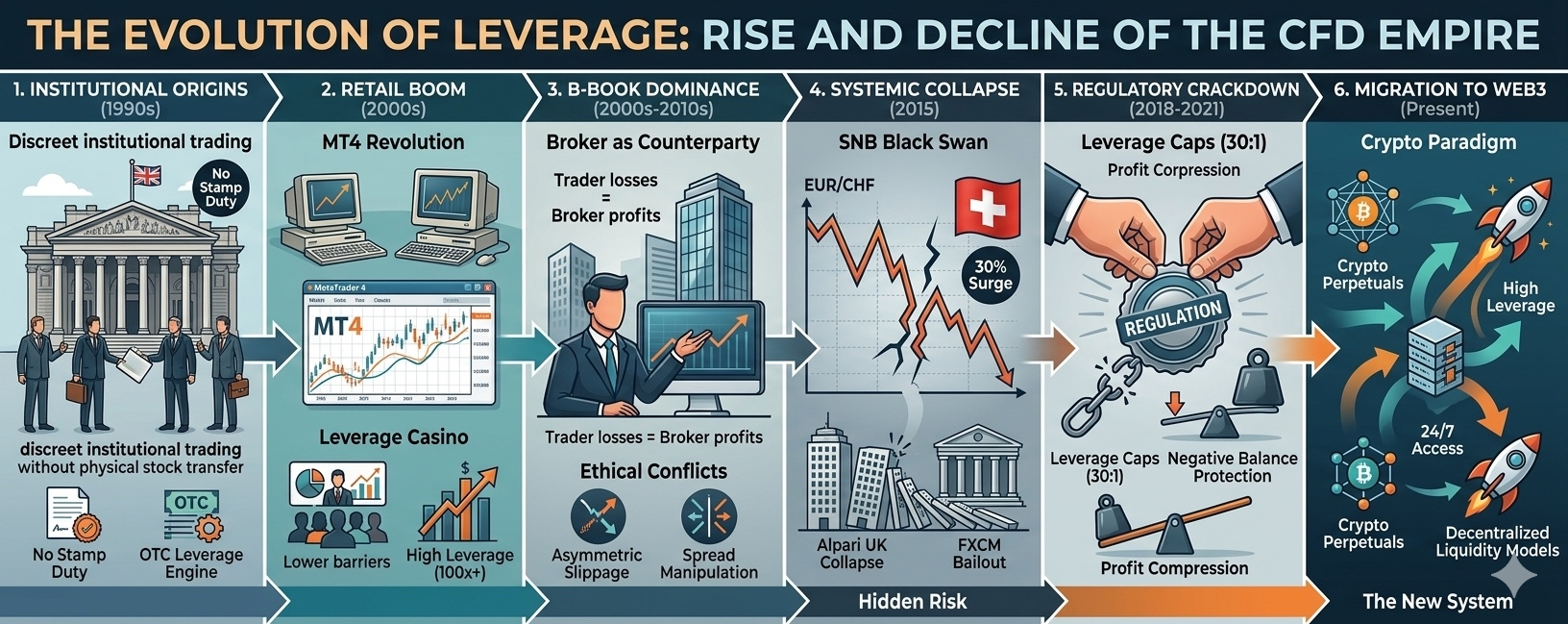
Article
The Evolution of Leverage: The Rise and Regulatory Death of the CFD EmpireIntroduction: From Traditional Leverage to Crypto Transformation
Financial markets have always been driven by one powerful force: leverage. Among the many instruments that enabled traders to amplify returns, Contracts for Difference (CFDs) stood out as one of the most influential—and controversial.
Today, however, the dominance of CFDs is fading. A structural shift is underway:
Traditional CFD brokers are losing their edge due to regulatory pressureCrypto exchanges are absorbing liquidity and usersCapital is migrating toward Web3 derivatives, especially perpetual futures
To understand why this shift is happening, we must first examine how the CFD empire was built—and why it is now collapsing.
The Origins of CFDs: A Smart Institutional Workaround
CFDs were not designed for retail traders. They originated in the early 1990s in London’s institutional trading environment.
At the time, the UK imposed a stamp duty on stock transactions, making frequent trading expensive for hedge funds and investment banks. CFDs solved this problem elegantly:
Traders didn’t own the underlying assetOnly the price difference between entry and exit was settledNo physical transfer = no tax liability
This innovation allowed institutions to:
■ Trade large positions discreetly
■ Use high leverage efficiently
■ Avoid regulatory friction
Initially, CFDs were an exclusive tool—essentially a private leverage engine for institutions.
The Retail Boom: Internet + MT4 Revolution
The transition from institutional tool to retail phenomenon happened in two major waves:
1. Internet & Direct Market Access (Late 1990s)
Online trading platforms allowed retail users to access real-time markets from home. This broke the monopoly of institutions.
2. MetaTrader 4 (2005)
The launch of MT4 changed everything:
■ Introduced automated trading via Expert Advisors (EAs)
■ Enabled retail algorithmic trading
■ Lowered technical barriers dramatically
Combined with high leverage (up to 100x or more) and low capital requirements, CFDs entered a golden era. Millions of retail traders joined what became, effectively, a global leveraged trading casino.
The Hidden Mechanics: A-Book vs. B-Book
Unlike traditional exchanges, CFDs operate in an over-the-counter (OTC) environment. This gave brokers significant control over trade execution.
Two main models emerged:
A-Book Model
Orders are passed to real market liquidityBroker earns from spreads/commissionsLower conflict of interest
B-Book Model
Broker acts as the counterpartyTrader losses = broker profitsHighly profitable but ethically questionable
The reality:
■ Most retail traders lose (often 70–80%)
■ Brokers optimized systems to capitalize on this
This led to controversial practices:
Asymmetric slippageSpread manipulationStop-loss hunting
The system was profitable—but fragile.
The 2015 Black Swan: Systemic Weakness Exposed
On January 15, 2015, a major event reshaped the industry.
The Swiss National Bank unexpectedly removed the EUR/CHF peg. Within minutes:
Swiss Franc surged ~30%Liquidity disappearedStop-loss orders failed
Result:
■ Traders incurred massive negative balances
■ Brokers had to absorb losses
Major consequences:
Alpari UK collapsedFXCM required a $300M bailout
This event exposed a critical flaw:
Brokers carried hidden systemic risk under extreme market conditions.
The Regulatory Crackdown (2018–2021)
After 2015, regulators globally took action to control risk:
Key Measures:
■ Leverage caps (e.g., 30:1 in Europe & Australia)
■ Mandatory Negative Balance Protection
■ Restrictions on retail participation
■ Full bans in some jurisdictions (e.g., USA)
Impact:
Profit margins for brokers shrankHigh-risk retail trading was limitedThe “Wild West” era ended
While these reforms improved safety, they also created a new problem:
Demand for high leverage did not disappear—it was displaced.
The Migration to Web3: A New Frontier
With traditional CFDs constrained, traders and capital began moving elsewhere.
Crypto derivatives emerged as the natural successor because they offered:
■ Higher leverage options
■ 24/7 global access
■ Fewer restrictions
■ Transparent (or semi-transparent) mechanisms
Most importantly, Web3 introduced innovations that addressed CFD flaws:
Decentralized liquidity modelsReduced counterparty conflictsMechanisms like funding rates
This shift represents not just evolution—but replacement.
Conclusion: The Fall of an Empire, The Rise of a New System
The CFD industry followed a clear lifecycle:
Innovation (institutional efficiency tool)Expansion (retail adoption & leverage boom)Exploitation (B-Book dominance)Collapse Trigger (2015 black swan)Regulation (profit compression)Migration (capital flows to crypto)
Today, the CFD empire is no longer the center of leveraged trading. Its limitations—conflicts of interest, systemic risk, and regulatory pressure—have opened the door for a new paradigm.
In the next phase of this evolution, crypto perpetual futures are not just competing—they are redefining leverage itself.
#CryptoDerivatives #LeverageEvolution #Web3Finance #CryptoEducation #ArifAlpha
The Evolution of Leverage: The Rise and Regulatory Death of the CFD Empire
Introduction: From Traditional Leverage to Crypto Transformation
Financial markets have always been driven by one powerful force: leverage. Among the many instruments that enabled traders to amplify returns, Contracts for Difference (CFDs) stood out as one of the most influential—and controversial.
Today, however, the dominance of CFDs is fading. A structural shift is underway:
Traditional CFD brokers are losing their edge due to regulatory pressureCrypto exchanges are absorbing liquidity and usersCapital is migrating toward Web3 derivatives, especially perpetual futures
To understand why this shift is happening, we must first examine how the CFD empire was built—and why it is now collapsing.
The Origins of CFDs: A Smart Institutional Workaround
CFDs were not designed for retail traders. They originated in the early 1990s in London’s institutional trading environment.
At the time, the UK imposed a stamp duty on stock transactions, making frequent trading expensive for hedge funds and investment banks. CFDs solved this problem elegantly:
Traders didn’t own the underlying assetOnly the price difference between entry and exit was settledNo physical transfer = no tax liability
This innovation allowed institutions to:
■ Trade large positions discreetly
■ Use high leverage efficiently
■ Avoid regulatory friction
Initially, CFDs were an exclusive tool—essentially a private leverage engine for institutions.
The Retail Boom: Internet + MT4 Revolution
The transition from institutional tool to retail phenomenon happened in two major waves:
1. Internet & Direct Market Access (Late 1990s)
Online trading platforms allowed retail users to access real-time markets from home. This broke the monopoly of institutions.
2. MetaTrader 4 (2005)
The launch of MT4 changed everything:
■ Introduced automated trading via Expert Advisors (EAs)
■ Enabled retail algorithmic trading
■ Lowered technical barriers dramatically
Combined with high leverage (up to 100x or more) and low capital requirements, CFDs entered a golden era. Millions of retail traders joined what became, effectively, a global leveraged trading casino.
The Hidden Mechanics: A-Book vs. B-Book
Unlike traditional exchanges, CFDs operate in an over-the-counter (OTC) environment. This gave brokers significant control over trade execution.
Two main models emerged:
A-Book Model
Orders are passed to real market liquidityBroker earns from spreads/commissionsLower conflict of interest
B-Book Model
Broker acts as the counterpartyTrader losses = broker profitsHighly profitable but ethically questionable
The reality:
■ Most retail traders lose (often 70–80%)
■ Brokers optimized systems to capitalize on this
This led to controversial practices:
Asymmetric slippageSpread manipulationStop-loss hunting
The system was profitable—but fragile.
The 2015 Black Swan: Systemic Weakness Exposed
On January 15, 2015, a major event reshaped the industry.
The Swiss National Bank unexpectedly removed the EUR/CHF peg. Within minutes:
Swiss Franc surged ~30%Liquidity disappearedStop-loss orders failed
Result:
■ Traders incurred massive negative balances
■ Brokers had to absorb losses
Major consequences:
Alpari UK collapsedFXCM required a $300M bailout
This event exposed a critical flaw:
Brokers carried hidden systemic risk under extreme market conditions.
The Regulatory Crackdown (2018–2021)
After 2015, regulators globally took action to control risk:
Key Measures:
■ Leverage caps (e.g., 30:1 in Europe & Australia)
■ Mandatory Negative Balance Protection
■ Restrictions on retail participation
■ Full bans in some jurisdictions (e.g., USA)
Impact:
Profit margins for brokers shrankHigh-risk retail trading was limitedThe “Wild West” era ended
While these reforms improved safety, they also created a new problem:
Demand for high leverage did not disappear—it was displaced.
The Migration to Web3: A New Frontier
With traditional CFDs constrained, traders and capital began moving elsewhere.
Crypto derivatives emerged as the natural successor because they offered:
■ Higher leverage options
■ 24/7 global access
■ Fewer restrictions
■ Transparent (or semi-transparent) mechanisms
Most importantly, Web3 introduced innovations that addressed CFD flaws:
Decentralized liquidity modelsReduced counterparty conflictsMechanisms like funding rates
This shift represents not just evolution—but replacement.
Conclusion: The Fall of an Empire, The Rise of a New System
The CFD industry followed a clear lifecycle:
Innovation (institutional efficiency tool)Expansion (retail adoption & leverage boom)Exploitation (B-Book dominance)Collapse Trigger (2015 black swan)Regulation (profit compression)Migration (capital flows to crypto)
Today, the CFD empire is no longer the center of leveraged trading. Its limitations—conflicts of interest, systemic risk, and regulatory pressure—have opened the door for a new paradigm.
In the next phase of this evolution, crypto perpetual futures are not just competing—they are redefining leverage itself.
#CryptoDerivatives #LeverageEvolution #Web3Finance #CryptoEducation #ArifAlpha
Financial markets have always been driven by one powerful force: leverage. Among the many instruments that enabled traders to amplify returns, Contracts for Difference (CFDs) stood out as one of the most influential—and controversial.
Today, however, the dominance of CFDs is fading. A structural shift is underway:
Traditional CFD brokers are losing their edge due to regulatory pressureCrypto exchanges are absorbing liquidity and usersCapital is migrating toward Web3 derivatives, especially perpetual futures
To understand why this shift is happening, we must first examine how the CFD empire was built—and why it is now collapsing.
The Origins of CFDs: A Smart Institutional Workaround
CFDs were not designed for retail traders. They originated in the early 1990s in London’s institutional trading environment.
At the time, the UK imposed a stamp duty on stock transactions, making frequent trading expensive for hedge funds and investment banks. CFDs solved this problem elegantly:
Traders didn’t own the underlying assetOnly the price difference between entry and exit was settledNo physical transfer = no tax liability
This innovation allowed institutions to:
■ Trade large positions discreetly
■ Use high leverage efficiently
■ Avoid regulatory friction
Initially, CFDs were an exclusive tool—essentially a private leverage engine for institutions.
The Retail Boom: Internet + MT4 Revolution
The transition from institutional tool to retail phenomenon happened in two major waves:
1. Internet & Direct Market Access (Late 1990s)
Online trading platforms allowed retail users to access real-time markets from home. This broke the monopoly of institutions.
2. MetaTrader 4 (2005)
The launch of MT4 changed everything:
■ Introduced automated trading via Expert Advisors (EAs)
■ Enabled retail algorithmic trading
■ Lowered technical barriers dramatically
Combined with high leverage (up to 100x or more) and low capital requirements, CFDs entered a golden era. Millions of retail traders joined what became, effectively, a global leveraged trading casino.
The Hidden Mechanics: A-Book vs. B-Book
Unlike traditional exchanges, CFDs operate in an over-the-counter (OTC) environment. This gave brokers significant control over trade execution.
Two main models emerged:
A-Book Model
Orders are passed to real market liquidityBroker earns from spreads/commissionsLower conflict of interest
B-Book Model
Broker acts as the counterpartyTrader losses = broker profitsHighly profitable but ethically questionable
The reality:
■ Most retail traders lose (often 70–80%)
■ Brokers optimized systems to capitalize on this
This led to controversial practices:
Asymmetric slippageSpread manipulationStop-loss hunting
The system was profitable—but fragile.
The 2015 Black Swan: Systemic Weakness Exposed
On January 15, 2015, a major event reshaped the industry.
The Swiss National Bank unexpectedly removed the EUR/CHF peg. Within minutes:
Swiss Franc surged ~30%Liquidity disappearedStop-loss orders failed
Result:
■ Traders incurred massive negative balances
■ Brokers had to absorb losses
Major consequences:
Alpari UK collapsedFXCM required a $300M bailout
This event exposed a critical flaw:
Brokers carried hidden systemic risk under extreme market conditions.
The Regulatory Crackdown (2018–2021)
After 2015, regulators globally took action to control risk:
Key Measures:
■ Leverage caps (e.g., 30:1 in Europe & Australia)
■ Mandatory Negative Balance Protection
■ Restrictions on retail participation
■ Full bans in some jurisdictions (e.g., USA)
Impact:
Profit margins for brokers shrankHigh-risk retail trading was limitedThe “Wild West” era ended
While these reforms improved safety, they also created a new problem:
Demand for high leverage did not disappear—it was displaced.
The Migration to Web3: A New Frontier
With traditional CFDs constrained, traders and capital began moving elsewhere.
Crypto derivatives emerged as the natural successor because they offered:
■ Higher leverage options
■ 24/7 global access
■ Fewer restrictions
■ Transparent (or semi-transparent) mechanisms
Most importantly, Web3 introduced innovations that addressed CFD flaws:
Decentralized liquidity modelsReduced counterparty conflictsMechanisms like funding rates
This shift represents not just evolution—but replacement.
Conclusion: The Fall of an Empire, The Rise of a New System
The CFD industry followed a clear lifecycle:
Innovation (institutional efficiency tool)Expansion (retail adoption & leverage boom)Exploitation (B-Book dominance)Collapse Trigger (2015 black swan)Regulation (profit compression)Migration (capital flows to crypto)
Today, the CFD empire is no longer the center of leveraged trading. Its limitations—conflicts of interest, systemic risk, and regulatory pressure—have opened the door for a new paradigm.
In the next phase of this evolution, crypto perpetual futures are not just competing—they are redefining leverage itself.
#CryptoDerivatives #LeverageEvolution #Web3Finance #CryptoEducation #ArifAlpha
217
·
--
🛢️ UAE Exit from OPEC+ — Macro Shock or Managed Shift?
The OPEC+ structure faces a critical shift as the United Arab Emirates confirms its exit effective May 1, 2026. This move introduces a fresh layer of uncertainty into global energy markets—and by extension, crypto.
📊 What’s Happening
▪ UAE plans to move toward independent production policy
▪ Focus shifts to flexibility + long-term national strategy
▪ Gradual supply increases expected based on market demand
▪ Decision follows ongoing quota tensions within OPEC+
⚠️ Why This Matters (Macro Impact)
▪ Potential increase in global oil supply → downward pressure on prices (CL -1.27%)
▪ Weak oil = easing inflation narrative → possible risk-on sentiment
▪ But disorderly supply shift = volatility spike across commodities & equities
▪ Energy market instability can spill into crypto liquidity flows
₿ Crypto Angle
▪ BTC (+1.15%) showing resilience despite macro noise
▪ Lower oil → softer inflation → supportive for risk assets like Bitcoin
▪ However, sudden supply shocks = short-term uncertainty & liquidity shifts
🧠 Strategic Insight
▪ If oil stabilizes lower → bullish tailwind for crypto mid-term
▪ If OPEC+ cohesion weakens further → expect macro-driven volatility spikes
▪ Watch correlation between oil → inflation → Fed expectations → BTC trend
📌 Bottom Line
This isn’t just an oil story—it’s a macro regime signal. Controlled supply expansion could support markets, but any fragmentation inside OPEC+ increases the risk of unpredictable volatility across global assets.
#CryptoMarkets #MacroAnalysis #ArifAlpha
🛢️ UAE Exit from OPEC+ — Macro Shock or Managed Shift?
The OPEC+ structure faces a critical shift as the United Arab Emirates confirms its exit effective May 1, 2026. This move introduces a fresh layer of uncertainty into global energy markets—and by extension, crypto.
📊 What’s Happening
▪ UAE plans to move toward independent production policy
▪ Focus shifts to flexibility + long-term national strategy
▪ Gradual supply increases expected based on market demand
▪ Decision follows ongoing quota tensions within OPEC+
⚠️ Why This Matters (Macro Impact)
▪ Potential increase in global oil supply → downward pressure on prices (CL -1.27%)
▪ Weak oil = easing inflation narrative → possible risk-on sentiment
▪ But disorderly supply shift = volatility spike across commodities & equities
▪ Energy market instability can spill into crypto liquidity flows
₿ Crypto Angle
▪ BTC (+1.15%) showing resilience despite macro noise
▪ Lower oil → softer inflation → supportive for risk assets like Bitcoin
▪ However, sudden supply shocks = short-term uncertainty & liquidity shifts
🧠 Strategic Insight
▪ If oil stabilizes lower → bullish tailwind for crypto mid-term
▪ If OPEC+ cohesion weakens further → expect macro-driven volatility spikes
▪ Watch correlation between oil → inflation → Fed expectations → BTC trend
📌 Bottom Line
This isn’t just an oil story—it’s a macro regime signal. Controlled supply expansion could support markets, but any fragmentation inside OPEC+ increases the risk of unpredictable volatility across global assets.
#CryptoMarkets #MacroAnalysis #ArifAlpha
The OPEC+ structure faces a critical shift as the United Arab Emirates confirms its exit effective May 1, 2026. This move introduces a fresh layer of uncertainty into global energy markets—and by extension, crypto.
📊 What’s Happening
▪ UAE plans to move toward independent production policy
▪ Focus shifts to flexibility + long-term national strategy
▪ Gradual supply increases expected based on market demand
▪ Decision follows ongoing quota tensions within OPEC+
⚠️ Why This Matters (Macro Impact)
▪ Potential increase in global oil supply → downward pressure on prices (CL -1.27%)
▪ Weak oil = easing inflation narrative → possible risk-on sentiment
▪ But disorderly supply shift = volatility spike across commodities & equities
▪ Energy market instability can spill into crypto liquidity flows
₿ Crypto Angle
▪ BTC (+1.15%) showing resilience despite macro noise
▪ Lower oil → softer inflation → supportive for risk assets like Bitcoin
▪ However, sudden supply shocks = short-term uncertainty & liquidity shifts
🧠 Strategic Insight
▪ If oil stabilizes lower → bullish tailwind for crypto mid-term
▪ If OPEC+ cohesion weakens further → expect macro-driven volatility spikes
▪ Watch correlation between oil → inflation → Fed expectations → BTC trend
📌 Bottom Line
This isn’t just an oil story—it’s a macro regime signal. Controlled supply expansion could support markets, but any fragmentation inside OPEC+ increases the risk of unpredictable volatility across global assets.
#CryptoMarkets #MacroAnalysis #ArifAlpha
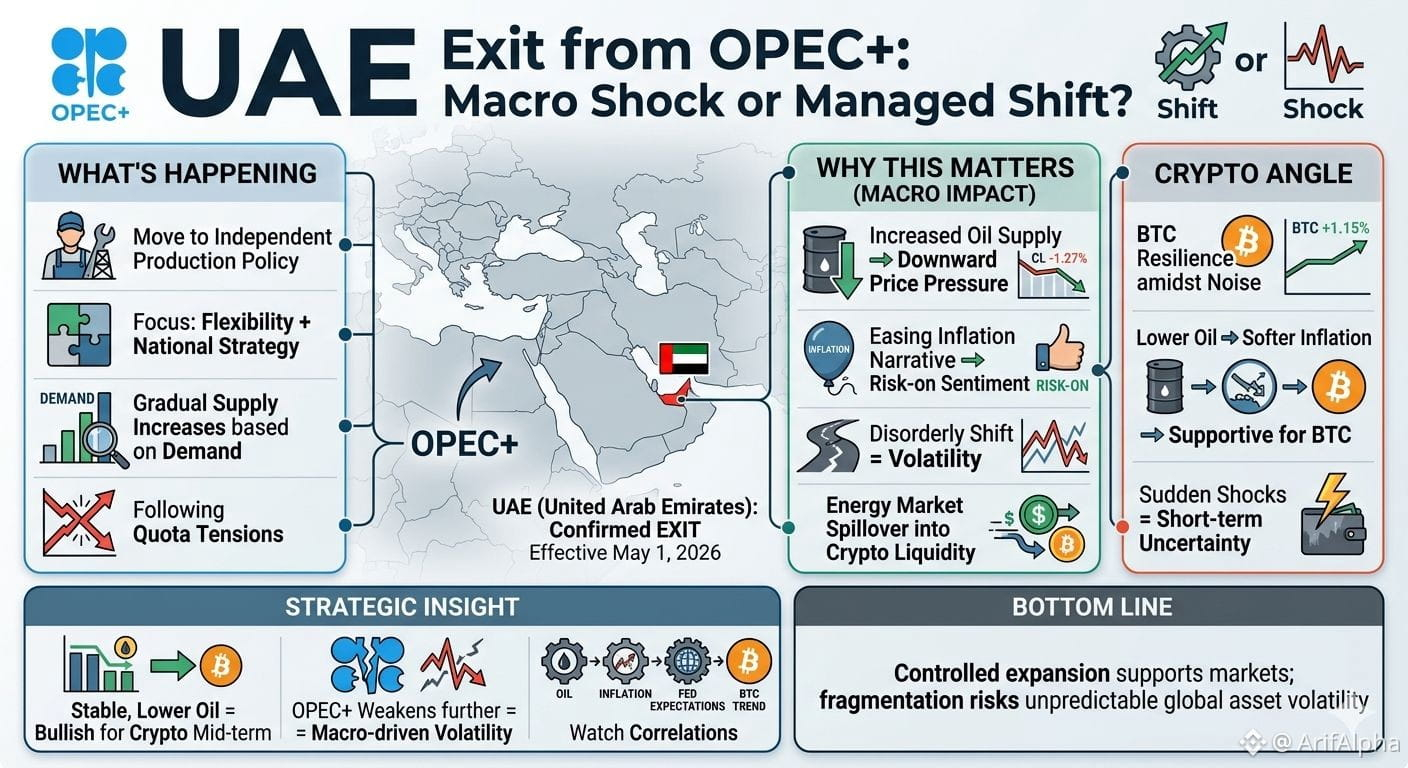
271
·
--
U.S.-Iran tensions around the Strait of Hormuz are back in focus, injecting fresh macro uncertainty into global markets.
Project Freedom, launched by U.S. Central Command on May 4, aims to secure commercial shipping through Hormuz — a route responsible for nearly 25% of global seaborne oil trade. Meanwhile, conflicting reports between Iranian state media and CENTCOM regarding an alleged strike on a U.S. warship are keeping geopolitical risk elevated.
▫️ Oil market volatility could increase if escalation continues
▫️ Risk assets may face short-term pressure from macro uncertainty
▫️ BTC holding near $80K despite headlines shows strong resilience
▫️ U.S. spot Bitcoin ETFs recorded $532M inflows on May 4
▫️ Latest 2-day ETF inflows now total roughly $1.16B
▫️ Institutional demand remains a major support pillar for BTC
While traditional markets monitor Middle East developments closely, Bitcoin continues trading in a structurally strong zone supported by sustained spot accumulation and ETF demand. A stable hold above key psychological levels could keep bullish momentum intact unless macro conditions deteriorate sharply.
#Bitcoin #CryptoMarkets #ArifAlpha
U.S.-Iran tensions around the Strait of Hormuz are back in focus, injecting fresh macro uncertainty into global markets.
Project Freedom, launched by U.S. Central Command on May 4, aims to secure commercial shipping through Hormuz — a route responsible for nearly 25% of global seaborne oil trade. Meanwhile, conflicting reports between Iranian state media and CENTCOM regarding an alleged strike on a U.S. warship are keeping geopolitical risk elevated.
▫️ Oil market volatility could increase if escalation continues
▫️ Risk assets may face short-term pressure from macro uncertainty
▫️ BTC holding near $80K despite headlines shows strong resilience
▫️ U.S. spot Bitcoin ETFs recorded $532M inflows on May 4
▫️ Latest 2-day ETF inflows now total roughly $1.16B
▫️ Institutional demand remains a major support pillar for BTC
While traditional markets monitor Middle East developments closely, Bitcoin continues trading in a structurally strong zone supported by sustained spot accumulation and ETF demand. A stable hold above key psychological levels could keep bullish momentum intact unless macro conditions deteriorate sharply.
#Bitcoin #CryptoMarkets #ArifAlpha
Project Freedom, launched by U.S. Central Command on May 4, aims to secure commercial shipping through Hormuz — a route responsible for nearly 25% of global seaborne oil trade. Meanwhile, conflicting reports between Iranian state media and CENTCOM regarding an alleged strike on a U.S. warship are keeping geopolitical risk elevated.
▫️ Oil market volatility could increase if escalation continues
▫️ Risk assets may face short-term pressure from macro uncertainty
▫️ BTC holding near $80K despite headlines shows strong resilience
▫️ U.S. spot Bitcoin ETFs recorded $532M inflows on May 4
▫️ Latest 2-day ETF inflows now total roughly $1.16B
▫️ Institutional demand remains a major support pillar for BTC
While traditional markets monitor Middle East developments closely, Bitcoin continues trading in a structurally strong zone supported by sustained spot accumulation and ETF demand. A stable hold above key psychological levels could keep bullish momentum intact unless macro conditions deteriorate sharply.
#Bitcoin #CryptoMarkets #ArifAlpha
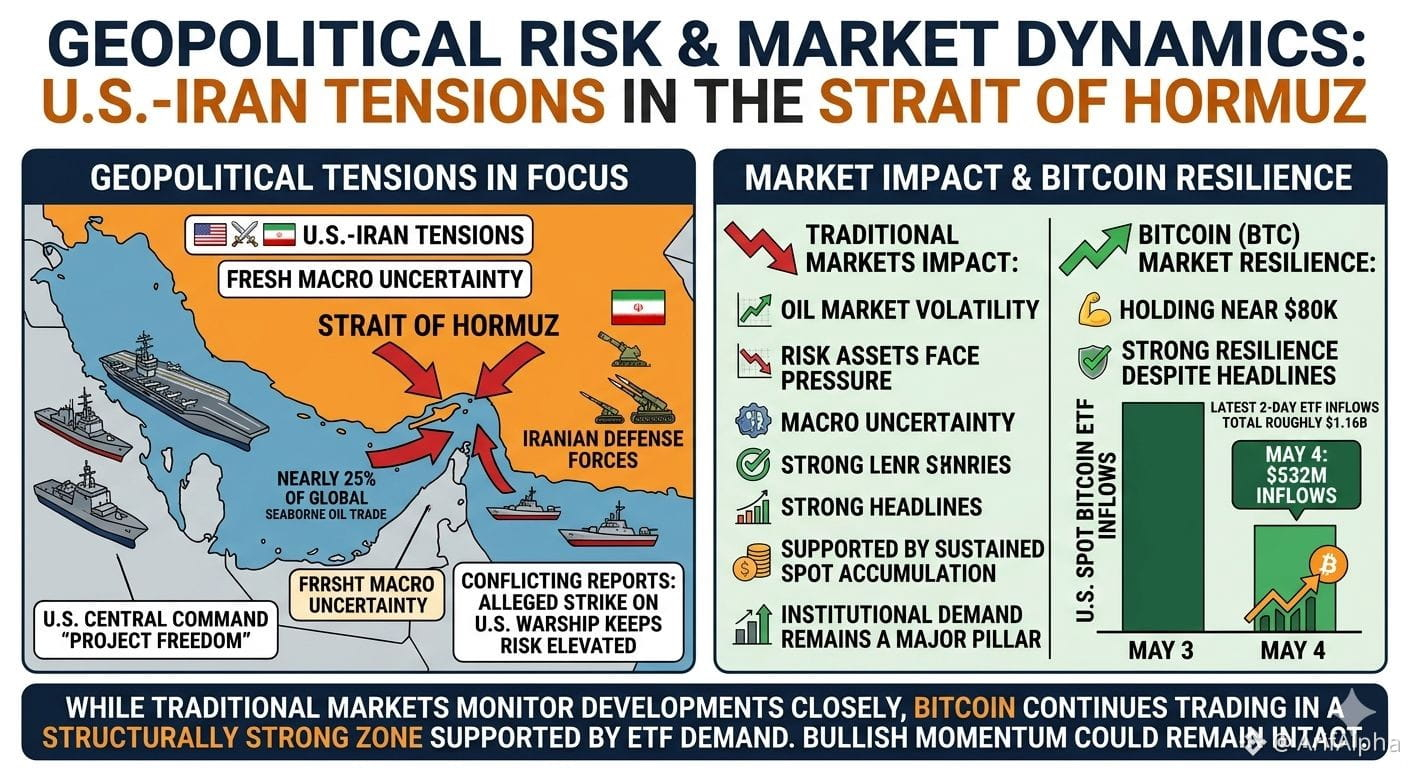
1
107
·
--
🚨 ETH Value-Capture Debate Is Back in Focus
Bankless co-founder David Hoffman revealed he sold his ETH holdings, arguing that Ethereum’s network may continue thriving while ETH’s asset rerating narrative has weakened.
🔍 Key Breakdown:
◾ The debate is no longer about Ethereum survival — it’s about whether ETH can effectively capture the value generated by the ecosystem.
◾ Hoffman highlighted that many smart-contract L1 valuations remain heavily linked to:
▪️ Network activity
▪️ Fee generation
▪️ Token burns
▪️ Revenue growth
◾ He pointed to NEAR Protocol as an example where stronger revenue growth and token burn dynamics supported a more aggressive rerating in 2026.
◾ The market is increasingly separating:
▪️ Bullish Ethereum adoption 📈
from
▪️ Bullish ETH price performance 💰
◾ This creates a major narrative shift:
Ethereum can dominate infrastructure while ETH underperforms if value capture mechanisms fail to scale alongside usage.
📊 What Traders Are Watching Now:
▫️ ETH burn efficiency after scaling upgrades
▫️ Layer-2 impact on mainnet fee capture
▫️ Real yield and staking demand
▫️ Competing L1 revenue models
▫️ Institutional preference for productive crypto assets
The discussion signals a broader market transition from “growth at any cost” toward sustainable on-chain cash flow and token economics.
#Ethereum #ETH #ArifAlpha
🚨 ETH Value-Capture Debate Is Back in Focus
Bankless co-founder David Hoffman revealed he sold his ETH holdings, arguing that Ethereum’s network may continue thriving while ETH’s asset rerating narrative has weakened.
🔍 Key Breakdown:
◾ The debate is no longer about Ethereum survival — it’s about whether ETH can effectively capture the value generated by the ecosystem.
◾ Hoffman highlighted that many smart-contract L1 valuations remain heavily linked to:
▪️ Network activity
▪️ Fee generation
▪️ Token burns
▪️ Revenue growth
◾ He pointed to NEAR Protocol as an example where stronger revenue growth and token burn dynamics supported a more aggressive rerating in 2026.
◾ The market is increasingly separating:
▪️ Bullish Ethereum adoption 📈
from
▪️ Bullish ETH price performance 💰
◾ This creates a major narrative shift:
Ethereum can dominate infrastructure while ETH underperforms if value capture mechanisms fail to scale alongside usage.
📊 What Traders Are Watching Now:
▫️ ETH burn efficiency after scaling upgrades
▫️ Layer-2 impact on mainnet fee capture
▫️ Real yield and staking demand
▫️ Competing L1 revenue models
▫️ Institutional preference for productive crypto assets
The discussion signals a broader market transition from “growth at any cost” toward sustainable on-chain cash flow and token economics.
#Ethereum #ETH #ArifAlpha
Bankless co-founder David Hoffman revealed he sold his ETH holdings, arguing that Ethereum’s network may continue thriving while ETH’s asset rerating narrative has weakened.
🔍 Key Breakdown:
◾ The debate is no longer about Ethereum survival — it’s about whether ETH can effectively capture the value generated by the ecosystem.
◾ Hoffman highlighted that many smart-contract L1 valuations remain heavily linked to:
▪️ Network activity
▪️ Fee generation
▪️ Token burns
▪️ Revenue growth
◾ He pointed to NEAR Protocol as an example where stronger revenue growth and token burn dynamics supported a more aggressive rerating in 2026.
◾ The market is increasingly separating:
▪️ Bullish Ethereum adoption 📈
from
▪️ Bullish ETH price performance 💰
◾ This creates a major narrative shift:
Ethereum can dominate infrastructure while ETH underperforms if value capture mechanisms fail to scale alongside usage.
📊 What Traders Are Watching Now:
▫️ ETH burn efficiency after scaling upgrades
▫️ Layer-2 impact on mainnet fee capture
▫️ Real yield and staking demand
▫️ Competing L1 revenue models
▫️ Institutional preference for productive crypto assets
The discussion signals a broader market transition from “growth at any cost” toward sustainable on-chain cash flow and token economics.
#Ethereum #ETH #ArifAlpha
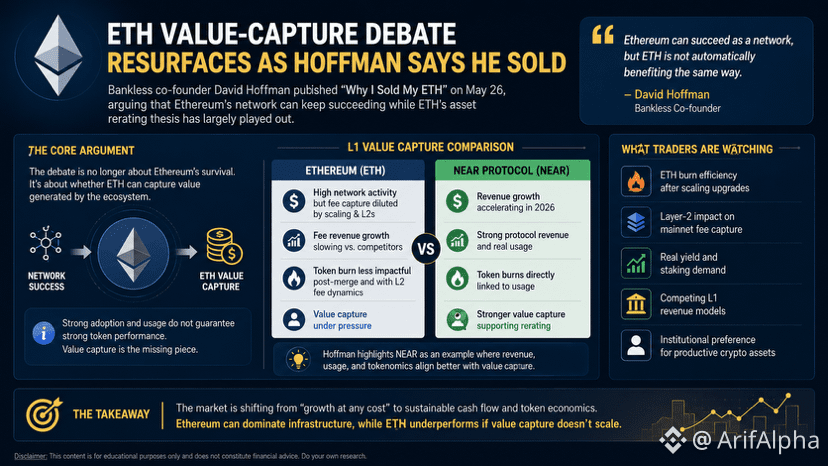
83
·
--
Article
Vitalik Explains Ethereum Foundation New Leaner Vision Focused on Security and Privacy in 2026Vitalik Buterin Explains Ethereum Foundation’s New Direction: Why Ethereum Is Choosing Conviction Over Size
The future direction of the Ethereum Foundation is becoming clearer — and according to Vitalik Buterin, it is not about becoming bigger, faster, or more corporate.
Instead, Ethereum is moving toward a leaner, more focused structure centered on what Vitalik calls the “CROPS” values:
▪︎ Censorship Resistance
▪︎ Openness
▪︎ Privacy
▪︎ Security
In a detailed reflection on the Foundation’s transition, Vitalik explained why Ethereum is intentionally avoiding the path taken by many competing blockchains and technology companies. His message was direct: Ethereum should not aim to be “slightly better” than everyone else. It should aim to become fundamentally different.
Ethereum Foundation Is Shrinking — By Design
One of the most important revelations from Vitalik’s comments is that the Ethereum Foundation is intentionally becoming smaller.
Unlike many blockchain ecosystems where foundations control massive portions of token supply, the Ethereum Foundation reportedly holds only around 0.16% of total ETH supply. In contrast, many competing blockchain foundations hold anywhere from 10% to 50% of their native assets.
That difference matters.
Vitalik emphasized that Ethereum was never designed to have a permanent centralized administrator. The Foundation originally existed to complete core milestones such as:
▪︎ Frontier
▪︎ Homestead
▪︎ Metropolis
▪︎ Serenity
Most of those foundational goals were completed years ago. Now, the organization is shifting from being a broad operator into a focused mission-driven institution.
This also explains why the Foundation is reducing its involvement in certain areas, allowing developers and researchers to build independently with outside funding rather than remaining permanently tied to EF.
According to Vitalik, this is not weakness — it is decentralization in practice.
Ethereum Does Not Want To Become “Just Another Fast Chain”
One of the strongest themes in Vitalik’s message was his rejection of the industry obsession with speed alone.
Today, many blockchains compete primarily on:
▪︎ Higher TPS
▪︎ Lower latency
▪︎ Faster finality
▪︎ Cheaper fees
Vitalik argues this path leads to mediocrity if decentralization and resilience are sacrificed along the way.
Instead of chasing “1 million TPS marketing,” Ethereum wants to dominate in trust, neutrality, and security.
This is where the CROPS philosophy becomes central.
Ethereum’s long-term vision is not simply scaling transaction throughput. It is building infrastructure that can survive political pressure, censorship attempts, surveillance, and systemic attacks while remaining open to everyone.
That is a much harder engineering challenge.
The Rise of “Unreasonable Ethereum”
Vitalik used an interesting comparison involving Google to explain his philosophy.
He described how many tech companies started with idealistic goals but gradually drifted toward profit maximization, surveillance systems, and government alignment.
His argument is that society benefits when at least some organizations resist those trends.
Ethereum wants to become one of those “unreasonable” systems — a network willing to prioritize principles even when doing so is slower, harder, or less profitable in the short term.
This philosophy also reflects Ethereum’s long-standing commitment to neutrality and open access.
AI Could Transform Ethereum Security
Perhaps the most fascinating technical point from Vitalik’s discussion involved AI-assisted formal verification.
He stated that creating a nearly bug-free Ethereum once sounded impossible, but advances in AI are rapidly changing that assumption.
Formal verification uses mathematical proofs to validate software correctness. Historically, this process has been expensive and difficult to scale.
Now, AI tools are making it significantly more practical.
If successful, Ethereum could become the first major blockchain ecosystem to dramatically reduce smart contract vulnerabilities and protocol-level bugs through large-scale verification systems.
This would be a major leap forward for blockchain security.
Ethereum’s Biggest Competitive Advantage May Be Trust
Vitalik also highlighted Ethereum’s unique consensus design.
According to him, Ethereum combines two important security properties:
▪︎ Byzantine Fault Tolerance-style security
▪︎ Bitcoin-style resilience against large attackers
Very few networks attempt to combine both.
Rather than relying heavily on social coordination or emergency hard forks, Ethereum’s roadmap increasingly focuses on making the protocol itself more resilient under extreme conditions.
This matters because Ethereum secures hundreds of billions of dollars in assets and infrastructure.
In Vitalik’s view, trust minimization will become more important — not less — as AI systems, digital surveillance, and geopolitical tensions continue accelerating globally.
Privacy Is Becoming A Core Ethereum Priority
Another major area of focus is privacy infrastructure.
Vitalik criticized the current blockchain user experience where wallets and applications often depend heavily on intermediaries and third-party infrastructure providers.
Projects and upgrades such as:
▪︎ FOCIL
▪︎ EIP-8141
▪︎ Smart contract wallets
▪︎ Privacy protocols like Railgun
are designed to reduce dependency on centralized intermediaries while improving transaction privacy and inclusion guarantees.
The broader goal is to ensure users can interact with Ethereum without exposing excessive personal information or relying on centralized gateways.
Why Some Talent Is Leaving Ethereum Foundation
One controversial part of the transition is the departure of respected developers and contributors from EF.
Vitalik addressed this directly.
He explained that allowing talented individuals to leave the Foundation can actually strengthen the ecosystem because it enables independent organizations and external funding sources to emerge.
In other words, decentralization means Ethereum innovation should not depend entirely on one institution.
This shift may initially appear chaotic, but it aligns closely with Ethereum’s original philosophy of distributed coordination.
Ethereum’s Future: Smaller Organization, Bigger Conviction
Vitalik’s overall message is not about retreat.
It is about specialization.
The Ethereum Foundation wants to focus on the hardest problems that few others are willing to prioritize:
▪︎ Censorship resistance
▪︎ Privacy preservation
▪︎ Secure scaling
▪︎ Neutral infrastructure
▪︎ Intermediary minimization
▪︎ Long-term protocol resilience
Rather than competing solely on transaction speed, Ethereum wants to become the blockchain ecosystem most trusted to survive over decades.
That strategy may not produce the fastest short-term growth narrative.
But if Ethereum succeeds, it could create something far more valuable: a decentralized financial and digital infrastructure durable enough for the AI era.
#Ethereum #ETH #VitalikButerin #Blockchain #ArifAlpha
Vitalik Explains Ethereum Foundation New Leaner Vision Focused on Security and Privacy in 2026
Vitalik Buterin Explains Ethereum Foundation’s New Direction: Why Ethereum Is Choosing Conviction Over Size
The future direction of the Ethereum Foundation is becoming clearer — and according to Vitalik Buterin, it is not about becoming bigger, faster, or more corporate.
Instead, Ethereum is moving toward a leaner, more focused structure centered on what Vitalik calls the “CROPS” values:
▪︎ Censorship Resistance
▪︎ Openness
▪︎ Privacy
▪︎ Security
In a detailed reflection on the Foundation’s transition, Vitalik explained why Ethereum is intentionally avoiding the path taken by many competing blockchains and technology companies. His message was direct: Ethereum should not aim to be “slightly better” than everyone else. It should aim to become fundamentally different.
Ethereum Foundation Is Shrinking — By Design
One of the most important revelations from Vitalik’s comments is that the Ethereum Foundation is intentionally becoming smaller.
Unlike many blockchain ecosystems where foundations control massive portions of token supply, the Ethereum Foundation reportedly holds only around 0.16% of total ETH supply. In contrast, many competing blockchain foundations hold anywhere from 10% to 50% of their native assets.
That difference matters.
Vitalik emphasized that Ethereum was never designed to have a permanent centralized administrator. The Foundation originally existed to complete core milestones such as:
▪︎ Frontier
▪︎ Homestead
▪︎ Metropolis
▪︎ Serenity
Most of those foundational goals were completed years ago. Now, the organization is shifting from being a broad operator into a focused mission-driven institution.
This also explains why the Foundation is reducing its involvement in certain areas, allowing developers and researchers to build independently with outside funding rather than remaining permanently tied to EF.
According to Vitalik, this is not weakness — it is decentralization in practice.
Ethereum Does Not Want To Become “Just Another Fast Chain”
One of the strongest themes in Vitalik’s message was his rejection of the industry obsession with speed alone.
Today, many blockchains compete primarily on:
▪︎ Higher TPS
▪︎ Lower latency
▪︎ Faster finality
▪︎ Cheaper fees
Vitalik argues this path leads to mediocrity if decentralization and resilience are sacrificed along the way.
Instead of chasing “1 million TPS marketing,” Ethereum wants to dominate in trust, neutrality, and security.
This is where the CROPS philosophy becomes central.
Ethereum’s long-term vision is not simply scaling transaction throughput. It is building infrastructure that can survive political pressure, censorship attempts, surveillance, and systemic attacks while remaining open to everyone.
That is a much harder engineering challenge.
The Rise of “Unreasonable Ethereum”
Vitalik used an interesting comparison involving Google to explain his philosophy.
He described how many tech companies started with idealistic goals but gradually drifted toward profit maximization, surveillance systems, and government alignment.
His argument is that society benefits when at least some organizations resist those trends.
Ethereum wants to become one of those “unreasonable” systems — a network willing to prioritize principles even when doing so is slower, harder, or less profitable in the short term.
This philosophy also reflects Ethereum’s long-standing commitment to neutrality and open access.
AI Could Transform Ethereum Security
Perhaps the most fascinating technical point from Vitalik’s discussion involved AI-assisted formal verification.
He stated that creating a nearly bug-free Ethereum once sounded impossible, but advances in AI are rapidly changing that assumption.
Formal verification uses mathematical proofs to validate software correctness. Historically, this process has been expensive and difficult to scale.
Now, AI tools are making it significantly more practical.
If successful, Ethereum could become the first major blockchain ecosystem to dramatically reduce smart contract vulnerabilities and protocol-level bugs through large-scale verification systems.
This would be a major leap forward for blockchain security.
Ethereum’s Biggest Competitive Advantage May Be Trust
Vitalik also highlighted Ethereum’s unique consensus design.
According to him, Ethereum combines two important security properties:
▪︎ Byzantine Fault Tolerance-style security
▪︎ Bitcoin-style resilience against large attackers
Very few networks attempt to combine both.
Rather than relying heavily on social coordination or emergency hard forks, Ethereum’s roadmap increasingly focuses on making the protocol itself more resilient under extreme conditions.
This matters because Ethereum secures hundreds of billions of dollars in assets and infrastructure.
In Vitalik’s view, trust minimization will become more important — not less — as AI systems, digital surveillance, and geopolitical tensions continue accelerating globally.
Privacy Is Becoming A Core Ethereum Priority
Another major area of focus is privacy infrastructure.
Vitalik criticized the current blockchain user experience where wallets and applications often depend heavily on intermediaries and third-party infrastructure providers.
Projects and upgrades such as:
▪︎ FOCIL
▪︎ EIP-8141
▪︎ Smart contract wallets
▪︎ Privacy protocols like Railgun
are designed to reduce dependency on centralized intermediaries while improving transaction privacy and inclusion guarantees.
The broader goal is to ensure users can interact with Ethereum without exposing excessive personal information or relying on centralized gateways.
Why Some Talent Is Leaving Ethereum Foundation
One controversial part of the transition is the departure of respected developers and contributors from EF.
Vitalik addressed this directly.
He explained that allowing talented individuals to leave the Foundation can actually strengthen the ecosystem because it enables independent organizations and external funding sources to emerge.
In other words, decentralization means Ethereum innovation should not depend entirely on one institution.
This shift may initially appear chaotic, but it aligns closely with Ethereum’s original philosophy of distributed coordination.
Ethereum’s Future: Smaller Organization, Bigger Conviction
Vitalik’s overall message is not about retreat.
It is about specialization.
The Ethereum Foundation wants to focus on the hardest problems that few others are willing to prioritize:
▪︎ Censorship resistance
▪︎ Privacy preservation
▪︎ Secure scaling
▪︎ Neutral infrastructure
▪︎ Intermediary minimization
▪︎ Long-term protocol resilience
Rather than competing solely on transaction speed, Ethereum wants to become the blockchain ecosystem most trusted to survive over decades.
That strategy may not produce the fastest short-term growth narrative.
But if Ethereum succeeds, it could create something far more valuable: a decentralized financial and digital infrastructure durable enough for the AI era.
#Ethereum #ETH #VitalikButerin #Blockchain #ArifAlpha
The future direction of the Ethereum Foundation is becoming clearer — and according to Vitalik Buterin, it is not about becoming bigger, faster, or more corporate.
Instead, Ethereum is moving toward a leaner, more focused structure centered on what Vitalik calls the “CROPS” values:
▪︎ Censorship Resistance
▪︎ Openness
▪︎ Privacy
▪︎ Security
In a detailed reflection on the Foundation’s transition, Vitalik explained why Ethereum is intentionally avoiding the path taken by many competing blockchains and technology companies. His message was direct: Ethereum should not aim to be “slightly better” than everyone else. It should aim to become fundamentally different.
Ethereum Foundation Is Shrinking — By Design
One of the most important revelations from Vitalik’s comments is that the Ethereum Foundation is intentionally becoming smaller.
Unlike many blockchain ecosystems where foundations control massive portions of token supply, the Ethereum Foundation reportedly holds only around 0.16% of total ETH supply. In contrast, many competing blockchain foundations hold anywhere from 10% to 50% of their native assets.
That difference matters.
Vitalik emphasized that Ethereum was never designed to have a permanent centralized administrator. The Foundation originally existed to complete core milestones such as:
▪︎ Frontier
▪︎ Homestead
▪︎ Metropolis
▪︎ Serenity
Most of those foundational goals were completed years ago. Now, the organization is shifting from being a broad operator into a focused mission-driven institution.
This also explains why the Foundation is reducing its involvement in certain areas, allowing developers and researchers to build independently with outside funding rather than remaining permanently tied to EF.
According to Vitalik, this is not weakness — it is decentralization in practice.
Ethereum Does Not Want To Become “Just Another Fast Chain”
One of the strongest themes in Vitalik’s message was his rejection of the industry obsession with speed alone.
Today, many blockchains compete primarily on:
▪︎ Higher TPS
▪︎ Lower latency
▪︎ Faster finality
▪︎ Cheaper fees
Vitalik argues this path leads to mediocrity if decentralization and resilience are sacrificed along the way.
Instead of chasing “1 million TPS marketing,” Ethereum wants to dominate in trust, neutrality, and security.
This is where the CROPS philosophy becomes central.
Ethereum’s long-term vision is not simply scaling transaction throughput. It is building infrastructure that can survive political pressure, censorship attempts, surveillance, and systemic attacks while remaining open to everyone.
That is a much harder engineering challenge.
The Rise of “Unreasonable Ethereum”
Vitalik used an interesting comparison involving Google to explain his philosophy.
He described how many tech companies started with idealistic goals but gradually drifted toward profit maximization, surveillance systems, and government alignment.
His argument is that society benefits when at least some organizations resist those trends.
Ethereum wants to become one of those “unreasonable” systems — a network willing to prioritize principles even when doing so is slower, harder, or less profitable in the short term.
This philosophy also reflects Ethereum’s long-standing commitment to neutrality and open access.
AI Could Transform Ethereum Security
Perhaps the most fascinating technical point from Vitalik’s discussion involved AI-assisted formal verification.
He stated that creating a nearly bug-free Ethereum once sounded impossible, but advances in AI are rapidly changing that assumption.
Formal verification uses mathematical proofs to validate software correctness. Historically, this process has been expensive and difficult to scale.
Now, AI tools are making it significantly more practical.
If successful, Ethereum could become the first major blockchain ecosystem to dramatically reduce smart contract vulnerabilities and protocol-level bugs through large-scale verification systems.
This would be a major leap forward for blockchain security.
Ethereum’s Biggest Competitive Advantage May Be Trust
Vitalik also highlighted Ethereum’s unique consensus design.
According to him, Ethereum combines two important security properties:
▪︎ Byzantine Fault Tolerance-style security
▪︎ Bitcoin-style resilience against large attackers
Very few networks attempt to combine both.
Rather than relying heavily on social coordination or emergency hard forks, Ethereum’s roadmap increasingly focuses on making the protocol itself more resilient under extreme conditions.
This matters because Ethereum secures hundreds of billions of dollars in assets and infrastructure.
In Vitalik’s view, trust minimization will become more important — not less — as AI systems, digital surveillance, and geopolitical tensions continue accelerating globally.
Privacy Is Becoming A Core Ethereum Priority
Another major area of focus is privacy infrastructure.
Vitalik criticized the current blockchain user experience where wallets and applications often depend heavily on intermediaries and third-party infrastructure providers.
Projects and upgrades such as:
▪︎ FOCIL
▪︎ EIP-8141
▪︎ Smart contract wallets
▪︎ Privacy protocols like Railgun
are designed to reduce dependency on centralized intermediaries while improving transaction privacy and inclusion guarantees.
The broader goal is to ensure users can interact with Ethereum without exposing excessive personal information or relying on centralized gateways.
Why Some Talent Is Leaving Ethereum Foundation
One controversial part of the transition is the departure of respected developers and contributors from EF.
Vitalik addressed this directly.
He explained that allowing talented individuals to leave the Foundation can actually strengthen the ecosystem because it enables independent organizations and external funding sources to emerge.
In other words, decentralization means Ethereum innovation should not depend entirely on one institution.
This shift may initially appear chaotic, but it aligns closely with Ethereum’s original philosophy of distributed coordination.
Ethereum’s Future: Smaller Organization, Bigger Conviction
Vitalik’s overall message is not about retreat.
It is about specialization.
The Ethereum Foundation wants to focus on the hardest problems that few others are willing to prioritize:
▪︎ Censorship resistance
▪︎ Privacy preservation
▪︎ Secure scaling
▪︎ Neutral infrastructure
▪︎ Intermediary minimization
▪︎ Long-term protocol resilience
Rather than competing solely on transaction speed, Ethereum wants to become the blockchain ecosystem most trusted to survive over decades.
That strategy may not produce the fastest short-term growth narrative.
But if Ethereum succeeds, it could create something far more valuable: a decentralized financial and digital infrastructure durable enough for the AI era.
#Ethereum #ETH #VitalikButerin #Blockchain #ArifAlpha
1
97
Connectez-vous pour découvrir plus de contenu
Rejoignez la communauté mondiale des adeptes de cryptomonnaies sur Binance Square
⚡️ Suviez les dernières informations importantes sur les cryptomonnaies.
💬 Jugé digne de confiance par la plus grande plateforme d’échange de cryptomonnaies au monde.
👍 Découvrez les connaissances que partagent les créateurs vérifiés.
Adresse e-mail/Nº de téléphone
Sujets d’actualité
1
#QNTRises287%
0 vues
8 mentions
2
#TrumpRejectsAIRulesForVoluntaryAudits
2,365 vues
169 mentions
3
#BitgetHotWalletBreachTiedToThirdPartySecurityFlaw
1,104 vues
124 mentions
4
#OpenAIUnveilsAlwaysOnAgentDots
2,218 vues
168 mentions
5
#ChainlinkLaunchesBankSWIFTLedgerFramework
3,699 vues
149 mentions
6
#EarningsSeason
451,647 vues
3,398 mentions
7
#SECChairWantsStockMarketsOnChain
7,671 vues
195 mentions
8
#MulticoinInvestsInGrass
4,741 vues
141 mentions
9
#CEARenamesToBNBStandardUnderBNC
5,421 vues
138 mentions
10
#BitwiseLaunchesFirstSpotNEARETF
61,507 vues
773 mentions