

Why I Think DIA Has an Interesting Business Model
In crypto, it’s easy to get excited about a token because of its narrative.
But I think a more important question is:
How does the underlying network create economic value?
That’s one reason I’ve been paying closer attention to DIA.
DIA isn’t simply building another price-feed product. It’s building oracle infrastructure designed to provide verifiable data to onchain applications across DeFi, RWAs and other financial markets. Its current platform supports 20,000+ assets, 65+ blockchains, 100+ data sources and 250+ dApps.
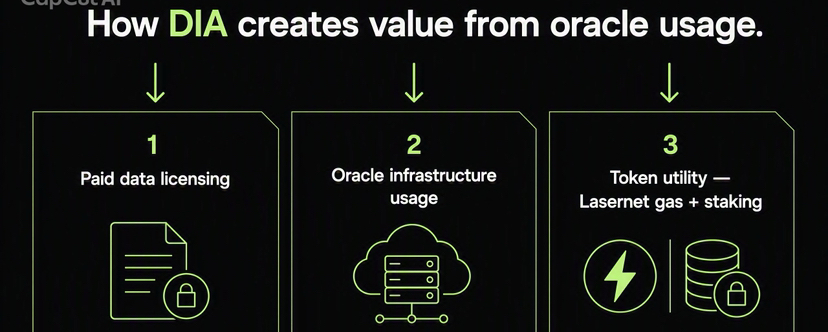
The first part: selling data
DIA has a data-licensing model where customers pay license fees for access to DIA data.
That creates a straightforward commercial relationship:
Customer needs financial data → DIA provides the data → customer pays for usage.
The interesting part is that the potential customer base isn’t limited to crypto.
DIA’s infrastructure covers digital assets as well as stocks, commodities, FX and other RWA-related data.
Then comes the network layer
DIA’s Lasernet is an Ethereum L2 rollup powering its oracle infrastructure.
And $DIA is the native gas token.
Oracle computations, data submissions and transactions on the verification layer consume $DIA as gas.
That creates a direct relationship between network activity and token utility.
More oracle activity means more transactions taking place on the infrastructure.
Then there’s staking
$DIA is also used to secure the oracle network.
Stakers and Feeders lock DIA to participate in the security layer, while Feeders submit data onchain and are rewarded based on performance.
So the token has multiple roles:
Gas → Security → Staking → Governance
That’s more interesting to me than a token whose only purpose is speculation.
And then we get to the RWA opportunity
This is where I think the model could become particularly interesting.
As more financial assets move onchain, applications need increasingly specialized data.
Tokenized stocks need market prices.
Tokenized funds can need NAV data.
Lending protocols need collateral prices.
Stablecoins can need reserve information.
RWA protocols need valuation data.
DIA is building infrastructure across these different data requirements, including RWA price feeds and fundamental asset data.
The potential flywheel
This is the model I’m watching:
More onchain applications
More demand for reliable financial data
↓
More DIA oracle usage
↓
More network activity
↓
More $DIA utility through Lasernet + staking
↓
Potentially more ecosystem growth
Of course, this is an economic model, not a guarantee of future token performance. The important variables are actual customer adoption, oracle usage, fees and continued ecosystem growth.
But that’s exactly why I find DIA interesting.
It’s not just:
“Oracle narrative → token.”
It’s closer to:
Data infrastructure → customers → network usage → token utility → ecosystem growth.
If DeFi, RWAs and tokenized financial markets continue expanding, the demand for reliable data infrastructure could expand with them.
That’s the DIA business model I’m watching
And honestly, that’s what makes $DIA more interesting to me than simply looking at its chart. 👀