
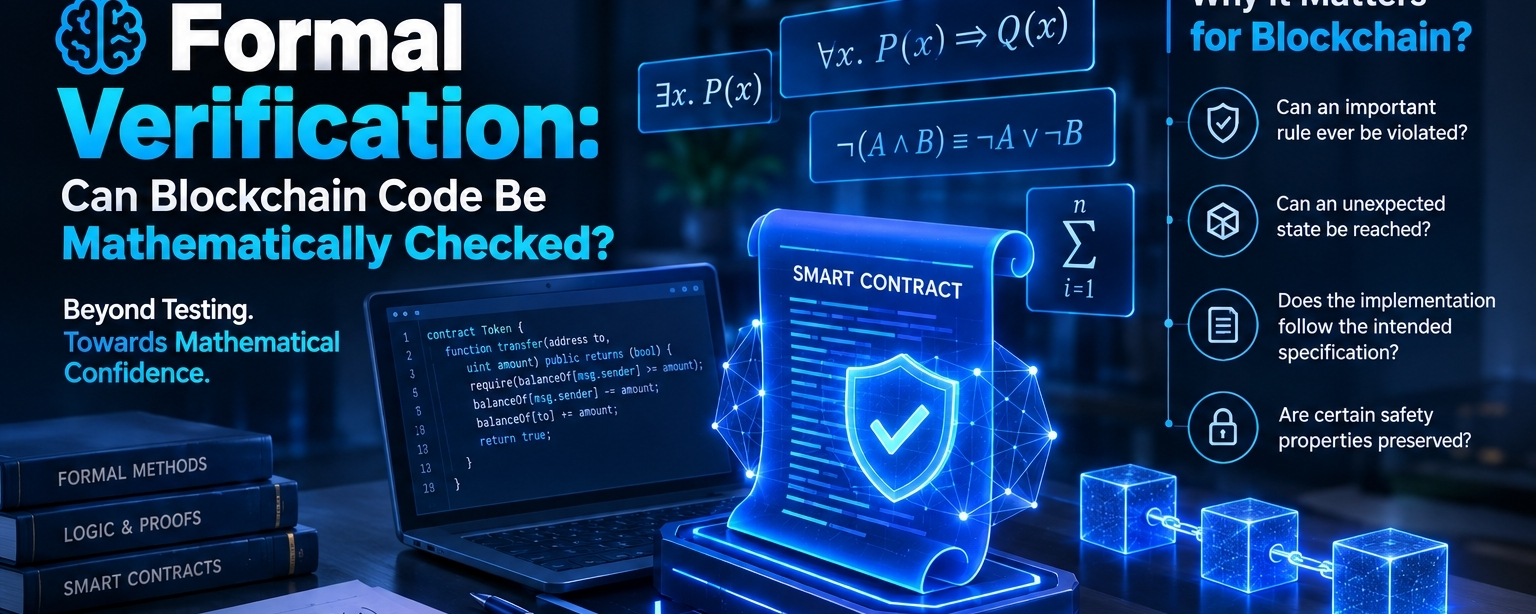

Blockchain applications can hold valuable digital assets and execute important operations through code.
But how can developers gain stronger confidence that a smart contract behaves according to its intended rules?
One approach is formal verification — a method that uses mathematical techniques to check whether software satisfies specific properties.
🔍 More Than Ordinary Testing
Traditional testing checks selected scenarios:
🧪 “What happens if this function receives this input?”
🧪 “What happens when these two actions occur together?”
Formal verification takes a different approach.
Instead of checking only selected examples, developers can mathematically specify certain properties and attempt to prove that the code satisfies them.
⚙️ Why It Matters for Blockchain
Smart contracts can be difficult to change after deployment, so finding problems early can be especially important.
Formal methods can help developers examine questions such as:
🔹 Can an important rule ever be violated?
🔹 Can an unexpected state be reached?
🔹 Does the implementation follow the intended specification?
🔹 Are certain safety properties preserved?
🚀 The Bigger Picture
Blockchain innovation isn't only about creating new protocols.
It's also about improving the engineering discipline behind them.
As smart contracts become more sophisticated, techniques such as formal verification could become an increasingly important part of building software that people can confidently rely on.
💡 The future of blockchain security may not be just about finding bugs — it may also be about mathematically proving that certain classes of mistakes cannot occur.
💬 Question:
Would mathematical verification make you more confident in a blockchain application?
#Blockchain #SmartContracts #Web3 #Cryptography #BlockchainSecurity #CryptoEducation