
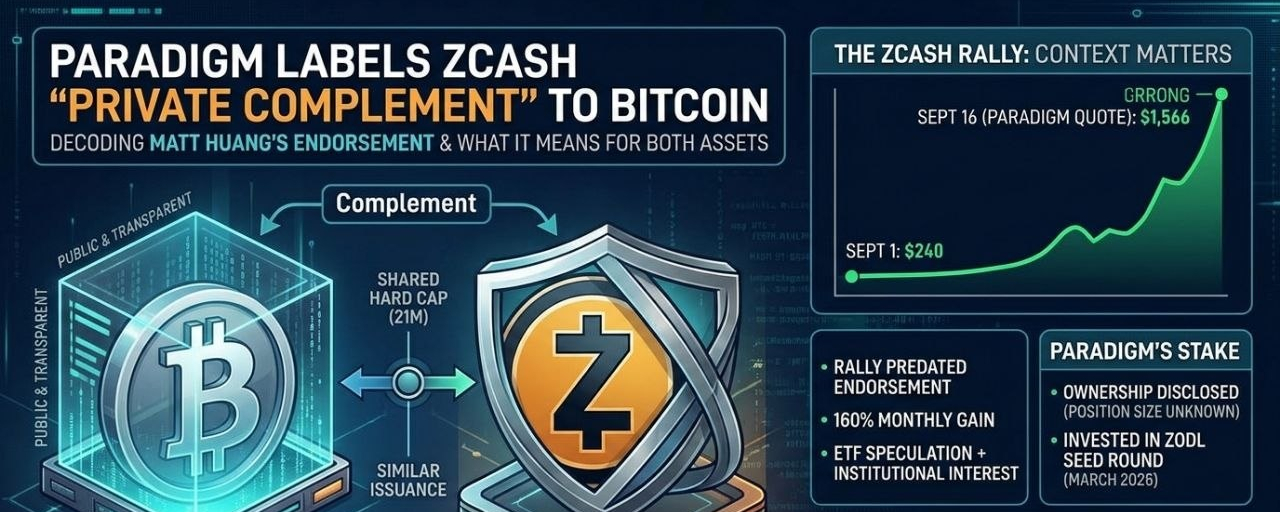

Paradigm co founder Matt Huang dropped a quote on social media that sent the privacy coin sector into a frenzy: he called #zcash "a private complement to #bitcoin ," and revealed his firm holds ZEC in its portfolio. Huang also confirmed Paradigm has invested in the Zcash Open Development Lab (ZODL), the organization behind Zcash's primary wallet.
The rally that started before the endorsement. Here's the twist that most headlines gloss over: ZEC had already surged from $569 to $1,566 before Huang's quote appeared, meaning the rally predated the endorsement rather than being caused by it. By the time Huang spoke, Zcash was already the hottest asset in crypto, up roughly 160% for the month compared to Bitcoin's 18.2% gain over the same stretch. Zcash's climb from around $240 to nearly $1,477 in recent weeks has been fueled by ETF speculation and renewed institutional attention on privacy tech broadly.

What Paradigm actually disclosed, and what it didn't. This is important for setting expectations. Paradigm confirmed it owns ZEC but revealed no position size, no cost basis, and no price target, which genuinely limits how much signal the endorsement carries. What is publicly verifiable is that Paradigm joined a more than $25 million seed round for ZODL back in March 2026, alongside a16z crypto and other ventures.
Why "complement" rather than "competitor" or "replacement" matters. Huang framed the relationship carefully. Zcash shares Bitcoin's 21 million coin hard cap and a similar halving driven issuance schedule, but adds an optional layer Bitcoin doesn't have: shielded transactions that can hide the sender, receiver, and transaction amount using zero knowledge cryptography. The pitch isn't that #zec replaces #BTC . It's that Bitcoin remains the transparent, auditable store of value, while Zcash covers the privacy use case Bitcoin was never built for.
The governance caveat Huang added. Beyond the price talk, Huang cautioned against Zcash relying purely on coin based voting, where the largest ZEC holders effectively control governance outcomes, warning this concentration can make a currency more volatile and less credible as sound money. He argued for blending in more diverse governance mechanisms and backed continuing ZEC's inflation funded developer fund, citing the importance of sustained development as AI driven cyber threats and quantum computing capabilities advance.
Community momentum is real too. Around the same period, Zcash holders overwhelmingly approved network upgrades under the NU7 proposal, including cutting block times from 75 seconds down to 25 seconds for faster transaction processing, while preserving the Bitcoin style halving structure that reinforces ZEC's scarcity narrative.
Implications for Zcash. The Paradigm halo effect adds a recognizable institutional name to an already accelerating narrative, likely extending attention and possibly capital inflows into the privacy coin sector broadly. Data cited around this period showed privacy coins collectively sitting roughly 213% above Bitcoin's October 2025 peak levels, with even a basket excluding ZEC itself up about 85% over the past year. That said, an endorsement without disclosed position size is a soft catalyst, not a hard one, and ZEC's next real test is whether it can hold decisively above the $1,400 level rather than give back the run.
Implications for Bitcoin. Here's the part worth sitting with. Analysts note the statement adds no new implications for Bitcoin, since "complement" suggests adding to existing Bitcoin positions rather than divesting from them. In plain terms, Paradigm isn't suggesting anyone rotate out of $BTC into $ZEC

Bitcoin's own price action stayed healthy through this window too, moving from roughly $76,145 up to $81,214 in the days around Huang's comments, so this reads less like a zero sum rotation story and more like both assets catching separate but overlapping tailwinds.
The bigger picture. When a firm with Paradigm's reputation speaks, it tends to move sentiment for weeks, not days, and that alone makes Huang's comments worth tracking even without hard position data behind them. But the honest takeaway is that Zcash's rally was already well underway on its own fundamentals, the governance risks Huang flagged are real and unresolved, and "complement" is a much more modest claim than "successor." Treat this as a notable institutional signal boosting an existing trend, not as proof that smart money is choosing privacy coins over Bitcoin.
This is market and policy reporting, not financial advice. Crypto assets, especially smaller cap privacy coins, remain highly volatile. Always do independent research before making investment decisions.
#dyor