

Nigeria has become one of the clearest examples of growing real-world crypto demand. Chainalysis’ 2025 Global Crypto Adoption Index ranked Nigeria 6th globally overall and 3rd for DeFi value received.
For users in markets like this, blockchain infrastructure is not merely a technical discussion. Speed, transaction costs, liquidity and composability directly affect the experience.
That is the context in which Elysium caught my attention.
#Kinetiq is proposing a purpose-built Layer 2 designed around Hyperliquid, addressing what it describes as HyperEVM bottlenecks while maintaining close connectivity with HyperCore. Rather than building another isolated chain competing for liquidity, the thesis is to expand what can happen within the Hyperliquid ecosystem.
Kinetiq calls this a new era for Hyperliquid, and there are several reasons why.
Why Hyperliquid Needs Elysium
HyperEVM opened the door to general-purpose applications, but Kinetiq points to challenges including its dual-block architecture, limited throughput and high transaction costs. The manifesto notes that simple swaps have reached around $20 during periods of congestion.
That creates friction for builders and traders.
Elysium is designed to provide a higher-performance environment while remaining closely connected to HyperCore. If it delivers as proposed, developers can gain better infrastructure without abandoning the liquidity and markets that make Hyperliquid valuable.
This is where the #Hyperliquid and #Layer2 narratives begin to intersect.
Supercharging Spot Trading
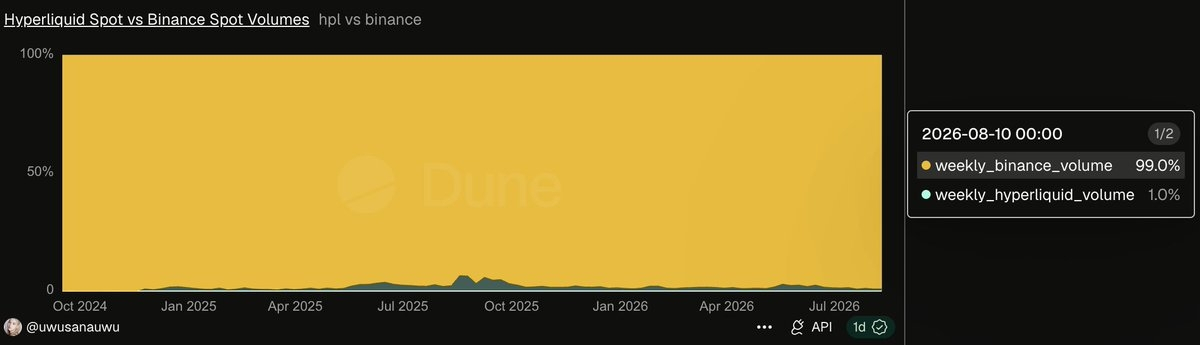
Hyperliquid is best known for perpetuals, while its spot market has significant room for growth. Elysium aims to address this by creating an environment suited to high-performance spot applications and professional market makers.
Its customized L1Read precompile is particularly interesting. By exposing HyperCore information to applications on Elysium, builders can potentially use Hyperliquid pricing and liquidity as native infrastructure.
This could make PropAMMs more attractive while creating new opportunities across #defi .
HYPE as Gas
One practical decision is making $HYPE the gas token for Elysium.
Users would not need to acquire another asset simply to interact with the network. That reduces friction while strengthening the connection between Elysium and the broader Hyperliquid economy.
The bigger question, however, is adoption. HYPE as gas is useful only if Elysium provides the performance and applications that give users a reason to transact there.
A Connected Token Lifecycle
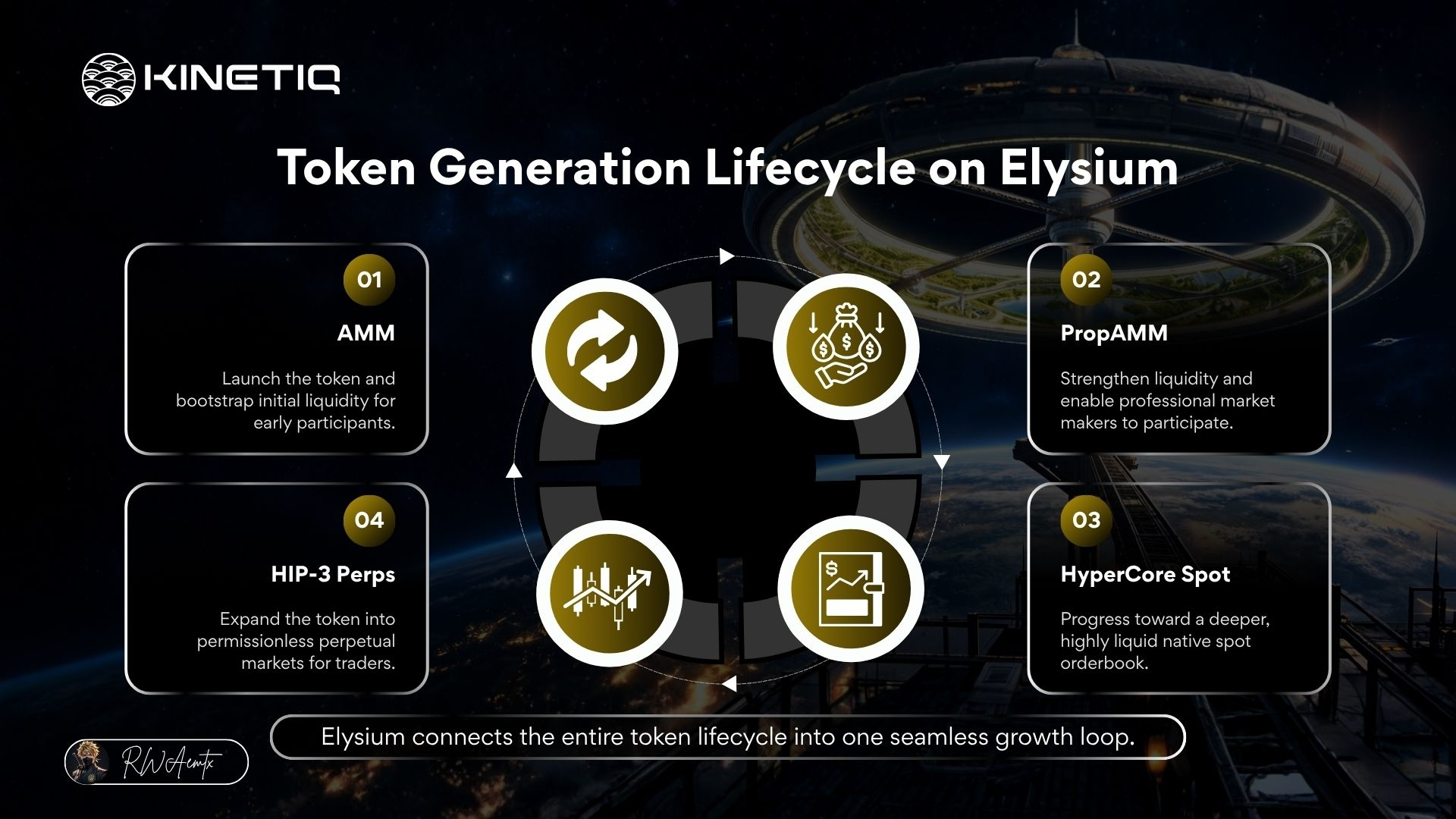
Elysium also proposes a more complete path for launching and growing tokens.
A project could potentially bootstrap liquidity through an AMM, develop deeper liquidity through PropAMMs, move toward a HyperCore spot order book, and eventually access HIP-3 permissionless perpetual deployments.
AMM → PropAMM → HyperCore Spot → HIP-3 Perps
The important part is not simply having these components. It is connecting them into one potential growth path.
The Sequencer Fee Model
The most compelling part of Elysium, in my view, is its proposed sequencer fee structure:
25% Builders | 25% Treasury | 50% KNTQ
The builder allocation can support incentives and rebates. The treasury receives 25% for operations, while 50% is directed toward programmatic KNTQ purchases. The purchased KNTQ is then burned through the Hyperliquid Assistance Fund.
That creates a proposed cycle:
Elysium activity → Sequencer fees → KNTQ purchases → KNTQ burned
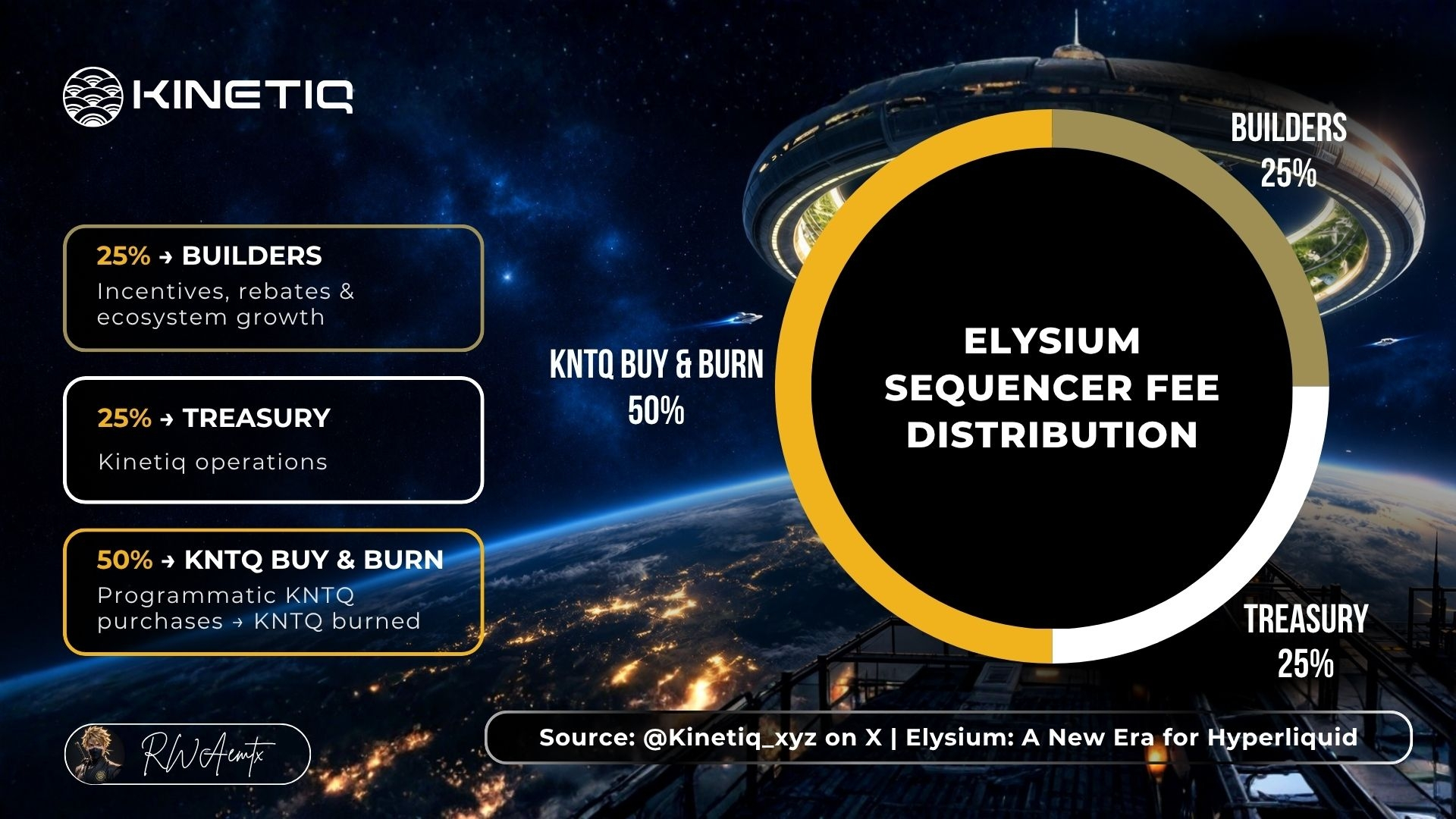
This mechanism is why Kinetiq describes Elysium as value-accretive. Instead of an L2 simply extracting activity from its underlying ecosystem, part of the proposed economic value flows toward builders, Kinetiq and KNTQ.
Still, “hyper-deflationary” should not be treated as a guarantee of price appreciation. Burns matter only when supported by genuine demand and sustained network activity.
My Take
What makes Elysium interesting is its ecosystem-specific design. It is being built around HyperCore liquidity, HYPE, spot markets and HIP-3 perps rather than trying to create another disconnected DeFi destination.
The thesis is compelling, but execution will determine everything. Builders must come, traders must use it, liquidity must deepen and transaction activity must become substantial.
If those pieces align, Elysium could demonstrate that an L2 can expand an existing ecosystem while creating mechanisms designed to return economic value to its participants.
For me, that is the experiment worth watching as #Elysium moves toward launch, and why this development matters for #Web3 .
References:
Kinetiq (Website): https://kinetiq.xyz/
Kinetiq (Documentation): kinetiq.xyz/docs
Chainalysis (The 2025 Global Crypto Adoption Index): https://www.chainalysis.com/blog/2025-global-crypto-adoption-index/
Hyperliquid Docs (Interacting with HyperCore): https://hyperliquid.gitbook.io/hyperliquid-docs/for-developers/hyperevm/interacting-with-hypercore