
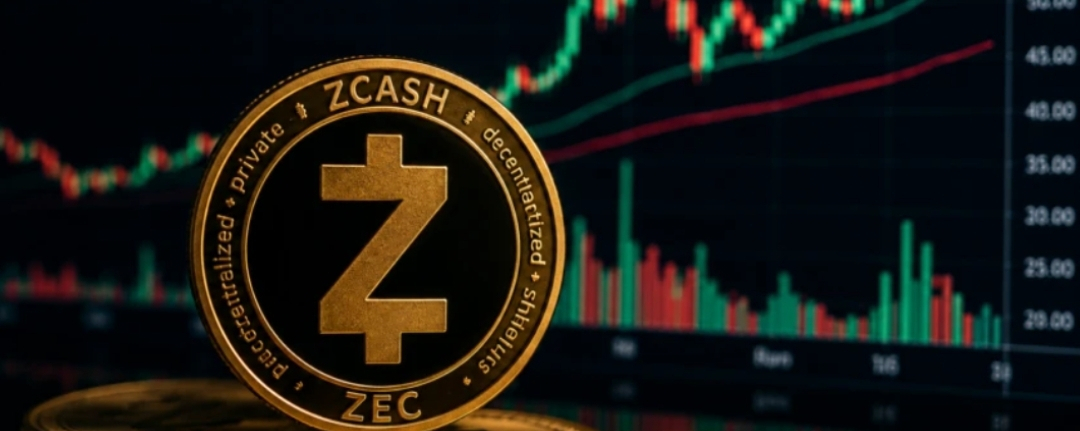


While much of the crypto market is still trying to decide its next direction, Zcash has been doing something completely different.
ZEC surged roughly 23% over 24 hours on September 17, trading around $1,369 while Bitcoin gained less than 1%. That kind of gap in performance is difficult to ignore.
And this isn't just a one-day move.
ZEC has gained roughly 160% over the past month, compared with about 18% for Bitcoin over the same period. Privacy-focused cryptocurrencies more broadly have also been outperforming the wider market.
So why has privacy suddenly become one of crypto's strongest narratives again?
Privacy Is Becoming Valuable Again
For years, crypto's biggest stories revolved around DeFi, NFTs, meme coins, Layer 2 networks and AI.
Privacy never disappeared, but it wasn't always where traders were looking.
That appears to be changing.
Zcash allows users to make shielded transactions where transaction information can remain private while the network still verifies that the transaction is valid.
And actual use of Zcash's privacy technology has grown. Research published earlier this year found that shielded transactions represented about 30% of weekly Zcash activity at the beginning of 2025 and reached 59.3% in February 2026.
That gives the privacy narrative something important: real network usage alongside market speculation.
Big Crypto Investors Are Paying Attention
Another major catalyst arrived this week.
Paradigm co-founder Matt Huang disclosed that the investment firm holds ZEC and described Zcash as a private complement to Bitcoin. Paradigm had also previously invested in the wider Zcash development ecosystem.
That matters because institutional attention can change how traders view an older cryptocurrency.
Instead of ZEC being treated simply as a coin left over from an earlier crypto cycle, investors are beginning to debate whether privacy could become a much larger part of crypto's future.
That narrative helped add momentum to an already strong market.
Zcash Is Also Changing Technically
The rally isn't happening while the network stands still.
Zcash activated its Ironwood upgrade in July. The upgrade introduced a new shielded pool designed to strengthen security and make the integrity of ZEC's circulating supply independently verifiable.
Now attention is turning toward the next major upgrade.
ZEC holders recently participated in a privacy-preserving governance vote on NU7. Nearly 2.4 million ZEC participated, and holders overwhelmingly supported reducing block times from 75 seconds to 25 seconds.
They also strongly supported keeping Zcash's Bitcoin-style halving schedule.
Faster blocks could improve the payment experience, while keeping halvings maintains the predictable supply structure that many holders value.
The vote itself doesn't automatically implement those changes. They still need to be developed, tested and included in the upgrade.
The Bitcoin Comparison Is Getting Stronger
Zcash has always shared some characteristics with Bitcoin.
Both have a maximum supply of 21 million coins, and Zcash holders have now backed keeping its scheduled halving model.
But there is one major difference.
Bitcoin's blockchain is transparent by design. Zcash provides the option of shielded transactions.
That difference is becoming central to the current ZEC narrative.
As crypto becomes more mainstream and blockchain analytics become more sophisticated, some investors are asking a new question: What happens if financial privacy becomes increasingly valuable?
ZEC is currently one of the clearest ways the market is expressing that idea.
Momentum Is Helping Too
Fundamentals aren't the whole explanation.
Price itself attracts attention.
When an asset strongly outperforms the rest of the market, traders notice. More attention can create more volume, more speculative positioning and even sharper price swings.
That appears to be part of what's happening with ZEC now.
The important distinction is that a powerful rally doesn't automatically mean every move higher is sustainable. After such a large increase, volatility and corrections can become much more aggressive.
That's why traders should separate the long-term privacy narrative from short-term price excitement.
Is This Bigger Than ZEC?
This may be the most interesting question.
If ZEC were the only privacy-focused cryptocurrency moving higher, the rally could simply be viewed as a Zcash-specific event.
But data cited by Cointelegraph shows the broader privacy-coin sector has also substantially outperformed the wider crypto market, even when ZEC is excluded from the comparison.
That suggests something broader may be developing.
Crypto spent years proving that blockchains could make money transparent and verifiable.
The next debate may be about how much of that information should actually remain public.
What Happens Next?
ZEC has already made an enormous move, so expectations are now much higher.
The next phase will depend on whether network improvements translate into greater usage, whether institutional interest continues, and whether the privacy narrative spreads beyond a handful of coins.
There is also an important difference between a strong technology narrative and a strong price forever. After a rapid rally, markets can cool down even when the underlying story remains intact.
For now, however, Zcash is showing something the market hasn't seen from it in a long time: sustained attention, technical development and strong relative performance arriving at the same time.
ZEC isn't simply following the crypto market anymore.
Right now, it's forcing the market to pay attention to privacy again.