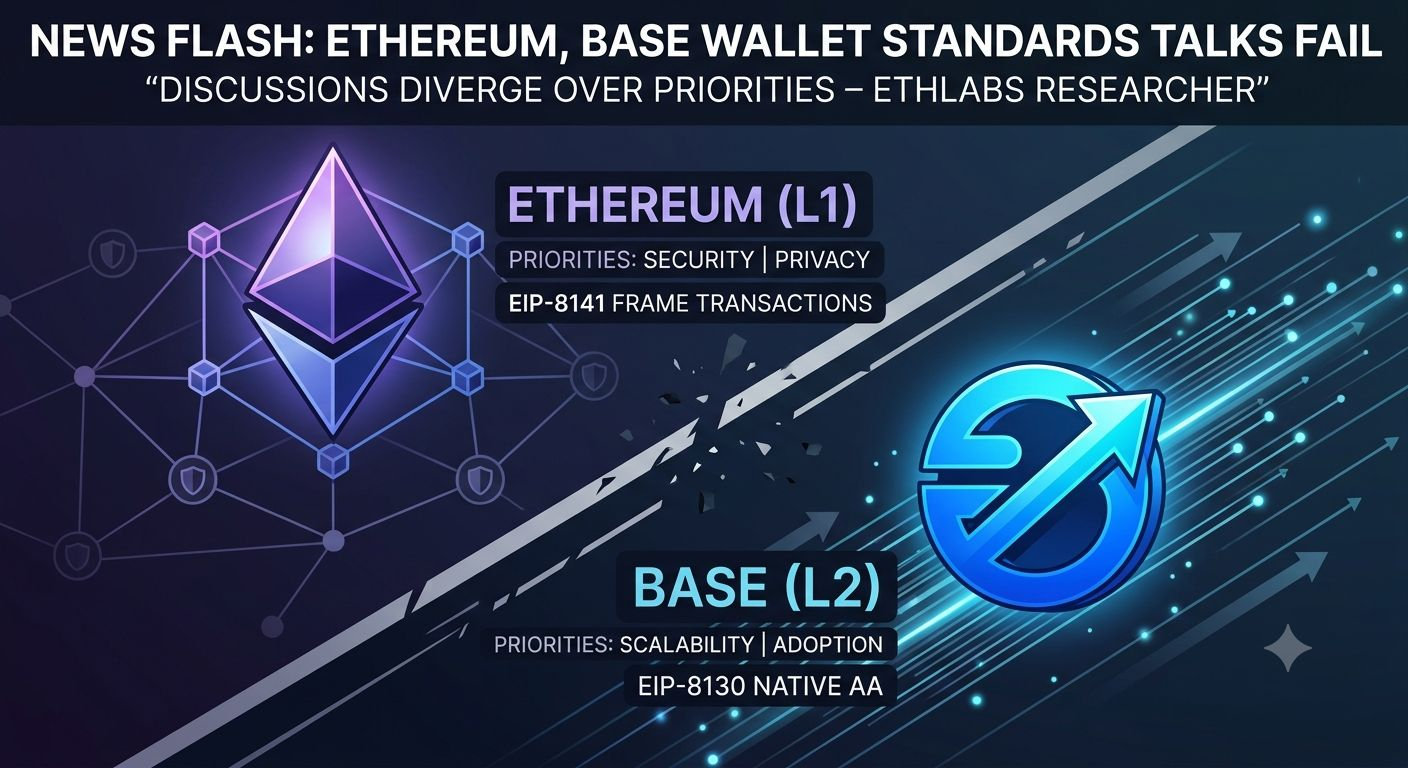
The breakdown in joint account abstraction (AA) negotiations between Ethereum core developers and Base engineers marks a significant architectural decoupling between Layer 1 (L1) and Layer 2 (L2) execution models.
As confirmed by Ethlabs researcher Derek Chiang, discussions aimed at merging Ethereum’s EIP-8141 (Frame Transactions) and Base’s EIP-8130 into a single cross-chain transaction standard ultimately failed due to fundamentally conflicting network goals.
The Core Conflict: EIP-8141 vs. EIP-8130
Both initiatives aim to bring native smart contract wallet capabilities—such as gasless transactions, batched operations, key rotation, and passkey authentication—directly into the base layer. However, their underlying technical approaches diverge:
Ethereum's Approach (EIP-8141 / Frame Transactions): Frame Transactions divide execution into dynamic, programmable contract calls ("frames") handling validation, gas sponsorship, and user logic separately. This design favors censorship resistance, maximum EVM-level flexibility, advanced privacy proofs, and post-quantum security guarantees needed for L1 settlement.
Base's Approach (EIP-8130 / Keystore): Authored by Coinbase/Base engineers, EIP-8130 utilizes an on-chain Keystore system paired with pre-declared authenticators. This model provides predictable validation overhead, tailored for high-throughput environments, custom L2 execution, and enterprise compliance requirements. Feature / GoalEthereum (EIP-8141)Base (EIP-8130)
Primary FocusCensorship resistance, privacy, quantum readinessHigh throughput, gas sponsorship, compliance
Transaction ModelDynamic multi-frame execution callsOn-chain Keystore & explicit authenticators
Validation OverheadDynamic (more flexible, higher L2 compute cost)Static/Predictable (optimized for sequencers)
ImplementationPriority "must-ship" for the Hegotá upgradeNative deployment on Base devnets / OP Stack
Key Technical Differences.
As confirmed by Ethlabs researcher Derek Chiang, discussions aimed at merging Ethereum’s EIP-8141 (Frame Transactions) and Base’s EIP-8130 into a single cross-chain transaction standard ultimately failed due to fundamentally conflicting network goals.
The Core Conflict: EIP-8141 vs. EIP-8130
Both initiatives aim to bring native smart contract wallet capabilities—such as gasless transactions, batched operations, key rotation, and passkey authentication—directly into the base layer. However, their underlying technical approaches diverge:
Ethereum's Approach (EIP-8141 / Frame Transactions): Frame Transactions divide execution into dynamic, programmable contract calls ("frames") handling validation, gas sponsorship, and user logic separately. This design favors censorship resistance, maximum EVM-level flexibility, advanced privacy proofs, and post-quantum security guarantees needed for L1 settlement.
Base's Approach (EIP-8130 / Keystore): Authored by Coinbase/Base engineers, EIP-8130 utilizes an on-chain Keystore system paired with pre-declared authenticators. This model provides predictable validation overhead, tailored for high-throughput environments, custom L2 execution, and enterprise compliance requirements. Feature / GoalEthereum (EIP-8141)Base (EIP-8130)
Primary FocusCensorship resistance, privacy, quantum readinessHigh throughput, gas sponsorship, compliance
Transaction ModelDynamic multi-frame execution callsOn-chain Keystore & explicit authenticators
Validation OverheadDynamic (more flexible, higher L2 compute cost)Static/Predictable (optimized for sequencers)
ImplementationPriority "must-ship" for the Hegotá upgradeNative deployment on Base devnets / OP Stack
Key Technical Differences.