
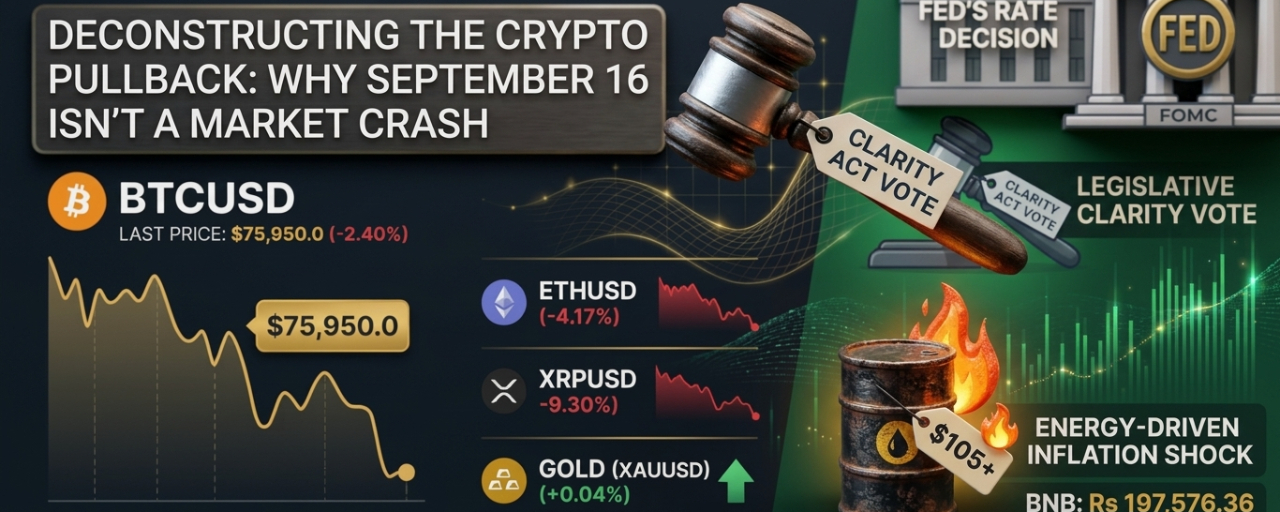

Looking at the market data from September 16, 2026, a quick glance at the screens might make it seem like a sudden crash is underway. The Binance dashboard is dominated by red, with Bitcoin ($BTC ) trading down 2.40% at $75,950, while Ethereum ($ETH ) and $XRP have pulled back by 4.17% and 9.30% respectively. However, a closer analysis reveals that this is not a structural collapse or panic-driven sell-off, but rather a deliberate, highly cautious recalibration by traders ahead of major macroeconomic events.
The primary catalyst behind this market anxiety is the impending Federal Reserve interest rate decision, alongside discussions surrounding the U.S. Senate's Clarity Act. Major financial institutions—including UBS, HSBC, Barclays, Citigroup, JPMorgan, and Goldman Sachs—have broadly priced in a 25-basis-point rate hike, bringing the target range to 3.50%–3.75%. What remains unresolved, however, is the Fed's trajectory for the rest of the year. With banks divided between expectations of further tightening and a eventual pause, market participants are choosing to de-risk rather than take aggressive directional bets.
Compounding this macro uncertainty is an energy-driven inflation shock. With Saudi Arabia closing key supply routes bypassing the Strait of Hormuz, Brent Crude has breached $105 a barrel. This spike in oil prices keeps core inflation sticky—running around 3.7%—and limits the Fed’s flexibility to ease monetary policy, constraining liquidity across risk assets like crypto.
This tension is clearly visible in Bitcoin’s price action. Following comments regarding a potential resolution to the Iran conflict, BTC briefly spiked past $79,000, triggering over $100 million in short liquidations within 30 minutes before retracing back down. According to Glassnode data, the $79,500 to $82,000 range represents a massive supply overhead, as nearly 8% of the total supply was acquired in this band. Investors who bought near these highs are using every relief rally to break even, creating persistent overhead resistance.
Ultimately, today's market pullbacks reflect a period of equilibrium-seeking rather than fundamental weakness. Institutional capital is sitting on the sidelines, waiting for the Fed’s updated dot plot projections to clarify the path ahead before committing to the next major trend.