
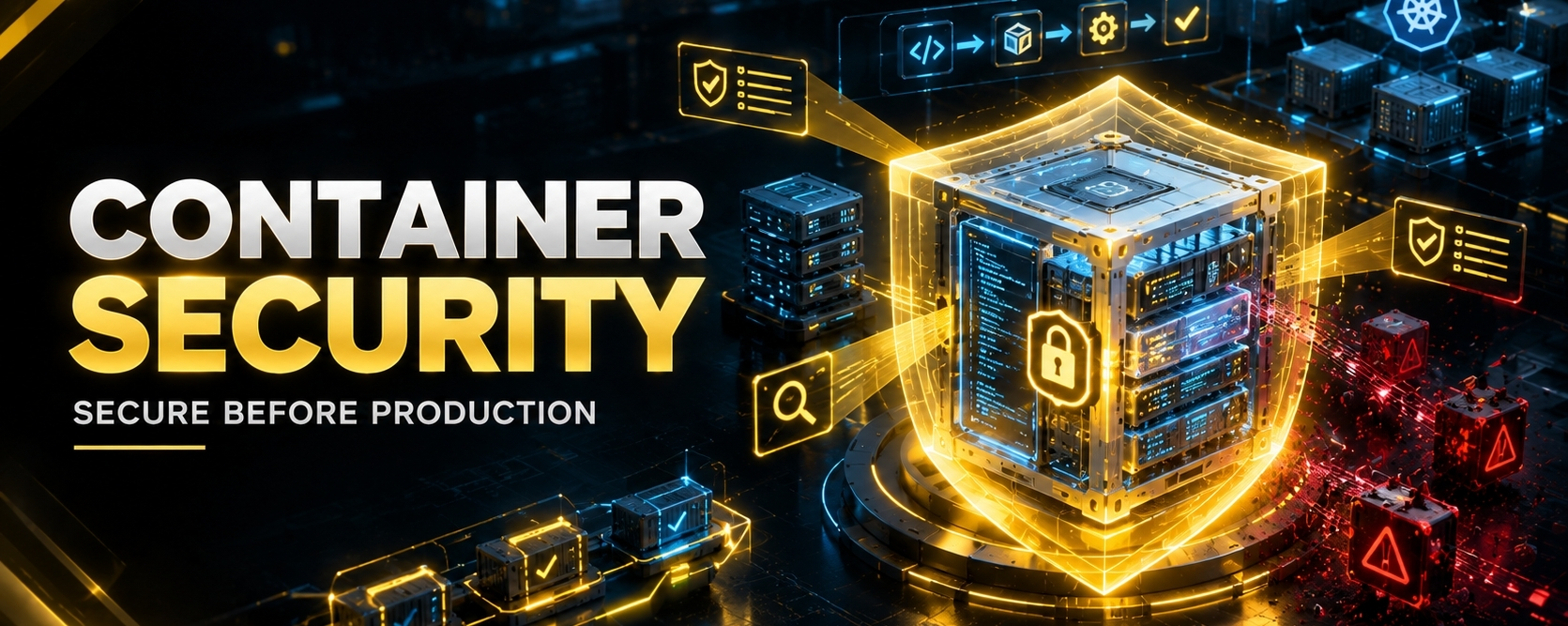

🐳 Container Security: Securing Applications From Image to Production
Containers have transformed modern software development.
They allow developers to package applications and dependencies into portable environments that can run consistently across systems.
But containers aren't automatically secure.
A vulnerable container image can carry security problems directly into production.
That's why container security should begin before deployment.
🔍 Where Can Container Security Fail?
Think about the container lifecycle:
Code → Dependencies → Image → Registry → Deployment → Runtime
Security needs to follow the entire path.
1️⃣ Vulnerable Dependencies
An application may depend on outdated packages containing known vulnerabilities.
Building a container doesn't remove those vulnerabilities.
It packages them.
That's why dependency scanning should happen during development and CI/CD.
2️⃣ Insecure Base Images
Containers commonly start from base images.
If the base image contains unnecessary packages or known vulnerabilities, every application built on top of it inherits the problem.
Use:
Trusted base images
Minimal images
Regular updates
Vulnerability scanning
3️⃣ Secrets Inside Images
One of the most dangerous mistakes is placing credentials directly inside container images.
Examples include:
API keys
Passwords
Tokens
Cloud credentials
Private keys
If the image is pushed to a registry, those secrets may travel with it.
Secrets should be managed separately from application images.
4️⃣ Running With Excessive Privileges
Containers should receive only the permissions they actually need.
Running everything with unnecessary privileges increases potential impact if an application becomes compromised.
This connects directly to the principle of:
Least Privilege.
5️⃣ Untrusted Container Images
A production environment shouldn't blindly trust every image available online.
Organizations should establish trusted image sources and security controls around their registries.
🛡️ Building a Container Security Pipeline
A mature container security workflow can look like:
Developer Code
↓
SAST
↓
Dependency Scan
↓
Container Build
↓
Image Scan
↓
SBOM Generation
↓
Registry Controls
↓
Deployment Security
↓
Runtime Monitoring
This turns security into a continuous process instead of a final checkpoint.
☁️ Containers + Kubernetes
Containers are often deployed through orchestration platforms such as Kubernetes.
That introduces additional security layers:
Cluster security
Identity and access control
Network policies
Secrets management
Workload security
Admission controls
Runtime monitoring
So container security shouldn't be treated as a single scanner.
It's an ecosystem.
🚀 Final Thought
Containers make software delivery faster.
But speed without security can also make vulnerabilities move faster.
The goal isn't:
“Scan the container once.”
The goal is:
Build securely → Scan continuously → Deploy safely → Monitor constantly.
That's the foundation of modern container security.