

I’ve spent enough time around crypto market to notice something slightly funny. We often talk about blockchains as if raw speed automatically solves everything. More transactions per second. Faster finality. Lower fees. The numbers get bigger, the benchmarks improve, and everyone moves on to the next comparison. But when I actually use a network for trading or DeFi, I rarely think about TPS. I think about whether the experience feels smooth, whether liquidity is actually there, and whether the application makes sense for the thing I’m trying to do.
That’s partly why Injective has always been interesting to me. It isn’t trying to be a general-purpose blockchain that happens to support finance somewhere in its ecosystem. Finance is much closer to the center of its design. Trading, markets, derivatives, asset creation, interoperability. That focus changes the conversation.
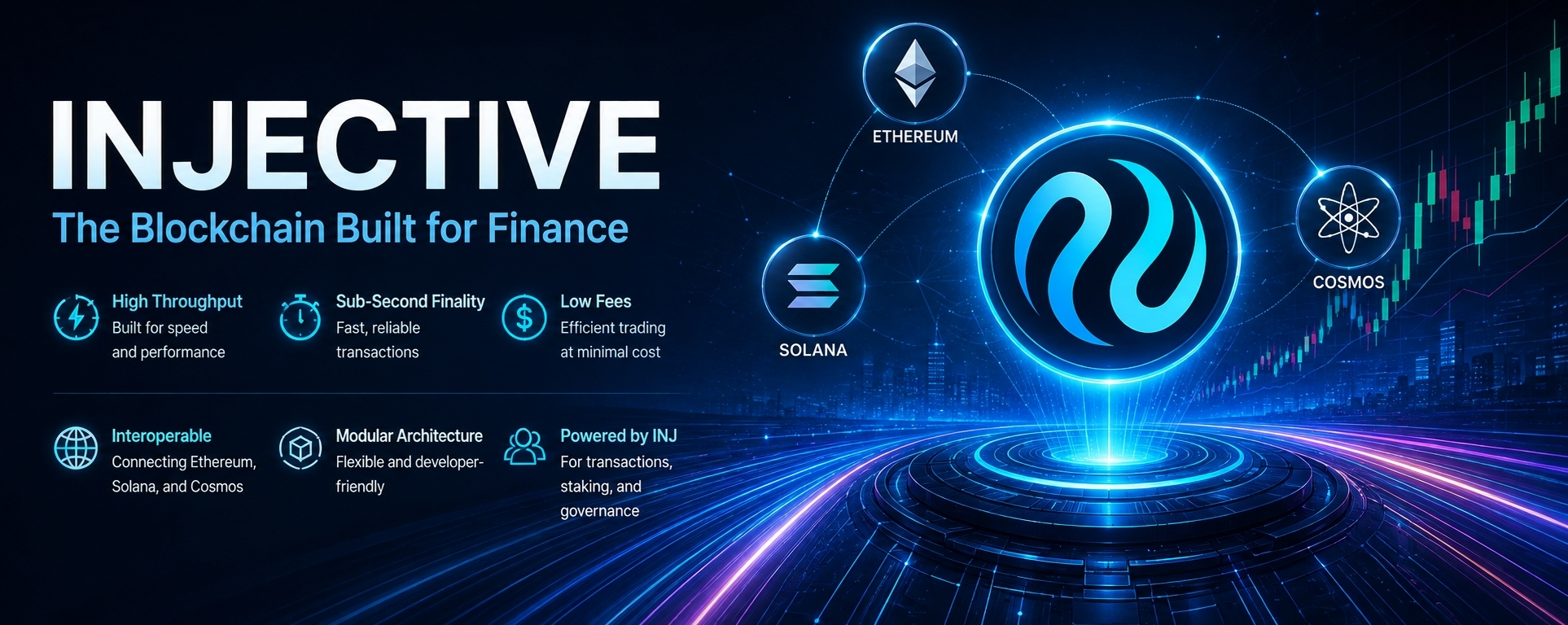
Injective is a Layer-1 blockchain built around financial applications. It offers high throughput, low transaction costs, and sub-second finality, while connecting with ecosystems such as Ethereum, Solana, and Cosmos. On paper, that sounds familiar because almost every major blockchain now has a performance story. The more interesting question, at least for me, is what happens when the architecture is deliberately shaped around financial activity.
I remember when decentralized exchanges often felt like experiments rather than serious trading environments. Swaps could be slow, transaction costs could become annoying, and moving assets between ecosystems was its own adventure. Sometimes the technology worked perfectly. Sometimes it didn't. You learned patience either way.
Injective seems to come from that problem set. Instead of treating financial applications as just another category, the network provides infrastructure intended specifically for building them. That can include different kinds of decentralized markets and financial products. The idea is fairly simple: developers shouldn't have to rebuild every piece of financial infrastructure from scratch before they can experiment.
Its modular architecture is part of that approach. Different components of the network are designed so developers can build applications without treating the entire blockchain as a fixed, one-size-fits-all system. I think this matters more than it initially sounds. Crypto development is already complicated enough. Every unnecessary layer can become another place where progress slows down.
Then there is interoperability, which is becoming harder to ignore. Liquidity doesn't live in one ecosystem anymore. Users don't either. Ethereum has enormous depth, Solana has developed its own active financial environment, and the Cosmos ecosystem brings another model of interconnected chains. A financial network that wants to operate across crypto probably can't afford to think too locally.
Injective's connections across these ecosystems are therefore a meaningful part of its identity. But interoperability is one of those things that sounds cleaner in a presentation than it can feel in practice. Moving value between networks introduces technical complexity and, depending on the design, additional risks. I’m still curious about how much ordinary users will care about the underlying connections versus simply wanting everything to work without thinking about bridges or infrastructure.
INJ sits at the center of the network's economic system. It is used for functions including transaction fees, staking, and governance. That gives the token a direct relationship with how the chain operates, rather than making it purely a speculative asset detached from the network. Of course, token utility alone doesn't automatically create long-term value. I've seen plenty of projects with impressive token models and limited real usage.
Staking is another interesting piece because it connects token holders with network security. Governance adds a different layer, allowing participants to influence certain decisions around the ecosystem. In theory, this creates a more decentralized relationship between the blockchain and its community. In reality, governance participation across crypto can be uneven. Maybe I'm overthinking it, but decentralization is always easier to describe than to maintain.
The trading side of crypto also makes Injective's low-latency design particularly relevant. Financial markets are sensitive to time. Even outside traditional high-frequency trading, users notice delays. A transaction that takes a few seconds can feel very different from one that settles almost immediately, especially when prices are moving quickly.
Still, speed is only one piece of a functioning market. This is where I think crypto discussions sometimes become too technical. A blockchain can be incredibly fast, but if liquidity is fragmented or users aren't showing up, the speed doesn't solve much. Markets need participants. Developers need reasons to build. Users need reasons to stay.
That creates an interesting challenge for Injective. Its infrastructure may be designed for financial applications, but the long-term question is whether those applications can develop their own meaningful activity. Will developers build products that feel genuinely different? Will traders find enough liquidity? Will financial applications benefit from being on a specialized Layer-1 rather than a larger general-purpose network?
I don't think those questions have simple answers yet. And honestly, that's part of what makes the project worth watching. Crypto infrastructure is full of networks making technical promises, but the more difficult test usually comes later. Technology has to turn into behavior. People have to use it repeatedly, not just once during a launch campaign or a market rally.
The broader idea behind Injective also makes me think about where blockchain development is heading. Perhaps we won't end up with one chain doing everything. Maybe specialized networks will continue to exist because different applications have different requirements. Finance, gaming, identity, and data systems don't necessarily need identical infrastructure.
Injective is essentially making a focused bet on that possibility. Build a blockchain with financial use cases in mind from the beginning, connect it to other ecosystems, and make development flexible enough for new products to emerge. It sounds logical. Whether that logic translates into durable adoption is the part nobody can fully predict.
I keep coming back to the user experience. Most people using a financial application probably won't care about the technical architecture underneath it. They will care whether their trade executes, whether their assets move safely, whether fees are reasonable, and whether the product gives them something useful. If the infrastructure disappears into the background, maybe that is actually a sign that it is doing its job.
So when I look at Injective, I’m less interested in asking whether it is simply fast or scalable. Those are useful characteristics, but they don't tell the whole story. I'm more curious about the ecosystem that grows around those characteristics and whether finance-focused infrastructure can create applications that people genuinely prefer using.
Maybe that takes years to answer. Maybe the future of on-chain finance ends up looking very different from what current Layer-1 networks are building toward. For now, Injective feels like one of those experiments where the architecture and the ambition are closely connected.
And I think that's the part I'll keep watching. Not just what the chain can do today, but what people eventually decide to do with it.
