

For decades, building a long-term investment portfolio followed a fairly predictable path.
You opened a brokerage account, gained access to financial markets, and gradually built exposure to stocks, funds, or broad-based index products.
But for many young people in emerging markets, that path was never equally accessible.
Access to international markets could involve geographic limitations, complicated onboarding, limited product availability, currency barriers, or financial infrastructure that was not designed with global participation in mind.
That is beginning to change.
A new generation of investors is gaining access to financial products and market exposure through digital infrastructure. For some, their first experience with long-term portfolio building is happening through the same ecosystem where they first discovered crypto.
And instead of focusing only on short-term price movements, some are beginning with a more familiar long-term principle: diversification.
From Trading Narratives to Long-Term Allocation
Crypto markets are often associated with fast-moving narratives and short-term trading.
But digital financial infrastructure can support a different type of behavior too.
Young investors are increasingly becoming familiar with ideas that have traditionally defined long-term portfolio construction:
Diversification
Broad market exposure
Long-term allocation
Consistent portfolio building
Rather than trying to identify a single winning company, broad-based index products can offer exposure to a larger segment of the market.
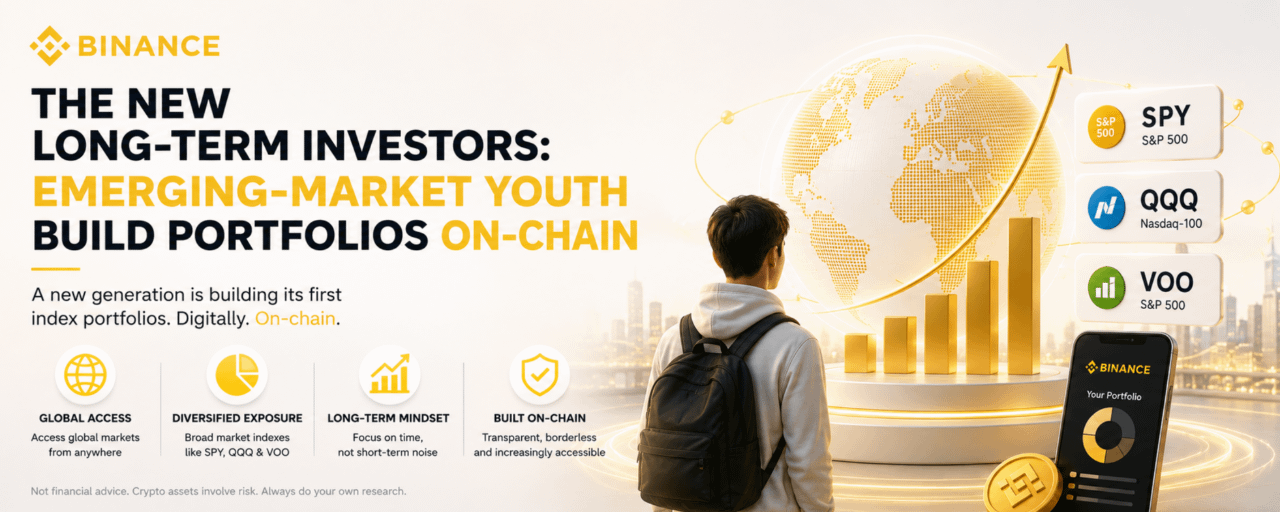
Products associated with major indexes, such as the S&P 500 or Nasdaq-100, have long been used by investors seeking diversified exposure through instruments such as SPY, QQQ, or VOO.
The investment principle itself is not new.
What is changing is who can increasingly access these markets and how that access is delivered.
A First Portfolio Built Digitally
For previous generations, long-term investing often started with a local bank or traditional brokerage account.
For today's younger generation, the starting point may look very different.
They grew up with smartphones, digital wallets, global apps, and 24/7 access to information. Financial participation increasingly follows the same pattern.
Digital and on-chain infrastructure can create new pathways toward global markets, potentially reducing some of the traditional barriers associated with accessing international financial products.
This does not mean that investing has become risk-free. Markets can decline, product structures vary, and availability depends on local regulations and platform requirements.
But accessibility is changing.
For a young person in an emerging market, the distance between discovering a global financial product and gaining access to a suitable investment platform may be significantly smaller than it was for previous generations.
Why Broad-Based Portfolios Matter
Long-term investing is often less about finding the most exciting opportunity and more about building consistent exposure over time.
Broad-based products can help investors avoid placing all of their capital into a single company, sector, or asset.
That idea is particularly relevant for a generation that entered financial markets through crypto.
The transition from actively following individual tokens or short-term market narratives toward thinking about allocation, diversification, and time horizons represents an important behavioral shift.
The infrastructure may be new.
The principles behind long-term investing are not.
The Bigger Change Is About Access
The most important part of this story may not be the specific products themselves.
It is who is now able to participate.
For much of modern financial history, building a globally diversified portfolio was easiest for people living in countries with mature capital markets and established brokerage systems.
Young people in emerging markets were often presented with more barriers.
Digital financial infrastructure is beginning to create alternative pathways.
A generation that was not always fully connected to global capital markets is increasingly finding ways to participate.
Some will trade actively.
Some will explore crypto.
And some may use the same digital infrastructure to build their first long-term portfolios.
That is the bigger shift.
Long-term wealth allocation is no longer only the preserve of the developed-market middle class.
For a new generation of investors, the first step toward a diversified portfolio may not begin at a traditional brokerage.
It may begin digitally.
And increasingly, it may begin on-chain.
This article is for educational purposes only and does not constitute financial advice. Investments and digital assets involve risk. Always conduct your own research and check product availability and applicable requirements in your region.