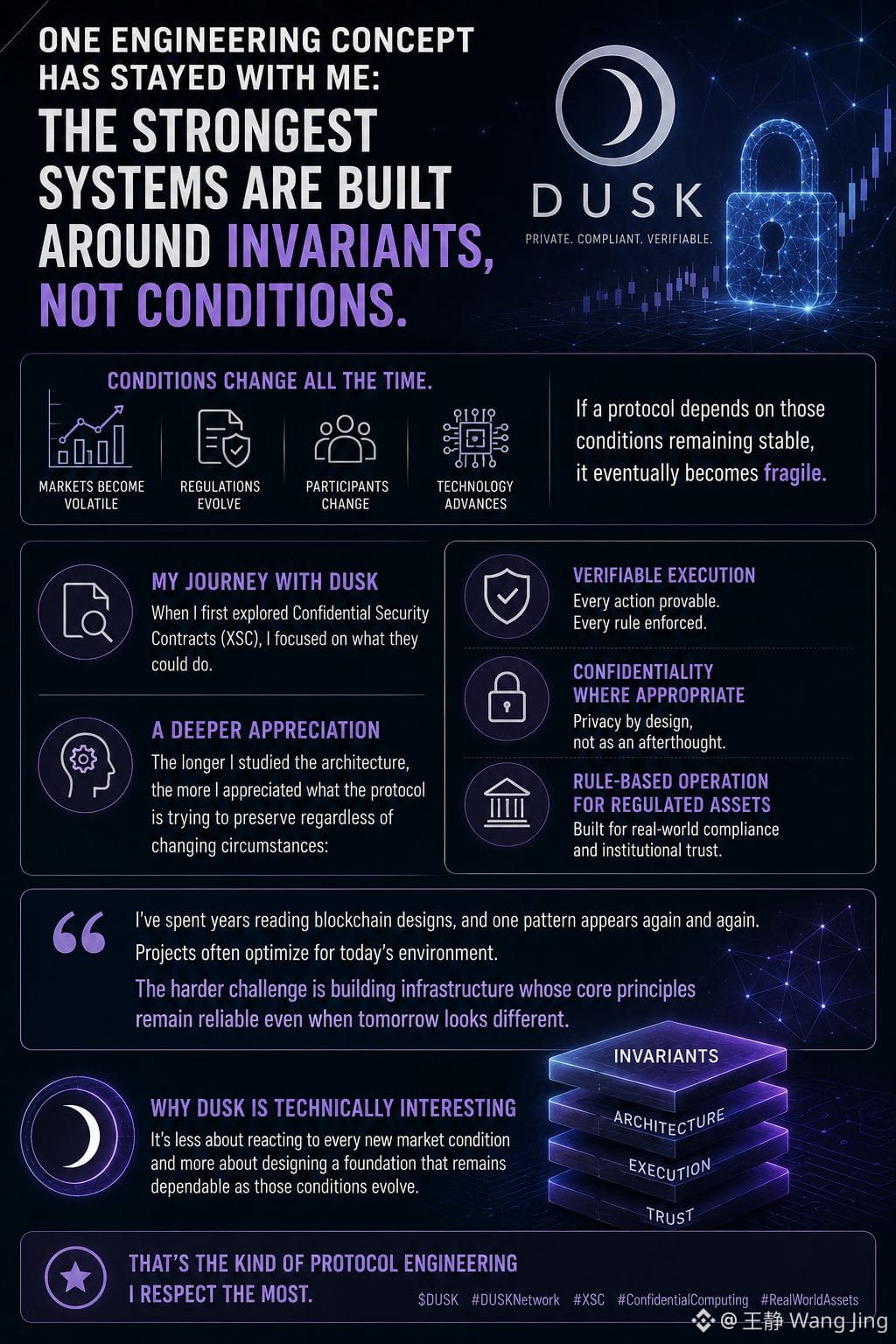
One engineering concept has stayed with me throughout my research into financial infrastructure:
The strongest systems are built around invariants, not conditions.
Conditions change all the time.
Markets become volatile.
Regulations evolve.
Participants change.
Technology advances.
If a protocol depends on those conditions remaining stable, it eventually becomes fragile.
That perspective made me rethink DUSK.
When I first explored Confidential Security Contracts (XSC), I focused on what they could do.
The longer I studied the architecture, the more I appreciated what the protocol is trying to preserve regardless of changing circumstances: verifiable execution, confidentiality where appropriate, and rule-based operation for regulated assets.
I've spent years reading blockchain designs, and one pattern appears again and again.
Projects often optimize for today's environment.
The harder challenge is building infrastructure whose core principles remain reliable even when tomorrow looks different.
For me, that's where DUSK becomes technically interesting.
It's less about reacting to every new market condition and more about designing a foundation that remains dependable as those conditions evolve.
That's the kind of protocol engineering I respect the most.
@Dusk $DUSK #dusk
The strongest systems are built around invariants, not conditions.
Conditions change all the time.
Markets become volatile.
Regulations evolve.
Participants change.
Technology advances.
If a protocol depends on those conditions remaining stable, it eventually becomes fragile.
That perspective made me rethink DUSK.
When I first explored Confidential Security Contracts (XSC), I focused on what they could do.
The longer I studied the architecture, the more I appreciated what the protocol is trying to preserve regardless of changing circumstances: verifiable execution, confidentiality where appropriate, and rule-based operation for regulated assets.
I've spent years reading blockchain designs, and one pattern appears again and again.
Projects often optimize for today's environment.
The harder challenge is building infrastructure whose core principles remain reliable even when tomorrow looks different.
For me, that's where DUSK becomes technically interesting.
It's less about reacting to every new market condition and more about designing a foundation that remains dependable as those conditions evolve.
That's the kind of protocol engineering I respect the most.
@Dusk $DUSK #dusk