

Two numbers came out of Washington this summer that don't agree with each other, and Bitcoin traders are the ones left holding the disagreement.
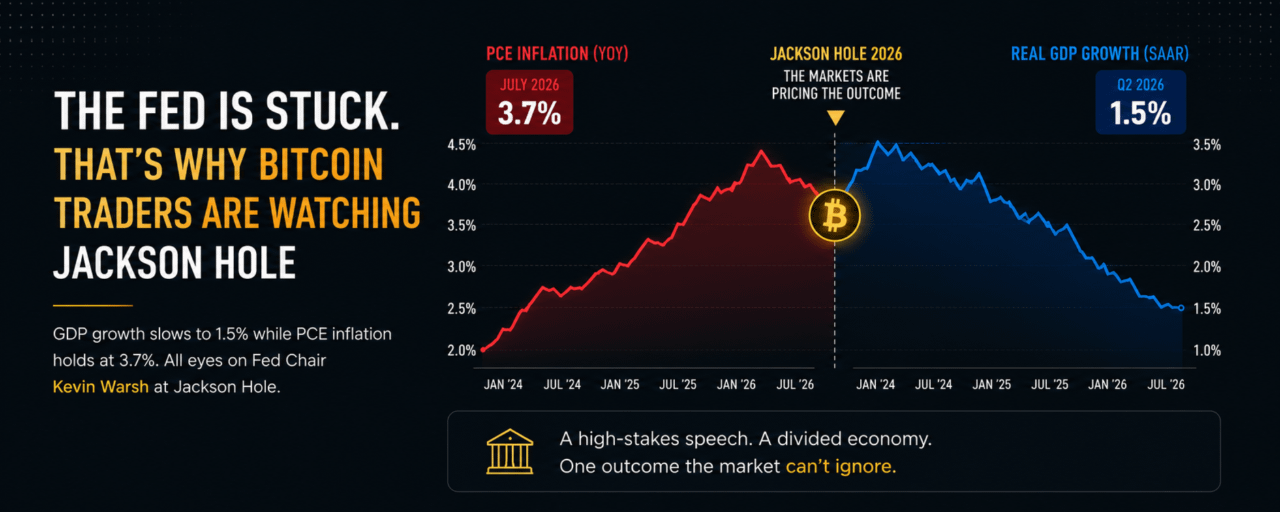
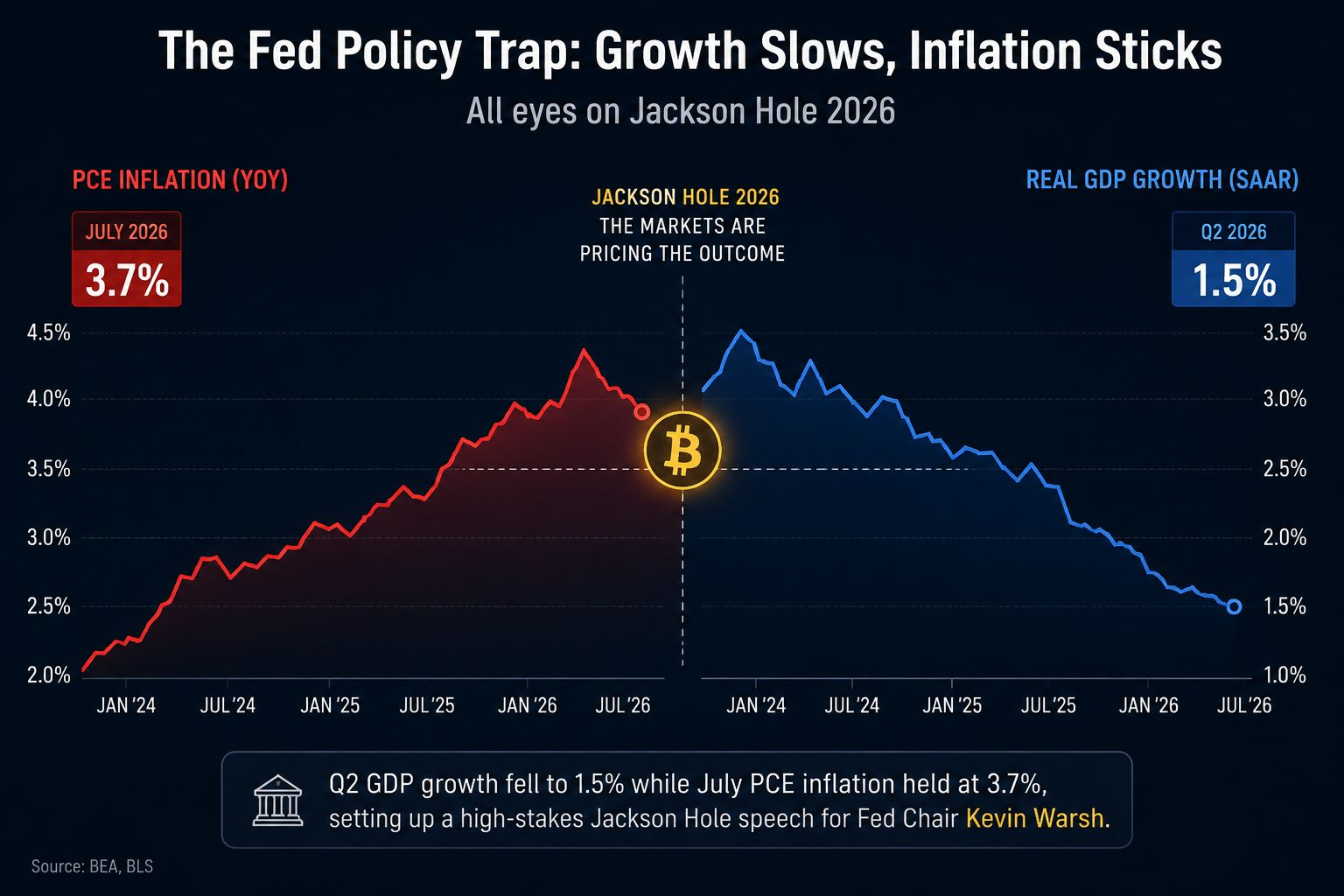
Second-quarter GDP grew at just 1.5%, a sharp step down from 2.1% in the first quarter. At the same time, the Fed's preferred inflation gauge, the personal consumption expenditures (PCE) price index, came in at 3.7% annually for July, a full 1.7 percentage points above the central bank's 2% target. Growth is slowing. Inflation isn't cooperating. And the person who has to decide what to do about it, new Federal Reserve Chair Kevin Warsh, steps up to the podium at Jackson Hole on August 28 for the first time since taking office.
What the data actually shows
The GDP slowdown is real but not catastrophic. The Bureau of Economic Analysis attributed the deceleration mainly to a downturn in government spending and a drag from rising imports, partly offset by stronger consumer spending. Underlying demand, measured by real final sales to private domestic purchasers, actually grew a much healthier 3.9% annualized, suggesting the headline number understates the economy's momentum in some areas even as it slows in others.
The inflation side is where the real tension sits. July's PCE index rose 0.2% on the month and 3.7% year-over-year, a tenth of a point above what economists expected. Core PCE, which strips out food and energy, held at 3.3%. Both numbers matter to the Fed, but policymakers generally treat core as the more reliable read on where prices are headed.
Here's the part that gives the Fed some room to breathe: inflation has come down from its 2026 peak. Headline PCE hit 4.1% in May, the highest reading since April 2023, driven largely by an energy price shock tied to the US-Iran conflict. It eased to 3.7% by June and has stayed there through July. That's progress, even if 3.7% is still nearly double the Fed's target.
Why this puts Warsh in a genuine bind
Cutting rates now would add fuel to inflation that's already running hot. Holding rates at the current 3.50%-3.75% range, or hiking further, risks squeezing an economy that just posted its weakest growth reading since the fourth quarter of 2025.
Warsh took over as Fed Chair on May 22, replacing Jerome Powell, and has spent his first three months signaling a harder line on inflation than markets expected. At his first FOMC meeting in June, the committee dropped a previously penciled-in rate cut and adopted language committing to "deliver price stability," a notable shift after the Fed missed its 2% target for five straight years. Fed officials have since floated the possibility of a rate hike rather than a cut, something that would have seemed unlikely at the start of the year.
That's the setup heading into Jackson Hole. Bank of America's fund manager survey found 69% of respondents expect Warsh to strike a neutral tone on Friday, which means the real market risk isn't the expected outcome. It's the surprise on either side of it.
The Treasury is trying to do the Fed's job
While Warsh manages inflation, Treasury Secretary Scott Bessent has been working a different lever. On August 19, the Treasury announced it would at least double its buybacks of longer-dated government bonds, from $2 billion to $4 billion per operation, starting September 9 and running through November 4. The move targets the 10-to-20-year and 20-to-30-year portions of the yield curve, an area that's seen weak demand since late June.
The effect was short-lived. Ten-year and thirty-year yields dropped initially, then climbed back above pre-announcement levels within a day. Bessent has since suggested the buyback size could grow even further, and reports indicate the Treasury may draw on its roughly $950 billion General Account to fund larger purchases.
This matters for the Fed's credibility problem. Warsh has publicly favored letting the open market set rates rather than having the government artificially suppress yields. RSM chief economist Joe Brusuelas put it bluntly: Treasury intervention aimed at controlling yields could work against the Fed's own effort to bring inflation down, since lower long-term borrowing costs can loosen financial conditions right when the central bank wants them tighter.
In short, two arms of the US government are currently pulling in different directions. One is trying to cool the economy. The other is trying to keep borrowing cheap.
What this means for Bitcoin
Bitcoin doesn't trade in a vacuum, and this is one of those stretches where the macro backdrop matters more than any technical setup on the BTC chart.
A genuine policy trap, where the Fed can't cut without reigniting inflation and can't hold or hike without choking growth, tends to produce exactly the kind of volatility that moves crypto markets sharply in either direction. If Warsh leans hawkish at Jackson Hole and signals a rate hike is coming, that typically strengthens the dollar and pressures risk assets, Bitcoin included, in the near term. If he leans dovish or emphasizes the growth slowdown, that could be read as an opening for eventual rate relief, which historically has supported Bitcoin as investors price in looser future liquidity.
There's also a longer-run argument some investors are watching closely. The Congressional Budget Office projects net interest payments on federal debt will hit roughly $1 trillion in fiscal year 2026, matching the base defense budget for the first time. Every rate increase adds billions more to that bill. That fiscal pressure doesn't show up in a PCE report, but it shapes the environment the Fed is actually operating in, and it's part of why some allocators have been rotating into assets seen as outside the traditional monetary system. Central banks bought 288.9 tonnes of gold in the second quarter of 2026 alone, a 62% jump from a year earlier, according to World Gold Council data. Bitcoin has drawn comparisons in that same "hedge against fiscal strain" conversation, though it remains far more volatile and far less established as a reserve asset than gold.
None of this guarantees a specific price outcome. What it does mean is that the next major move in BTC is more likely to be triggered by a sentence out of Jackson Hole or a surprise in the September inflation data than by anything visible on a candlestick chart right now.
What to watch next
Friday's Jackson Hole speech is the immediate catalyst. Beyond that, the September FOMC meeting will show whether the Fed follows through on the hawkish signals from earlier this year, and the next PCE report will reveal whether July's 3.7% reading was a plateau or a step toward reacceleration. Traders positioning around Bitcoin this week are, whether they realize it or not, making a bet on what a central banker says about payments innovation and monetary policy from a lodge in Wyoming.
FAQ
Why is the Fed's decision considered a "trap" right now? Because the two halves of its mandate are pulling in opposite directions. Inflation at 3.7% is well above the 2% target, which argues for holding or raising rates. But GDP growth slowed to 1.5% in the second quarter, which argues for cutting. Any move addresses one problem while worsening the other.
How does the Treasury's bond buyback program relate to Fed policy? The Treasury's decision to double its buybacks of long-dated bonds is aimed at lowering long-term borrowing costs, a job typically associated with Fed policy. If it succeeds, it could loosen financial conditions at the same time the Fed is trying to tighten them, working against the central bank's inflation fight.
Does a Fed rate hike automatically mean lower Bitcoin prices? Not automatically, but historically a more hawkish Fed and a stronger dollar have tended to pressure Bitcoin and other risk assets in the short term, while signals of future rate cuts or a growth slowdown that forces the Fed's hand have tended to support it. The relationship isn't fixed, and other factors, including crypto-specific flows and regulation, also drive price.
#Bitcoin #FederalReserve #JacksonHole #MacroEconomics #CryptoMarkets