

Bitcoin News: Bitcoin Steadies at $77,800 as Falling Open Interest Confirms the Rally Was Spot-Driven, Not Leveraged
Binance News
Verified Binance official account
Follow
Bitcoin traded around $77,800 Monday morning — little changed since midnight UTC — as markets digested one of the sharpest weekly rallies in over three years. The pause follows a week in which BTC surged roughly 24% from below $63,000 in its best performance since March 2023, after the US Treasury's decision to double buybacks of long-dated bonds cracked a six-week trading range and triggered more than $3 billion in short liquidations in 24 hours. Gold added around 0.8% Monday morning and sits near record highs as Treasury Secretary Bessent's debt management strategy continued to weigh on long-dated yields — the 30-year bond yield briefly touched a 19-year high before the buyback announcement pulled it back. Bitcoin futures open interest declined to a two-month low of 715,000 BTC from the August 18 high of 762,000 BTC — the most analytically significant derivatives development of the session, confirming that last week's surge was driven by spot buying and short unwinding rather than leveraged bullish positioning.
Falling Open Interest Into a 24% Rally
Open interest declining from 762,000 BTC to a two-month low of 715,000 BTC while Bitcoin rallied 24% is the structural signature of a genuinely spot-driven advance rather than a leverage-fueled squeeze. In leveraged rallies, open interest rises as traders add new long positions — the price appreciation and the leverage build reinforce each other until the position becomes crowded and vulnerable to a liquidation cascade. In spot-driven rallies, open interest falls as existing short positions are closed and no new leveraged longs replace them — the buying is coming from participants purchasing actual Bitcoin rather than derivatives exposure.
The 47,000 BTC decline in open interest across the rally week — combined with the $3 billion in short liquidations — describes exactly this: shorts closing positions, reducing total open interest, while spot buyers absorbed the resulting demand without adding new leveraged exposure. ETH, SOL, and XRP futures revealed the same pattern of OI declines amid price rallies, confirming that the spot-driven dynamic extended across majors rather than being Bitcoin-specific.
This is the structurally healthiest configuration a rally can have. It directly addresses the sustainability question CryptoQuant raised when its 30-day apparent spot demand approached the zero-cross: whether the spot bid that emerged behind the squeeze holds once forced covering stops. Falling open interest into a rising price says the answer is yes — the buying is spot, not futures.
BVIV at 47% — Volatility Exploding Higher During a Rally
Bitcoin's 30-day implied volatility climbing to 47% annualized from 36% a week ago is an unusual configuration that deserves specific attention. The BVIV index is widely treated as a fear gauge that typically spikes during selloffs — implied volatility rising during a price rally is the exception rather than the rule. Ether's EVIV index surged similarly.
The rise from 36% to 47% during a 24% price advance reflects the market repricing the probability distribution of future outcomes rather than pricing fear. When Bitcoin was range-bound between $61,500 and $66,900 for six weeks, options markets could price a narrow distribution of likely outcomes — hence BVIV at multi-year lows of 35-36%. The breakout through $66,600, $70,000, $75,385, and $79,400 in five sessions widened that distribution dramatically: Bitcoin is now capable of moving in either direction with substantially more magnitude than the range period implied. Options sellers require higher premiums to underwrite that wider distribution regardless of direction.
For traders who followed TDX Strategies' December strangle recommendation at BVIV 35.59% lows, the move from 36% to 47% represents a significant mark-to-market gain on the volatility component of the position independent of the directional gain from Bitcoin's price advance. The article that noted implied volatility at 36% was 65% above realized volatility of 21.8% now has its resolution: realized volatility has caught up dramatically as the range broke, and implied volatility has expanded further to reflect the new regime.
ZEC — The Only Major With Rising OI Alongside Rising Price
Zcash's open interest climbing to 2.24 million tokens from 1.81 million a week ago — while its price rose over 70% — is the inverse of the pattern across BTC, ETH, SOL, and XRP, and it is the analytically stronger configuration for trend confirmation. Rising open interest alongside rising price means new capital is entering on the long side rather than shorts merely closing. The OI-adjusted weekly cumulative volume delta being the most positive among majors confirms that ZEC buyers have been leading price action through market orders rather than passive limit orders — aggressive directional conviction rather than opportunistic accumulation.
ZEC's 70% weekly gain with confirming OI growth makes it the strongest trend-confirmed move among major cryptocurrencies in the current rally. The privacy sector catching a bid alongside the broader risk-on move — with Monero having been August's earlier privacy outperformer — describes a rotation that predates the Treasury buyback catalyst and has now been amplified by it.
Funding Rates at 10% — No Signs of Overheating
Annualized funding rates for BTC, ETH, and other majors hovering around 10% describes a market with a bullish bias but nothing resembling the overheated positioning that historically precedes sharp reversals. In prior cycle tops, funding rates have reached 50-100% annualized as leveraged long demand became extreme. At 10%, longs are paying a modest premium to maintain positions — consistent with genuine directional interest rather than crowded speculation.
The 10% funding rate combined with falling open interest is the most constructive derivatives configuration available: bullish bias without leverage buildup, spot-driven price appreciation, and no crowded positioning vulnerable to a liquidation cascade. This is a materially different market structure than the 20-month high funding rates recorded just before the breakout — the rally has actually reduced the leverage risk rather than amplifying it, because shorts closing outweighed new longs opening.
Options — Cautious Optimism With the $70,000 Put Leading Volume
The Deribit call-put skew flipping positive at the front end — meaning short-dated calls are now pricier than puts — is the options market's confirmation of directional bullishness. But the 24-hour volume profile complicates that read: the $70,000 put topped the most active list, followed by call options. The combination describes cautious optimism rather than unrestrained bullishness — traders paying up for calls while simultaneously buying downside protection at $70,000, approximately 10% below spot.
The $70,000 put as the most active contract is analytically coherent given the rally's speed. Bitcoin moved from $62,600 to $79,400 in five sessions. A pullback to $70,000 would represent a normal retracement of roughly 40% of that advance — the kind of consolidation that follows any parabolic move. Traders buying $70,000 puts are hedging that scenario without abandoning their bullish directional positioning.
Altcoins Consolidating — Selective, Not Broad Rotation
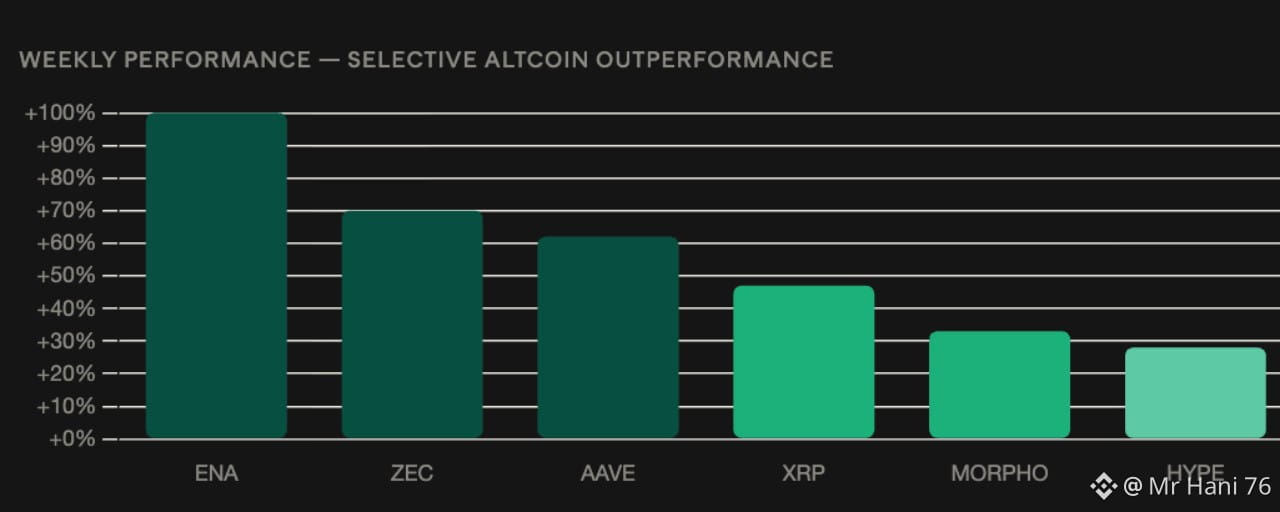
Bitcoin dominance holding near 59.2% with the Altcoin Season index at 42/100 — up from 33 on Friday but still firmly in Bitcoin territory — confirms that last week's altcoin outperformance was selective rather than a broad rotation. The standout performers had specific catalysts: ENA doubled to $1.79 following its $1 billion FalconX secured warehouse facility, AAVE rose more than 62% as DeFi tokens caught the broader risk-on bid, XRP gained 47% on the week, HYPE rose approximately 28% fueled in part by Trump's CFTC oversight comments before setting a record high of $83.30 late Sunday, and MORPHO gained 33% on the week.
Monday's pullbacks — HYPE down 3.3% to $79.59 from its record, XRP down 2.8% to $1.48, MORPHO down 6.2% to $2.73 despite holding an 18% 24-hour gain, AAVE easing 0.6% to $140.68 — are profit-taking after sharp runs rather than trend reversals. The Altcoin Season index rising from 33 to 42 while Bitcoin dominance holds at 59.2% describes the early stage of rotation rather than its completion: capital is beginning to move into altcoins but Bitcoin remains the dominant destination.
Gold Near Record Highs — the Parallel Trade Confirms the Macro Driver
Gold adding 0.8% Monday and sitting near record highs — with Bessent's debt management strategy continuing to weigh on long-dated yields after the 30-year briefly touched a 19-year high — confirms that the Treasury buyback catalyst is driving both gold and Bitcoin through the same channel. Both assets are responding to the reduced term premium pressure, the dollar weakness, and the sovereign risk repricing that the buyback announcement produced.
The gold-Bitcoin co-movement through a full week of the rally is the most sustained correlation between the two assets since the current cycle began — supporting the thesis that Bitcoin's institutional categorization may be shifting from purely liquidity-sensitive risk asset toward partial debasement hedge. Equities lagging while crypto and gold rallied in tandem is the specific relative performance signature that distinguishes a debasement trade from a general risk-on move.

