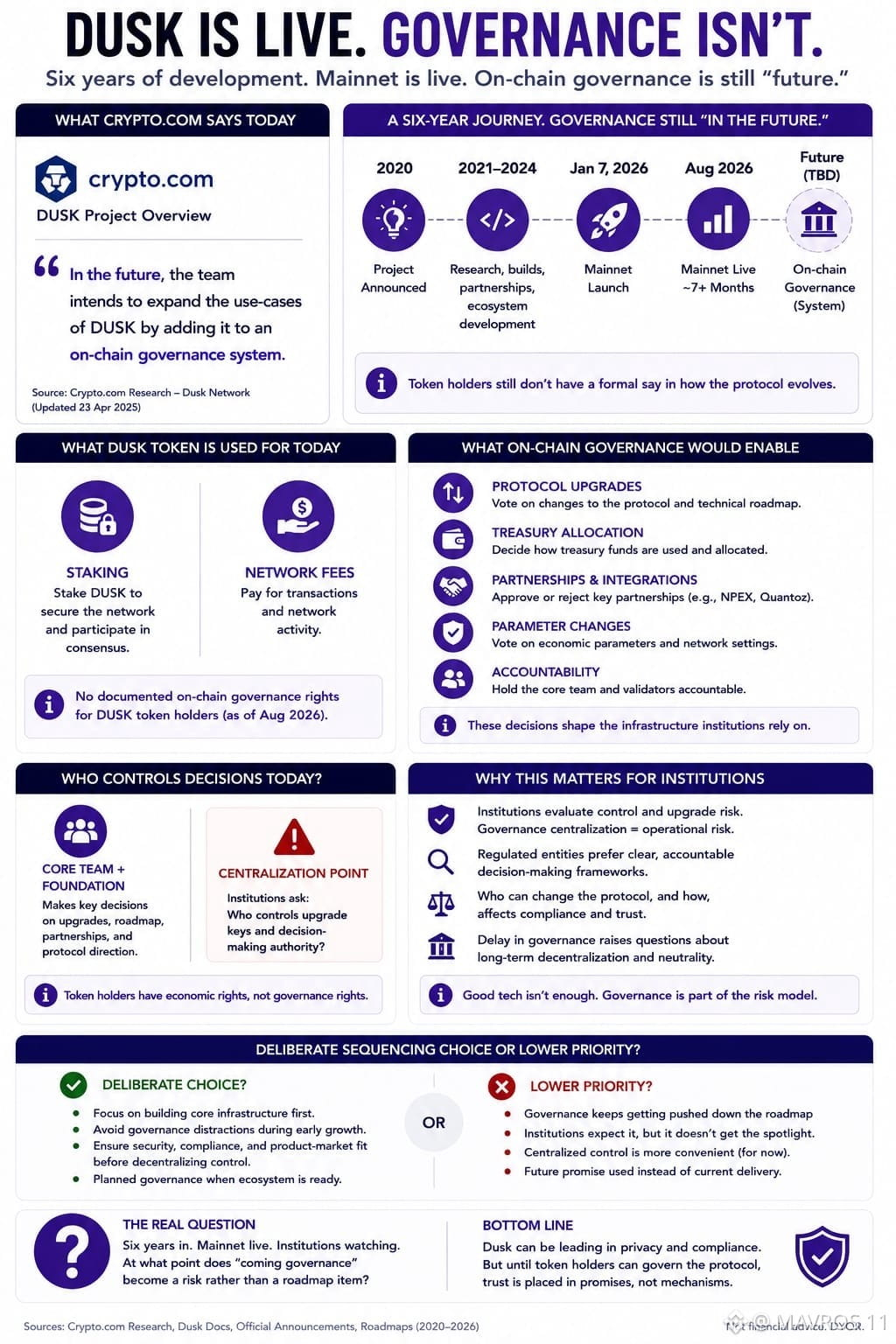
Crypto. com's writeup on @Dusk includes this line: "In the future, the team intends to expand the use-cases of DUSK by adding it to an on-chain governance system." Present tense mainnet, future tense governance — six years into development, months after mainnet launch, and token holders still don't have a formal say in how the protocol evolves.
That's worth sitting with given what DUSK is actually used for right now: staking to participate in consensus, and paying for network activity. Governance — the mechanism that would let holders vote on protocol upgrades, treasury allocation, or partnership terms like the NPEX and Quantoz integrations everything else depends on — is described as aspirational, not operational.
For a lot of L1s this wouldn't be unusual; plenty of chains launch with core teams making decisions and formalize governance later. But it sits oddly next to Dusk's institutional positioning specifically. Institutions doing due diligence on infrastructure they're settling regulated securities through tend to ask who actually controls upgrade decisions, and right now the honest answer for Dusk is: not token holders, at least not through any documented on-chain mechanism. That's a centralization point that doesn't show up in the privacy or compliance narrative at all, because it's not framed as a risk — it's framed as a future feature.
Six years of development and a live mainnet, and holders still can't formally direct the protocol. Does that reflect a deliberate sequencing choice, or a lower priority than the roadmap items that get more attention?$DUSK #dusk
That's worth sitting with given what DUSK is actually used for right now: staking to participate in consensus, and paying for network activity. Governance — the mechanism that would let holders vote on protocol upgrades, treasury allocation, or partnership terms like the NPEX and Quantoz integrations everything else depends on — is described as aspirational, not operational.
For a lot of L1s this wouldn't be unusual; plenty of chains launch with core teams making decisions and formalize governance later. But it sits oddly next to Dusk's institutional positioning specifically. Institutions doing due diligence on infrastructure they're settling regulated securities through tend to ask who actually controls upgrade decisions, and right now the honest answer for Dusk is: not token holders, at least not through any documented on-chain mechanism. That's a centralization point that doesn't show up in the privacy or compliance narrative at all, because it's not framed as a risk — it's framed as a future feature.
Six years of development and a live mainnet, and holders still can't formally direct the protocol. Does that reflect a deliberate sequencing choice, or a lower priority than the roadmap items that get more attention?$DUSK #dusk