
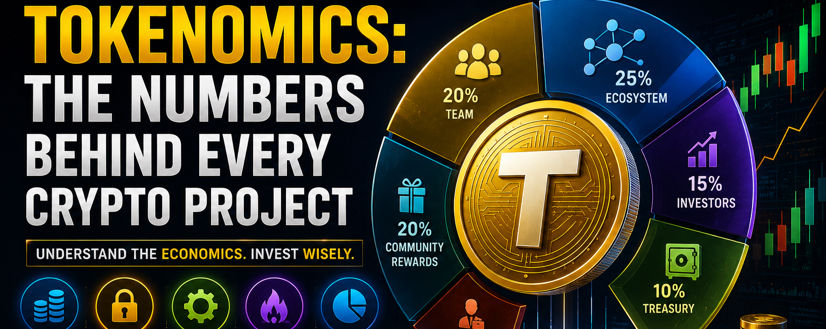

A crypto project can have an impressive website, a strong community, and a powerful narrative.
But there is one question many investors forget to ask:
How does the token actually work?
That is where Tokenomics becomes important.
Tokenomics is essentially the economic design of a cryptocurrency or token—how it is created, distributed, used, and released into the market.
Understanding it can help you look beyond the hype.
🧠 1. Supply Is More Important Than It Looks
Before looking at a token’s price, look at its supply.
You may see a token trading at $1 and think it is cheap.
But if there are billions of tokens in circulation, its total market value could already be very large.
This is why comparing token prices alone can be misleading.
A better question is:
“What is the market capitalization relative to the token’s supply?”
🔢 2. Circulating Supply vs. Maximum Supply
Two numbers deserve special attention:
Circulating Supply
The number of tokens currently available in the market.
Maximum Supply
The maximum number of tokens that can ultimately exist, if the project has a defined maximum.
The difference between these numbers can matter.
For example, a project with a relatively small circulating supply but a much larger future supply may face additional selling pressure as new tokens enter the market.
⏳ 3. Token Unlocks Can Change the Equation
This is one of the most overlooked areas of crypto research.
Some tokens are allocated to:
Team members
Investors
Advisors
Ecosystem incentives
Community rewards
Treasury reserves
These tokens may be locked initially and released according to an unlock schedule.
When a significant amount of previously locked tokens becomes available, market participants may pay close attention to whether those tokens could increase selling pressure.
An unlock does not automatically mean the price will fall.
But it is an important event to understand.
🏗️ 4. Where Does the Token Get Its Value?
A token should have more than just a ticker symbol.
Ask:
What is the token actually used for?
Possible utilities include:
Paying network fees
Governance
Staking
Accessing applications
Incentivizing network participants
Using decentralized services
Participating in an ecosystem
The stronger the connection between real utility and token demand, the more interesting the economic model becomes.
But remember:
Utility does not automatically guarantee price appreciation.
🔥 5. Token Burns: Powerful Narrative or Real Economics?
Some projects use token-burning mechanisms to permanently remove tokens from circulation.
The idea sounds simple:
Lower supply → potentially greater scarcity.
But investors should look deeper.
How many tokens are actually being burned?
How frequently?
Is demand growing at the same time?
A burn mechanism may be interesting, but its impact depends on the overall economics of the project.
⚠️ 6. Watch for Inflation
Some cryptocurrencies continuously issue new tokens to reward validators, stakers, or ecosystem participants.
This can create inflation.
Inflation isn’t necessarily bad.
In fact, it can be an intentional part of a network’s economic design.
The important question is:
Is new token issuance creating enough utility and demand to justify the expanding supply?
That’s a much more useful question than simply asking whether a token has a “low price.”
🔍 A Simple Tokenomics Checklist
Before getting excited about a crypto project, try checking these seven things:
1. Circulating Supply
2. Maximum / Total Supply
3. Market Capitalization
4. Token Unlock Schedule
5. Allocation to Team & Investors
6. Token Utility
7. Inflation or Burn Mechanism
This simple framework can reveal information that a price chart cannot.
💡 The Bigger Lesson
A beautiful website can create attention.
A large community can create excitement.
A viral narrative can create momentum.
But Tokenomics helps explain the economic structure underneath the project.
That’s why smart crypto research should go beyond:
“How much can this token go up?”
Instead, ask:
“How is this token designed, who controls the supply, and where could future demand come from?”
The more you understand the economics behind a token, the less dependent you become on hype.
💬 Your Turn
When researching a new crypto project, what do you check first?
Tokenomics, Team, Technology, Community, or Market Cap?
Drop your answer below 👇


#usdt #Binance #BinanceSquareFamily