#termmax @TermMax I started looking at TermMax from a different angle today.
Most people look at DeFi protocols and ask one question:
“How much revenue does it generate?”
But I think the more important question is:
Where does that revenue actually come from?
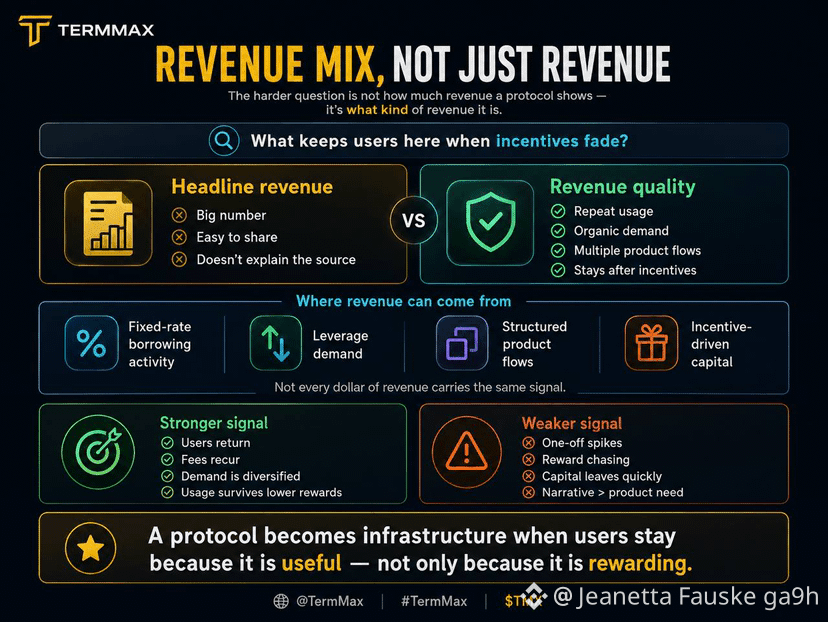
Because not all revenue has the same quality.
A protocol can show impressive numbers, but the source matters.
Is the revenue coming from:
sustainable user activity?
trading demand?
leverage usage?
temporary incentives?
Or is it simply capital moving because rewards are attractive?
This is why TermMax is interesting.
The protocol is not built around only one income stream.
Different parts of the system create different economic flows:
Fixed-rate markets create predictable lending activity.
Leveraged products create demand from users who want specific exposure.
Structured products introduce another layer where risk and reward are packaged differently.
The important part is not only the size of the numbers.
It is the composition behind them.
A $1M revenue stream generated from organic demand can be fundamentally different from $1M generated through short-term incentives.
For DeFi, the next stage will probably not be about who can show the biggest TVL.
It will be about who can build a healthier economic engine.
The question I keep thinking about:
Will users stay because the protocol is rewarding them, or because the protocol is actually useful?
That difference decides whether a DeFi product becomes a temporary opportunity or long-term infrastructure.
Most people look at DeFi protocols and ask one question:
“How much revenue does it generate?”
But I think the more important question is:
Where does that revenue actually come from?
Because not all revenue has the same quality.
A protocol can show impressive numbers, but the source matters.
Is the revenue coming from:
sustainable user activity?
trading demand?
leverage usage?
temporary incentives?
Or is it simply capital moving because rewards are attractive?
This is why TermMax is interesting.
The protocol is not built around only one income stream.
Different parts of the system create different economic flows:
Fixed-rate markets create predictable lending activity.
Leveraged products create demand from users who want specific exposure.
Structured products introduce another layer where risk and reward are packaged differently.
The important part is not only the size of the numbers.
It is the composition behind them.
A $1M revenue stream generated from organic demand can be fundamentally different from $1M generated through short-term incentives.
For DeFi, the next stage will probably not be about who can show the biggest TVL.
It will be about who can build a healthier economic engine.
The question I keep thinking about:
Will users stay because the protocol is rewarding them, or because the protocol is actually useful?
That difference decides whether a DeFi product becomes a temporary opportunity or long-term infrastructure.