
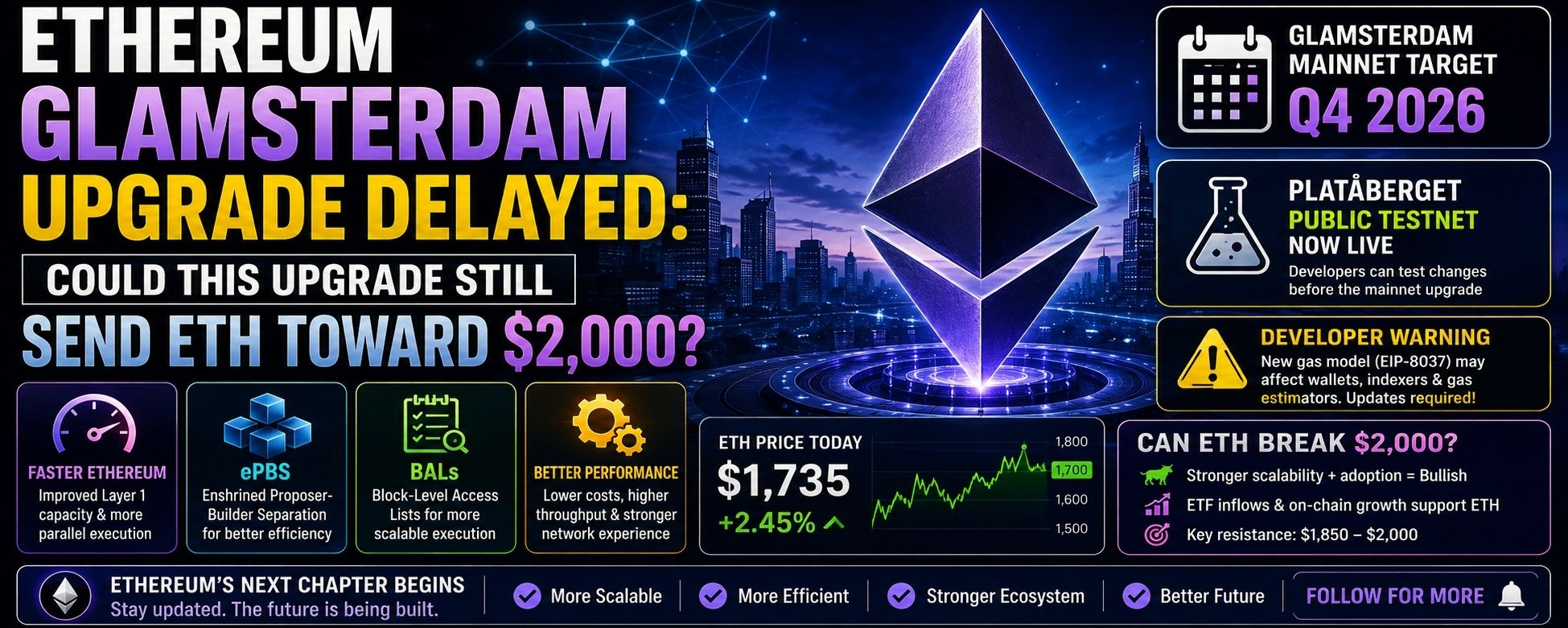
Ethereum just entered a major new testing phase — but there is a twist. Glamsterdam is now targeted for Q4 2026, while the new Platåberget public testnet is already open for testing.
For ETH traders, this is a much bigger story than a simple upgrade delay.
Ethereum is preparing one of its most important protocol changes since The Merge, with Glamsterdam designed to improve Layer 1 capacity, enable more parallel processing and change how blocks are built. At the same time, the Ethereum Foundation has warned that some wallets, indexers and gas-estimation tools could break if they rely on old gas assumptions.
So the question for traders is:
Can Glamsterdam become the catalyst that finally pushes ETH toward $2,000 — or will the delay keep bulls waiting?
🔥 What Just Happened?
On August 17, the Ethereum Foundation announced the launch of Platåberget, a public testnet created specifically to test Glamsterdam.
This is important because developers now have a broader environment where clients, validators, infrastructure providers and application developers can test the upcoming changes before the upgrade eventually reaches mainnet.
But there is also a timeline change.
Ethereum's official roadmap now lists Glamsterdam for Q4 2026, rather than an earlier 2026 target.
For investors, that creates both a positive and a negative interpretation.
The negative side is obvious:
The upgrade is taking longer.
But the positive side is arguably more important:
Ethereum developers are giving the upgrade more time for testing before putting billions of dollars of economic activity behind it.
🧊 Why Is Glamsterdam So Important?
Glamsterdam combines changes to Ethereum's execution and consensus layers.
Two of the headline components are:
ePBS — Enshrined Proposer-Builder Separation
and
BALs — Block-Level Access Lists.
ePBS is designed to bring proposer-builder separation directly into Ethereum's protocol, while BALs are intended to provide a foundation for more parallel transaction execution.
In simple words:
Ethereum wants to process more activity while improving the way blocks are constructed and validated.
That could become increasingly important as decentralized finance, stablecoins, tokenized assets and Layer 2 networks continue to grow.
⚡ The Big Gas-Model Change
One of the most interesting parts of the current testnet is the change to Ethereum's gas model.
The Ethereum Foundation warned that EIP-8037 introduces a new state-gas charge, meaning certain operations that create new state could cost more than users are accustomed to paying today.
This may sound like a technical developer issue.
It isn't.
Wallets and infrastructure tools often depend on assumptions about gas limits and transaction costs.
If those assumptions become outdated, applications may behave incorrectly.
That is why Ethereum's team is warning developers early.
The goal is to discover these problems on the testnet rather than after mainnet activation.
⚠️ Could Wallets Actually Break?
The Ethereum Foundation has specifically warned that tools relying on a hard-capped maximum gas limit — including some wallets, indexers and gas estimators — may need updates.
This does not mean that ordinary ETH holders need to panic.
It also does not mean users need to transfer their ETH or perform a token migration.
Glamsterdam is a protocol upgrade, not a new ETH token.
The main responsibility falls on developers, infrastructure providers, validators and service operators to make sure their software is compatible before mainnet activation.
📈 Why Could This Be Bullish for ETH?
Ethereum's long-term challenge is simple:
Can the network scale while maintaining security and decentralization?
Glamsterdam is aimed directly at that problem.
If the upgrade successfully improves execution efficiency and Layer 1 capacity, it could strengthen Ethereum's position as infrastructure for DeFi, stablecoins, tokenized real-world assets and Layer 2 ecosystems.
That could eventually create a stronger fundamental narrative for ETH.
And crypto markets love narratives.
When traders see:
Major upgrade + improved scalability + institutional adoption + strong ecosystem
sentiment can change quickly.
🎯 Could ETH Reach $2,000?
This is where traders need to separate fundamentals from price predictions.
Glamsterdam alone cannot guarantee that ETH will reach $2,000.
ETH still depends on Bitcoin, macroeconomic conditions, liquidity, ETF flows and overall crypto-market sentiment.
But the upgrade could become an important catalyst if ETH is already showing strong momentum.
A bullish roadmap could look like:
$1,900 → $2,000 → $2,100 → $2,200
The $2,000 level would be especially important because psychological round numbers often attract both buyers and sellers.
A clean breakout above $2,000 with strong volume would be much more meaningful than a temporary spike above the level.
🟢 Bullish Scenario
The bullish setup is straightforward.
If ETH continues holding its nearby support levels, market sentiment improves and Ethereum's upgrade narrative gains attention, buyers could attempt to push ETH higher.
A strong move above the current resistance structure could bring $2,000 back into focus.
If ETH breaks $2,000 and successfully turns it into support, traders could start watching higher targets.
The strongest version of this scenario would combine:
ETH breakout + rising volume + improving ETF flows + positive crypto sentiment + successful Glamsterdam testing.
That combination could be powerful.
🔴 Bearish Scenario
There is also a clear risk.
If ETH fails to hold support while Bitcoin remains weak, the Glamsterdam story may not be enough to stop sellers.
A delayed upgrade can also become a short-term negative headline if traders focus only on the postponement.
The market could interpret:
“Q4 2026 target”
as another delay rather than evidence of careful testing.
This is why price action remains more important than the headline.
A great upgrade does not automatically produce a rally if the broader market is bearish.
🐋 Why Whales and Institutions Matter
Ethereum's future is increasingly connected to institutional adoption.
Large investors are looking at ETH not simply as a cryptocurrency but as exposure to an ecosystem containing DeFi, stablecoins, tokenization and smart-contract infrastructure.
If institutional demand strengthens while Ethereum's protocol becomes more scalable, the long-term investment narrative could become stronger.
This is why Glamsterdam matters beyond technical developers.
It could influence how investors think about Ethereum's competitiveness over the next several years.
🌐 Ethereum vs. Other Smart-Contract Networks
Ethereum is not operating in a vacuum.
Solana and other high-performance networks continue competing for developers, users and liquidity.
Ethereum's biggest advantage remains its enormous ecosystem and developer base.
But competitors are constantly pushing transaction speed, fees and user experience.
Glamsterdam is therefore partly about keeping Ethereum competitive.
The goal is not simply to make Ethereum faster.
It is to improve the base layer while preserving the network's broader security and decentralization goals.
👀 What Traders Should Watch
For ETH traders, there are several things worth monitoring.
1. Glamsterdam Testing
The Platåberget testnet will provide important information about how the upgrade behaves under real testing conditions.
2. Developer Warnings
If more compatibility issues appear, the mainnet timeline could potentially move again.
3. ETH Price Structure
Watch whether ETH can reclaim important psychological resistance levels.
4. ETH ETF Flows
Institutional flows can provide an important indication of demand.
5. Bitcoin
ETH rarely trades completely independently from $BTC .
If Bitcoin enters a strong rally, Ethereum could benefit from broader market liquidity.
🚨 The Delay May Actually Be Bullish
Here is the controversial part.
Some traders may see the Q4 2026 target as bearish.
But from a network-development perspective, delaying a major protocol upgrade can be positive if the extra time reduces technical risk.
Ethereum's public testnet process is designed to uncover problems before mainnet.
The Ethereum Foundation explicitly described Platåberget as an early opportunity for developers to test breaking changes.
In other words:
A slower upgrade could potentially mean a safer upgrade.
For a blockchain securing billions of dollars, that matters.
🔮 Final Outlook
Ethereum has just entered another important chapter.
Glamsterdam is no longer simply an upcoming upgrade on a roadmap.
The Platåberget public testnet is now live, developers are testing major changes, and the mainnet target has shifted toward Q4 2026.
The upgrade brings major technical changes involving block production, access lists and gas economics.
It also creates short-term risks because some existing infrastructure may need updates.
For ETH investors, the most important question is whether these technical improvements eventually translate into stronger network usage and greater investor confidence.
If testing goes smoothly, Ethereum could enter the next stage of its scaling roadmap with a much stronger foundation.
And if the broader crypto market turns bullish at the same time?
ETH could have a very interesting road ahead.
🔥 The big question: Will Ethereum's Glamsterdam upgrade become the catalyst for ETH to reclaim $2,000 — or will the Q4 delay keep bulls waiting?
Bullish or bearish on ETH? Comment your target below. 👇
#Ethereum #ETH #crypto #CryptoNews #Glamsterdam $ETH
