#termmax @TermMax Who actually needs fixed-rate borrowing?
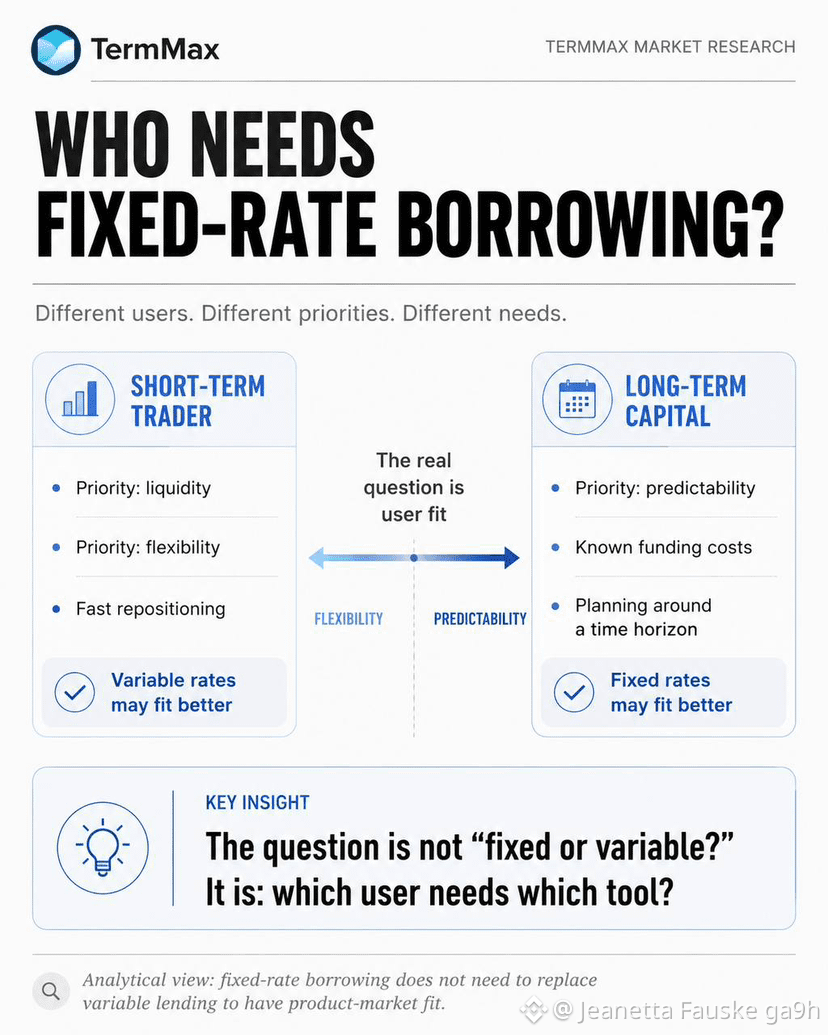
The interesting question isn’t whether fixed rates sound better. It’s who is willing to pay for predictability.
A short-term trader may prefer variable rates because flexibility matters more.
But a treasury, yield strategy, or long-term investor working with a known time horizon may value something else: knowing the cost of capital before entering the position.
That is where @TermMax becomes interesting.
Fixed-rate borrowing does not need to replace variable lending to find product-market fit. It only needs to solve a real problem for the right users.
For #TermMax and $TMX, the metric I’d watch is simple:
Do users try fixed-rate borrowing once, or do they come back because predictability is actually useful?
The interesting question isn’t whether fixed rates sound better. It’s who is willing to pay for predictability.
A short-term trader may prefer variable rates because flexibility matters more.
But a treasury, yield strategy, or long-term investor working with a known time horizon may value something else: knowing the cost of capital before entering the position.
That is where @TermMax becomes interesting.
Fixed-rate borrowing does not need to replace variable lending to find product-market fit. It only needs to solve a real problem for the right users.
For #TermMax and $TMX, the metric I’d watch is simple:
Do users try fixed-rate borrowing once, or do they come back because predictability is actually useful?