
Introduction
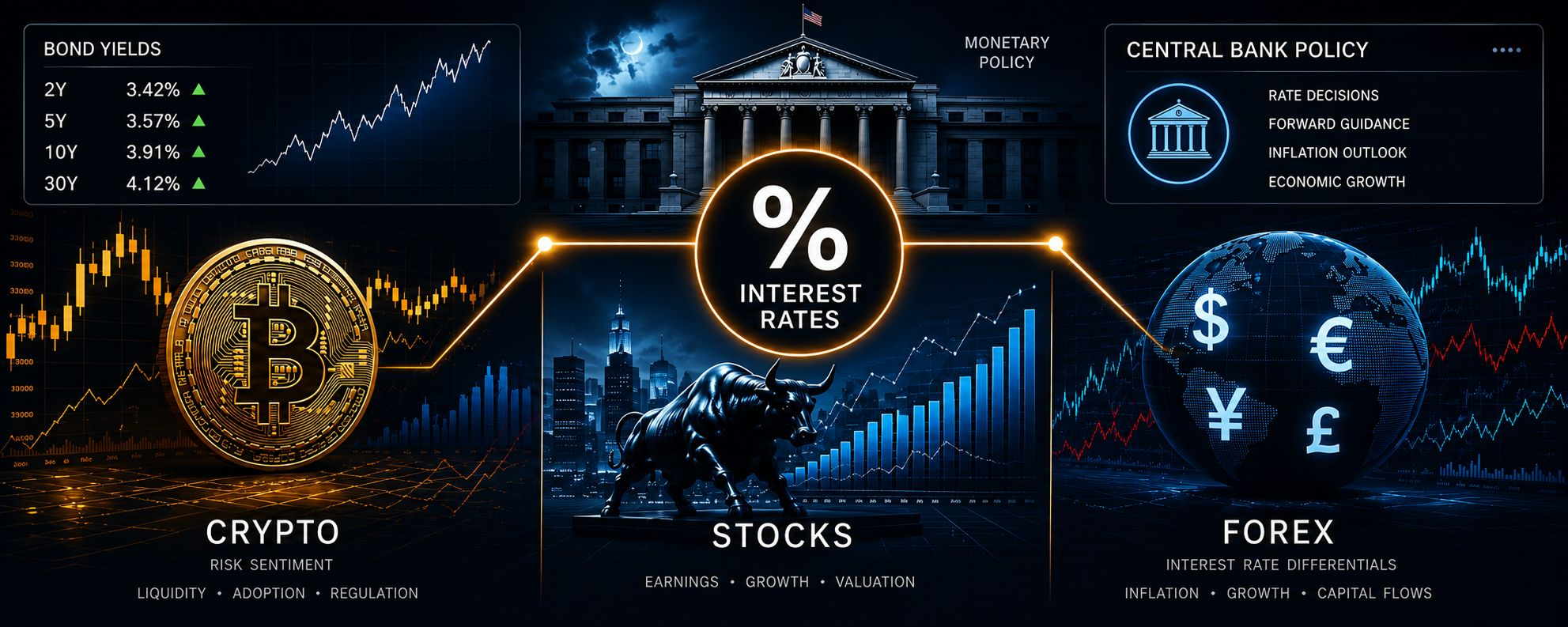
Why can a central bank decision affect Bitcoin, stock markets, and currency prices within the same period?
The answer often comes back to one powerful factor: interest rates.
Interest rates influence the cost of borrowing, the return investors can seek from relatively lower-risk assets, consumer spending, business investment, and the value of currencies. Because financial markets are connected, a change in monetary policy can affect crypto, stocks, and forex through different channels.
Understanding this relationship can help beginners look beyond individual price movements and understand the broader forces behind them.
What Are Interest Rates?
In simple terms, an interest rate is the cost of borrowing money or the return earned for lending or saving it.
Central banks use policy interest rates as one of their main monetary-policy tools. When inflation is a concern, a central bank may raise rates to make borrowing more expensive and reduce economic demand. When economic activity needs support, it may lower rates to make borrowing relatively cheaper.
These decisions can influence financial markets because they change the flow and cost of money throughout the economy.
How Does It Work?
A simplified chain looks like this:
Central bank decision → borrowing costs → economic activity → investor expectations → asset prices
For example:
A central bank raises its policy rate.
Borrowing generally becomes more expensive.
Consumers and businesses may become more cautious about spending and investment.
Returns available from interest-bearing assets can become more attractive relative to some riskier investments.
Investors reassess valuations and risk.
Stocks, currencies and crypto assets can respond.
The important point is that this is not an automatic one-directional reaction. Markets respond to expectations, economic data and future policy assumptions, not just to the rate decision itself.
Key Concepts You Need to Understand
1. Hawkish vs. Dovish Policy
A hawkish monetary-policy stance generally means a central bank is more focused on controlling inflation and may favor tighter financial conditions.
A dovish stance generally indicates greater willingness to support economic activity through easier monetary conditions.
These terms describe policy direction and expectations, not guaranteed market outcomes.
2. Inflation
Inflation is one of the major factors behind interest-rate decisions.
If inflation remains elevated, markets may expect tighter monetary policy. If inflation shows signs of cooling, expectations for future policy can change.
That is why inflation reports can sometimes move financial markets even before a central bank meeting.
3. Real Interest Rates
The relationship between interest rates and inflation also matters.
A simplified concept is:
Real interest rate ≈ nominal interest rate − inflation
This helps explain why a high interest rate does not automatically mean investors are receiving a high inflation-adjusted return.
4. Market Expectations
Markets often move before an official interest-rate decision.
Why?
Because investors constantly form expectations about what central banks may do next.
If a decision is already widely expected, the actual announcement may cause a relatively limited reaction. If the decision differs significantly from expectations, volatility can be much greater.
How Interest Rates Affect Stocks
Higher interest rates can affect stocks through several channels.
Borrowing costs
Companies may face higher financing costs when interest rates rise. This can affect expansion plans, debt servicing and investment decisions.
Consumer spending
Higher borrowing costs can also influence consumers. If households spend less, businesses in some sectors may experience weaker demand.
Valuation
Interest rates can influence how investors value future corporate earnings. When market interest rates rise, future cash flows may become less attractive in valuation models.
However, not every stock reacts in the same way.
A company with strong cash flow, low debt and stable demand may respond differently from a highly leveraged company whose growth depends heavily on inexpensive financing.
How Interest Rates Affect Forex
Forex is particularly sensitive to interest-rate expectations because currencies are traded relative to one another.
Suppose traders expect one country's central bank to maintain relatively higher interest rates than another country's central bank.
That difference can influence demand for the respective currencies.
This is known as an interest-rate differential.
But currencies are influenced by much more than interest rates. Inflation, economic growth, employment, political developments, trade conditions and market sentiment can all matter.
So, a higher interest rate does not automatically mean a currency will rise.
How Interest Rates Affect Crypto
Crypto markets can also respond to changes in monetary conditions and investor risk appetite.
When financial conditions become tighter, some investors may become more cautious about assets considered higher risk or more volatile. Crypto can therefore experience increased sensitivity to changes in liquidity, interest-rate expectations and broader market sentiment.
When financial conditions become easier, risk appetite can change as well.
But this relationship is not a simple formula.
Crypto prices are also influenced by factors such as:
Network activity
Regulation
Market liquidity
Institutional participation
Token-specific developments
Investor sentiment
Leverage and derivatives activity
Therefore, interest rates are one factor among many, not a standalone explanation for crypto price movements.
A Simple Practical Example
Imagine investors begin expecting a major central bank to keep interest rates higher for longer than previously expected.
That expectation could create several effects:
Stocks:
Investors may reassess company valuations and borrowing conditions.
Forex:
The expected difference between interest rates in two economies may influence currency demand.
Crypto:
Some investors may reduce exposure to higher-risk assets as financial conditions and risk appetite change.
Now consider the opposite situation.
If economic data leads markets to expect lower rates in the future, investors may reassess these same markets again.
Notice that the important factor is not simply "rates went up" or "rates went down."
The bigger question is:
What changed in expectations, and how was that change already priced into the market?
Important Factors to Watch
When studying the relationship between rates and markets, consider:
Central bank decisions
Look at the policy rate and the central bank's broader guidance.
Inflation data
Inflation can influence expectations for future monetary policy.
Employment data
Employment and wage conditions can affect how policymakers assess economic strength and inflation pressure.
Economic growth
A slowing economy can change expectations about future interest rates.
Bond yields
Government bond yields provide useful information about market expectations for interest rates and economic conditions.
Currency strength
Changes in major currencies can influence international financial conditions and commodity markets.
Market expectations
Compare what investors expected with what actually happened.
Liquidity and risk sentiment
Markets can behave differently depending on whether investors are seeking safety or taking on more risk.
Benefits and Use Cases
Understanding interest rates can help investors and students:
Connect macroeconomic news with financial markets.
Understand why different asset classes can move together.
Interpret central-bank announcements more carefully.
Understand the relationship between currencies and interest-rate differentials.
Analyze stock valuations at a broader level.
Put crypto market movements into a wider financial context.
Avoid viewing every price movement as an isolated event.
The goal is not to predict every market move. It is to develop a better framework for understanding why markets may react.
Risks and Limitations
Interest rates do not control financial markets by themselves.
Markets can move in unexpected directions because several factors interact at the same time.
For example, a rate cut could be interpreted positively because borrowing becomes cheaper, but negatively if investors believe the cut signals serious economic weakness.
Similarly, an expected rate hike may produce a smaller reaction than an unexpected policy change.
There is also a timing problem. The economy does not respond instantly to monetary policy, and financial markets often anticipate future developments months in advance.
This is why interest-rate analysis should be treated as a framework for understanding markets, not as a reliable method for predicting individual price movements.
Common Beginner Mistakes
1. Assuming rate cuts always make markets rise
The economic reason behind a rate cut matters.
2. Looking only at the headline rate
Forward guidance and market expectations can be just as important.
3. Ignoring inflation
Nominal rates do not tell the entire story.
4. Treating crypto like a direct interest-rate trade
Crypto has its own market-specific drivers.
5. Assuming higher rates automatically strengthen a currency
Forex is based on relative conditions between economies.
6. Confusing correlation with causation
Two markets moving together does not prove that one directly caused the other.
7. Ignoring what was already priced in
Markets react to surprises, not simply to news that everyone already expected.
What to Check and Research
Before drawing conclusions about how monetary policy may affect markets, independently check:
The latest central-bank policy statement.
Recent inflation data.
Employment and economic-growth data.
Government bond yields.
Market expectations for future policy.
Currency movements and interest-rate differentials.
Broader risk sentiment.
Relevant crypto-specific developments.
Company earnings and fundamentals when studying stocks.
For current figures or events, use primary or reliable market sources and verify them before publishing.
Key Takeaway
Interest rates are one of the important connections between stocks, forex and crypto.
Higher or lower rates can influence borrowing costs, economic activity, currency demand, valuations and investor risk appetite. But the relationship is not mechanical.
The most useful question is not simply "Will rates rise or fall?"
It is:
"What does the market expect, what actually happened, and how could that change financial conditions?"
Understanding that difference can make market analysis much more thoughtful and less reactive.
Relevant Hashtags
#InterestRates
#MacroEconomics
#CryptoEducation
#StockMarketEducation
#ForexEducation
Educational Disclaimer
Educational content only. This is not financial advice. Always conduct your own research and consider your risk tolerance before making financial decisions.