
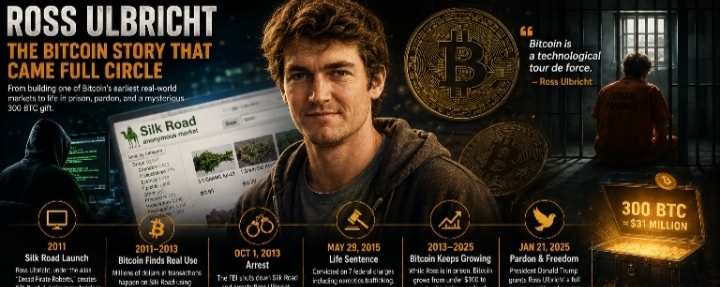

He built one of Bitcoin’s earliest major real-world markets. He was sentenced to life in prison. Eleven years later, he walked free and 300 BTC suddenly appeared in his wallet. But the real story is more complicated than the viral version.
Back when Bitcoin was still worth only a few dollars, most people had never heard of it.
Then Ross Ulbricht, operating under the name “Dread Pirate Roberts,” created Silk Road in 2011.
Silk Road was a darknet marketplace where people could buy and sell goods using Bitcoin. The problem was that much of what was being sold was illegal, particularly drugs and other unlawful goods and services. The U.S. Department of Justice eventually described it as a major criminal marketplace.
But something important happened through Silk Road.
Bitcoin was no longer just an idea on a computer. It was being used to move real economic value.
People were buying. Sellers were accepting Bitcoin. Transactions were taking place without traditional banks or payment processors.
That doesn't make Silk Road legitimate it wasn't.
But from a technological perspective, it demonstrated something Bitcoin supporters had been arguing about for years: a decentralized digital currency could actually be used as a medium of exchange.
And that's where the story becomes complicated.
Ross wasn't imprisoned simply for “using Bitcoin”
Ulbricht was arrested in October 2013 after authorities shut down Silk Road.
In 2015, he was convicted on seven federal charges connected to operating the marketplace, including narcotics distribution, money laundering, computer hacking and trafficking in fraudulent identity documents.
He was sentenced to two life sentences plus additional prison terms, without parole.
So the popular description that he was simply “sent to prison for building Bitcoin's first use case” isn't accurate.
He was convicted for operating an illegal marketplace.
Still, his supporters argued that the punishment was excessively harsh, and the case became a major symbol for libertarians, privacy advocates and parts of the cryptocurrency community.
Then Bitcoin kept growing
While Ulbricht was behind bars, Bitcoin went from a relatively obscure experiment into a global financial asset, the technology continued developing.
The ecosystem expanded and the value of Bitcoin rose dramatically.
Ulbricht's story became one of those strange reminders of how quickly technology can move while an individual person's life remains frozen in time.
Then came January 21, 2025.
President Donald Trump granted Ulbricht a full and unconditional pardon, ending the prison sentence he had been serving since his 2013 arrest.
After more than a decade behind bars, Ross Ulbricht was free,But the story wasn't finished.
The mysterious 300 BTC
In May 2025, approximately 300 BTC worth around $31 million at the time was sent to a Bitcoin address associated with Ulbricht.
At first glance, it looked almost too perfect.
The man who helped bring Bitcoin into one of its earliest major real-world markets had spent more than a decade in prison.
Then, after his release, someone sent him millions of dollars in Bitcoin, It sounded like the Bitcoin community saying:
“We haven't forgotten you.”
But here's where we need to separate fact from a great story.
We do not know who sent the Bitcoin or why.
Blockchain analytics firm Chainalysis reportedly traced the funds and suggested they may have originated from wallets connected to the former darknet marketplace AlphaBay.
So saying that “the Bitcoin community donated 300 BTC to Ross” is not something we can confirm.
The transaction is real.
The 300 BTC is real.
The roughly $31 million valuation at the time is real.
The identity and motivation of the sender remain the mystery.
And that's what makes this story fascinating
Ross Ulbricht's story isn't simply a story about a hero or a villain, It's a story about technology, freedom, crime, punishment, privacy and the unintended consequences of innovation.
Silk Road was illegal.
But it also became one of the earliest large-scale examples of Bitcoin being used as an actual medium of exchange.
Ulbricht went to prison while Bitcoin continued evolving outside his cell.
More than a decade later, he walked free into a world where Bitcoin had become something almost unrecognizable compared with the tiny cryptocurrency he knew in 2011, andthen 300 BTC arrived.
Whether it was a thank-you, a personal gesture, or something connected to the old darknet ecosystem, we may never know for certain.
But there is something undeniably poetic about it.
A man who helped demonstrate Bitcoin's ability to move value without a traditional financial intermediary eventually received a life-changing amount of value through that same technology.
Bitcoin didn't stay where Ross left it.
It kept moving, and so did his story.
