I have become increasingly skeptical of blockchain projects that describe privacy as if it were simply another feature to add to a network. The word sounds powerful, but the real question is much harder: privacy from whom, and for what reason?
Public blockchains were built around an almost radical idea that financial activity should be visible and independently verifiable. That solved one problem surprisingly well. We no longer have to blindly trust a central database to tell us what happened. But the same transparency creates an uncomfortable weakness when blockchain technology moves closer to serious finance.
Not every financial decision should be visible to the entire world.
A business may need to prove that it owns an asset without revealing its entire balance sheet. An investor may need to satisfy a regulatory requirement without publishing every detail of their financial history. A market participant may want to execute a strategy without announcing their intentions before the transaction even happens.
This is where Dusk Network caught my attention.
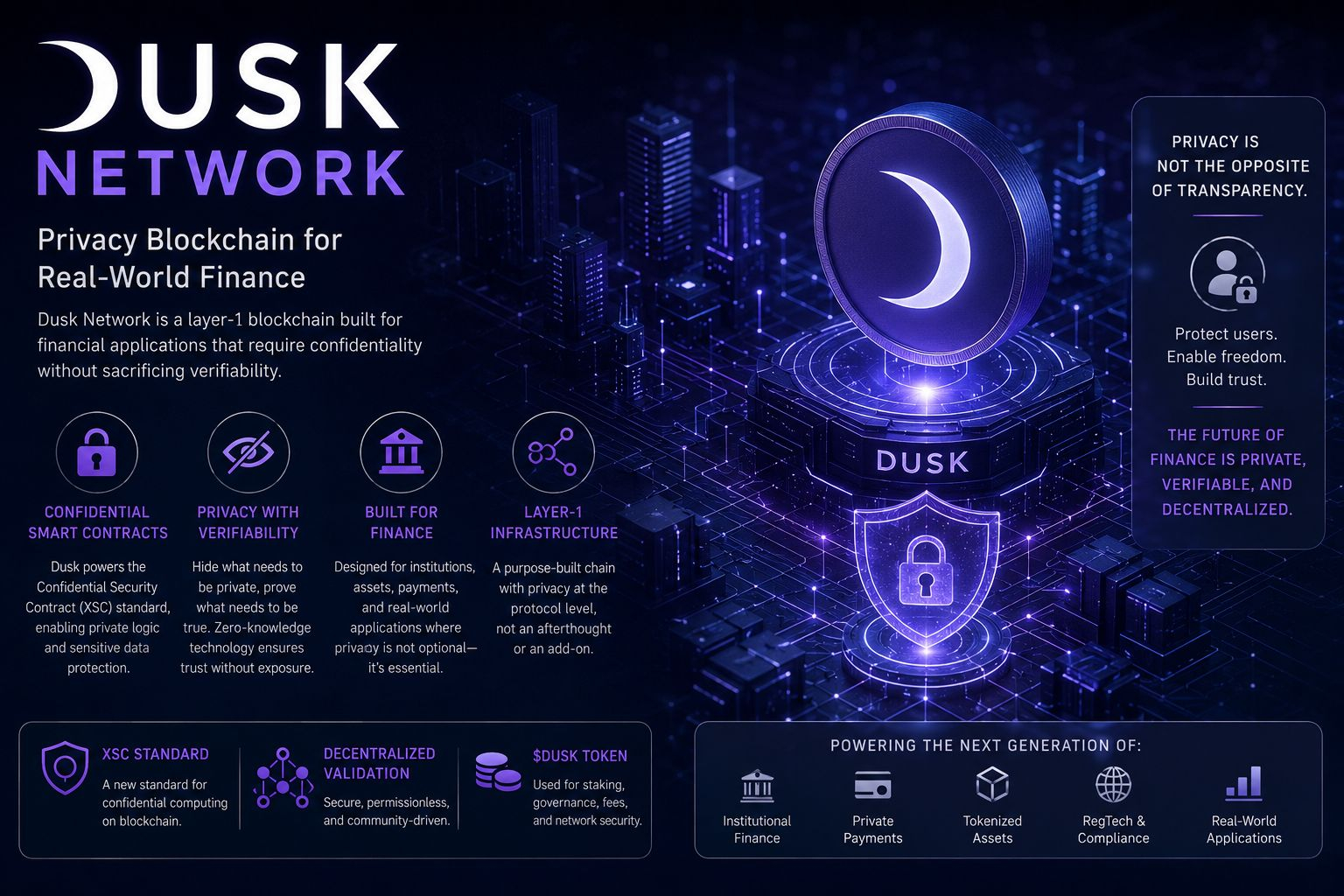
At first, I looked at it as another layer-1 trying to find a place in an already crowded industry. But the more interesting part is not the fact that it is another blockchain. It is the problem it is choosing to wrestle with: how can financial applications remain verifiable while keeping sensitive information confidential?
Dusk approaches this through an architecture designed around privacy, including its Confidential Security Contract, or XSC, standard. The idea is deeper than simply hiding transactions. It is about making confidentiality part of how smart contracts operate.
That distinction matters.
Traditional blockchains often treat transparency as the default. Anyone can inspect activity, follow addresses, study balances, and sometimes infer what users are planning to do next. Transparency creates trust, but it can also create information asymmetry. Knowing what everyone else is doing is not always a neutral advantage. In financial markets, information itself is part of the game.
Dusk is therefore exploring a different balance. Instead of asking users to choose between complete transparency and complete secrecy, the architecture points toward a world where certain facts can remain private while the necessary outcomes can still be verified.
That sounds simple until you think about what it actually means.
Privacy without accountability can become dangerous. If everything is hidden, how does anyone know that the system is behaving honestly? Financial infrastructure cannot simply say, “Trust us, the information is private.” That would recreate the very dependency blockchain was supposed to reduce.
The interesting challenge is creating privacy without creating blind trust.
This is where cryptography becomes more than a technical tool. It becomes a way of negotiating social relationships. A user should not necessarily have to reveal everything just to prove one specific fact. In an ideal system, you reveal what is necessary and nothing more.
That idea has consequences far beyond transactions.
It changes how we think about ownership. It changes how we think about compliance. It changes how we think about identity. It even changes what transparency means.
For years, transparency in crypto has almost been treated as a moral principle. If something is on-chain, everyone can see it, therefore everyone can verify it. But perhaps that was partly a limitation of early infrastructure rather than the final destination.
Real financial systems have always operated with layers of information. Regulators see certain things. Institutions see others. Customers have access to their own records. Competitors see very little. Privacy is not necessarily the enemy of accountability. Sometimes privacy is what makes participation possible in the first place.
Dusk seems to be building around that uncomfortable reality.
Of course, the architecture alone does not solve the economic problem. A blockchain needs participants who are willing to secure it, developers who are willing to build on it, users who actually need its capabilities, and an economic system that does not depend entirely on speculation.
This is where I remain cautious.
A technically sophisticated network can still struggle if the real demand for its infrastructure does not develop. Privacy may be important, but importance does not automatically create adoption. Financial institutions also move slowly, partly because security, regulation, interoperability, and operational reliability matter more to them than interesting technology.
There is another issue that is easy to overlook: governance.
The more private a system becomes, the more carefully its rules have to be designed. Someone still has to determine how upgrades happen, how disputes are handled, what information can be disclosed under specific circumstances, and how the network reacts when different jurisdictions impose different requirements.
Privacy does not eliminate governance.
In some ways, it makes governance more important.
There is also an irony here. Decentralization is often presented as a reduction of authority, but sophisticated financial infrastructure may require new forms of coordination. The challenge is not simply removing institutions. It is deciding which responsibilities should be automated by code, which should remain subject to human judgment, and which should be shared among participants.
That is a much messier problem than the usual blockchain narrative suggests.
And perhaps that is why I find Dusk more interesting when viewed without the usual price-driven lens.
The real experiment is not whether another token can outperform another token. It is whether blockchain infrastructure can mature beyond the assumption that every piece of information must either be completely public or completely controlled by an institution.
There may be a middle ground.
A world where ownership can be verified without exposing unnecessary personal information. A world where financial contracts can enforce rules without revealing every private detail. A world where compliance does not automatically mean surrendering an entire history of economic activity.
Whether Dusk ultimately reaches that vision is a separate question. There are too many variables between a good architecture and meaningful adoption to pretend otherwise.
But I think the question itself deserves attention.
The next stage of blockchain development may not be about making everything more transparent. It may be about becoming more precise about what transparency is actually for.
If decentralization is ultimately about giving people greater control over their digital lives, then privacy is not a side issue. It is part of the definition of ownership itself.
And that leaves me with a more interesting thought than any short-term prediction: perhaps the mature blockchain is not the one where everyone can see everything, but the one where people can prove what matters without being forced to reveal what does not.