
With the ever-changing paradigm in the development of block chain technology, the balance between trust and speed has appeared to be a double-edged sword. While some block chains have compromised too far in the direction of trust, others in the direction of speed. Vanar Chain, by using the $VANRY token, is in the process of developing an answer to the questioned duality.
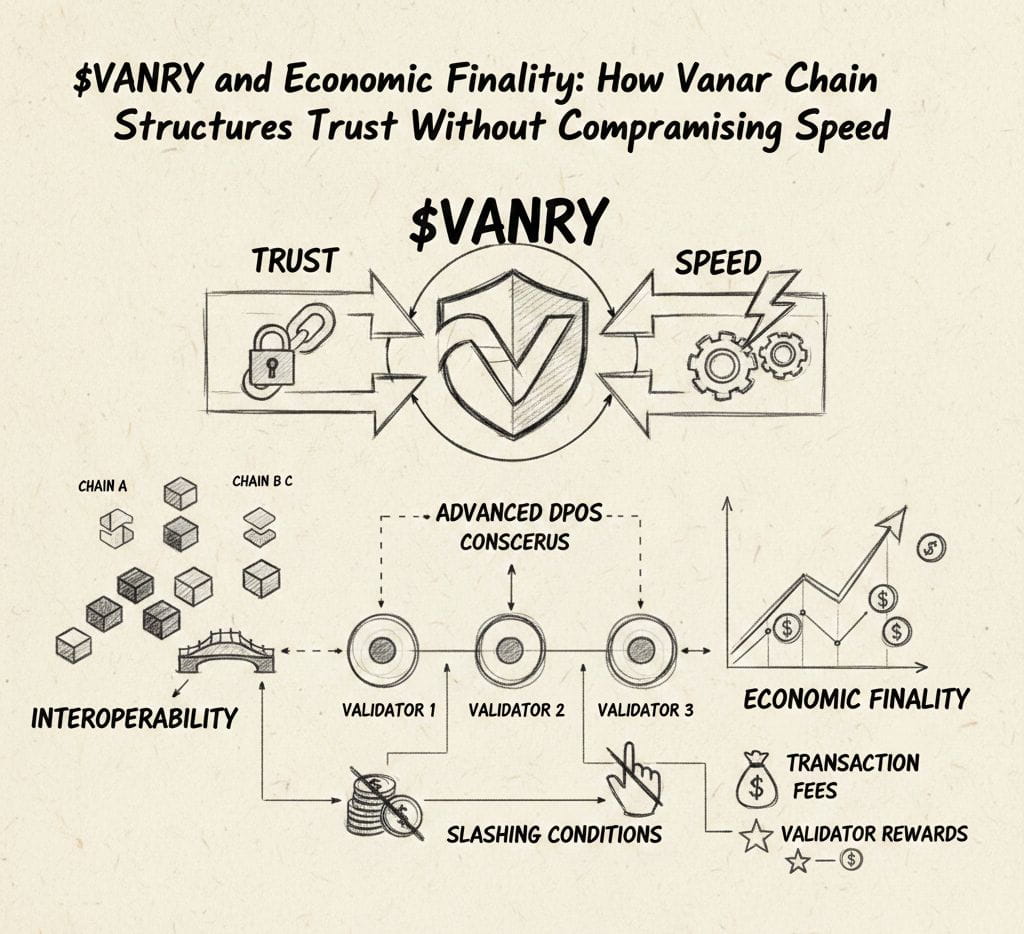
But what underlies Vanar's model is a thoughtfully designed architecture, with a particular dependency on a wide range of creative and impactful consensus models and transaction processing efficiency. The crux of any blockchain system has to do with how you guarantee that if a particular piece of a blockchain has reached a certain level of confirmation, there's no way to go back and alter that piece. This notion of "economic finality" has long bedeviled proof-of-work, in particular, with a need to confirm multiple blocks before a particular piece of a blockchain has a chance to "set." Meanwhile, in proof-of-stake systems, issues sometimes emerge around centralization and potential "collusion."
Vanar has addressed this by using an advanced delegated proof-of-stake (DPoS). Additionally, the system has introduced specific features that aim to provide utmost security and decentralization within the system. In the DPoS system, for example, participants vote for certain validators in the system that can create block verification entries. This leads to the consensus of very few participants, resulting in speedy transaction levels within the system. In the case of the Vanar system, the validators operate under stern slashing conditions that are geared towards securing the system since the validators can lose their own invested amount in case they misbehave.
Also, a powerful feature of the #Vanar platform is a framework for communication and interoperability between different chains. In the current global digital world that is highly connected or integrated with itself technologically, no blockchain is seen as an isolated chain. As such, the Vanar platform is quite useful in the current world in the sense that it is able to interact well with other chains. The need for the ecosystem is the key to the finality of the involved economies.
Furthermore, the position held by VANRY token in the network cannot be overstated. As the native utility token for the network, the primary uses for the coin are in network transaction fees. It is from such a position that the economic motivation for network utilization to secure the network by network participants becomes a major strength. Validators lock-up their native coin to secure the network. They also get rewarded in kind. Similarly, network participant fees also cater to the native coin. Thus, the more the network remains efficient and secure, the more the native coin generates wealth.
The attention to detail employed in @Vanarchain design, in striking a delicate balance between timely transactional processing and unfaltering trust, suggests that this project is a force to potentially reckon with in this industry. With its intelligent design of consensus, incentivized honesty through VANRY, and adoption of interoprability, Vanar is proving that economic finality and speed don't necessarily go at odds; rather, a new standard of decentralized applications that scale while preserving core tenets of security and trust seems well in view.
