
I keep coming back to a fairly practical question:
If Bitcoin is going to become productive capital, how much of the underlying financial activity are institutions actually comfortable making visible?
It sounds like a technical question, but I don't think it is.
A bank, asset manager, or regulated financial institution doesn't necessarily object to using public blockchains because it dislikes transparency. In many cases, transparency is useful. Regulators need auditability. Institutions need records. Counterparties need to know that transactions happened.
The problem starts when transparency becomes exposure.
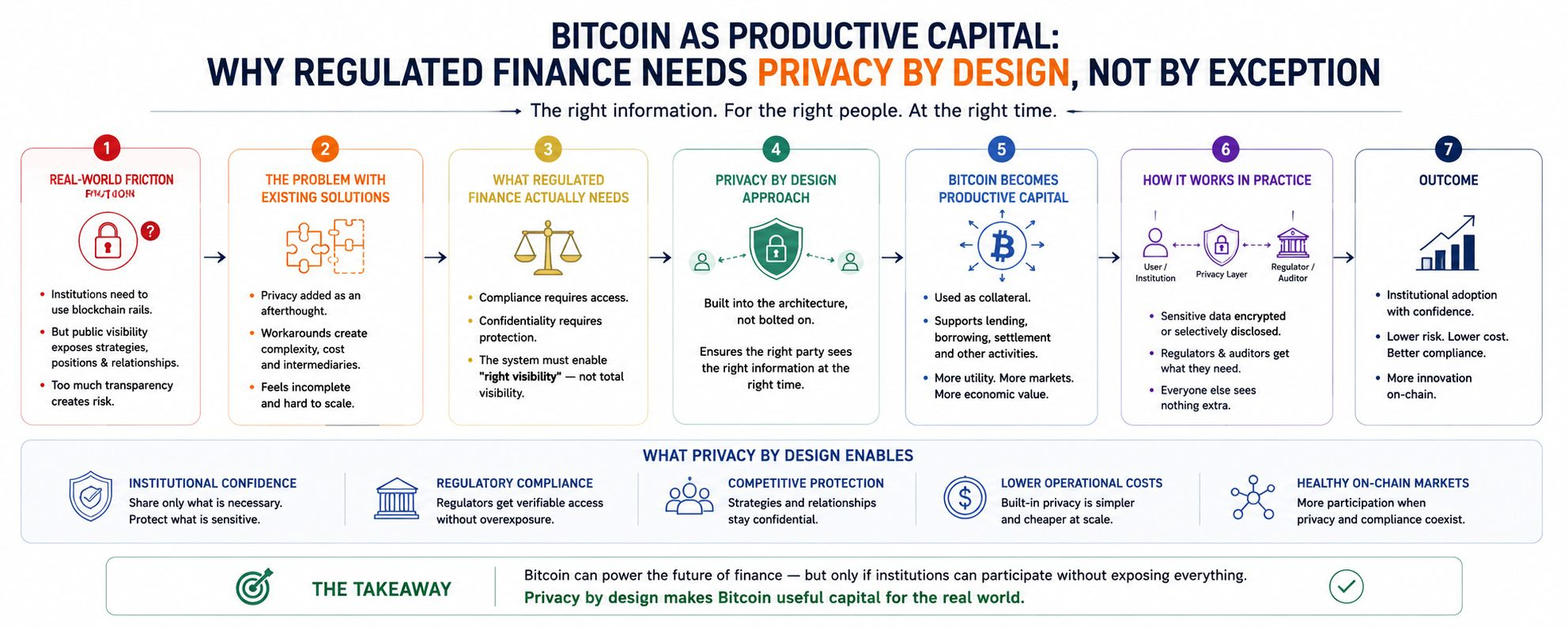
A company may need to prove that a transaction is legitimate without revealing its entire financial history. An institution may need to demonstrate that collateral exists without showing every position it holds. A regulated lender may need compliance information without broadcasting its counterparties, balances, trading strategy, and settlement activity to anyone capable of reading a blockchain.
That distinction matters.
For years, the crypto industry has treated privacy almost like a separate feature. Something you add when users specifically ask for it.
I suspect that approach is backwards.
For regulated finance, privacy probably needs to be part of the architecture from the beginning.
Not because institutions want to hide things.
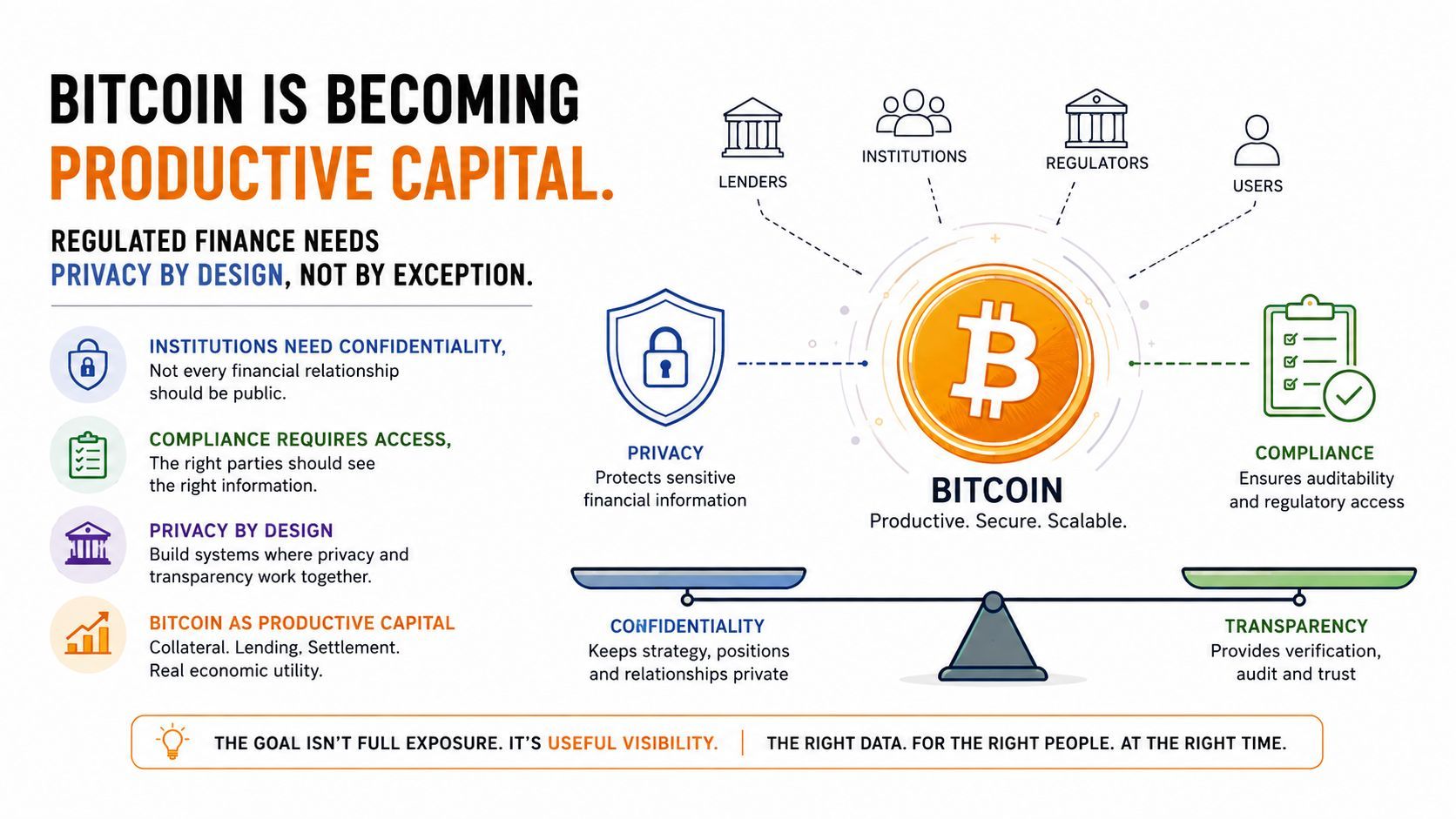
Because compliance and confidentiality are different requirements.
And public blockchains are unusually good at satisfying the first while sometimes making the second uncomfortable.
The awkward part about putting everything on-chain
The original appeal of blockchain settlement was straightforward.
Put transactions on a shared ledger. Let everyone verify the state. Remove unnecessary intermediaries. Make settlement easier to audit.
In theory, this is elegant.
In practice, financial institutions don't operate with the assumption that everyone should be able to inspect their economic relationships.
Imagine an institution using Bitcoin as collateral.
The institution might want the economic benefits of that Bitcoin without giving the market a permanent window into its balance sheet.
If the collateral movement, borrowing activity, repayment history, counterparties, and associated addresses are all publicly observable, the institution has gained a new settlement mechanism while potentially losing something it considers equally important: financial confidentiality.
That creates an uncomfortable choice.
Either accept the visibility, which many institutions won't.
Or build complicated layers around the public infrastructure to reduce what becomes visible.
That is where things often become messy.
Privacy is added through another intermediary, another permissioning layer, another database, another trusted party, or some temporary workaround.
The result can technically function.
But it starts defeating the reason people were interested in the underlying infrastructure in the first place.
Regulation makes this harder, not easier
There is a tendency to frame regulation as the thing preventing crypto adoption.
I'm not convinced that's the whole story.
Regulated finance has legitimate reasons for wanting both transparency and privacy.
A regulator might need access to transaction information.
An institution might need to prove that a customer passed a particular compliance check.
A lender might need assurance that collateral hasn't already been pledged elsewhere.
But none of those requirements necessarily imply that every piece of information should be permanently public.
This is where I think the phrase “privacy by design” becomes important.
Privacy by design doesn't mean hiding transactions from regulators.
It means designing the system so that the right party can see the right information at the right time, rather than assuming that the only alternatives are complete secrecy or complete public disclosure.
That sounds obvious when written down.
It is considerably harder to implement.
Bitcoin makes the question more interesting
Bitcoin is increasingly being discussed not only as an asset to hold, but as capital that can potentially support other financial activity.
That changes the conversation.
If Bitcoin becomes collateral for loans, a source of economic security, or part of institutional financial infrastructure, then its value isn't limited to simply sitting on a balance sheet.
Capital can become productive.
But productive capital creates relationships.
There is a borrower.
There is a lender.
There are risk parameters.
There are repayment conditions.
There may be liquidation rules.
There may be regulatory obligations.
And suddenly the simple act of moving Bitcoin becomes part of a much larger financial process.
That's where privacy becomes less of a philosophical issue and more of an operational requirement.
An institution doesn't necessarily want to announce every time it borrows against its Bitcoin.
A market maker doesn't want competitors reconstructing its strategy from transaction flows.
A corporate treasury doesn't want its liquidity position becoming obvious simply because it uses a public settlement network.
A regulator, meanwhile, still needs enough information to determine whether the activity is legitimate.
Those interests aren't inherently contradictory.
But the infrastructure has to acknowledge both.
The expensive solution is usually the workaround
This is another thing I have become more skeptical about.
In financial infrastructure, people often underestimate the cost of workarounds.
A system can technically support something while still being economically unpleasant to use.
If privacy requires additional custodians, manual verification, off-chain reconciliation, duplicated records, specialized legal agreements, or complicated transaction routing, the institution may eventually ask a simple question:
Why are we using this instead of the system we already have?
That question kills more infrastructure projects than technical failure.
The blockchain can be faster.
The settlement can be more transparent.
The collateral can be programmable.
None of that matters if the compliance department cannot explain the transaction, the legal team cannot establish who controls the asset, or the operations team needs five people to reconcile something that previously took one.
Real adoption is usually much less glamorous than the technology suggests.
People use infrastructure when it reduces friction without creating a different category of risk.
Privacy also changes human behavior
There is another part that doesn't get discussed enough.
People behave differently when they know everything is observable.
That is true for individuals, companies, and institutions.
If every financial action becomes permanently traceable, organizations may become more conservative about experimentation.
They may avoid certain markets.
They may avoid certain counterparties.
They may keep activity off-chain simply because the reputational and competitive cost of visibility is too high.
That creates a strange outcome.
A system designed to make finance more transparent can push serious financial activity back into less transparent systems.
So the goal shouldn't be maximum visibility.
It should be useful visibility.
That distinction is probably one of the most important design questions for institutional blockchain infrastructure.
What I would actually look for
I wouldn't judge a privacy-focused financial system by how impressive its cryptography sounds.
I'd ask much more boring questions.
Can a regulated institution prove what a regulator needs to know?
Can a counterparty verify the information necessary to take risk?
Can auditors reconstruct the relevant history?
Can the system prevent unauthorized disclosure?
Can compliance rules operate without turning every transaction into a manual investigation?
And perhaps most importantly:
Does the privacy mechanism reduce operational complexity, or simply move it somewhere else?
Because if privacy is achieved by introducing another trusted intermediary, we've only changed the location of the trust problem.
That doesn't make the solution useless.
It just means the trade-off should be acknowledged honestly.
Where Bitcoin fits
This is why I find the idea of Bitcoin becoming productive capital more interesting than another argument about Bitcoin's price.
The question isn't only whether Bitcoin appreciates.
The more consequential question may be whether Bitcoin can participate in financial markets without forcing institutions to abandon the confidentiality, compliance processes, and legal controls they already depend on.
If that happens, Bitcoin starts looking less like an isolated asset and more like a component of financial infrastructure.
But I wouldn't assume that transition is inevitable.
The systems that win will probably be the ones that understand an uncomfortable reality:
Institutions don't want less compliance. They want compliance that doesn't require exposing everything.
And users don't necessarily want absolute privacy either. They want control over who gets to know what.
That is a much narrower—and probably much more useful—definition of privacy.
The likely users, then, aren't people looking for a completely invisible financial system.
They are institutions, businesses, lenders, asset managers, and eventually ordinary users who want blockchain settlement while retaining reasonable financial confidentiality.
It could work if privacy becomes part of the settlement architecture rather than an afterthought bolted onto it.
It could fail if the privacy layer becomes too complicated, too expensive, legally ambiguous, or dependent on another trusted intermediary.
For me, that's the real test.
Not whether someone can make Bitcoin private.
Whether Bitcoin can become productive capital without making every participant's financial life an open book.
#BIP110ForkSignalingExpectedThisWeekend

