
@PositiveMindsGlobalResults - @Binance Square Official
Think Positive Global
19:50 | 03 August 2026
Saudi Arabia has emerged as an increasingly active diplomatic player in efforts to ease tensions between the United States and Iran. Last week, Saudi Crown Prince Mohammed bin Salman reportedly held a telephone conversation with US President Donald Trump, urging restraint and emphasizing the importance of pursuing a ceasefire through diplomacy.
To reinforce this message, the Crown Prince dispatched Saudi Defense Minister Prince Khalid bin Salman to Washington, where he met with US Vice President JD Vance. Their discussions focused on reducing regional tensions, preventing further military escalation, and creating an opportunity for renewed diplomatic engagement. Reports indicate that Prince Khalid delivered proposals from the Saudi leadership aimed at encouraging dialogue and restoring stability. Following these diplomatic efforts, President Trump's public rhetoric appeared to soften, signaling a greater willingness to pause military action and leave room for negotiations.
Why Is Saudi Arabia Taking the Lead?
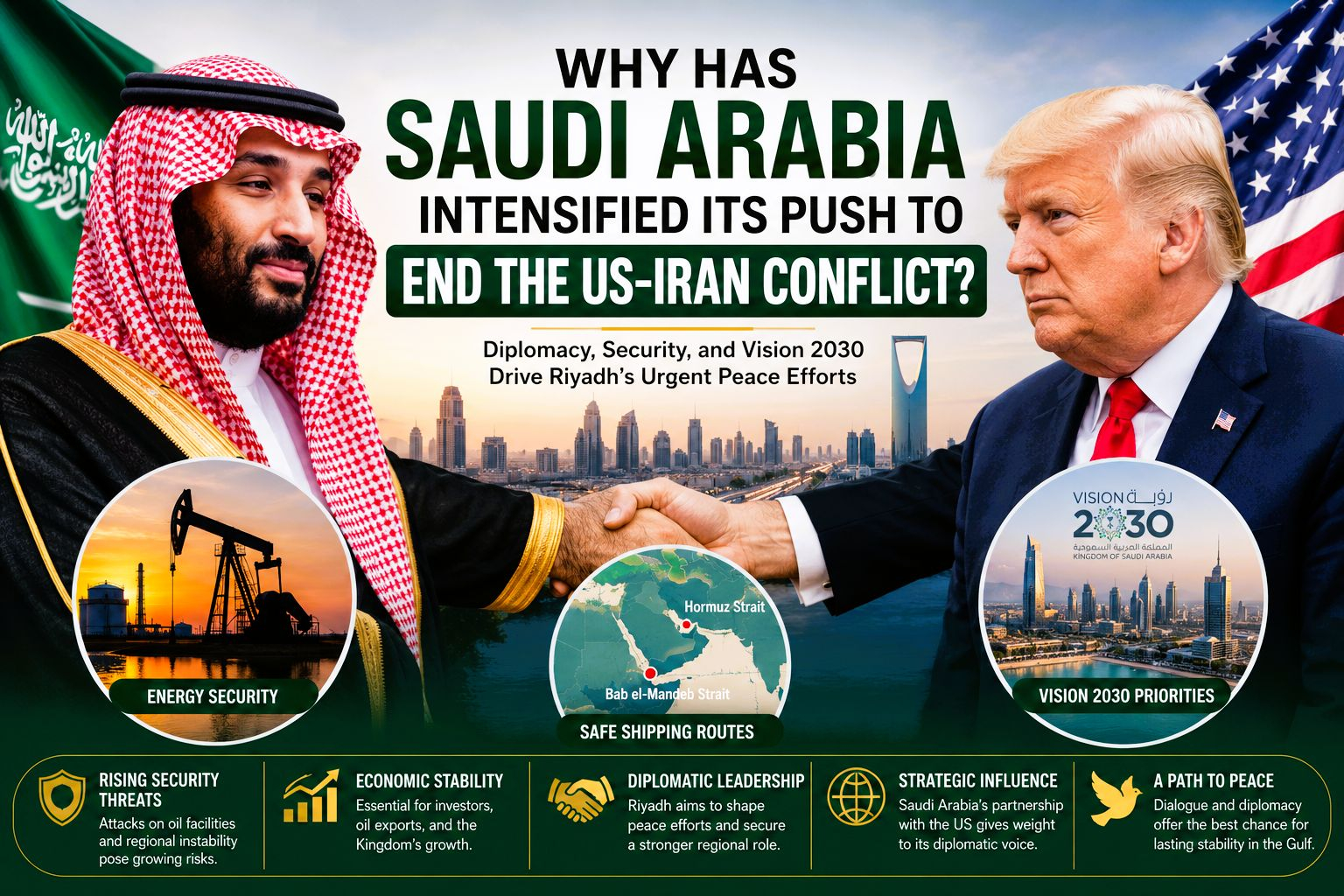
Several strategic and economic considerations explain why Saudi Arabia has become increasingly determined to prevent a broader US-Iran conflict.
The Kingdom is currently undertaking one of the most ambitious economic transformation programs in its history through Vision 2030, a long-term strategy designed to diversify the economy beyond oil. This initiative includes massive investments in infrastructure, tourism, technology, renewable energy, and futuristic developments such as NEOM.
The success of these projects depends heavily on regional stability, investor confidence, and uninterrupted energy exports. Any prolonged military confrontation in the Gulf threatens Saudi Arabia's economic outlook by increasing geopolitical risk, disrupting global energy markets, and discouraging foreign investment.
Protecting critical oil infrastructure—including refineries, processing facilities, export terminals, and shipping routes—has therefore become a national priority. Equally important is ensuring that maritime trade continues through key waterways such as the Strait of Hormuz and the Bab el-Mandeb Strait, both of which are essential corridors for global energy supplies.
Growing Regional Security Concerns
Saudi Arabia's security concerns have intensified as regional tensions have escalated.
Iran-backed armed groups across the region have periodically launched missile and drone attacks targeting energy infrastructure and military facilities. Yemen's Houthi movement has carried out repeated strikes against targets inside Saudi Arabia, while regional militia activity has increased uncertainty throughout the Gulf.
Although Saudi air defenses have intercepted many of these attacks, the persistent security threat continues to raise operational costs and create uncertainty for investors. Any disruption to shipping through the Strait of Hormuz or the Bab el-Mandeb Strait would have significant consequences for Saudi oil exports and the broader global economy.
For Saudi Arabia, the conflict is no longer viewed as a distant geopolitical dispute. Instead, it represents a direct challenge to national security, economic growth, and the successful implementation of Vision 2030.
Protecting Vision 2030
Regional stability is fundamental to the Kingdom's long-term development strategy.
Saudi Arabia has invested hundreds of billions of dollars in mega-projects intended to reshape its economy and position the country as a global center for business, tourism, innovation, and investment. Sustaining this transformation requires a predictable security environment that reassures both domestic and international investors.
Any escalation in military conflict could delay investment decisions, increase insurance and shipping costs, reduce economic activity, and undermine confidence in Saudi Arabia's long-term development plans.
These realities help explain why Crown Prince Mohammed bin Salman has devoted considerable diplomatic effort toward encouraging dialogue between Washington and Tehran. From Riyadh's perspective, preventing a wider regional conflict is not only a foreign policy objective but also an economic necessity.
Saudi Arabia's Influence in Washington
Saudi Arabia remains one of the United States' most important strategic partners in the Middle East. The relationship encompasses energy cooperation, regional security, counterterrorism, defense, and significant investment ties.
As one of the world's largest oil exporters and a leading economic power in the Arab world, Saudi Arabia possesses considerable diplomatic influence. While US foreign policy is ultimately determined by Washington's own national interests, Saudi perspectives often carry substantial weight due to the strategic partnership between the two countries.
For this reason, diplomatic initiatives originating from Riyadh typically receive close attention from American policymakers. Saudi Arabia's regional leadership and economic importance distinguish its role from many other Gulf states, giving its mediation efforts additional credibility.
Shaping the Gulf's Future
Should tensions between the United States and Iran eventually ease, the political and security landscape of the Gulf could undergo significant change.
Countries that contribute meaningfully to reducing hostilities and facilitating negotiations are likely to strengthen their diplomatic standing and regional influence. Saudi Arabia appears determined to position itself as one of the principal architects of any future security framework in the Gulf.
By promoting dialogue rather than escalation, Riyadh seeks to protect its national interests, preserve regional stability, strengthen investor confidence, and reinforce its position as a leading diplomatic power in the Middle East.
Whether these latest mediation efforts ultimately succeed remains uncertain. However, Saudi Arabia's growing diplomatic engagement reflects a clear strategic calculation: lasting regional stability is essential not only for Gulf security but also for the Kingdom's economic future and the successful realization of Vision 2030.
Disclaimer: This article is for informational and educational purposes only and does not constitute financial or investment advice. Always conduct your own research (DYOR) and assess your risk tolerance before making financial commitments in volatile global climates.
ThinkPositiveGlobal — Understanding Global Change, Markets, and the Future