
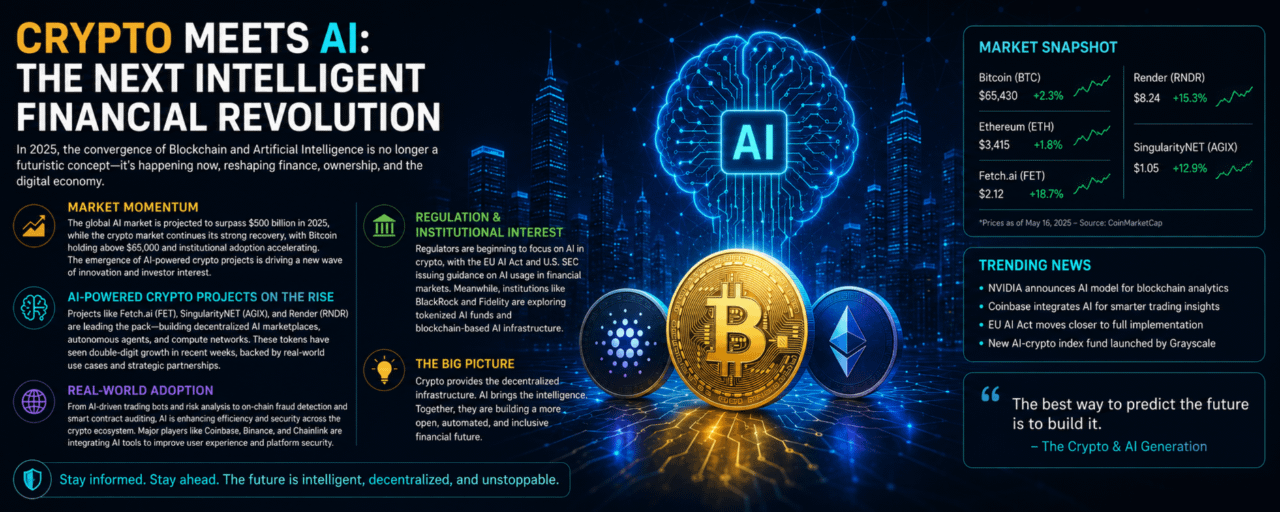
Cryptocurrency and artificial intelligence are no longer developing as separate technologies. In 2026, they are rapidly converging to create a new “machine economy” in which AI agents can hold digital wallets, purchase services, execute trades and settle payments without continuous human involvement.
One of the strongest drivers of this shift is the growth of autonomous AI agents. Unlike conventional chatbots, these agents can interpret objectives, select tools and perform transactions. Blockchain provides them with programmable payments, transparent records and smart contracts. Research published in 2026 describes blockchain as a potential foundation for agent-to-agent commerce, identity verification and auditable financial activity.
Early adoption is already visible. A 2026 industry report estimated that AI agents processed more than $73 million through approximately 176 million blockchain transactions between May 2025 and April 2026. Although the value remains relatively small, the high transaction count suggests demand for low-cost, automated micropayments.
Stablecoins may become the preferred currency of this emerging economy bec$ause they are faster and less volatile than most cryptocurrencies. Companies are exploring their use for cross-border settlements, corporate treasury operations and payments made automatically by AI software. Meanwhile, blockchain networks are being redesigned for higher speeds. BNB Chain, for example, announced development of a new network intended for high-frequency trading and autonomous AI agents, targeting more than 100,000 transactions per second.
The convergence also extends beyond payments. AI can analyse blockchain activity, detect fraud, manage decentralized-finance positions and support the tokenization of real-world assets. Crypto, in return, can provide verifiable ownership, decentralized computing markets and financial incentives for sharing data or processing power.
However, the risks are significant. AI-driven trading systems could amplify market volatility, make errors at machine speed or become targets for cyberattacks. Regulators are therefore examining safeguards such as spending limits, human approvals, emergency shutdown mechanisms and clear accountability when an autonomous agent causes financial loss. The Bank of England has warned that existing oversight systems may not be sufficient for increasingly autonomous financial AI.
The next phase of crypto may therefore be defined less by speculative tokens and more by invisible infrastructure. The biggest opportunity could emerge when blockchains become payment, identity and trust networks for billions of transactions conducted by intelligent software.


