
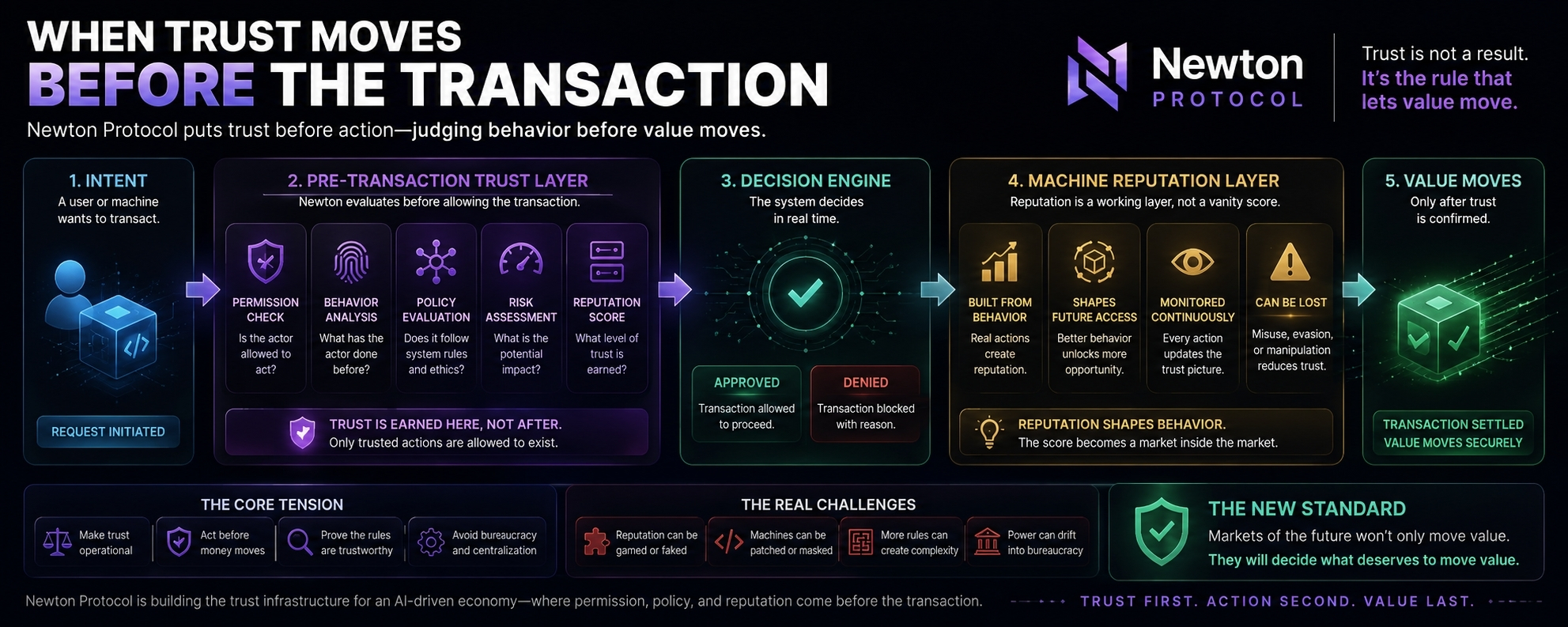

What keeps pulling me back to Newton Protocol is not the language around AI or automation. Those words are already everywhere, and most of the time they arrive before the actual problem does. What feels more important here is the quieter idea underneath it: the attempt to place trust before action, instead of explaining failure after the fact.
That sounds simple, but it is not. In most systems, trust is treated like a result. Something happens first, and only then do people decide whether the system was safe, honest, or broken.
Newton seems to push in the opposite direction. It tries to make permission part of the act itself. A transaction is not just sent; it is judged before it is allowed to exist.That shift matters because it changes what a market is built on.
Once a system begins checking behavior before settlement, it is no longer just moving value. It is deciding what kind of behavior deserves to move value at all. That is where reputation enters the picture. Not as a badge, and not as a vanity score, but as a working layer of judgment.
The difficult part is that reputation is never only descriptive. The moment it starts to matter, it starts to shape behavior. People do not just try to be reliable; they try to look reliable. Systems do not just record history; they begin to reward the appearance of history. That is how a reputation layer can become a market inside the market. The score stops being a mirror and starts becoming an object of competition.That is why machine reputation is such a serious idea inside Newton.
Machines do not build character the way people do. They can be patched, replaced, rerouted, or wrapped in a cleaner interface. So the question is not simply whether a model or agent has performed well before. The question is what exactly is being trusted: the code, the operator, the policy, or the behavior that emerges when all of those pieces are combined.
And even if the system gets that right, another problem appears. The more useful the policy layer becomes, the more power it accumulates. The more power it has, the more people will try to game it. The more it tries to explain itself, the more complexity it adds. At some point, the promise of protection can drift into bureaucracy.
That is the tension I keep seeing in Newton. It is trying to make trust operational without making it invisible. It wants rules that act before money moves, but it also has to prove that those rules are worth trusting in the first place. That is not a small design choice. It is the core problem.
Maybe that is why this project feels more real than most. It is not pretending trust can disappear. It is admitting that trust still has to be built, checked, and carried somewhere. The only question is whether Newton can make that burden clearer instead of hiding it behind a newer story.
$NEWT $US $DN @NewtonProtocol #Newt #newt
