
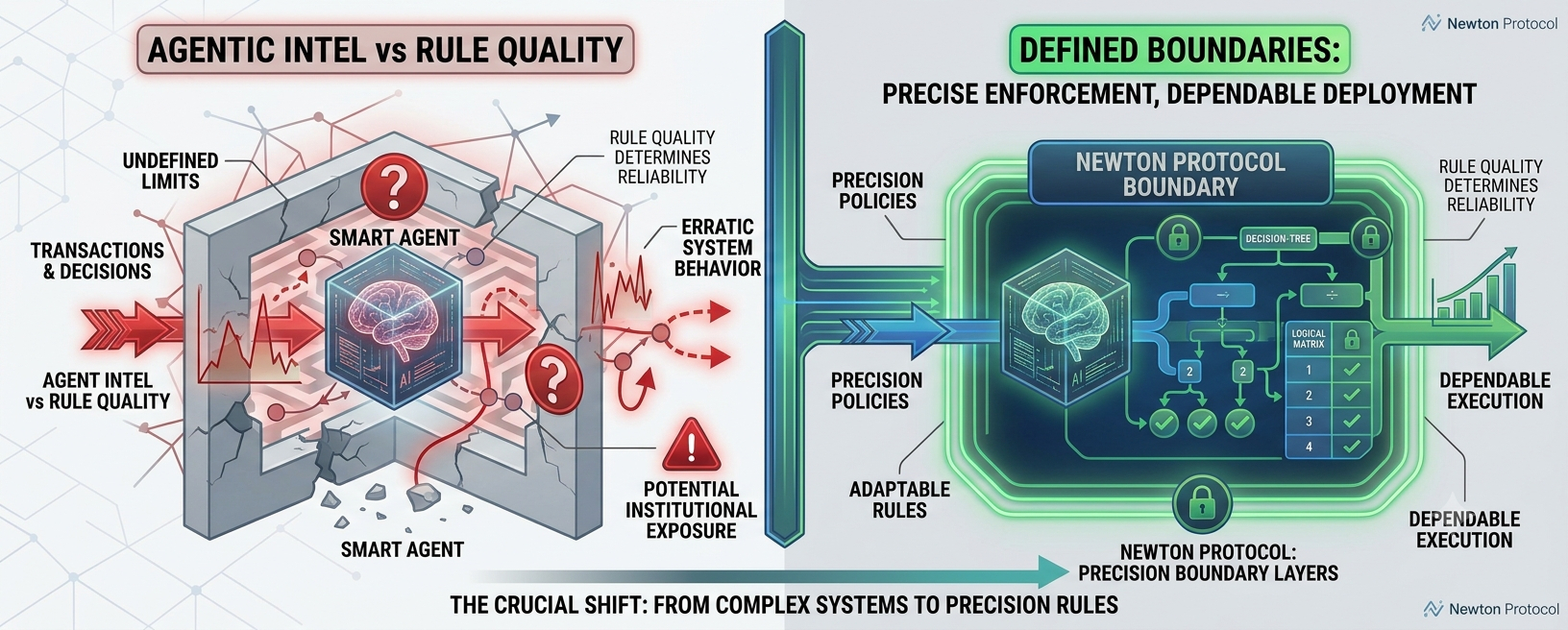
Newton's security guarantees ultimately rest on the integrity of its operator network. The design is clean and the economic incentives are well-structured, but the real test of any system that relies on a network of participants is how that network behaves under realistic conditions — including conditions where individual participants might benefit from acting against the system's interest.
Understanding the operator role is essential to this evaluation. Operators in Newton's system are responsible for evaluating transaction intents against authorization policies and producing the cryptographic proofs that allow or block execution. They have visibility into the transaction details and the policy requirements. They make the enforcement decision — or more precisely, their systems make the enforcement decision, and the proofs they produce reflect that decision.
The economic accountability model requires operators to stake NEWT as collateral. If they misbehave, their stake is at risk through slashing. This creates a direct financial incentive to operate correctly, which is the standard mechanism for aligning economic interests in proof-of-stake systems. The strength of this mechanism depends on two things: whether the slashing conditions are well-defined and enforceable, and whether the stake at risk is economically significant relative to the potential gain from misbehavior.
On the first point, the quality of slashing conditions in any decentralized system is genuinely difficult to get right. Slashing for technical failures — producing invalid proofs, going offline — is relatively straightforward because the violation is objectively verifiable. Slashing for policy enforcement failures is harder because it requires evaluating whether the operator's enforcement decision was correct, which depends on interpreting the policy as applied to the specific transaction. That interpretive layer introduces complexity that pure technical slashing conditions do not have.
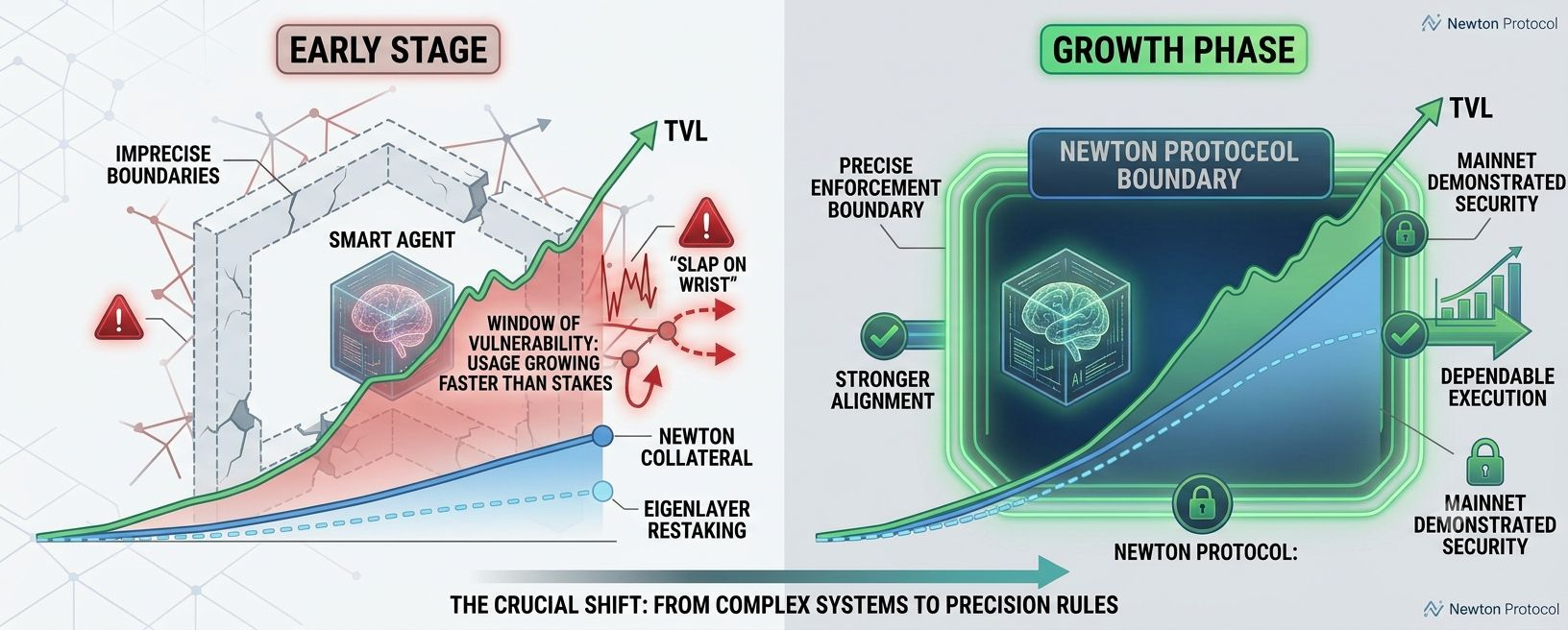
On the second point, the economic significance of operator stakes relative to the value they are protecting will evolve as the system grows. In the early stages, operator stakes will likely be small relative to the value flowing through the system. As usage grows and the stakes increase accordingly, the economic alignment becomes stronger. But the transition period — when usage is growing faster than operator stakes — is the window of greatest vulnerability.
The EigenLayer restaking layer provides an additional accountability mechanism, and the combination of both forms of collateral raises the cost of misbehavior. Whether that combined collateral is sufficient for the institutional use cases Newton is targeting is something that will be demonstrated through mainnet operation rather than theoretical analysis.
What I find most credible about Newton's security model is not any single mechanism but the layered approach. Multiple overlapping accountability mechanisms are harder to compromise simultaneously than any single mechanism, and the design reflects an understanding that security at the level institutions require cannot be achieved through a single elegant solution.#newt $NEWT @NewtonProtocol