
Market felt weirdly quiet today. I was scanning some risk alerts on my usual dashboards when one offhand comment in a group chat made me curious enough to click deeper.
So out of curiosity I started looking at Newton Protocol and how it supposedly connects external risk signals with autonomous onchain decisions. I expected it to be pretty straightforward integration. Then something clicked that’s been sitting uncomfortably since I tested it during CreatorPad.
People are looking at this risk-to-decision connection wrong. The hype paints it as AI agents intelligently pulling real-world signals and making independent onchain moves on their own. In practice, the connection feels more like a tightly scripted handoff where external signals only trigger actions after you’ve predefined exactly which risks matter and how the agent should respond.
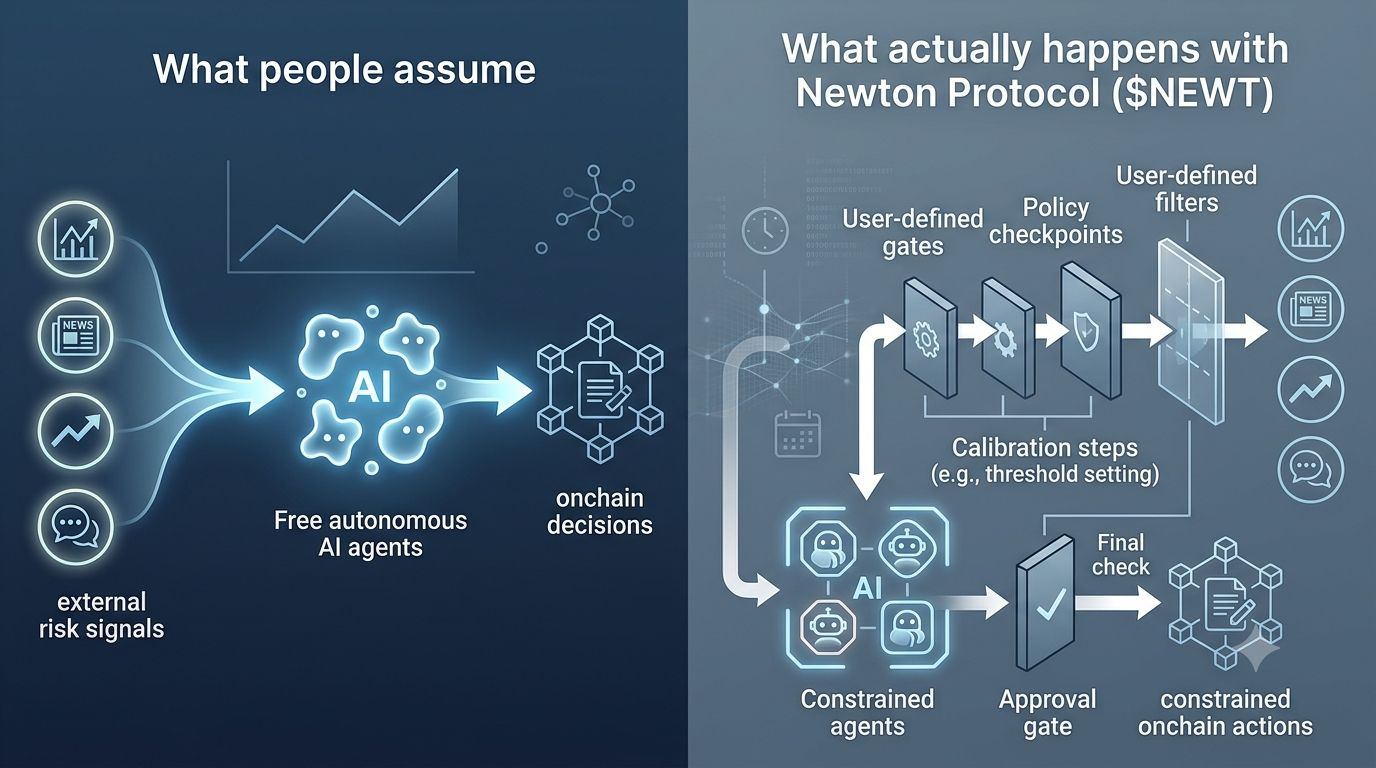
What people assume is smart, adaptive autonomy that reacts fluidly to incoming data. What actually happens is you end up spending time mapping signals to permissions and thresholds upfront. I thought one risk-based test would feel more self-directed, but actually it required more calibration from my side than anticipated.
But here’s the part that bothers me: if external signals are meant to power truly autonomous decisions, why does the system still lean so heavily on human-configured rules to make the link trustworthy? I’m not fully convinced this holds up cleanly during chaotic market events when signals flood in and decisions need to be near-instant.
It matters most for users managing real exposure who crave reduced stress but can’t afford blind automation. The moments it stands out are those evenings when you realize you’re still the one teaching the system what “risk” really means to you. I hesitated on a signal threshold yesterday thinking it was too manual, but it actually prevented a move I later regretted avoiding.
Anyway, market still looks shaky and I’ll probably just watch how these risk connections play out. Might tweak one more setup before calling it a night.