I will be honest, At a glance, it looks simple. A farming game. #pixel art. A calm world. People planting crops, walking around, gathering things, building up land. Nothing too complicated on the surface.
But when you spend a little time with it, it starts to feel like something else. Not bigger exactly. Just more layered than it first seems.
It lives on the Ronin Network, which matters, but probably not in the loud way people usually talk about blockchain games. For a lot of players, that part sits in the background at first. What they notice instead is the rhythm of the game. The routine. You log in, move around, tend crops, pick up resources, talk to people, maybe work on a task that seemed small until it turned into half your session. It has that kind of loop. Quiet, repetitive in a good way, and strangely easy to stay in.
That’s usually a sign that the core of the game works on its own.
You can usually tell when a web3 game is leaning too hard on the web3 part. Everything starts feeling like a system before it feels like a world. Pixels doesn’t come across that way as much. The farming, exploration, and creation parts give it a more grounded center. Even if the economy and ownership layer are there, the moment-to-moment experience is still about being in the space and doing ordinary things inside it.
And that changes how it feels.
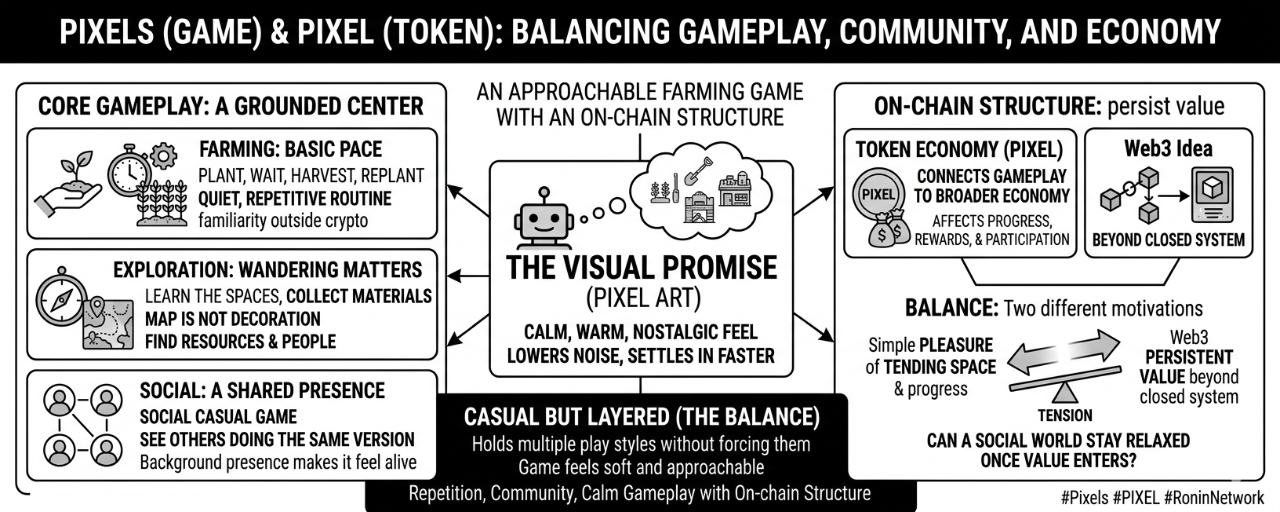
The farming side is probably the easiest place to start because it gives the game its basic pace. Planting, waiting, harvesting, replanting. That loop is familiar even outside crypto games. It slows things down. It gives you something to return to. Not everything needs to happen at once. There’s time built into it. That can sound minor, but it shapes the whole mood. Instead of pushing the player toward constant action, the game leaves room for routine. A lot of people end up liking that more than they expected.
Then there’s exploration, which opens the world up a bit. Not in a huge cinematic way. More in the sense that wandering actually matters. You move through different areas, collect materials, notice how spaces connect, and start to understand where certain things happen. It becomes obvious after a while that the map is not just there for decoration. It’s part of how the game teaches you. You learn by moving through it. By repeating routes. By realizing that one place is good for resources, another for tasks, another just because people gather there.
That social part matters too, maybe more than it first seems.
Pixels is often described as a social casual game, and that part makes sense once you think about how these worlds actually hold attention. Farming alone can be relaxing, but a world starts to feel alive when other people are around doing their own version of the same thing. Not always talking. Sometimes just moving past you, working on land nearby, trading, showing up in the same places often enough that the world begins to feel shared. It doesn’t have to be dramatic. In games like this, even a small sense of presence can do a lot.
That’s where things get interesting, because the game isn’t only about tasks or resource loops. It’s also about habit and atmosphere.
People sometimes underestimate that. They assume the value of a blockchain game has to come from ownership, tokens, or earning potential. And sure, those parts exist here. $PIXEL as a token plays a role in the broader economy of the game. It connects gameplay to something outside the game itself. That can affect how people approach progress, rewards, and participation. But if that becomes the only lens, the game starts to look flatter than it really is.
A better way to look at it, maybe, is that Pixels is trying to combine two different motivations that don’t always fit together neatly. One is the simple pleasure of tending a space, gathering materials, making progress little by little. The other is the web3 idea that digital time and digital items can carry some persistent value beyond a closed system. Sometimes those two ideas support each other. Sometimes they pull in different directions.
And that tension is part of what makes the project worth watching.
Because the question changes from “is this just a farming game?” to “what happens when a farming game is also an economy?” Then later it changes again. It becomes “can a social world stay relaxed once value enters the picture?” That’s not a criticism exactly. It’s just the real question underneath a lot of blockchain games, and Pixels makes it easier to notice because the game itself feels soft and approachable.
The art style helps with that. @Pixels visuals tend to carry a certain kind of emotional shorthand. They feel familiar. Warm, a little nostalgic, easy to read. That doesn’t automatically make a game good, of course, but it does shape the player’s first relationship with the world. It lowers the noise. You aren’t dealing with too much detail. You settle in faster. And once that happens, small mechanics have more room to matter.
Creation is another part that gives the game its identity. Not just in the literal sense of making or building things, but in the broader sense of shaping your own experience. Working on land. Choosing what to grow. Deciding how to spend time. There’s a difference between a game that sends everyone through the same path and one that lets people build slightly different routines inside a shared structure. Pixels seems more interested in the second approach.
That probably explains why people describe it as casual, even though there are systems under the surface.
Casual doesn’t mean empty. It usually means the game understands that not every player wants intensity all the time. Some people want to check in, do a few things, feel a little progress, and leave. Some want to stay longer and optimize more. Some are there for community. Some for the token economy. Some because the world is calm and they like that. A game like Pixels works best when it can hold all of those people without forcing them into the same style of play.
And to be fair, that’s not easy.
Web3 games often end up being judged by their economy first and their play experience second. Traditional games are usually judged the other way around. Pixels sits in the middle of that. It has to feel like a real game, not just a structure for transactions. But it also has to make sense as something built on Ronin, with assets, token utility, and all the things that come with that setup. So the project is always balancing two forms of trust. Players need to trust that the game is worth spending time in. Users on the blockchain side need to trust that the systems around it are stable enough to matter.
Those are different expectations. Sometimes even opposite ones.
Still, there’s something quietly effective about the way Pixels presents itself. It doesn’t feel like it’s trying too hard to prove what it is. It lets the world do some of the work. A farm here. A path there. Other players moving through the same routines. A token in the background, but not always at the center of attention unless you go looking for it.
Maybe that’s why it stays in people’s minds a bit longer than expected. Not because it overwhelms you. More because it settles into a pattern you start recognizing. And once you notice that pattern, you start seeing the project less as a pitch and more as a place. Something built around repetition, community, and the strange mix of calm gameplay with on-chain structure.
It doesn’t really resolve into one simple idea. It just keeps sitting in that space between game, habit, and economy. And for a project like this, that may be the most honest way to look at it. It’s still unfolding a little while you’re in it, and maybe even after you log off.

Artículo
Pixels, or PIXEL on the token side, is one of those projects that can seem misleading at first.
Aviso legal: Contiene opiniones de terceros. Esto no constituye asesoramiento financiero. Es posible que incluya contenido patrocinado. Consultar Términos y condiciones.