
RAZIQ17
3.2k Publicaciones

RAZIQ17
Abrir trade
Traders de alta frecuencia
6.8 mes(es)
2 Siguiendo
10.2K+ Seguidores
2.4K+ Me gusta
Publicaciones
Cartera
Todo
Live
PINNED
Verificado
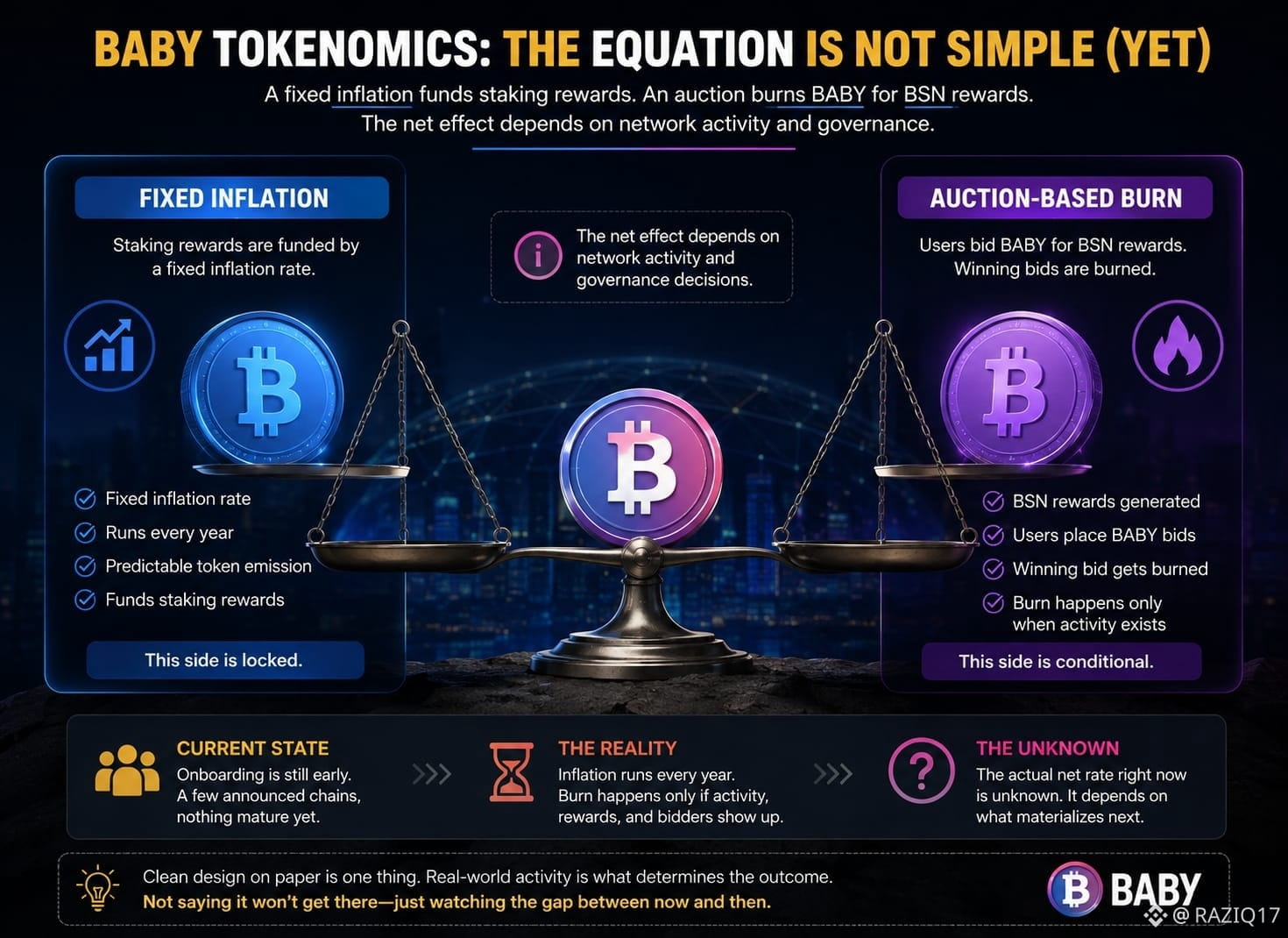
I’ve spent enough years in this space to notice when the write-up and the reality start drifting apart. Went back through BABY’s own page today. There’s a fixed inflation number that funds the staking rewards no matter what. On the other side sits this auction where people bid BABY for the BSN rewards and the winning bid gets burned. It’s tempting to line those two up and picture some kind of quiet balance. The page never actually says that. It just notes the net effect depends on network activity and whatever governance decides.
One side of the equation is locked. It shows up every year. The burn only appears if enough BSNs actually come online, generate real rewards, and someone shows up to bid. Right now onboarding still looks early—a few announced chains, nothing that feels mature yet. I’ve watched versions of this before. Designs that look clean on paper until the activity they rely on never quite scales the way people hoped. Not claiming it won’t get there. Just sitting with the fact that the inflation keeps running while the offset is still waiting on something that has to materialize first. The actual net rate at this stage is the piece nobody can point to a solid number for yet.
$BABY @BabylonLabs_io #baby
One side of the equation is locked. It shows up every year. The burn only appears if enough BSNs actually come online, generate real rewards, and someone shows up to bid. Right now onboarding still looks early—a few announced chains, nothing that feels mature yet. I’ve watched versions of this before. Designs that look clean on paper until the activity they rely on never quite scales the way people hoped. Not claiming it won’t get there. Just sitting with the fact that the inflation keeps running while the offset is still waiting on something that has to materialize first. The actual net rate at this stage is the piece nobody can point to a solid number for yet.
$BABY @BabylonLabs_io #baby
PINNED
I’ve been looking at this TBV thing from Babylon for a while now, and something about it feels different from the usual bridge-and-wrap stories.
Got home late and ended up sitting with the docs a lot longer than I expected. The withdrawal paths kept looping in my head. Most designs move BTC somewhere else, then ask you to trust a whole new set of parties to bring it back. I’ve seen that movie enough times. When things break, responsibility gets blurry really fast.
What they’re doing here doesn’t try to teach Bitcoin new tricks. It turns the external state into spending conditions that the existing script can already verify. BTC never leaves its own chain. Each vault is its own UTXO, locked from the beginning, not mixed into some shared pool. That part feels intentional. The funds stay isolated. Withdrawals and state changes all have to resolve against that single output.
The challenge window is interesting too. It doesn’t pretend the system is perfect. It simply leaves room for someone to stop an incorrect state from being finalized. Verification on the Bitcoin side stays narrow, while more of the complexity gets pushed outward.
I’m still not fully convinced. Scale, real demand, and how the withdrawal flow behaves when the network is under pressure are all still open questions. BABY will only matter if people keep using the network after the first wave fades. But the caution I usually carry feels a little quieter here. Not gone. Just quieter.
I’ll keep watching the numbers.🧐
$BABY @BabylonLabs_io #baby
Got home late and ended up sitting with the docs a lot longer than I expected. The withdrawal paths kept looping in my head. Most designs move BTC somewhere else, then ask you to trust a whole new set of parties to bring it back. I’ve seen that movie enough times. When things break, responsibility gets blurry really fast.
What they’re doing here doesn’t try to teach Bitcoin new tricks. It turns the external state into spending conditions that the existing script can already verify. BTC never leaves its own chain. Each vault is its own UTXO, locked from the beginning, not mixed into some shared pool. That part feels intentional. The funds stay isolated. Withdrawals and state changes all have to resolve against that single output.
The challenge window is interesting too. It doesn’t pretend the system is perfect. It simply leaves room for someone to stop an incorrect state from being finalized. Verification on the Bitcoin side stays narrow, while more of the complexity gets pushed outward.
I’m still not fully convinced. Scale, real demand, and how the withdrawal flow behaves when the network is under pressure are all still open questions. BABY will only matter if people keep using the network after the first wave fades. But the caution I usually carry feels a little quieter here. Not gone. Just quieter.
I’ll keep watching the numbers.🧐
$BABY @BabylonLabs_io #baby

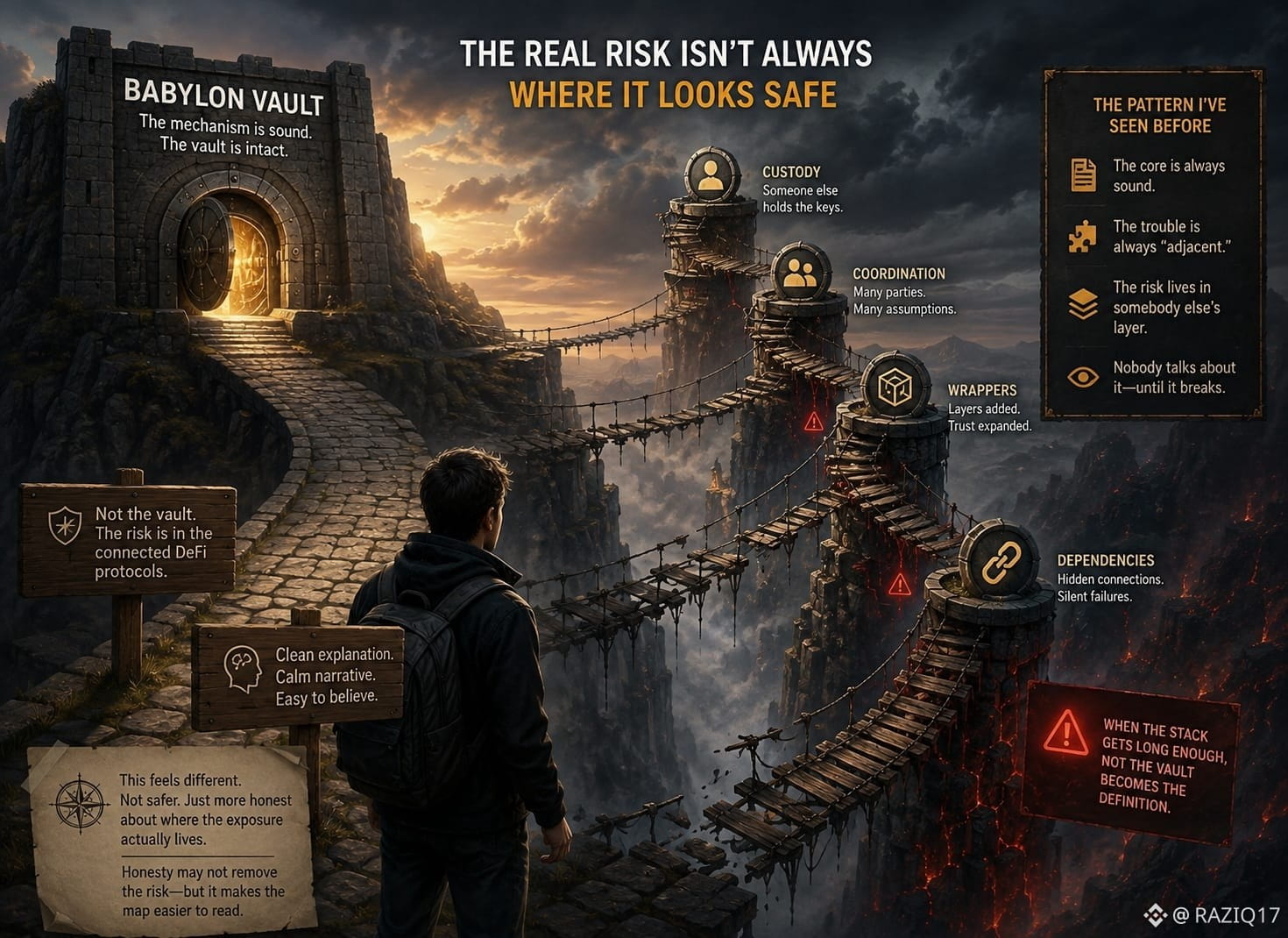
I’m noticing something I’ve seen before, but not quite like this. Babylon says the risk is in the connected DeFi protocols, not the vault itself, and on paper that sounds clean. Clean enough to calm people down. Clean enough to keep the story moving.
But I don’t fully trust clean explanations in crypto anymore. I’ve watched too many systems survive the headline while the real damage sat somewhere else: in custody, in coordination, in the wrapper, in the dependency nobody wanted to talk about until it broke. That’s the part that keeps bothering me here. The vault may be intact, but if every deposit has to pass through a chain of other people’s assumptions, then the risk is still there. It just has better manners.
I’ve seen this pattern over and over. The promise is always that the core mechanism is sound. The trouble is always “adjacent.” The trouble is always somebody else’s layer. And maybe that’s technically true. Maybe that’s the whole point. But when the stack gets long enough, “not the vault” starts to sound less like a defense and more like a definition.
Something about this feels different, though. Not safer. Just more honest about where the exposure actually lives. I’m not sure yet whether that honesty matters, or whether it only makes the map easier to read while the terrain stays just as rough.
@BabylonLabs_io #baby $BABY
But I don’t fully trust clean explanations in crypto anymore. I’ve watched too many systems survive the headline while the real damage sat somewhere else: in custody, in coordination, in the wrapper, in the dependency nobody wanted to talk about until it broke. That’s the part that keeps bothering me here. The vault may be intact, but if every deposit has to pass through a chain of other people’s assumptions, then the risk is still there. It just has better manners.
I’ve seen this pattern over and over. The promise is always that the core mechanism is sound. The trouble is always “adjacent.” The trouble is always somebody else’s layer. And maybe that’s technically true. Maybe that’s the whole point. But when the stack gets long enough, “not the vault” starts to sound less like a defense and more like a definition.
Something about this feels different, though. Not safer. Just more honest about where the exposure actually lives. I’m not sure yet whether that honesty matters, or whether it only makes the map easier to read while the terrain stays just as rough.
@BabylonLabs_io #baby $BABY
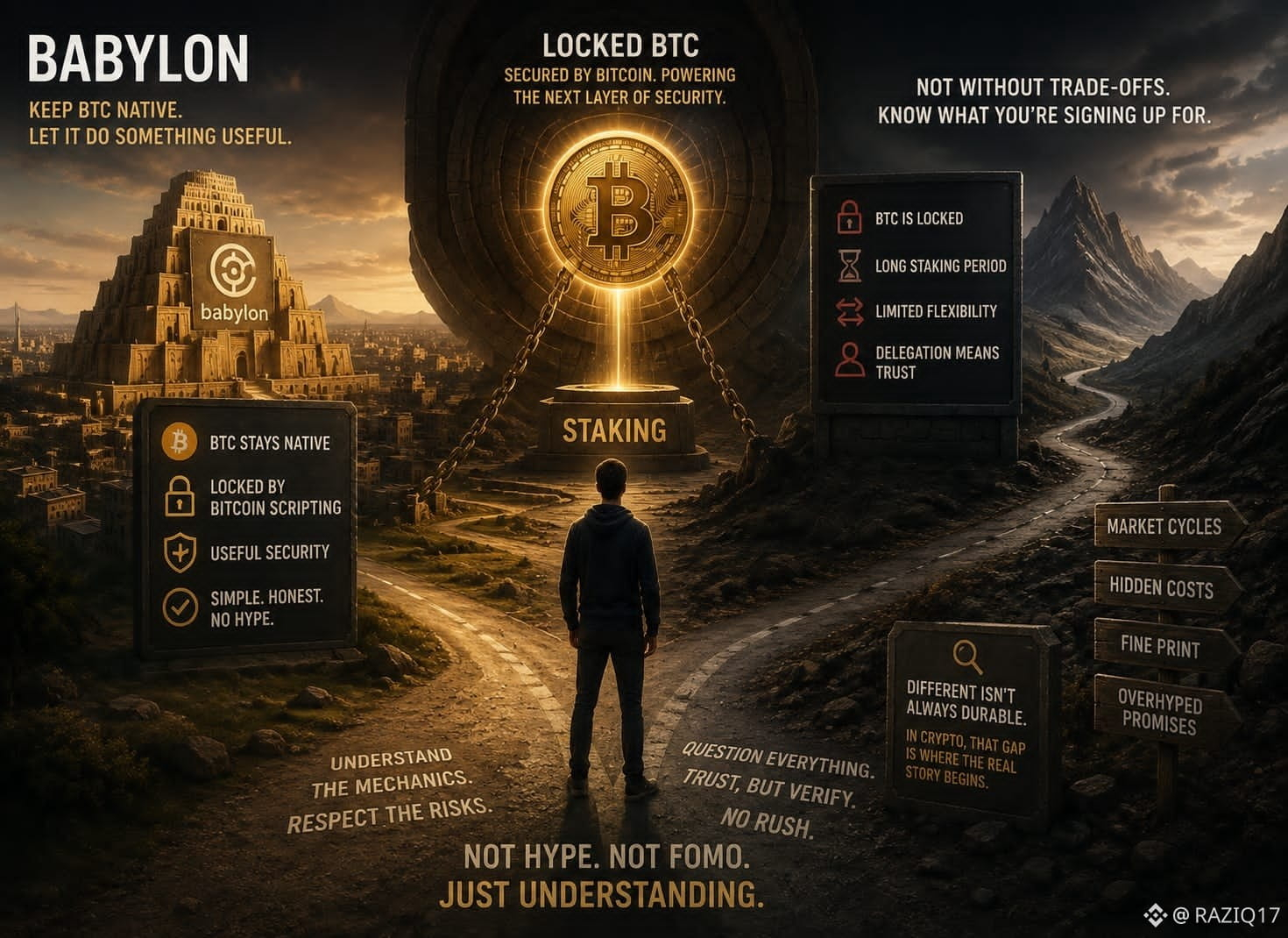
I’m noticing that these days I care less about the story and a lot more about how things actually work. Babylon caught my attention for exactly that reason. It isn’t trying to sell me another bridge, a wrapped version of Bitcoin, or some shiny promise built on layers of trust I never asked for. The idea feels refreshingly simple: keep BTC native, lock it through Bitcoin’s own scripting, and let it do something useful without pretending there aren’t trade-offs.
That’s also the point where I naturally slow down. The BTC is locked. The staking period is long. Flexibility is limited. And if you delegate, you’re still relying on someone else to do the right thing. That part matters to me far more than any reward ever could.
I’ve seen enough cycles to know that every “new use case” comes with a quiet cost attached. Most of the time, that cost is buried in the fine print or only becomes obvious after the excitement fades. So I’m not dismissing Babylon, but I’m not rushing toward it either. Something about it does feel different. Still, different doesn’t automatically mean durable. In crypto, that gap is usually where the real story begins.🤔
@BabylonLabs_io #baby $BABY
That’s also the point where I naturally slow down. The BTC is locked. The staking period is long. Flexibility is limited. And if you delegate, you’re still relying on someone else to do the right thing. That part matters to me far more than any reward ever could.
I’ve seen enough cycles to know that every “new use case” comes with a quiet cost attached. Most of the time, that cost is buried in the fine print or only becomes obvious after the excitement fades. So I’m not dismissing Babylon, but I’m not rushing toward it either. Something about it does feel different. Still, different doesn’t automatically mean durable. In crypto, that gap is usually where the real story begins.🤔
@BabylonLabs_io #baby $BABY
I’m noticing something that keeps getting buried under the usual crypto noise: the first TBV market on Morpho wasn’t some big, obvious moment with deep liquidity behind it. It was $14. Just fourteen dollars. That’s what was sitting behind the word "historic" once I looked past the announcement itself.
I’ve seen this kind of thing before. A project announces a milestone, and over time people start remembering it as if it was already massive from day one. But that’s rarely how these things actually begin. Sometimes the real story is much smaller, a little awkward, and far more uncertain. Real Bitcoin. Mainnet. Borrowing USDC against native BTC for the first time. That happened. I’m just not sure many people appreciate how little capital was there when it first became real.
I keep noticing that crypto has a habit of confusing proof with scale. Something can work without anyone fully trusting it yet. A few dollars can prove the plumbing works, but they can’t prove a market exists.
That’s the part I keep thinking about. Not the announcement or the headlines, but the idea that something this important may have started with almost nobody paying attention. Just a tiny amount of liquidity, quietly answering the only question that really mattered: does it actually work?🌱
@BabylonLabs_io #baby $BABY
I’ve seen this kind of thing before. A project announces a milestone, and over time people start remembering it as if it was already massive from day one. But that’s rarely how these things actually begin. Sometimes the real story is much smaller, a little awkward, and far more uncertain. Real Bitcoin. Mainnet. Borrowing USDC against native BTC for the first time. That happened. I’m just not sure many people appreciate how little capital was there when it first became real.
I keep noticing that crypto has a habit of confusing proof with scale. Something can work without anyone fully trusting it yet. A few dollars can prove the plumbing works, but they can’t prove a market exists.
That’s the part I keep thinking about. Not the announcement or the headlines, but the idea that something this important may have started with almost nobody paying attention. Just a tiny amount of liquidity, quietly answering the only question that really mattered: does it actually work?🌱
@BabylonLabs_io #baby $BABY

Parcialmente cierto
I’ve watched this market long enough to know when something is mostly noise. This one feels a little different. I keep coming back to the parts people usually skip past: the BTC unbonding takes about a week, and there is still a 0.1% slashing penalty for misbehaving finality providers. That does not feel like a system built for easy applause. It feels like one built around the idea that trust has to be earned the hard way.
What stuck with me even more was the reward side. Babylon Genesis’s share of BSN rewards does not just go straight to stakers; it goes into weekly burn auctions first. Slower. Less polished. A little less convenient, maybe, but more honest about the trade-offs. I’ve seen enough crypto stories collapse under their own marketing to know that friction is often where the truth lives.
I’m still thinking about one thing, though: what happens when multi-staking starts spreading one BTC position across several BSNs at once? That’s usually where neat ideas get tested. That’s usually where the real pressure shows up.
@BabylonLabs_io #baby $BABY
What stuck with me even more was the reward side. Babylon Genesis’s share of BSN rewards does not just go straight to stakers; it goes into weekly burn auctions first. Slower. Less polished. A little less convenient, maybe, but more honest about the trade-offs. I’ve seen enough crypto stories collapse under their own marketing to know that friction is often where the truth lives.
I’m still thinking about one thing, though: what happens when multi-staking starts spreading one BTC position across several BSNs at once? That’s usually where neat ideas get tested. That’s usually where the real pressure shows up.
@BabylonLabs_io #baby $BABY

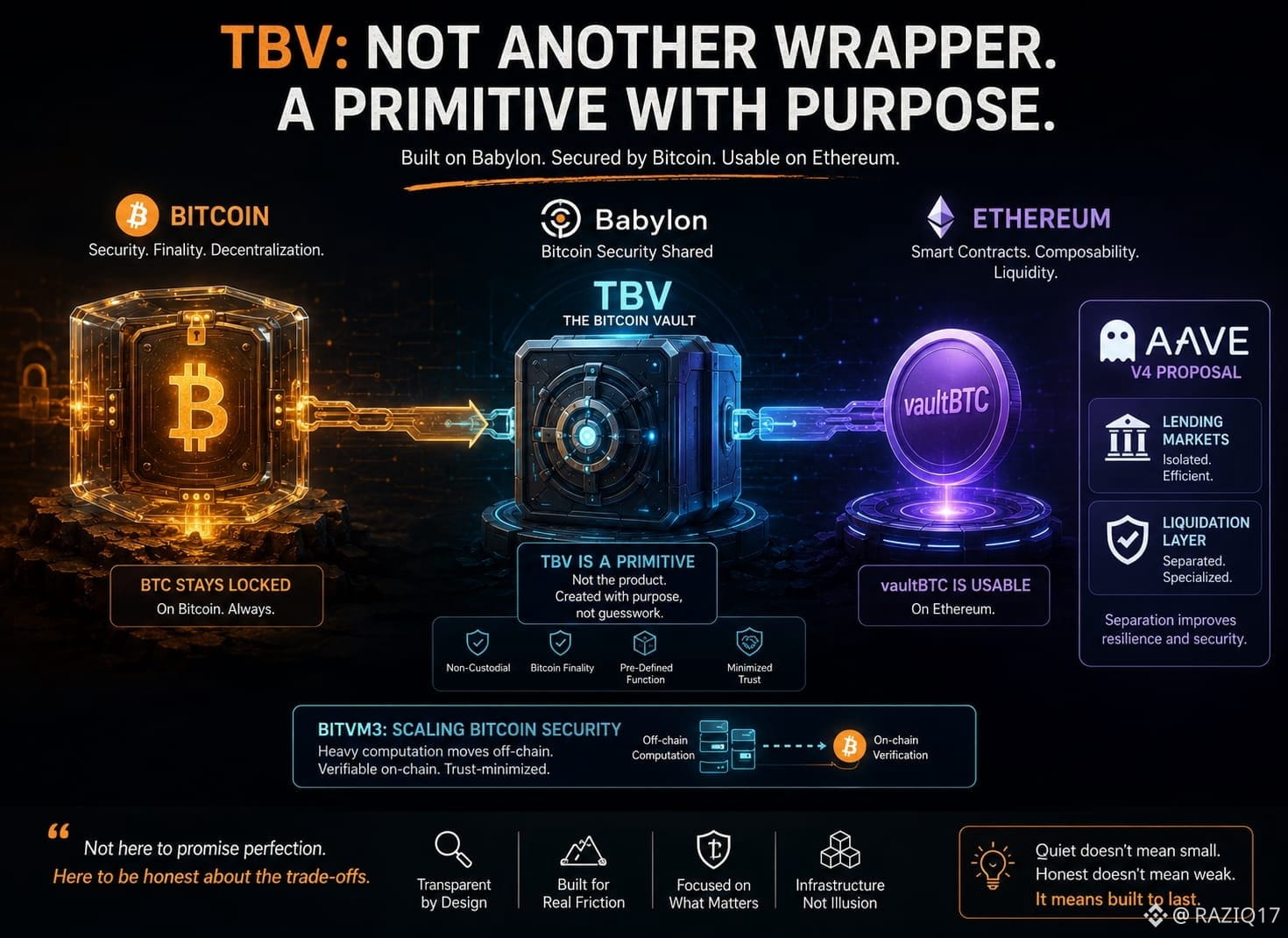
I've been around crypto long enough to recognize the usual script. Wrap the asset, add another layer of trust, call it infrastructure, and hope nobody notices the trade-offs until much later. TBV feels different to me, not because I think it solves everything, but because it starts by admitting where the real problem is. Babylon keeps saying TBV is just a primitive, not the product, and for some reason that stuck with me more than anything else. The vault is created already knowing what it's meant to do instead of leaving those decisions for later. Maybe that's a small detail, maybe it isn't.
I keep coming back to the Aave V4 proposal because it makes the whole idea feel less abstract. BTC stays locked on Bitcoin, vaultBTC becomes usable on Ethereum, and the lending side is separated from the liquidation side instead of pretending they're the same thing. BitVM3 moves a lot of the heavy work off-chain, which sounds cleaner on paper, but I've watched enough systems struggle once real volume shows up to know that's still an open question.
I don't fully trust crypto whenever it starts celebrating another wrapper around an old promise. I've seen too many cycles where the narrative arrived long before the product did. But something about this feels quieter. Not necessarily better, just more honest about the friction. After all these years, that's the part that actually gets my attention.⚡
@BabylonLabs_io #baby $BABY
I keep coming back to the Aave V4 proposal because it makes the whole idea feel less abstract. BTC stays locked on Bitcoin, vaultBTC becomes usable on Ethereum, and the lending side is separated from the liquidation side instead of pretending they're the same thing. BitVM3 moves a lot of the heavy work off-chain, which sounds cleaner on paper, but I've watched enough systems struggle once real volume shows up to know that's still an open question.
I don't fully trust crypto whenever it starts celebrating another wrapper around an old promise. I've seen too many cycles where the narrative arrived long before the product did. But something about this feels quieter. Not necessarily better, just more honest about the friction. After all these years, that's the part that actually gets my attention.⚡
@BabylonLabs_io #baby $BABY
Verificado
I’m noticing Babylon gets more interesting the longer I stare at its plumbing, and less comfortable over time.
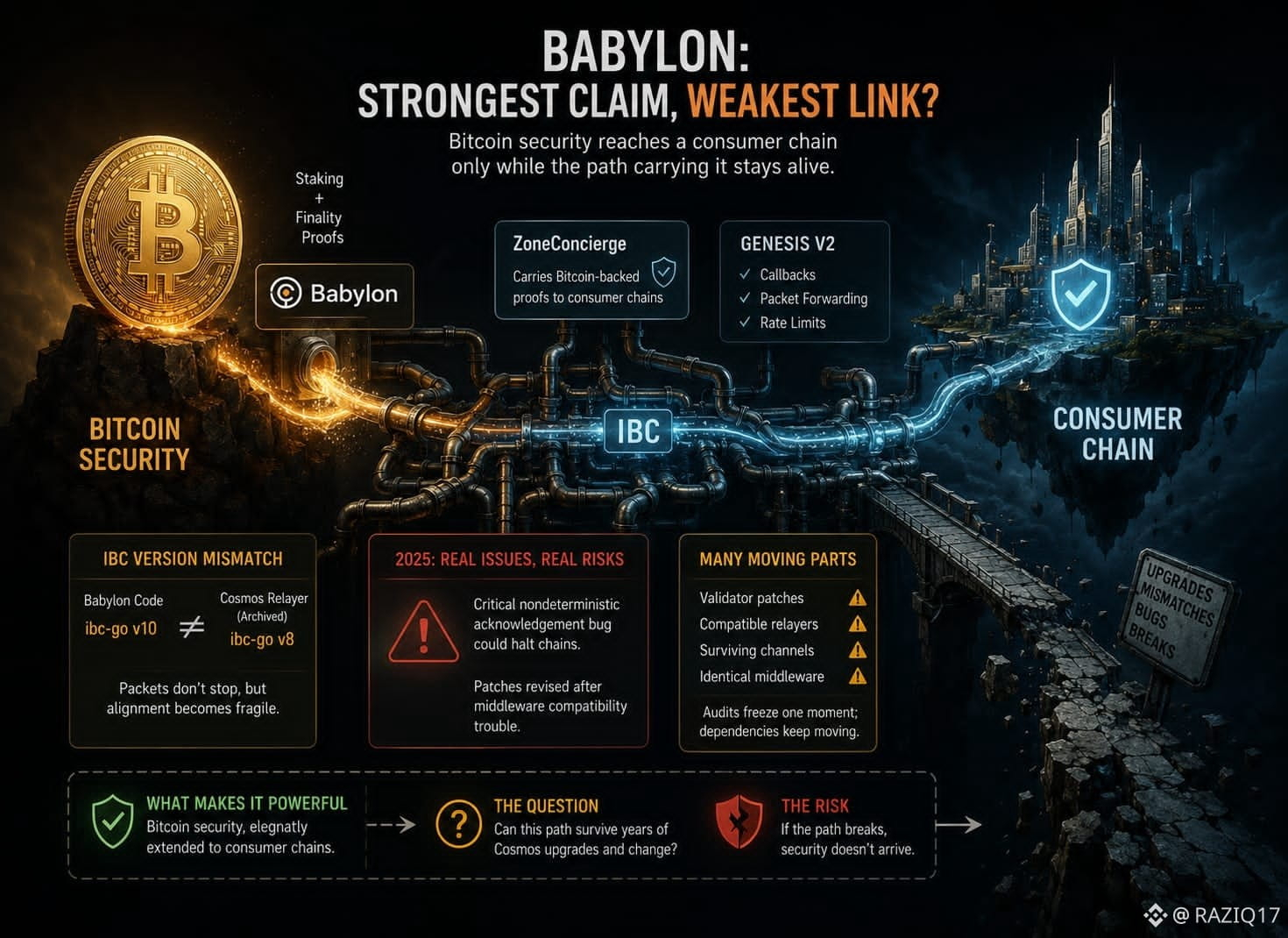
On Monday, our technical director asked what happens to IBC when Cosmos keeps changing. I expected another “Bitcoin security everywhere” story. Instead I found substance: ZoneConcierge carries Bitcoin-backed proofs to consumer chains, while Genesis V2 added callbacks, packet forwarding and rate limits.
But I’ve seen this before. Babylon’s current code pins ibc-go v10, while the now-archived Cosmos relayer code still imports v8 types. That mismatch does not mean packets stop—the two are separate binaries—but it reveals how many pieces must stay aligned. In 2025, ibc-go disclosed a critical nondeterministic acknowledgement bug that could halt chains, then revised its patches after middleware compatibility trouble appeared. This is the friction clean diagrams hide.
I don’t fully trust promises dependent on quick validator patches, compatible relayers, surviving channels and identical middleware. Audits and rate limits matter, but audits freeze one moment; dependencies keep moving.
Something about Babylon feels different, yet its strongest claim may be its weakest link: Bitcoin security reaches a consumer chain only while the path carrying it stays alive. I’m not sure that path can survive years of Cosmos upgrades. What do you think?🤔
@BabylonLabs_io #baby $BABY
On Monday, our technical director asked what happens to IBC when Cosmos keeps changing. I expected another “Bitcoin security everywhere” story. Instead I found substance: ZoneConcierge carries Bitcoin-backed proofs to consumer chains, while Genesis V2 added callbacks, packet forwarding and rate limits.
But I’ve seen this before. Babylon’s current code pins ibc-go v10, while the now-archived Cosmos relayer code still imports v8 types. That mismatch does not mean packets stop—the two are separate binaries—but it reveals how many pieces must stay aligned. In 2025, ibc-go disclosed a critical nondeterministic acknowledgement bug that could halt chains, then revised its patches after middleware compatibility trouble appeared. This is the friction clean diagrams hide.
I don’t fully trust promises dependent on quick validator patches, compatible relayers, surviving channels and identical middleware. Audits and rate limits matter, but audits freeze one moment; dependencies keep moving.
Something about Babylon feels different, yet its strongest claim may be its weakest link: Bitcoin security reaches a consumer chain only while the path carrying it stays alive. I’m not sure that path can survive years of Cosmos upgrades. What do you think?🤔
@BabylonLabs_io #baby $BABY
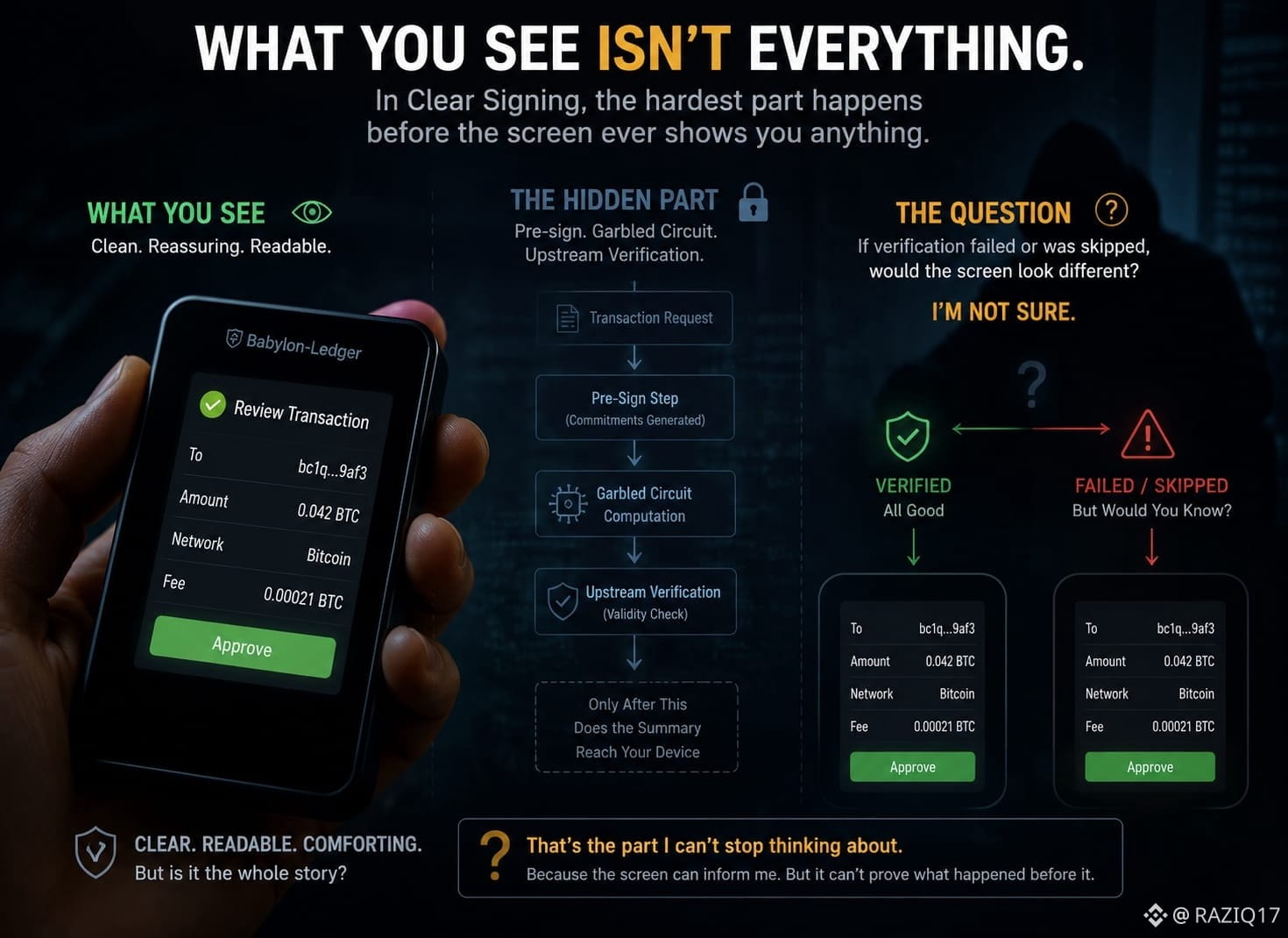
I’ve been around crypto long enough to know when a feature is trying to make people feel more comfortable instead of actually solving the hard part. Babylon-Ledger’s Clear Signing gave me that feeling. On the surface, it’s reassuring: readable details on the device, a clean summary, a vault setup that finally feels easier to understand. I get why people like that. I’ve wanted that too.
But I keep coming back to the part nobody really sees on the screen. The pre-sign step. The garbled circuit. The verification that’s supposed to happen somewhere upstream, out of sight, before that nice little summary ever shows up. That’s the part I keep thinking about, and it’s not something a hardware display can really prove to me.
I’ve seen this kind of thing before in crypto. The interface gets cleaner while the trust model quietly becomes more complicated. So I’m not fully convinced yet. Maybe that’s just years of watching the same patterns repeat. But something about this keeps pulling me back to one question.
If that verification ever failed or got skipped, would the screen in my hand look any different? I’m still not sure, and that’s the part I can’t stop thinking about.
@BabylonLabs_io #baby $BABY
But I keep coming back to the part nobody really sees on the screen. The pre-sign step. The garbled circuit. The verification that’s supposed to happen somewhere upstream, out of sight, before that nice little summary ever shows up. That’s the part I keep thinking about, and it’s not something a hardware display can really prove to me.
I’ve seen this kind of thing before in crypto. The interface gets cleaner while the trust model quietly becomes more complicated. So I’m not fully convinced yet. Maybe that’s just years of watching the same patterns repeat. But something about this keeps pulling me back to one question.
If that verification ever failed or got skipped, would the screen in my hand look any different? I’m still not sure, and that’s the part I can’t stop thinking about.
@BabylonLabs_io #baby $BABY
$BANK USDT is on fire! 🚀🔥
BANKUSDT just delivered a strong +11.89% move, trading at $0.40027 after reaching a 24H High of $0.67205 📈. The 24H Low stands at $0.34010, showing massive volatility and strong trader interest ⚡.
📊 Key Stats: • 💰 Last Price: $0.40027 • 📈 24H High: $0.67205 • 📉 24H Low: $0.34010 • 💹 24H Volume: 2.26B BANK • 💵 24H Volume (USDT): 914.10M • 📍 Mark Price: $0.39888 • ⏱️ Timeframe: 15M
The explosive volume and sharp price action suggest BANKUSDT is attracting significant market attention. Keep an eye on volatility and manage risk carefully! 👀📊
$AKE
$BTW
#BANKUSDT #BANK #BİNANCEFUTURES #CryptoTrading #Altcoin #Perpetual #PriceAction #TradingView #Bullish #CryptoNews
BANKUSDT just delivered a strong +11.89% move, trading at $0.40027 after reaching a 24H High of $0.67205 📈. The 24H Low stands at $0.34010, showing massive volatility and strong trader interest ⚡.
📊 Key Stats: • 💰 Last Price: $0.40027 • 📈 24H High: $0.67205 • 📉 24H Low: $0.34010 • 💹 24H Volume: 2.26B BANK • 💵 24H Volume (USDT): 914.10M • 📍 Mark Price: $0.39888 • ⏱️ Timeframe: 15M
The explosive volume and sharp price action suggest BANKUSDT is attracting significant market attention. Keep an eye on volatility and manage risk carefully! 👀📊
$AKE
$BTW
#BANKUSDT #BANK #BİNANCEFUTURES #CryptoTrading #Altcoin #Perpetual #PriceAction #TradingView #Bullish #CryptoNews
BANK USDT price 0.4111
5%
Next stop: $0.67? 🚀
69%
Pump or pullback? 👀
5%
Just getting started? 🔥
21%
19 Voto(s) • Votación cerrada
$BANK /USDT is on fire! 🚀 The price is trading at $0.38713, showing an impressive +12.19% gain in the last 24 hours 📈. Bulls remain in control as the token recently touched a 24H High of $0.40800, while the 24H Low stands at $0.33246 🔥.
Strong market participation is visible with 24H Volume: 1.93B BANK and 714.94M USDT, reflecting high trader interest 💰⚡. The daily chart remains bullish, with MA(7): 0.284237, MA(25): 0.120261, and MA(99): 0.057906, showing a powerful uptrend 📊.
If BANK breaks above $0.40800, the next bullish wave could begin 🚀. However, traders should also watch for profit-taking and manage risk carefully 🎯.
$EUL
$DIA
#BANK #BANKUSDT #LorenzoProtocol #Crypto #BinanceSquareTalks #Altcoin #Bullish #Trading #CryptoTrading #DeFi #Blockchain #CryptoNews #MarketUpdate #Breakout #TrendingCoin
Strong market participation is visible with 24H Volume: 1.93B BANK and 714.94M USDT, reflecting high trader interest 💰⚡. The daily chart remains bullish, with MA(7): 0.284237, MA(25): 0.120261, and MA(99): 0.057906, showing a powerful uptrend 📊.
If BANK breaks above $0.40800, the next bullish wave could begin 🚀. However, traders should also watch for profit-taking and manage risk carefully 🎯.
$EUL
$DIA
#BANK #BANKUSDT #LorenzoProtocol #Crypto #BinanceSquareTalks #Altcoin #Bullish #Trading #CryptoTrading #DeFi #Blockchain #CryptoNews #MarketUpdate #Breakout #TrendingCoin
Bank price New price 0.3883
100%
What's your BANK price target?
0%
Bull run or correction? 📈
0%
Will BANK hit a new ATH? 🚀
0%
2 Voto(s) • Votación cerrada
$AKE Skyrockets 25.79% – Strong Momentum Building! 🚀
AKE is making waves with an impressive +25.79% gain today! 📈 Current price is 0.0033523 (≈ Rs 0.93186), showing strong buying pressure and growing market interest. 👀 If this momentum continues, AKE could attract even more traders looking for short-term opportunities. 🔥 Always manage risk and do your own research before investing. 💰
$EUL
$BANK
#AKE #Crypto #Altcoins! #BullishMomentum #CryptoTrading #Binance #MarketUpdate2025 #CryptonewswithJack #Blockchain #DYOR
AKE is making waves with an impressive +25.79% gain today! 📈 Current price is 0.0033523 (≈ Rs 0.93186), showing strong buying pressure and growing market interest. 👀 If this momentum continues, AKE could attract even more traders looking for short-term opportunities. 🔥 Always manage risk and do your own research before investing. 💰
$EUL
$BANK
#AKE #Crypto #Altcoins! #BullishMomentum #CryptoTrading #Binance #MarketUpdate2025 #CryptonewswithJack #Blockchain #DYOR
ARAI ($AA ) Jumps 22.03% – Bulls Take Control! 📊
ARAI (AA) is showing excellent strength with a +22.03% rally! 🚀 The current price stands at 0.028587 (≈ Rs 7.94653), reflecting increasing demand and positive market sentiment. 📈 This strong move has put AA on many traders' watchlists. Keep an eye on volume and price action for the next breakout. 💎
#ARAI #AA #Crypto #Altcoin #CryptoTrading #BullRun #Blockchain #MarketUpdate #Binance #DYOR
ARAI (AA) is showing excellent strength with a +22.03% rally! 🚀 The current price stands at 0.028587 (≈ Rs 7.94653), reflecting increasing demand and positive market sentiment. 📈 This strong move has put AA on many traders' watchlists. Keep an eye on volume and price action for the next breakout. 💎
#ARAI #AA #Crypto #Altcoin #CryptoTrading #BullRun #Blockchain #MarketUpdate #Binance #DYOR
Quack AI ($Q ) Surges 20.99% – AI Crypto on Fire! 🤖🔥
Quack AI (Q) is gaining serious attention after climbing +20.99%! 📈 The token is currently trading at 0.023551 (≈ Rs 6.54653), showing strong momentum and growing investor confidence. 🚀 AI-related crypto projects continue to attract interest, making Q one to watch closely. 👀
$EUL
$LAB
#QuackAI #Q #AICrypto #Crypto #Altcoin #Blockchain #CryptoTrading #MarketUpdate #Binance #DYOR
Quack AI (Q) is gaining serious attention after climbing +20.99%! 📈 The token is currently trading at 0.023551 (≈ Rs 6.54653), showing strong momentum and growing investor confidence. 🚀 AI-related crypto projects continue to attract interest, making Q one to watch closely. 👀
$EUL
$LAB
#QuackAI #Q #AICrypto #Crypto #Altcoin #Blockchain #CryptoTrading #MarketUpdate #Binance #DYOR
Bitlight Labs ($LIGHT ) Shines with 19.37% Gain! 💡✨
Bitlight Labs (LIGHT) is lighting up the market with a solid +19.37% increase! 🚀 Current price is 0.16049 (≈ Rs 44.61), supported by strong bullish momentum. 📊 Traders are watching closely as LIGHT continues to show positive price action and market strength. 💰
$EUL
$VELVET
#BitlightLabs #LIGHT #Crypto #Altcoin #Bullish #CryptoTrading #Blockchain #MarketUpdate #Binance #DYOR
Bitlight Labs (LIGHT) is lighting up the market with a solid +19.37% increase! 🚀 Current price is 0.16049 (≈ Rs 44.61), supported by strong bullish momentum. 📊 Traders are watching closely as LIGHT continues to show positive price action and market strength. 💰
$EUL
$VELVET
#BitlightLabs #LIGHT #Crypto #Altcoin #Bullish #CryptoTrading #Blockchain #MarketUpdate #Binance #DYOR
YOOLDO ($ESPORTS ) Climbs 10.99% – Gaming Token Rising! 🎮🚀
YOOLDO (ESPORTS) posts a healthy +10.99% gain, trading at 0.05127 (≈ Rs 14.25). 📈 The steady upward movement highlights growing interest in gaming-focused crypto projects. 🎯 If buying momentum continues, ESPORTS could remain on traders' radar for further moves. Always trade wisely and manage risk. 💎
#YOOLDO #ESPORTS #GamingCrypto #Crypto #Altcoin #CryptoTrading #Blockchain #MarketUpdate #Binance #DYOR
$ESPORTS
$EUL
YOOLDO (ESPORTS) posts a healthy +10.99% gain, trading at 0.05127 (≈ Rs 14.25). 📈 The steady upward movement highlights growing interest in gaming-focused crypto projects. 🎯 If buying momentum continues, ESPORTS could remain on traders' radar for further moves. Always trade wisely and manage risk. 💎
#YOOLDO #ESPORTS #GamingCrypto #Crypto #Altcoin #CryptoTrading #Blockchain #MarketUpdate #Binance #DYOR
$ESPORTS
$EUL
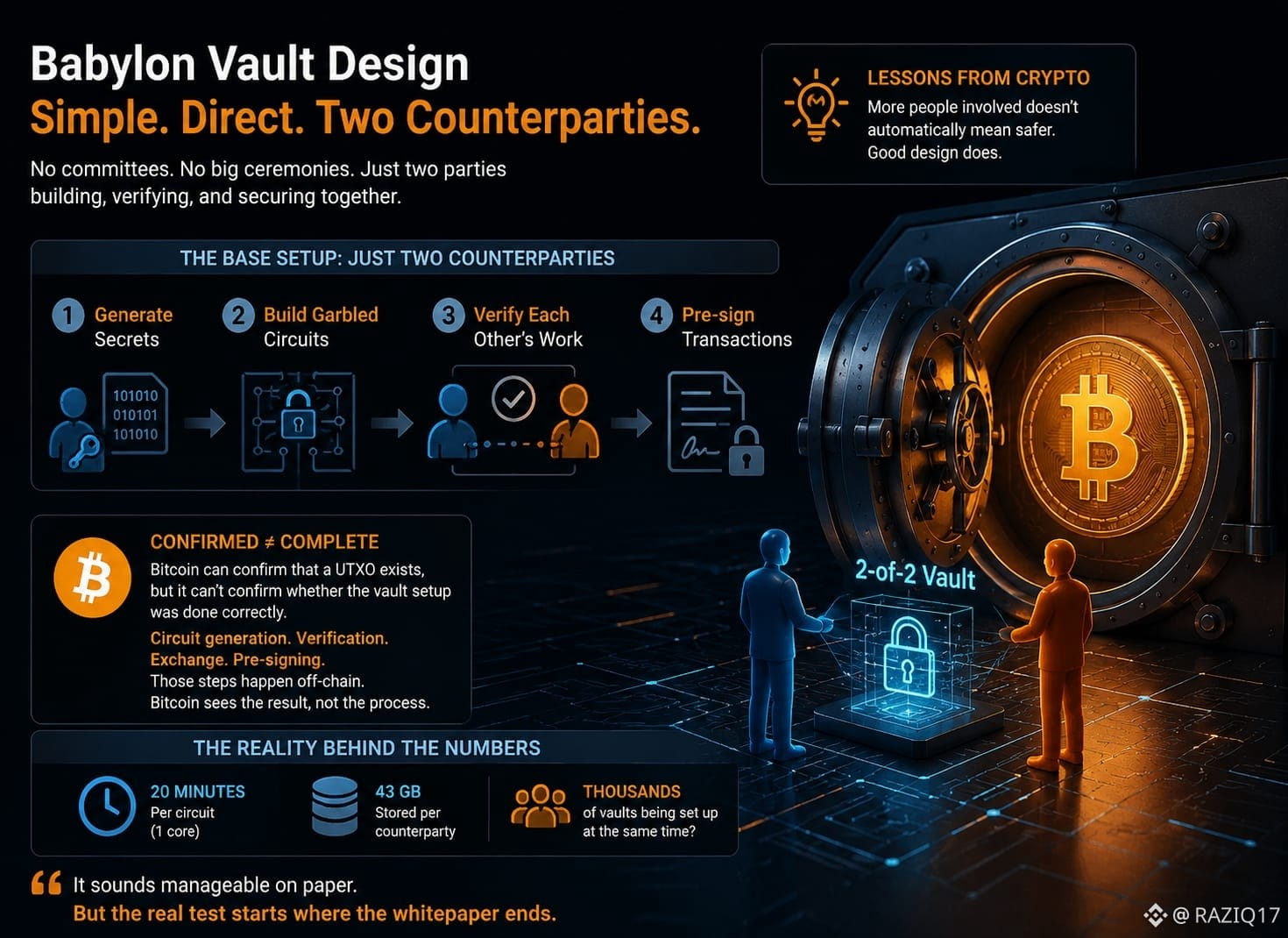
I keep coming back to this Babylon vault design because it strips away one of crypto’s favorite illusions: that having more people involved automatically makes something safer. I’m not convinced it does. At least not here. What caught my attention is how simple the base setup really is. Just two counterparties. No signer committee. No big ceremony. Both sides generate their own secrets, build the garbled circuits, check each other’s work, and only then pre-sign the spending transactions. There’s something refreshingly straightforward about that.🏛️
I’ve been around long enough to know that in crypto, people often treat "confirmed" like it means everything is finished. It usually doesn’t. Bitcoin can show that a UTXO exists, but it can’t tell you whether the work behind the vault was actually done properly, or whether both circuits were generated, verified, and exchanged without cutting corners. That’s the part I keep thinking about.🔍
The numbers aren’t exactly small either. Twenty minutes per circuit, one core, and 43GB stored per counterparty. That sounds manageable on paper. I’m just not sure what it looks like when thousands of vaults are being set up at the same time. Maybe it scales well, maybe it doesn’t. After watching this market for years, I’ve learned that the real test usually starts where the whitepaper ends.⚖️
@BabylonLabs_io #baby $BABY
I’ve been around long enough to know that in crypto, people often treat "confirmed" like it means everything is finished. It usually doesn’t. Bitcoin can show that a UTXO exists, but it can’t tell you whether the work behind the vault was actually done properly, or whether both circuits were generated, verified, and exchanged without cutting corners. That’s the part I keep thinking about.🔍
The numbers aren’t exactly small either. Twenty minutes per circuit, one core, and 43GB stored per counterparty. That sounds manageable on paper. I’m just not sure what it looks like when thousands of vaults are being set up at the same time. Maybe it scales well, maybe it doesn’t. After watching this market for years, I’ve learned that the real test usually starts where the whitepaper ends.⚖️
@BabylonLabs_io #baby $BABY
I’ve watched enough crypto cycles to know when something sounds cleaner than it probably is. Babylon is one of those names that makes me pause. On paper, the setup looks smart enough: BTC stays where it belongs, the vault state becomes verifiable on Ethereum, and suddenly you can borrow against it through Aave v4 instead of trying to build liquidity from zero. I get the appeal. Liquidity is always the hard part, and Babylon isn’t pretending otherwise.🧐
But I also keep thinking about the seam in the middle of it. The Bitcoin side may be protected, but the credit side still depends on a separate system with its own risk rules, its own pressure points, and its own way of breaking when markets move fast. I’ve seen this before: people talk like removing a bridge removes dependency, when it really just changes where the dependency sits.⚖️
That’s why I’m not rushing to call it solved. Babylon feels interesting, maybe genuinely useful, but I don’t fully trust anything in crypto until I see how it behaves when everyone starts reaching for the exit at the same time.🚪
@BabylonLabs_io #baby $BABY
But I also keep thinking about the seam in the middle of it. The Bitcoin side may be protected, but the credit side still depends on a separate system with its own risk rules, its own pressure points, and its own way of breaking when markets move fast. I’ve seen this before: people talk like removing a bridge removes dependency, when it really just changes where the dependency sits.⚖️
That’s why I’m not rushing to call it solved. Babylon feels interesting, maybe genuinely useful, but I don’t fully trust anything in crypto until I see how it behaves when everyone starts reaching for the exit at the same time.🚪
@BabylonLabs_io #baby $BABY

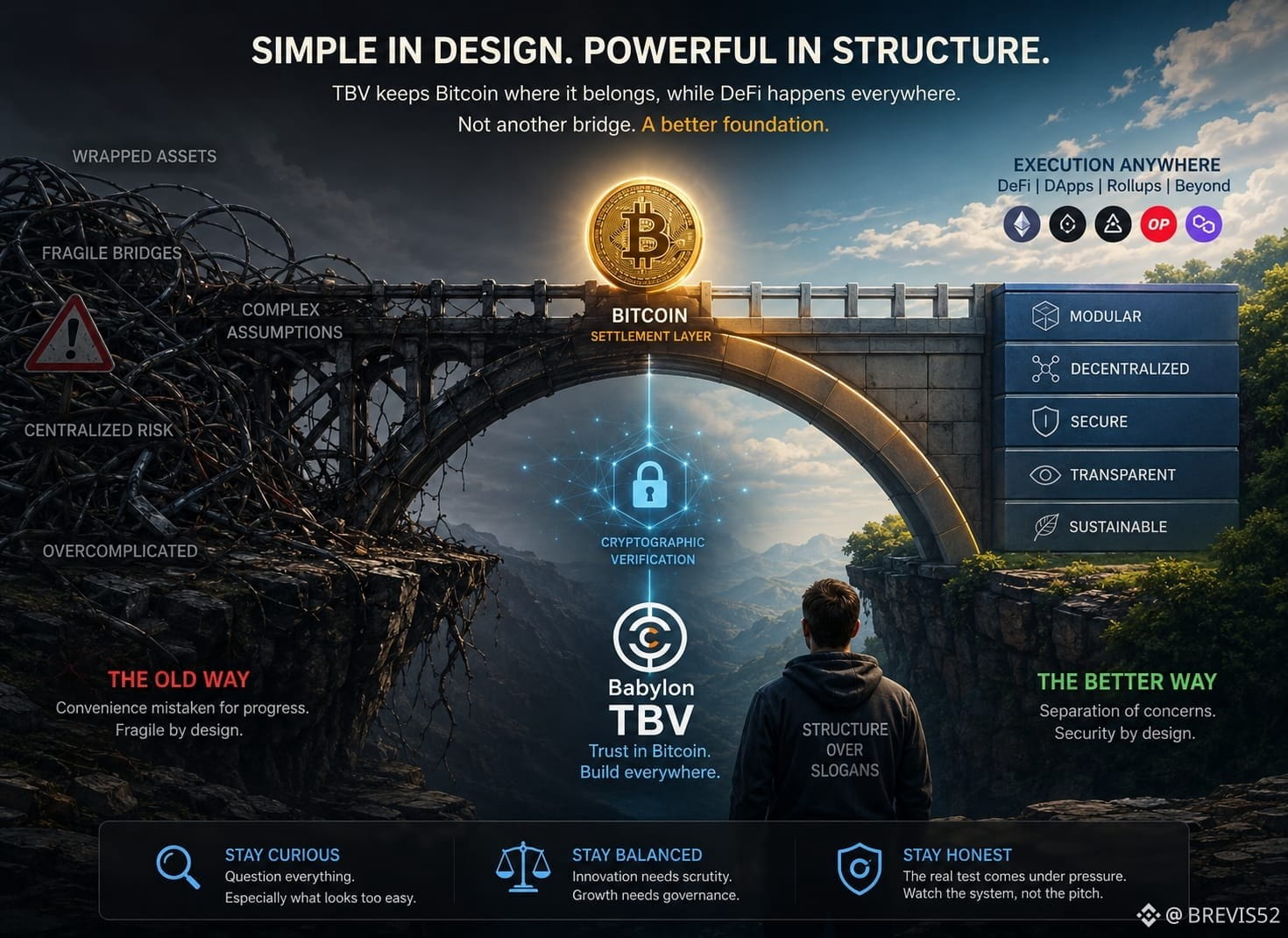
I’ve been around crypto long enough to know that the cleanest ideas are usually the ones people overcomplicate later. Babylon’s TBV keeps pulling at me for that reason. It looks simple on the surface, almost suspiciously so, and that’s usually where the real question starts. I keep noticing how often the market calls convenience “progress” right before it hands us another fragile setup wrapped in better branding.🤔
What sticks with me is the split between settlement and execution. BTC stays on Bitcoin, while the DeFi logic happens elsewhere through cryptographic verification instead of the usual wrapped-asset gymnastics. I’ve seen enough cycles to know that structure matters more than slogans. Something about this feels different, not because it is perfect, but because it refuses to pretend the old bridge model was ever elegant.🔍
Still, I don’t fully trust anything that asks for new assumptions. Complexity has a way of sneaking back in, and governance can drift when growth starts sounding like survival. That’s the part I keep watching. Not the pitch. Not the narrative. Just whether the system still looks honest after pressure starts to build.⚖️
@BabylonLabs_io $BABY #baby
What sticks with me is the split between settlement and execution. BTC stays on Bitcoin, while the DeFi logic happens elsewhere through cryptographic verification instead of the usual wrapped-asset gymnastics. I’ve seen enough cycles to know that structure matters more than slogans. Something about this feels different, not because it is perfect, but because it refuses to pretend the old bridge model was ever elegant.🔍
Still, I don’t fully trust anything that asks for new assumptions. Complexity has a way of sneaking back in, and governance can drift when growth starts sounding like survival. That’s the part I keep watching. Not the pitch. Not the narrative. Just whether the system still looks honest after pressure starts to build.⚖️
@BabylonLabs_io $BABY #baby
Inicia sesión para explorar más contenidos