Binance Square

CoinRank

image
Creador verificado
CoinRank is a global crypto media platform dedicated to delivering cutting-edge insights into the blockchain and Web3 industry. Through in-depth reporting and e
6 Siguiendo
5.3K+ Seguidores
8.9K+ Me gusta
934 compartieron
Publicaciones
·
--
BITCOIN MINING DIFFICULTY SEES BIGGEST CUT SINCE 2021 Bitcoin mining difficulty recorded its largest single adjustment since summer 2021, while the 7‑day average network hashrate sits near 990 EH/s. The reset suggests miners are recalibrating amid recent price pressure. #Bitcoin #Mining
BITCOIN MINING DIFFICULTY SEES BIGGEST CUT SINCE 2021

Bitcoin mining difficulty recorded its largest single adjustment since summer 2021, while the 7‑day average network hashrate sits near 990 EH/s.

The reset suggests miners are recalibrating amid recent price pressure.

#Bitcoin #Mining
BITMINE WALLET MOVES 20,000 ETH FROM KRAKEN A suspected new Bitmine wallet transferred 20,000 ETH (about $41.7M) from Kraken, indicating a large on‑chain movement from a centralized exchange. The transfer signals potential institutional positioning or custody changes. #Ethereum #Onchain
BITMINE WALLET MOVES 20,000 ETH FROM KRAKEN

A suspected new Bitmine wallet transferred 20,000 ETH (about $41.7M) from Kraken, indicating a large on‑chain movement from a centralized exchange.

The transfer signals potential institutional positioning or custody changes.

#Ethereum #Onchain
COINBASE CEO: LONG‑TERM CRYPTO BULL CASE UNCHANGED Coinbase CEO said sharp market swings are nothing new and do not alter his long‑term positive outlook on crypto. He emphasized that volatility is part of the asset’s maturation and does not invalidate the broader adoption trend. #Coinbase #MarketSentiment
COINBASE CEO: LONG‑TERM CRYPTO BULL CASE UNCHANGED

Coinbase CEO said sharp market swings are nothing new and do not alter his long‑term positive outlook on crypto.

He emphasized that volatility is part of the asset’s maturation and does not invalidate the broader adoption trend.

#Coinbase #MarketSentiment
BITWISE ADVISOR CLARIFIES IBIT OPTIONS LIMIT RUMOR Bitwise advisor Jeff Park refuted market rumors claiming Nasdaq canceled IBIT options position limits, enabling unlimited leverage. Park clarified that the "cancellation of standard limits on crypto assets" refers to a proposal to increase the 25,000 options cap for FBTC, ARKB, HODL, and Ethereum ETFs to the standard 250,000 limit, aligning them with IBIT and BITB for fair competition. An application to raise IBIT's options limit to 1 million, submitted last November, has not yet been approved. IBIT's current options position limit remains 250,000. #CryptoETFs
BITWISE ADVISOR CLARIFIES IBIT OPTIONS LIMIT RUMOR

Bitwise advisor Jeff Park refuted market rumors claiming Nasdaq canceled IBIT options position limits, enabling unlimited leverage.

Park clarified that the "cancellation of standard limits on crypto assets" refers to a proposal to increase the 25,000 options cap for FBTC, ARKB, HODL, and Ethereum ETFs to the standard 250,000 limit, aligning them with IBIT and BITB for fair competition.

An application to raise IBIT's options limit to 1 million, submitted last November, has not yet been approved. IBIT's current options position limit remains 250,000.

#CryptoETFs
WINTERMUTE CEO SKEPTICAL OF INSTITUTIONAL BLOWOUT RUMORS Wintermute CEO Evgeny Gaevoy expressed skepticism regarding recent market rumors of "institutional blowouts," questioning their impact. He observed no significant spillover effects or credible confirmation, unlike past events such as 3AC or FTX, noting current rumors stem from anonymous sources. Gaevoy highlighted that present market leverage predominantly originates from perpetual contracts, a structure he deems more orderly than prior cycles' opaque, uncollateralized lending. He also pointed to improved exchange margin management and ADL mechanisms. Additionally, he believes institutions are unlikely to repeat the FTX model of investing user deposits into illiquid assets. He further noted the significant legal risks of publicly denying actual bankruptcy, particularly for entities in regulated jurisdictions. #MarketOutlook
WINTERMUTE CEO SKEPTICAL OF INSTITUTIONAL BLOWOUT RUMORS

Wintermute CEO Evgeny Gaevoy expressed skepticism regarding recent market rumors of "institutional blowouts," questioning their impact. He observed no significant spillover effects or credible confirmation, unlike past events such as 3AC or FTX, noting current rumors stem from anonymous sources.

Gaevoy highlighted that present market leverage predominantly originates from perpetual contracts, a structure he deems more orderly than prior cycles' opaque, uncollateralized lending. He also pointed to improved exchange margin management and ADL mechanisms.

Additionally, he believes institutions are unlikely to repeat the FTX model of investing user deposits into illiquid assets. He further noted the significant legal risks of publicly denying actual bankruptcy, particularly for entities in regulated jurisdictions. #MarketOutlook
CoinRank AMA: Why On-Chain Credit Identity Matters On-chain identity shifts risk from collateral-driven assumptions to behavior-driven evaluation, allowing protocols to distinguish reliable users from high-risk participants.   AI and zero-knowledge proofs will work together to interpret fragmented on-chain behavior while preserving privacy, forming the technical backbone of credit identity.   Portable reputation across chains and applications unlocks higher capital efficiency, sustainable GameFi economies, institutional participation, and more accurate cross-chain risk pricing. IDENTITY AS THE FIRST LAYER OF RISK   In a recent AMA hosted by CoinRank, the discussion opened not with price targets or short-term market commentary but with a more foundational question: if Web3 truly intends to operate as a next-generation financial system, what is it missing at its core? Capital is abundant, users continue to grow, yet something deeper limits the system’s ability to function like mature financial markets. The moderator suggested that the missing layer might be identity — not in the traditional sense of personal information, but as a mechanism that allows risk to be understood, priced, and distributed. This framing quickly shifted the tone of the conversation. Instead of discussing markets asset by asset, speakers examined how uncertainty, behavior, and trust are absorbed across different parts of the crypto ecosystem. As soon as identity entered the conversation, it became clear that markets are not only repricing volatility; they are also reconsidering who carries risk, why they carry it, and how systems allocate it.   The moderator emphasized that a wallet starting from zero history may fit early ideals of decentralization but introduces significant inefficiency. Financial systems cannot operate without context. When every user is treated as identical, protocols must assume worst-case scenarios, lending pools set conservative parameters, and markets lose the ability to distinguish reliable participants from opportunistic ones. In this sense, the absence of identity is not a design feature but a systemic cost. It forces DeFi into a low-resolution model of risk where nuance is impossible. The opening segment made clear that on-chain credit identity is less about classification and more about eliminating structural ignorance, allowing risk to attach to the right places rather than being averaged across an undifferentiated pool of users.   BEHAVIOR OVER KYC   Co-host CreditLink reinforced this by drawing a critical distinction between KYC and credit identity. KYC answers who you are. On-chain identity answers what you have done. It is a record of behavior, consistency, reliability, and participation. Crypto markets already generate an enormous amount of behavioral data — transaction history, borrowing patterns, governance engagement, staking timelines — but without interpretation this data remains inert. CreditLink argued that meaningful identity in Web3 must transform fragmented actions into verifiable behavioral signals that protocols can use to price risk. That does not require exposing sensitive information. Instead, it requires a framework where users carry portable, privacy-preserving proof of their past reliability.   The co-host noted that the future of Web3 lending will not be defined solely by collateral but by a combination of collateral and demonstrated behavior. High-quality users should not bear the same cost of capital as unknown or high-risk participants. Similarly, protocols should not need to limit capital efficiency because they lack tools to evaluate borrower quality. The argument landed clearly: the relationship between users and networks changes once behavior becomes interpretable. And to interpret behavior at scale, the system will rely on AI. In CreditLink’s view, AI models are not about scoring users but about reading risk in real time — identifying patterns that signal stability or instability long before traditional indicators surface. This shifts identity from a static classification to a living, evolving representation of how a user behaves in the ecosystem.   CAPITAL EFFICIENCY AND STRUCTURAL LIMITATIONS   From Pindex, Mia expanded the conversation by examining the economic consequences of lacking identity. She argued that DeFi today is structurally trapped in a high-collateral, low-efficiency regime. The reason is straightforward: when a protocol cannot distinguish between user types, it prices risk as if everyone were equally risky. This forces responsible users to pay an inflated premium and prevents lending markets from maturing into more efficient models. Mia emphasized that this is not a theoretical limitation; it is a practical one. Without credit-based differentiation, the cost of uncertainty becomes embedded into every parameter — interest rates, loan-to-value ratios, liquidation thresholds. As a result, many promising lending markets operate far below their potential capacity.   Her argument positioned on-chain identity not as an add-on but as the mechanism that allows DeFi to evolve beyond its current constraints. Once a protocol can observe and verify consistent positive behavior, it can extend more favorable terms. The broader implication is that DeFi could finally serve long-term participants without forcing them into the same risk bucket as opportunistic actors. Mia was direct in her assessment: on-chain credit is the dividing line between a system that merely functions and one that can scale into a true financial layer.   RISK FILTERING IN GAME ECONOMIES   From the perspective of GamePad, Myo approached identity through the lens of GameFi — a sector that has seen explosive cycles of growth and collapse. He argued that most GameFi failures were not driven by tokenomics flaws but by the absence of a mechanism to distinguish long-term players from speculative inflows. When every account is treated equally, bots, exploiters, and opportunistic players receive the same economic benefits as genuine users. This creates a feedback loop that destabilizes the entire in-game economy. Myo explained that if games could recognize patterns such as DAO participation, asset retention, consistent in-game engagement, or long-term wallet behaviors, they could construct reward systems that support sustainable growth rather than rapid extraction.   In his view, credit identity acts not as a reward mechanism but as a filter. Games do not need to know the real-world identities of their participants; they need to understand which behaviors align with economic stability. By filtering participants based on trustworthy on-chain patterns, Web3 games can transition away from unsustainable emission-driven models and toward ecosystems where value is created rather than drained. This perspective extended the discussion beyond finance and illustrated how identity becomes foundational even in sectors where it is rarely acknowledged.   AI, PRIVACY, AND THE INTERPRETATION OF BEHAVIOR   From AIW3, Cedar offered a technical perspective that grounded the discussion in infrastructure realities. He described on-chain behavior as abundant but structurally fragmented. Wallet actions occur across many chains, formats, and contexts, making human interpretation impossible at scale. According to Cedar, AI is not optional but essential. Only AI models — particularly those built with graph analysis, sequence modeling, and semantic understanding — can convert scattered actions into coherent risk narratives. At the same time, identity systems must be privacy-preserving from the start. Cedar emphasized that the purpose of credit identity is not to expose information, but to allow users to prove reliability without revealing personal data. This requires a deep integration between AI-driven behavioral models and zero-knowledge cryptography.   His argument reframed identity as a multidisciplinary system rather than a single protocol feature. It must combine machine intelligence, cryptographic guarantees, and behavioral analysis to function properly. When these components align, identity becomes a powerful tool for risk interpretation rather than an intrusive form of surveillance.   INTEROPERABILITY AS AN IDENTITY PROBLEM   From Unibase, Valerio shifted the conversation toward the cross-chain environment. He argued that the largest inefficiency in cross-chain finance is not technical but informational. When a user moves from one chain to another, their entire behavioral history is lost. A wallet with years of positive engagement on Chain A appears as an empty newcomer on Chain B. This creates unnecessary friction and forces protocols to disregard valuable historical context. Valerio described this as a core identity failure. Interoperability, he argued, does not actually require faster bridges or cheaper transactions. What it requires is portable identity — the ability for users to carry their behavioral credibility across ecosystems without compromising privacy.   His position highlighted a key limitation in today’s multi-chain world: liquidity can move freely, but trust cannot. And until trust becomes portable, cross-chain finance will remain structurally constrained.   CREDIT AS A COORDINATION MECHANISM   The final perspective came from MetaSoil, where Dr. NFY analyzed identity through the lens of economic coordination. He argued that credit is not fundamentally about scoring users or rewarding good behavior. Its deeper purpose is to reduce friction. Markets become more efficient when participants can form reliable expectations about counterparties. Without identity-linked behavioral signals, every transaction carries hidden uncertainty. Dr. NFY described credit identity as a way to align incentives across participants, enabling capital to flow more predictably and reducing the need for redundant safeguards. He concluded with a striking point: risk does not disappear, but it can finally settle in the right places once identity exists.   WHEN RISK FINALLY FINDS ITS OWNER   The AMA closed without price predictions or market calls. Instead, it delivered a structural insight: Web3 does not need more liquidity — it needs a framework that understands how to hold and distribute risk. On-chain credit identity provides this framework. It allows DeFi to escape over-collateralization, enables GameFi to filter meaningful participants, gives cross-chain ecosystems continuity, unlocks institutional participation, and provides AI models with interpretable behavioral data. In other words, identity is not a feature but the next foundational layer of Web3. It turns scattered actions into coherent signals, reduces systemic uncertainty, and gives the market a way to assign risk to those who generate it. Once this shift happens, the Web3 financial system gains the clarity and precision it has lacked since inception. 〈CoinRank AMA: Why On-Chain Credit Identity Matters〉這篇文章最早發佈於《CoinRank》。

CoinRank AMA: Why On-Chain Credit Identity Matters

 On-chain identity shifts risk from collateral-driven assumptions to behavior-driven evaluation, allowing protocols to distinguish reliable users from high-risk participants.


AI and zero-knowledge proofs will work together to interpret fragmented on-chain behavior while preserving privacy, forming the technical backbone of credit identity.


Portable reputation across chains and applications unlocks higher capital efficiency, sustainable GameFi economies, institutional participation, and more accurate cross-chain risk pricing.

IDENTITY AS THE FIRST LAYER OF RISK


In a recent AMA hosted by CoinRank, the discussion opened not with price targets or short-term market commentary but with a more foundational question: if Web3 truly intends to operate as a next-generation financial system, what is it missing at its core? Capital is abundant, users continue to grow, yet something deeper limits the system’s ability to function like mature financial markets. The moderator suggested that the missing layer might be identity — not in the traditional sense of personal information, but as a mechanism that allows risk to be understood, priced, and distributed. This framing quickly shifted the tone of the conversation. Instead of discussing markets asset by asset, speakers examined how uncertainty, behavior, and trust are absorbed across different parts of the crypto ecosystem. As soon as identity entered the conversation, it became clear that markets are not only repricing volatility; they are also reconsidering who carries risk, why they carry it, and how systems allocate it.


The moderator emphasized that a wallet starting from zero history may fit early ideals of decentralization but introduces significant inefficiency. Financial systems cannot operate without context. When every user is treated as identical, protocols must assume worst-case scenarios, lending pools set conservative parameters, and markets lose the ability to distinguish reliable participants from opportunistic ones. In this sense, the absence of identity is not a design feature but a systemic cost. It forces DeFi into a low-resolution model of risk where nuance is impossible. The opening segment made clear that on-chain credit identity is less about classification and more about eliminating structural ignorance, allowing risk to attach to the right places rather than being averaged across an undifferentiated pool of users.


BEHAVIOR OVER KYC


Co-host CreditLink reinforced this by drawing a critical distinction between KYC and credit identity. KYC answers who you are. On-chain identity answers what you have done. It is a record of behavior, consistency, reliability, and participation. Crypto markets already generate an enormous amount of behavioral data — transaction history, borrowing patterns, governance engagement, staking timelines — but without interpretation this data remains inert. CreditLink argued that meaningful identity in Web3 must transform fragmented actions into verifiable behavioral signals that protocols can use to price risk. That does not require exposing sensitive information. Instead, it requires a framework where users carry portable, privacy-preserving proof of their past reliability.


The co-host noted that the future of Web3 lending will not be defined solely by collateral but by a combination of collateral and demonstrated behavior. High-quality users should not bear the same cost of capital as unknown or high-risk participants. Similarly, protocols should not need to limit capital efficiency because they lack tools to evaluate borrower quality. The argument landed clearly: the relationship between users and networks changes once behavior becomes interpretable. And to interpret behavior at scale, the system will rely on AI. In CreditLink’s view, AI models are not about scoring users but about reading risk in real time — identifying patterns that signal stability or instability long before traditional indicators surface. This shifts identity from a static classification to a living, evolving representation of how a user behaves in the ecosystem.


CAPITAL EFFICIENCY AND STRUCTURAL LIMITATIONS


From Pindex, Mia expanded the conversation by examining the economic consequences of lacking identity. She argued that DeFi today is structurally trapped in a high-collateral, low-efficiency regime. The reason is straightforward: when a protocol cannot distinguish between user types, it prices risk as if everyone were equally risky. This forces responsible users to pay an inflated premium and prevents lending markets from maturing into more efficient models. Mia emphasized that this is not a theoretical limitation; it is a practical one. Without credit-based differentiation, the cost of uncertainty becomes embedded into every parameter — interest rates, loan-to-value ratios, liquidation thresholds. As a result, many promising lending markets operate far below their potential capacity.


Her argument positioned on-chain identity not as an add-on but as the mechanism that allows DeFi to evolve beyond its current constraints. Once a protocol can observe and verify consistent positive behavior, it can extend more favorable terms. The broader implication is that DeFi could finally serve long-term participants without forcing them into the same risk bucket as opportunistic actors. Mia was direct in her assessment: on-chain credit is the dividing line between a system that merely functions and one that can scale into a true financial layer.


RISK FILTERING IN GAME ECONOMIES


From the perspective of GamePad, Myo approached identity through the lens of GameFi — a sector that has seen explosive cycles of growth and collapse. He argued that most GameFi failures were not driven by tokenomics flaws but by the absence of a mechanism to distinguish long-term players from speculative inflows. When every account is treated equally, bots, exploiters, and opportunistic players receive the same economic benefits as genuine users. This creates a feedback loop that destabilizes the entire in-game economy. Myo explained that if games could recognize patterns such as DAO participation, asset retention, consistent in-game engagement, or long-term wallet behaviors, they could construct reward systems that support sustainable growth rather than rapid extraction.


In his view, credit identity acts not as a reward mechanism but as a filter. Games do not need to know the real-world identities of their participants; they need to understand which behaviors align with economic stability. By filtering participants based on trustworthy on-chain patterns, Web3 games can transition away from unsustainable emission-driven models and toward ecosystems where value is created rather than drained. This perspective extended the discussion beyond finance and illustrated how identity becomes foundational even in sectors where it is rarely acknowledged.


AI, PRIVACY, AND THE INTERPRETATION OF BEHAVIOR


From AIW3, Cedar offered a technical perspective that grounded the discussion in infrastructure realities. He described on-chain behavior as abundant but structurally fragmented. Wallet actions occur across many chains, formats, and contexts, making human interpretation impossible at scale. According to Cedar, AI is not optional but essential. Only AI models — particularly those built with graph analysis, sequence modeling, and semantic understanding — can convert scattered actions into coherent risk narratives. At the same time, identity systems must be privacy-preserving from the start. Cedar emphasized that the purpose of credit identity is not to expose information, but to allow users to prove reliability without revealing personal data. This requires a deep integration between AI-driven behavioral models and zero-knowledge cryptography.


His argument reframed identity as a multidisciplinary system rather than a single protocol feature. It must combine machine intelligence, cryptographic guarantees, and behavioral analysis to function properly. When these components align, identity becomes a powerful tool for risk interpretation rather than an intrusive form of surveillance.


INTEROPERABILITY AS AN IDENTITY PROBLEM


From Unibase, Valerio shifted the conversation toward the cross-chain environment. He argued that the largest inefficiency in cross-chain finance is not technical but informational. When a user moves from one chain to another, their entire behavioral history is lost. A wallet with years of positive engagement on Chain A appears as an empty newcomer on Chain B. This creates unnecessary friction and forces protocols to disregard valuable historical context. Valerio described this as a core identity failure. Interoperability, he argued, does not actually require faster bridges or cheaper transactions. What it requires is portable identity — the ability for users to carry their behavioral credibility across ecosystems without compromising privacy.


His position highlighted a key limitation in today’s multi-chain world: liquidity can move freely, but trust cannot. And until trust becomes portable, cross-chain finance will remain structurally constrained.


CREDIT AS A COORDINATION MECHANISM


The final perspective came from MetaSoil, where Dr. NFY analyzed identity through the lens of economic coordination. He argued that credit is not fundamentally about scoring users or rewarding good behavior. Its deeper purpose is to reduce friction. Markets become more efficient when participants can form reliable expectations about counterparties. Without identity-linked behavioral signals, every transaction carries hidden uncertainty. Dr. NFY described credit identity as a way to align incentives across participants, enabling capital to flow more predictably and reducing the need for redundant safeguards. He concluded with a striking point: risk does not disappear, but it can finally settle in the right places once identity exists.


WHEN RISK FINALLY FINDS ITS OWNER


The AMA closed without price predictions or market calls. Instead, it delivered a structural insight: Web3 does not need more liquidity — it needs a framework that understands how to hold and distribute risk. On-chain credit identity provides this framework. It allows DeFi to escape over-collateralization, enables GameFi to filter meaningful participants, gives cross-chain ecosystems continuity, unlocks institutional participation, and provides AI models with interpretable behavioral data. In other words, identity is not a feature but the next foundational layer of Web3. It turns scattered actions into coherent signals, reduces systemic uncertainty, and gives the market a way to assign risk to those who generate it. Once this shift happens, the Web3 financial system gains the clarity and precision it has lacked since inception.

〈CoinRank AMA: Why On-Chain Credit Identity Matters〉這篇文章最早發佈於《CoinRank》。
BALCHUNAS: BITCOIN VOLATILITY TO ENDURE DESPITE ETF INFLOWS Bloomberg senior ETF analyst Eric Balchunas noted his prior assessment of a robust Bitcoin ETF investor base largely holds. However, his expectation that ETF inflows would mitigate significant market volatility proved inaccurate. He attributed this miscalculation to underestimating concentrated selling pressure from early holders at elevated price levels, despite his initial theory that retail ETF capital would replace highly speculative pre-FTX investors. Balchunas also highlighted Bitcoin's approximately 450% two-year surge as a potential risk indicator, noting rapid gains often correlate with high volatility. Consequently, Bitcoin's high-volatility, high-risk attributes are projected to continue. #Bitcoin #MarketAnalysis
BALCHUNAS: BITCOIN VOLATILITY TO ENDURE DESPITE ETF INFLOWS

Bloomberg senior ETF analyst Eric Balchunas noted his prior assessment of a robust Bitcoin ETF investor base largely holds. However, his expectation that ETF inflows would mitigate significant market volatility proved inaccurate.

He attributed this miscalculation to underestimating concentrated selling pressure from early holders at elevated price levels, despite his initial theory that retail ETF capital would replace highly speculative pre-FTX investors.

Balchunas also highlighted Bitcoin's approximately 450% two-year surge as a potential risk indicator, noting rapid gains often correlate with high volatility. Consequently, Bitcoin's high-volatility, high-risk attributes are projected to continue.

#Bitcoin #MarketAnalysis
China Clarifies Regulatory Oversight for #RWA Issuance According to reports, Chinese regulators have formally clarified the regulatory framework for cross-border issuance of RWA (Real-World Assets), ending long-standing regulatory ambiguity. Under the new guidelines, debt-based RWA will fall under the supervision of the National Development and Reform Commission (#NDRC ), while equity-based and asset-backed securities RWA will be regulated by the China Securities Regulatory Commission (#CSRC ), following the principle of “same business, same risk, same regulation.” The framework also notes that cross-border fundraising and capital repatriation related to overseas RWA issuance will remain subject to #ForeignExchange controls, with other RWA structures supervised by relevant authorities based on their specific nature.
China Clarifies Regulatory Oversight for #RWA Issuance

According to reports, Chinese regulators have formally clarified the regulatory framework for cross-border issuance of RWA (Real-World Assets), ending long-standing regulatory ambiguity.

Under the new guidelines, debt-based RWA will fall under the supervision of the National Development and Reform Commission (#NDRC ), while equity-based and asset-backed securities RWA will be regulated by the China Securities Regulatory Commission (#CSRC ), following the principle of “same business, same risk, same regulation.”

The framework also notes that cross-border fundraising and capital repatriation related to overseas RWA issuance will remain subject to #ForeignExchange controls, with other RWA structures supervised by relevant authorities based on their specific nature.
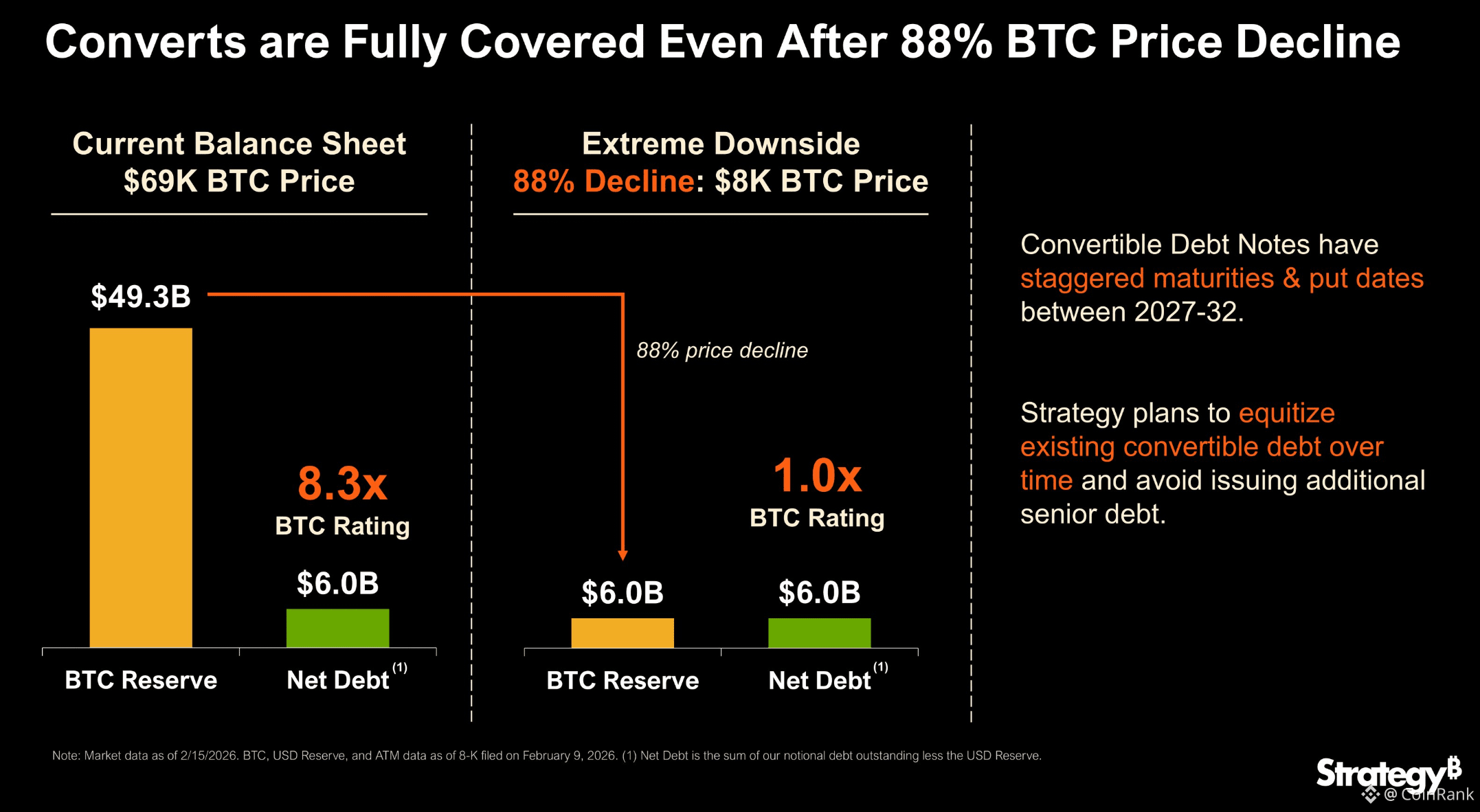
Michael Saylor: Selling #Bitcoin Is an Option Michael Saylor said Strategy no longer maintains a strict “buy-only” stance on #Bitcoin , noting that selling #BTC is now an option. The comment comes as the firm reported significant unrealized losses tied to BTC price fluctuations, a move some investors say could raise expectations of early selling pressure across the #Crypto market.
Michael Saylor: Selling #Bitcoin Is an Option

Michael Saylor said Strategy no longer maintains a strict “buy-only” stance on #Bitcoin , noting that selling #BTC is now an option.

The comment comes as the firm reported significant unrealized losses tied to BTC price fluctuations, a move some investors say could raise expectations of early selling pressure across the #Crypto market.
🔍 Weekly Crypto Overview Market divergence persisted over the week, with sharp gains in select small- and mid-cap tokens amid broad market weakness. Gainers: $BUTTCOIN +204.1% · $ARC +95.1% · $CYS +67.2% · $POKT +62.6% · $C98 +53.9% Losers: $RIVER −62.2% · $USELESS −43.2% · $AIX −41.9% · $HUMA −41.6% · $MARSMI −41.0% Trending: $BTC · $HYPE · $XRP · $PENGU · $SOL Funding: Anchorage ($100M) · TRM Labs ($70M) · Jupiter ($35M) · Prometheum ($23M) · Bluff ($21M) · Relay ($17M) #CoinRank #CryptoOverview
🔍 Weekly Crypto Overview

Market divergence persisted over the week, with sharp gains in select small- and mid-cap tokens amid broad market weakness.

Gainers:
$BUTTCOIN +204.1% · $ARC +95.1% · $CYS +67.2% · $POKT +62.6% · $C98 +53.9%

Losers:
$RIVER −62.2% · $USELESS −43.2% · $AIX −41.9% · $HUMA −41.6% · $MARSMI −41.0%

Trending:
$BTC · $HYPE · $XRP · $PENGU · $SOL

Funding:
Anchorage ($100M) · TRM Labs ($70M) · Jupiter ($35M) · Prometheum ($23M) · Bluff ($21M) · Relay ($17M)

#CoinRank #CryptoOverview
⏰ 2026/02/02 - 2026/02/08 | This Week's Key Events: What Did You Miss? This week, the Crypto market focused on ProjectUpdates, TokenSupply dynamics, and key Macro signals. Major developments included Binance listing stock perpetual contracts for MicroStrategy (MSTR) and Robinhood (HOOD), Matrixport launching stablecoin-linked equity investment products, and Stable completing its v1.2.0 mainnet upgrade. On the Token side, supply dynamics remained in focus. CoinList opened the public sale of Flying Tulip (FT), while the Hyperliquid team distributed 14.04 million unlocked HYPE tokens, keeping TokenUnlocks and post-#TGE activity on the radar. From a #Macro and #Regulation perspective, markets digested a series of global signals. Highlights included the release of U.S. labor market data, policy updates from the Bank of Japan, Reserve Bank of Australia, and Bank of England, alongside Japan’s early general election, adding to broader #MarketSentiment and #GlobalRisk discussions. #CoinRank #WeeklyRecap
⏰ 2026/02/02 - 2026/02/08 | This Week's Key Events: What Did You Miss?

This week, the Crypto market focused on ProjectUpdates, TokenSupply dynamics, and key Macro signals. Major developments included Binance listing stock perpetual contracts for MicroStrategy (MSTR) and Robinhood (HOOD), Matrixport launching stablecoin-linked equity investment products, and Stable completing its v1.2.0 mainnet upgrade.

On the Token side, supply dynamics remained in focus. CoinList opened the public sale of Flying Tulip (FT), while the Hyperliquid team distributed 14.04 million unlocked HYPE tokens, keeping TokenUnlocks and post-#TGE activity on the radar.

From a #Macro and #Regulation perspective, markets digested a series of global signals. Highlights included the release of U.S. labor market data, policy updates from the Bank of Japan, Reserve Bank of Australia, and Bank of England, alongside Japan’s early general election, adding to broader #MarketSentiment and #GlobalRisk discussions.

#CoinRank #WeeklyRecap
Crypto-friendly #ErebörBank secures a U.S. #NationalBank charter According to The Wall Street Journal, crypto-friendly Erebör Bank has received approval to operate as a U.S. national bank, becoming the first newly established bank to obtain a federal charter during the Trump administration’s second term, marking a notable signal for Crypto and Banking regulation. The Office of the Comptroller of the Currency (#OCC ) has confirmed that Erebör Bank’s charter application has been officially approved, highlighting a potential shift in the U.S. #Regulatory stance toward #DigitalAssets .
Crypto-friendly #ErebörBank secures a U.S. #NationalBank charter

According to The Wall Street Journal, crypto-friendly Erebör Bank has received approval to operate as a U.S. national bank, becoming the first newly established bank to obtain a federal charter during the Trump administration’s second term, marking a notable signal for Crypto and Banking regulation.

The Office of the Comptroller of the Currency (#OCC ) has confirmed that Erebör Bank’s charter application has been officially approved, highlighting a potential shift in the U.S. #Regulatory stance toward #DigitalAssets .
VanEck: Bitcoin Sell-Off Lacks Clear Trigger #VanEck says #Bitcoin ’s latest sell-off was driven by broad deleveraging rather than a single catalyst, making a clear market bottom harder to identify. VanEck digital assets research head #MatthewSigel notes factors include leverage unwinding, miner selling, cooling #Aİ narratives, and the typical four-year cycle psychology around #BTC .
VanEck: Bitcoin Sell-Off Lacks Clear Trigger

#VanEck says #Bitcoin ’s latest sell-off was driven by broad deleveraging rather than a single catalyst, making a clear market bottom harder to identify. VanEck digital assets research head #MatthewSigel notes factors include leverage unwinding, miner selling, cooling #Aİ narratives, and the typical four-year cycle psychology around #BTC .
🇨🇳CHINA REINFORCES CRYPTO MINING CRACKDOWN China’s eight major government departments have pledged to continue their crackdown on virtual currency mining, citing concerns over energy consumption, carbon emissions, and financial risk. Key implications: ➡️ Domestic crypto mining has virtually no policy room left ➡️ Regulatory focus remains on energy security and financial stability ➡️ Hashrate migration and offshore compliance will keep accelerating For miners and mining capital, global deployment and regulatory alignment are no longer optional — they are strategic necessities. #Bitcoin #Mining
🇨🇳CHINA REINFORCES CRYPTO MINING CRACKDOWN

China’s eight major government departments have pledged to continue their crackdown on virtual currency mining, citing concerns over energy consumption, carbon emissions, and financial risk.

Key implications:

➡️ Domestic crypto mining has virtually no policy room left
➡️ Regulatory focus remains on energy security and financial stability
➡️ Hashrate migration and offshore compliance will keep accelerating

For miners and mining capital, global deployment and regulatory alignment are no longer optional — they are strategic necessities.

#Bitcoin #Mining
🎙️ Why On-Chain Credit Identity Matters
background
avatar
Finalizado
01 h 00 m 59 s
174
5
0
MICHAEL SAYLOR: BITCOIN TO PREPARE FOR QUANTUM-RESISTANT UPGRADES TO MITIGATE FUTURE RISKS 🟠 Michael Saylor revealed during Strategy’s earnings call that the company will launch a “Bitcoin Security Program” to address long-term threats such as quantum computing, in collaboration with global cybersecurity organizations. He noted that quantum risks may not materialize for another 10+ years, with multiple teams already developing quantum-resistant solutions. Bitcoin’s upgradeability will strengthen network resilience, but timing is crucial—acting too early or too late both carries risks. #Bitcoin #Web3
MICHAEL SAYLOR: BITCOIN TO PREPARE FOR QUANTUM-RESISTANT UPGRADES TO MITIGATE FUTURE RISKS

🟠 Michael Saylor revealed during Strategy’s earnings call that the company will launch a “Bitcoin Security Program” to address long-term threats such as quantum computing, in collaboration with global cybersecurity organizations.

He noted that quantum risks may not materialize for another 10+ years, with multiple teams already developing quantum-resistant solutions. Bitcoin’s upgradeability will strengthen network resilience, but timing is crucial—acting too early or too late both carries risks.

#Bitcoin #Web3
🎬TIM SCOTT: WHITE HOUSE TALKS SIGNAL POSITIVE MOMENTUM, CRYPTO LEGISLATION MAY BREAK DEADLOCK
#CZ SAID HE IS WORKING WITH MULTIPLE COUNTRIES TO PROMOTE THE ISSUANCE AND ADOPTION OF LOCAL-CURRENCY STABLECOINS.
📉 Market sentiment continues to weaken as the Crypto Fear & Greed Index falls to 5, entering the “Extreme Fear” zone, with risk-averse behavior clearly intensifying among investors. #bitcoin #CryptoMarket
📉 Market sentiment continues to weaken as the Crypto Fear & Greed Index falls to 5, entering the “Extreme Fear” zone, with risk-averse behavior clearly intensifying among investors.

#bitcoin #CryptoMarket
Inicia sesión para explorar más contenidos
Conoce las noticias más recientes del sector
⚡️ Participa en los últimos debates del mundo cripto
💬 Interactúa con tus creadores favoritos
👍 Disfruta contenido de tu interés
Email/número de teléfono
Mapa del sitio
Preferencias de cookies
Términos y condiciones de la plataforma