

#tokenomics
tokenomics
2.1M vistas
4,714 están debatiendo
Hot
Lo último

·
--
El motor deflacionario oculto de Bitcoin: por qué la oferta circulante es menor de lo que crees
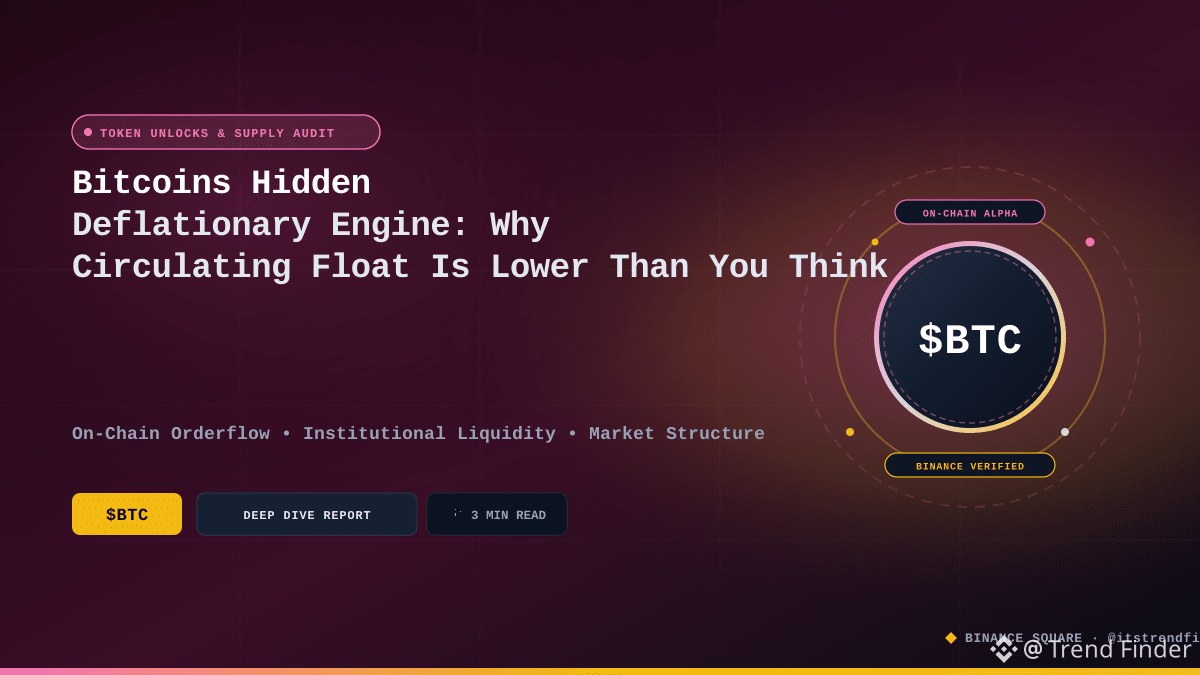
Mientras que los paneles habituales de desbloqueo de tokens se centran en los agresivos periodos de adquisición de derechos del capital de riesgo para los nuevos protocolos de capa 1, Bitcoin funciona según un paradigma económico completamente distinto. Con la reducción a la mitad de abril, que recortó la emisión diaria de 900 a 450 monedas, el crecimiento anual de la oferta cayó por debajo del 0,85 %. Pero si nos limitamos a analizar el calendario de emisión del protocolo, pasamos por alto más de la mitad de la realidad del lado de la oferta.
A diferencia de las altcoins, que afrontan desbloqueos periódicos que diluyen la oferta, $BTC experimenta una reducción orgánica y no programada de la oferta todos los días. Los análisis forenses de la cadena indican que alrededor de 3,7 millones de monedas han quedado permanentemente fuera de circulación debido a la pérdida de claves privadas, la inactividad de monederos de los primeros años y recompensas de minería iniciales irrecuperables. Si restamos estas monedas perdidas de los 19,7 millones minados hasta la fecha, la oferta circulante efectiva real se acerca más a los 16 millones de monedas.
Con el precio al contado rondando los 80060 USD, la oferta ilíquida que mantienen entidades a largo plazo durante más de un año continúa en máximos de varios años. Esta reducida oferta ilíquida permite que el mercado absorba sin esfuerzo la emisión diaria de los mineros. A diferencia de los bancos centrales que expanden sin cesar la oferta de dinero fiduciario, BTC combina un límite estricto de 21 millones con una iliquidez estructural continua, lo que genera una contracción acumulativa de la oferta a lo largo de ciclos de varios años.
La verdadera pregunta no es solo cuántas monedas nuevas entran al mercado con cada bloque, sino cuántas están realmente disponibles para que los compradores al contado las absorban ahora mismo. ¿Sigues la oferta líquida efectiva o solo te fijas en la capitalización de mercado total?
#TokenUnlocks #Tokenomics
El motor deflacionario oculto de Bitcoin: por qué la oferta circulante es menor de lo que crees
Mientras que los paneles habituales de desbloqueo de tokens se centran en los agresivos periodos de adquisición de derechos del capital de riesgo para los nuevos protocolos de capa 1, Bitcoin funciona según un paradigma económico completamente distinto. Con la reducción a la mitad de abril, que recortó la emisión diaria de 900 a 450 monedas, el crecimiento anual de la oferta cayó por debajo del 0,85 %. Pero si nos limitamos a analizar el calendario de emisión del protocolo, pasamos por alto más de la mitad de la realidad del lado de la oferta.
A diferencia de las altcoins, que afrontan desbloqueos periódicos que diluyen la oferta, $BTC experimenta una reducción orgánica y no programada de la oferta todos los días. Los análisis forenses de la cadena indican que alrededor de 3,7 millones de monedas han quedado permanentemente fuera de circulación debido a la pérdida de claves privadas, la inactividad de monederos de los primeros años y recompensas de minería iniciales irrecuperables. Si restamos estas monedas perdidas de los 19,7 millones minados hasta la fecha, la oferta circulante efectiva real se acerca más a los 16 millones de monedas.
Con el precio al contado rondando los 80060 USD, la oferta ilíquida que mantienen entidades a largo plazo durante más de un año continúa en máximos de varios años. Esta reducida oferta ilíquida permite que el mercado absorba sin esfuerzo la emisión diaria de los mineros. A diferencia de los bancos centrales que expanden sin cesar la oferta de dinero fiduciario, BTC combina un límite estricto de 21 millones con una iliquidez estructural continua, lo que genera una contracción acumulativa de la oferta a lo largo de ciclos de varios años.
La verdadera pregunta no es solo cuántas monedas nuevas entran al mercado con cada bloque, sino cuántas están realmente disponibles para que los compradores al contado las absorban ahora mismo. ¿Sigues la oferta líquida efectiva o solo te fijas en la capitalización de mercado total?
#TokenUnlocks #Tokenomics
Mientras que los paneles habituales de desbloqueo de tokens se centran en los agresivos periodos de adquisición de derechos del capital de riesgo para los nuevos protocolos de capa 1, Bitcoin funciona según un paradigma económico completamente distinto. Con la reducción a la mitad de abril, que recortó la emisión diaria de 900 a 450 monedas, el crecimiento anual de la oferta cayó por debajo del 0,85 %. Pero si nos limitamos a analizar el calendario de emisión del protocolo, pasamos por alto más de la mitad de la realidad del lado de la oferta.
A diferencia de las altcoins, que afrontan desbloqueos periódicos que diluyen la oferta, $BTC experimenta una reducción orgánica y no programada de la oferta todos los días. Los análisis forenses de la cadena indican que alrededor de 3,7 millones de monedas han quedado permanentemente fuera de circulación debido a la pérdida de claves privadas, la inactividad de monederos de los primeros años y recompensas de minería iniciales irrecuperables. Si restamos estas monedas perdidas de los 19,7 millones minados hasta la fecha, la oferta circulante efectiva real se acerca más a los 16 millones de monedas.
Con el precio al contado rondando los 80060 USD, la oferta ilíquida que mantienen entidades a largo plazo durante más de un año continúa en máximos de varios años. Esta reducida oferta ilíquida permite que el mercado absorba sin esfuerzo la emisión diaria de los mineros. A diferencia de los bancos centrales que expanden sin cesar la oferta de dinero fiduciario, BTC combina un límite estricto de 21 millones con una iliquidez estructural continua, lo que genera una contracción acumulativa de la oferta a lo largo de ciclos de varios años.
La verdadera pregunta no es solo cuántas monedas nuevas entran al mercado con cada bloque, sino cuántas están realmente disponibles para que los compradores al contado las absorban ahora mismo. ¿Sigues la oferta líquida efectiva o solo te fijas en la capitalización de mercado total?
#TokenUnlocks #Tokenomics


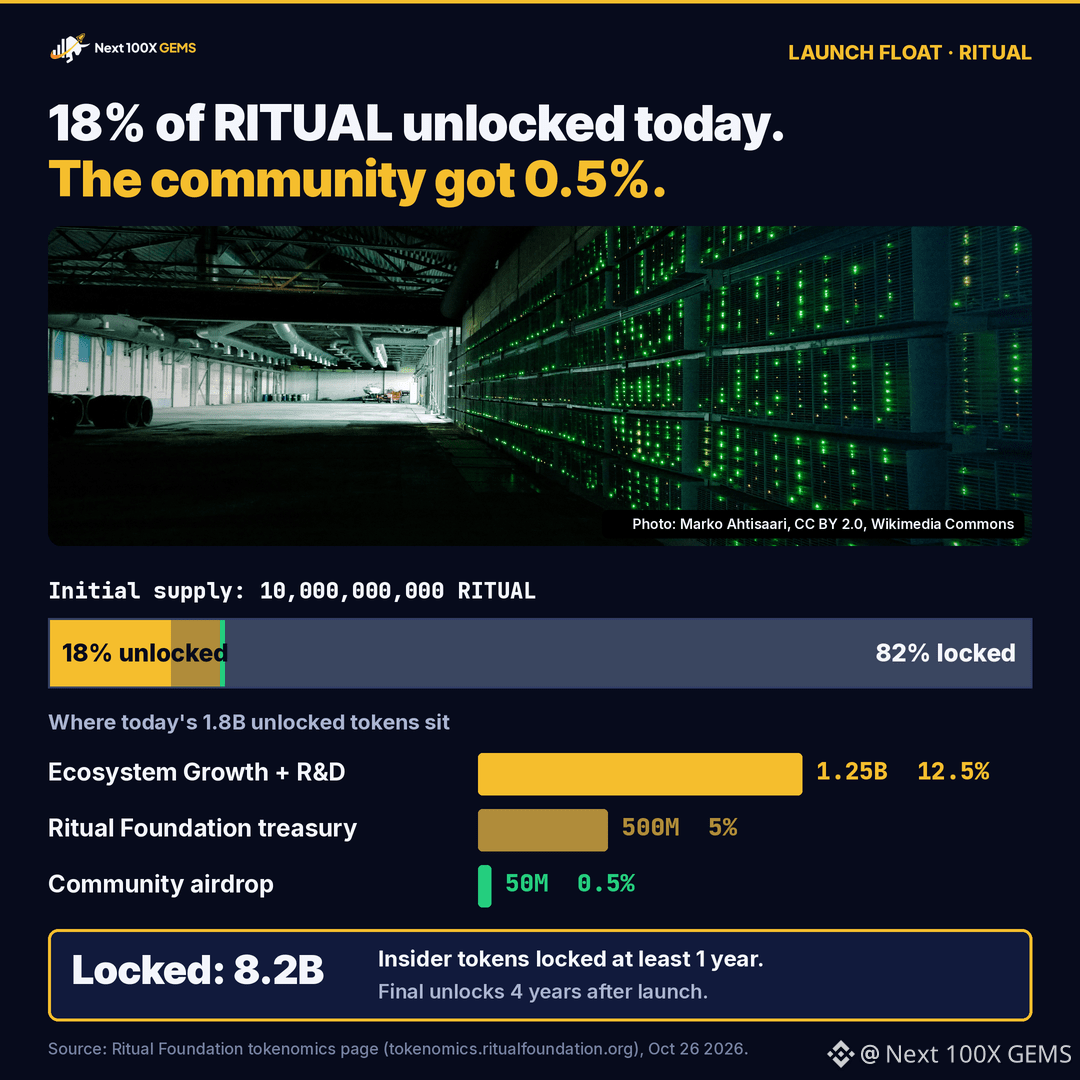
Ritual se lanzó hoy en la mainnet, y la página del token indica que el 18 % de RITUAL se desbloquea en el lanzamiento. Eso equivale a 1,8 mil millones de tokens de un suministro inicial de 10 mil millones. Coinbase también añadió hoy RITUAL-USD; las operaciones comenzarán cuando se cumplan las condiciones de liquidez.
Lo que vale la pena leer dos veces es de dónde salen esos 1,8 mil millones. 1.250 millones provienen del fondo de Crecimiento del Ecosistema + I+D y 500 millones de la tesorería de la Fundación Ritual. El airdrop comunitario para operadores de nodos, usuarios de Frenrug y miembros de larga trayectoria es de 50 millones de tokens, el 0,5 % del suministro, totalmente desbloqueados.
Así que el 97 % de la oferta circulante del primer día está en manos del proyecto, no de quienes buscan sacar provecho del airdrop. Si intentas evaluar la presión vendedora esta semana, las billeteras del airdrop son la parte menor de la historia. Lo importante sería que las billeteras de la Fundación y del ecosistema transfirieran tokens a exchanges.
Los otros 8.200 millones están bloqueados. Los colaboradores principales (29 %) y los inversores de Labs (11,3 %) deben esperar al menos un año, y los últimos tokens se desbloquearán cuatro años después del lanzamiento. Además, el suministro no tiene límite: se emite alrededor de un 5 % anual, compensado en parte por la quema de las comisiones base.
Antes de operar con el token tras su inclusión, revisa los cálculos de la oferta circulante, no solo el gráfico.
$RITUAL
#Ritual #Tokenomics
Esto no es asesoramiento financiero. Investiga por tu cuenta.
Ritual se lanzó hoy en la mainnet, y la página del token indica que el 18 % de RITUAL se desbloquea en el lanzamiento. Eso equivale a 1,8 mil millones de tokens de un suministro inicial de 10 mil millones. Coinbase también añadió hoy RITUAL-USD; las operaciones comenzarán cuando se cumplan las condiciones de liquidez.
Lo que vale la pena leer dos veces es de dónde salen esos 1,8 mil millones. 1.250 millones provienen del fondo de Crecimiento del Ecosistema + I+D y 500 millones de la tesorería de la Fundación Ritual. El airdrop comunitario para operadores de nodos, usuarios de Frenrug y miembros de larga trayectoria es de 50 millones de tokens, el 0,5 % del suministro, totalmente desbloqueados.
Así que el 97 % de la oferta circulante del primer día está en manos del proyecto, no de quienes buscan sacar provecho del airdrop. Si intentas evaluar la presión vendedora esta semana, las billeteras del airdrop son la parte menor de la historia. Lo importante sería que las billeteras de la Fundación y del ecosistema transfirieran tokens a exchanges.
Los otros 8.200 millones están bloqueados. Los colaboradores principales (29 %) y los inversores de Labs (11,3 %) deben esperar al menos un año, y los últimos tokens se desbloquearán cuatro años después del lanzamiento. Además, el suministro no tiene límite: se emite alrededor de un 5 % anual, compensado en parte por la quema de las comisiones base.
Antes de operar con el token tras su inclusión, revisa los cálculos de la oferta circulante, no solo el gráfico.
$RITUAL
#Ritual #Tokenomics
Esto no es asesoramiento financiero. Investiga por tu cuenta.
Lo que vale la pena leer dos veces es de dónde salen esos 1,8 mil millones. 1.250 millones provienen del fondo de Crecimiento del Ecosistema + I+D y 500 millones de la tesorería de la Fundación Ritual. El airdrop comunitario para operadores de nodos, usuarios de Frenrug y miembros de larga trayectoria es de 50 millones de tokens, el 0,5 % del suministro, totalmente desbloqueados.
Así que el 97 % de la oferta circulante del primer día está en manos del proyecto, no de quienes buscan sacar provecho del airdrop. Si intentas evaluar la presión vendedora esta semana, las billeteras del airdrop son la parte menor de la historia. Lo importante sería que las billeteras de la Fundación y del ecosistema transfirieran tokens a exchanges.
Los otros 8.200 millones están bloqueados. Los colaboradores principales (29 %) y los inversores de Labs (11,3 %) deben esperar al menos un año, y los últimos tokens se desbloquearán cuatro años después del lanzamiento. Además, el suministro no tiene límite: se emite alrededor de un 5 % anual, compensado en parte por la quema de las comisiones base.
Antes de operar con el token tras su inclusión, revisa los cálculos de la oferta circulante, no solo el gráfico.
$RITUAL
#Ritual #Tokenomics
Esto no es asesoramiento financiero. Investiga por tu cuenta.
48

$SHELL | Por qué difieren las cifras de capitalización de mercado entre sitios de datos
El informe de investigación encontró que las estimaciones recientes de capitalización de mercado $SHELL variaban entre aproximadamente 6 millones y 10,4 millones de dólares. También señaló una diferencia considerable en la oferta circulante declarada: algunas fuentes indicaban aproximadamente 270 millones de tokens y otras, alrededor de 458 millones.
Esta discrepancia importa porque la capitalización de mercado se calcula multiplicando el precio actual del token por la oferta circulante que utiliza el proveedor de datos.
Si dos plataformas utilizan cifras distintas de oferta circulante, sus estimaciones de capitalización de mercado pueden diferir incluso si muestran precios casi idénticos. Esto no significa automáticamente que una de las plataformas se haya equivocado, pero sí que es necesario comprobar la metodología utilizada.
Hay tres términos especialmente importantes.
La capitalización de mercado circulante utiliza la estimación del proveedor de los tokens que circulan actualmente.
La valoración totalmente diluida, o FDV, suele utilizar la oferta total o máxima de tokens especificada por la metodología pertinente.
La oferta total describe los tokens que se han creado, aunque el tratamiento exacto de los tokens bloqueados, quemados o restringidos de otro modo puede variar según el proveedor.
Estas métricas responden a preguntas diferentes. La capitalización de mercado estima el valor de la oferta circulante al precio actual, mientras que la FDV ilustra cómo sería la valoración bajo una hipótesis de oferta más amplia. Ninguna de las dos cifras, por sí sola, nos dice si un token es barato o caro.
Al comparar tokens, anota la fuente, la fecha y hora, la oferta circulante y el método de cálculo. Una metodología coherente hace que las comparaciones sean mucho más significativas.
#Tokenomics #MarketCap #DataQuality Fundamentos de educación sobre criptomonedas
$SHELL | Por qué difieren las cifras de capitalización de mercado entre sitios de datos
El informe de investigación encontró que las estimaciones recientes de capitalización de mercado $SHELL variaban entre aproximadamente 6 millones y 10,4 millones de dólares. También señaló una diferencia considerable en la oferta circulante declarada: algunas fuentes indicaban aproximadamente 270 millones de tokens y otras, alrededor de 458 millones.
Esta discrepancia importa porque la capitalización de mercado se calcula multiplicando el precio actual del token por la oferta circulante que utiliza el proveedor de datos.
Si dos plataformas utilizan cifras distintas de oferta circulante, sus estimaciones de capitalización de mercado pueden diferir incluso si muestran precios casi idénticos. Esto no significa automáticamente que una de las plataformas se haya equivocado, pero sí que es necesario comprobar la metodología utilizada.
Hay tres términos especialmente importantes.
La capitalización de mercado circulante utiliza la estimación del proveedor de los tokens que circulan actualmente.
La valoración totalmente diluida, o FDV, suele utilizar la oferta total o máxima de tokens especificada por la metodología pertinente.
La oferta total describe los tokens que se han creado, aunque el tratamiento exacto de los tokens bloqueados, quemados o restringidos de otro modo puede variar según el proveedor.
Estas métricas responden a preguntas diferentes. La capitalización de mercado estima el valor de la oferta circulante al precio actual, mientras que la FDV ilustra cómo sería la valoración bajo una hipótesis de oferta más amplia. Ninguna de las dos cifras, por sí sola, nos dice si un token es barato o caro.
Al comparar tokens, anota la fuente, la fecha y hora, la oferta circulante y el método de cálculo. Una metodología coherente hace que las comparaciones sean mucho más significativas.
#Tokenomics #MarketCap #DataQuality Fundamentos de educación sobre criptomonedas
El informe de investigación encontró que las estimaciones recientes de capitalización de mercado $SHELL variaban entre aproximadamente 6 millones y 10,4 millones de dólares. También señaló una diferencia considerable en la oferta circulante declarada: algunas fuentes indicaban aproximadamente 270 millones de tokens y otras, alrededor de 458 millones.
Esta discrepancia importa porque la capitalización de mercado se calcula multiplicando el precio actual del token por la oferta circulante que utiliza el proveedor de datos.
Si dos plataformas utilizan cifras distintas de oferta circulante, sus estimaciones de capitalización de mercado pueden diferir incluso si muestran precios casi idénticos. Esto no significa automáticamente que una de las plataformas se haya equivocado, pero sí que es necesario comprobar la metodología utilizada.
Hay tres términos especialmente importantes.
La capitalización de mercado circulante utiliza la estimación del proveedor de los tokens que circulan actualmente.
La valoración totalmente diluida, o FDV, suele utilizar la oferta total o máxima de tokens especificada por la metodología pertinente.
La oferta total describe los tokens que se han creado, aunque el tratamiento exacto de los tokens bloqueados, quemados o restringidos de otro modo puede variar según el proveedor.
Estas métricas responden a preguntas diferentes. La capitalización de mercado estima el valor de la oferta circulante al precio actual, mientras que la FDV ilustra cómo sería la valoración bajo una hipótesis de oferta más amplia. Ninguna de las dos cifras, por sí sola, nos dice si un token es barato o caro.
Al comparar tokens, anota la fuente, la fecha y hora, la oferta circulante y el método de cálculo. Una metodología coherente hace que las comparaciones sean mucho más significativas.
#Tokenomics #MarketCap #DataQuality Fundamentos de educación sobre criptomonedas

32
·
--
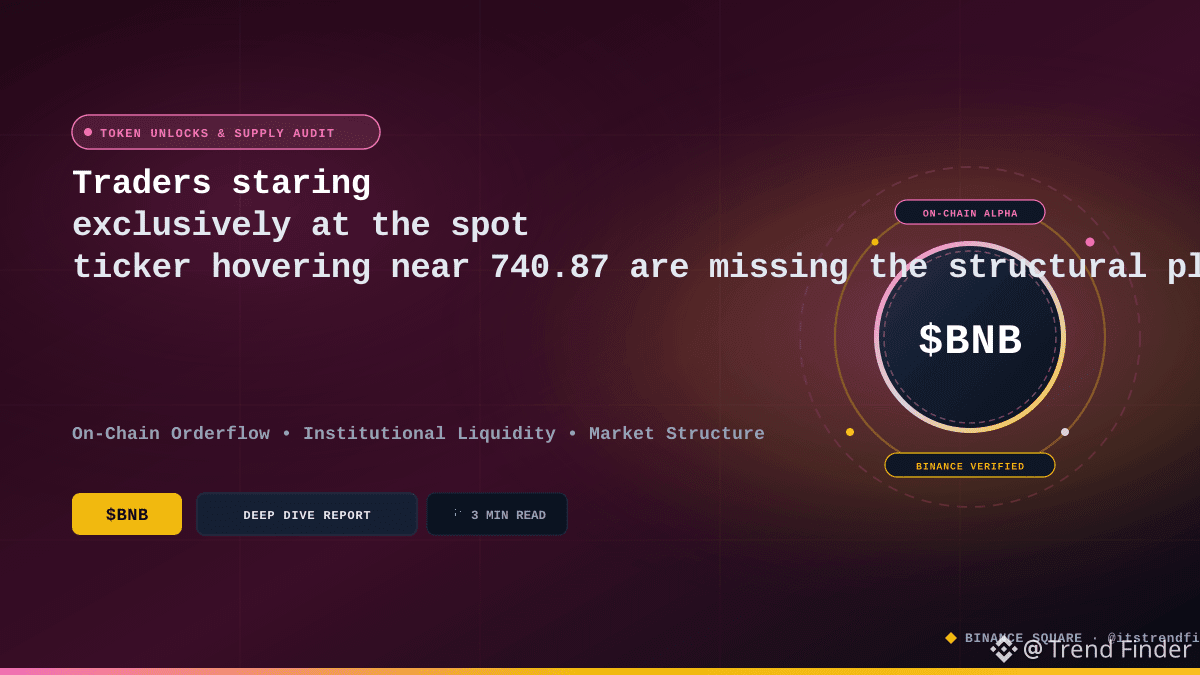
Los traders que solo miran la cotización spot, rondando los 740,87, están pasando por alto la estructura que está alterando silenciosamente toda la dinámica del mercado de $BNB. Mientras las altcoins tradicionales pierden liquidez debido a calendarios de vesting prolongados y desbloqueos recurrentes para los equipos, el ecosistema de Binance opera en una realidad completamente distinta. La era de la dilución de los primeros inversores quedó atrás y fue reemplazada por una contracción de la oferta implacable y automatizada que cambia el funcionamiento de la economía de la capa base.
El núcleo de esta contracción de la oferta reside en la velocidad constante del mecanismo Auto-Burn de BNB, junto con una participación masiva en staking. Si se compara la oferta circulante real con el volumen de comisiones del protocolo que se retiran permanentemente de circulación cada trimestre, la tasa neta de emisión cae profundamente en terreno negativo. A diferencia de las redes de capa uno inflacionarias, que luchan constantemente contra la presión vendedora de las emisiones, BNB funciona con un motor deflacionario impulsado por el reciclaje de los ingresos reales de la plataforma.
Además de los mecanismos de quema, un porcentaje extraordinario de la oferta total está actualmente bloqueado en nodos validadores y contratos de staking del ecosistema. Esto crea un intenso vacío de oferta en los libros de órdenes abiertos. El dinero institucional no está persiguiendo aquí olas de entusiasmo a corto plazo; está posicionándose en torno a las matemáticas de la capa base, donde la oferta disponible para negociar se reduce trimestre tras trimestre. Sin desbloqueos inminentes de gran magnitud ni excedentes de distribución de capital de riesgo que presionen los mercados spot, el desequilibrio entre la oferta y la demanda se vuelve matemáticamente considerable.
¿Estás incorporando estas profundas métricas deflacionarias a tu tesis a largo plazo o todavía te limitas a observar el libro de órdenes?
#TokenUnlocks #Tokenomics
Los traders que solo miran la cotización spot, rondando los 740,87, están pasando por alto la estructura que está alterando silenciosamente toda la dinámica del mercado de $BNB . Mientras las altcoins tradicionales pierden liquidez debido a calendarios de vesting prolongados y desbloqueos recurrentes para los equipos, el ecosistema de Binance opera en una realidad completamente distinta. La era de la dilución de los primeros inversores quedó atrás y fue reemplazada por una contracción de la oferta implacable y automatizada que cambia el funcionamiento de la economía de la capa base.
El núcleo de esta contracción de la oferta reside en la velocidad constante del mecanismo Auto-Burn de BNB, junto con una participación masiva en staking. Si se compara la oferta circulante real con el volumen de comisiones del protocolo que se retiran permanentemente de circulación cada trimestre, la tasa neta de emisión cae profundamente en terreno negativo. A diferencia de las redes de capa uno inflacionarias, que luchan constantemente contra la presión vendedora de las emisiones, BNB funciona con un motor deflacionario impulsado por el reciclaje de los ingresos reales de la plataforma.
Además de los mecanismos de quema, un porcentaje extraordinario de la oferta total está actualmente bloqueado en nodos validadores y contratos de staking del ecosistema. Esto crea un intenso vacío de oferta en los libros de órdenes abiertos. El dinero institucional no está persiguiendo aquí olas de entusiasmo a corto plazo; está posicionándose en torno a las matemáticas de la capa base, donde la oferta disponible para negociar se reduce trimestre tras trimestre. Sin desbloqueos inminentes de gran magnitud ni excedentes de distribución de capital de riesgo que presionen los mercados spot, el desequilibrio entre la oferta y la demanda se vuelve matemáticamente considerable.
¿Estás incorporando estas profundas métricas deflacionarias a tu tesis a largo plazo o todavía te limitas a observar el libro de órdenes?
#TokenUnlocks #Tokenomics
El núcleo de esta contracción de la oferta reside en la velocidad constante del mecanismo Auto-Burn de BNB, junto con una participación masiva en staking. Si se compara la oferta circulante real con el volumen de comisiones del protocolo que se retiran permanentemente de circulación cada trimestre, la tasa neta de emisión cae profundamente en terreno negativo. A diferencia de las redes de capa uno inflacionarias, que luchan constantemente contra la presión vendedora de las emisiones, BNB funciona con un motor deflacionario impulsado por el reciclaje de los ingresos reales de la plataforma.
Además de los mecanismos de quema, un porcentaje extraordinario de la oferta total está actualmente bloqueado en nodos validadores y contratos de staking del ecosistema. Esto crea un intenso vacío de oferta en los libros de órdenes abiertos. El dinero institucional no está persiguiendo aquí olas de entusiasmo a corto plazo; está posicionándose en torno a las matemáticas de la capa base, donde la oferta disponible para negociar se reduce trimestre tras trimestre. Sin desbloqueos inminentes de gran magnitud ni excedentes de distribución de capital de riesgo que presionen los mercados spot, el desequilibrio entre la oferta y la demanda se vuelve matemáticamente considerable.
¿Estás incorporando estas profundas métricas deflacionarias a tu tesis a largo plazo o todavía te limitas a observar el libro de órdenes?
#TokenUnlocks #Tokenomics
56

·
--
🔥 $APT SE AVECINA UNA CONTRACCIÓN DE LA OFERTA: ¡LA TASA ANUAL DE QUEMA ALCANZA LOS 1,8 M DE TOKENS! 📊
El dinero inteligente sigue la dinámica de la oferta mucho antes de que el precio refleje la contracción. $APT acaba de destruir 152,9 mil tokens solo en agosto, elevando la quema total de su red principal a más de 1,7 millones de tokens. 📊
Con una comisión promedio por transacción de apenas 0,0005 $, el uso de la red está aumentando y se proyecta una tasa anual de quema de 1,8 millones de APT. 🔍 La presión constante a la baja sobre la oferta, combinada con costos ultrabajos para los usuarios, crea un impulso estructural favorable para las estrategias de impulso a largo plazo.
🤔 ¿Crees que este mecanismo de quema constante provocará un shock macroeconómico de oferta para $APT , o estás esperando una confirmación de un mayor volumen de transacciones? 👇
⚠️ Esto no es asesoramiento financiero. Gestiona siempre tus riesgos. 🛡️
🏷️ #APT #Layer1 #Crypto #Tokenomics
⚡ 💎
🔥 $APT SE AVECINA UNA CONTRACCIÓN DE LA OFERTA: ¡LA TASA ANUAL DE QUEMA ALCANZA LOS 1,8 M DE TOKENS! 📊
El dinero inteligente sigue la dinámica de la oferta mucho antes de que el precio refleje la contracción. $APT acaba de destruir 152,9 mil tokens solo en agosto, elevando la quema total de su red principal a más de 1,7 millones de tokens. 📊
Con una comisión promedio por transacción de apenas 0,0005 $, el uso de la red está aumentando y se proyecta una tasa anual de quema de 1,8 millones de APT. 🔍 La presión constante a la baja sobre la oferta, combinada con costos ultrabajos para los usuarios, crea un impulso estructural favorable para las estrategias de impulso a largo plazo.
🤔 ¿Crees que este mecanismo de quema constante provocará un shock macroeconómico de oferta para $APT , o estás esperando una confirmación de un mayor volumen de transacciones? 👇
⚠️ Esto no es asesoramiento financiero. Gestiona siempre tus riesgos. 🛡️
🏷️ #APT #Layer1 #Crypto #Tokenomics
⚡ 💎
El dinero inteligente sigue la dinámica de la oferta mucho antes de que el precio refleje la contracción. $APT acaba de destruir 152,9 mil tokens solo en agosto, elevando la quema total de su red principal a más de 1,7 millones de tokens. 📊
Con una comisión promedio por transacción de apenas 0,0005 $, el uso de la red está aumentando y se proyecta una tasa anual de quema de 1,8 millones de APT. 🔍 La presión constante a la baja sobre la oferta, combinada con costos ultrabajos para los usuarios, crea un impulso estructural favorable para las estrategias de impulso a largo plazo.
🤔 ¿Crees que este mecanismo de quema constante provocará un shock macroeconómico de oferta para $APT , o estás esperando una confirmación de un mayor volumen de transacciones? 👇
⚠️ Esto no es asesoramiento financiero. Gestiona siempre tus riesgos. 🛡️
🏷️ #APT #Layer1 #Crypto #Tokenomics
⚡ 💎
20

·
--
Alcista
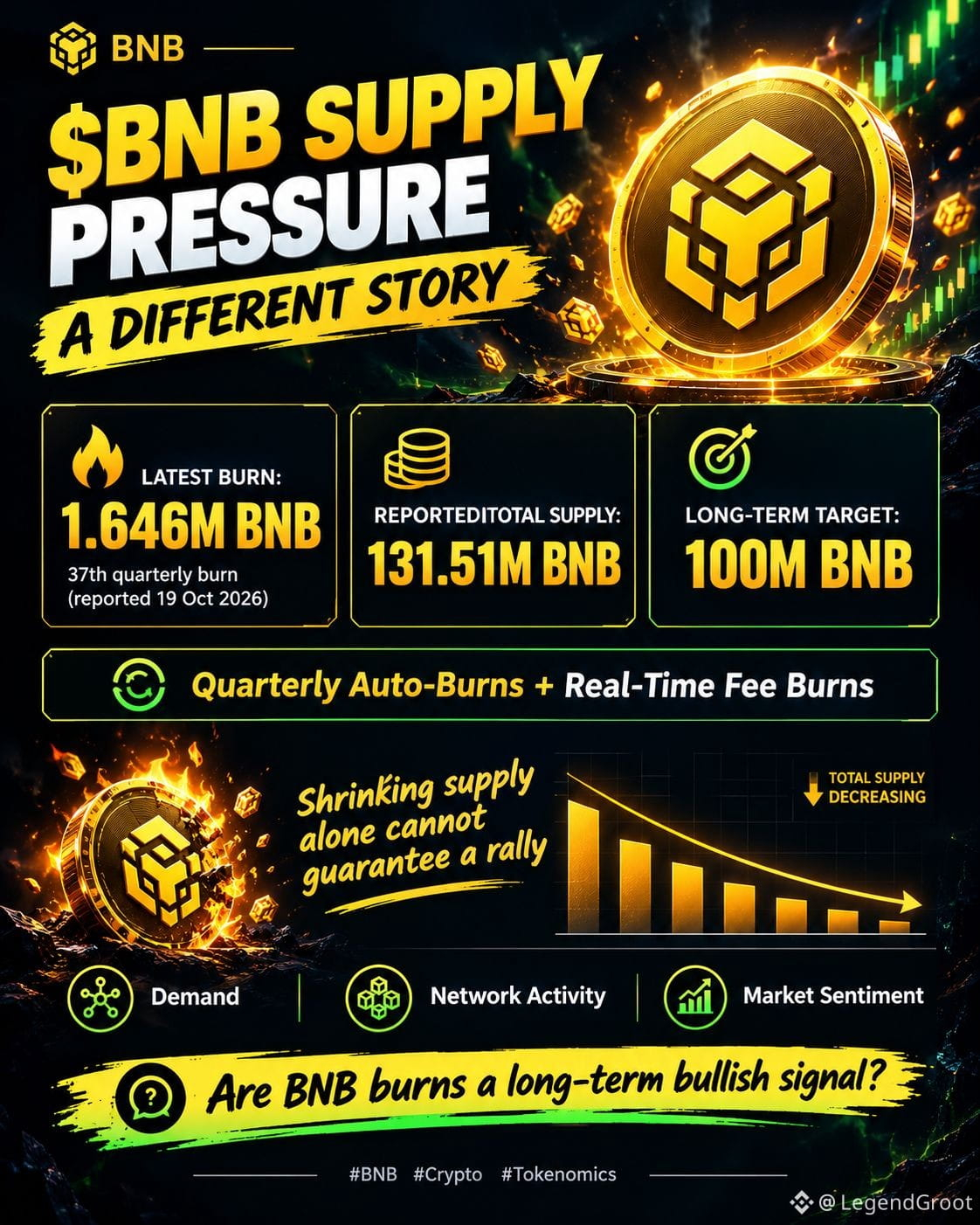
🚨 $BNB ¡LA OFERTA CUENTA OTRA HISTORIA!
A diferencia de los tokens que afrontan grandes desbloqueos programados, BNB está diseñado para reducir su oferta mediante quemas automáticas trimestrales y quemas de comisiones en tiempo real.
🔥 Última quema: 1,646 millones de BNB
📉 Oferta total declarada: 131,51 millones de BNB
🎯 Objetivo a largo plazo: 100 millones de BNB
Pero recuerda que reducir la oferta por sí solo no garantiza una subida de precio. La demanda, la actividad de la red y el sentimiento del mercado también importan.
¿Son las quemas de BNB una señal alcista a largo plazo? 👀
#BNB #Crypto #Tokenomics
🚨 $BNB ¡LA OFERTA CUENTA OTRA HISTORIA!
A diferencia de los tokens que afrontan grandes desbloqueos programados, BNB está diseñado para reducir su oferta mediante quemas automáticas trimestrales y quemas de comisiones en tiempo real.
🔥 Última quema: 1,646 millones de BNB
📉 Oferta total declarada: 131,51 millones de BNB
🎯 Objetivo a largo plazo: 100 millones de BNB
Pero recuerda que reducir la oferta por sí solo no garantiza una subida de precio. La demanda, la actividad de la red y el sentimiento del mercado también importan.
¿Son las quemas de BNB una señal alcista a largo plazo? 👀
#BNB #Crypto #Tokenomics
A diferencia de los tokens que afrontan grandes desbloqueos programados, BNB está diseñado para reducir su oferta mediante quemas automáticas trimestrales y quemas de comisiones en tiempo real.
🔥 Última quema: 1,646 millones de BNB
📉 Oferta total declarada: 131,51 millones de BNB
🎯 Objetivo a largo plazo: 100 millones de BNB
Pero recuerda que reducir la oferta por sí solo no garantiza una subida de precio. La demanda, la actividad de la red y el sentimiento del mercado también importan.
¿Son las quemas de BNB una señal alcista a largo plazo? 👀
#BNB #Crypto #Tokenomics
172

·
--
💡 ¡Una criptomoneda de $0.01 no siempre es barata!
Muchos principiantes ven una moneda que cuesta $0.01 y creen que tiene un enorme potencial de crecimiento.
Pero el precio de una moneda no cuenta toda la historia. 👇
📊 Ejemplo:
🔹 Moneda A: precio de $0.01 × 100 mil millones de tokens = capitalización de mercado de $1 mil millones.
🔹 Moneda B: precio de $100 × 10 millones de tokens = capitalización de mercado de $1 mil millones.
Ambas tienen la misma capitalización de mercado, a pesar de que sus precios por moneda son muy diferentes.
Antes de invertir, fíjate en:
✅ Capitalización de mercado
✅ Oferta circulante
✅ Valoración totalmente diluida (FDV)
✅ Desbloqueos de tokens e inflación de la oferta
Un precio bajo por token no significa automáticamente que una moneda esté infravalorada.
¿Compruebas la capitalización de mercado antes de comprar una moneda o te fijas principalmente en su precio? 👇
Sígueme para recibir información diaria sobre criptomonedas y novedades del mercado. 🚀📊
#CryptoEducation #MarketCap #Altcoins #Tokenomics #BinanceSquare
💡 ¡Una criptomoneda de $0.01 no siempre es barata!
Muchos principiantes ven una moneda que cuesta $0.01 y creen que tiene un enorme potencial de crecimiento.
Pero el precio de una moneda no cuenta toda la historia. 👇
📊 Ejemplo:
🔹 Moneda A: precio de $0.01 × 100 mil millones de tokens = capitalización de mercado de $1 mil millones.
🔹 Moneda B: precio de $100 × 10 millones de tokens = capitalización de mercado de $1 mil millones.
Ambas tienen la misma capitalización de mercado, a pesar de que sus precios por moneda son muy diferentes.
Antes de invertir, fíjate en:
✅ Capitalización de mercado
✅ Oferta circulante
✅ Valoración totalmente diluida (FDV)
✅ Desbloqueos de tokens e inflación de la oferta
Un precio bajo por token no significa automáticamente que una moneda esté infravalorada.
¿Compruebas la capitalización de mercado antes de comprar una moneda o te fijas principalmente en su precio? 👇
Sígueme para recibir información diaria sobre criptomonedas y novedades del mercado. 🚀📊
#CryptoEducation #MarketCap #Altcoins #Tokenomics #BinanceSquare
Muchos principiantes ven una moneda que cuesta $0.01 y creen que tiene un enorme potencial de crecimiento.
Pero el precio de una moneda no cuenta toda la historia. 👇
📊 Ejemplo:
🔹 Moneda A: precio de $0.01 × 100 mil millones de tokens = capitalización de mercado de $1 mil millones.
🔹 Moneda B: precio de $100 × 10 millones de tokens = capitalización de mercado de $1 mil millones.
Ambas tienen la misma capitalización de mercado, a pesar de que sus precios por moneda son muy diferentes.
Antes de invertir, fíjate en:
✅ Capitalización de mercado
✅ Oferta circulante
✅ Valoración totalmente diluida (FDV)
✅ Desbloqueos de tokens e inflación de la oferta
Un precio bajo por token no significa automáticamente que una moneda esté infravalorada.
¿Compruebas la capitalización de mercado antes de comprar una moneda o te fijas principalmente en su precio? 👇
Sígueme para recibir información diaria sobre criptomonedas y novedades del mercado. 🚀📊
#CryptoEducation #MarketCap #Altcoins #Tokenomics #BinanceSquare
1
106
·
--
Analizando hoy la dinámica de oferta de $ADA a 0.2054. La tasa de staking de ~70% está haciendo gran parte del trabajo al mantener la circulación efectiva muy ajustada. No hay grandes desbloqueos de vesting de capital riesgo en el horizonte, lo que significa poca presión inflacionaria neta. Un panorama saludable para la correlación de $BTC .
#TokenUnlocks #Tokenomics #ADA
Analizando hoy la dinámica de oferta de $ADA a 0.2054. La tasa de staking de ~70% está haciendo gran parte del trabajo al mantener la circulación efectiva muy ajustada. No hay grandes desbloqueos de vesting de capital riesgo en el horizonte, lo que significa poca presión inflacionaria neta. Un panorama saludable para la correlación de $BTC .
#TokenUnlocks #Tokenomics #ADA
#TokenUnlocks #Tokenomics #ADA
3

🚨 DESBLOQUEOS DE TOKENS: VE MÁS ALLÁ DEL TITULAR.
.
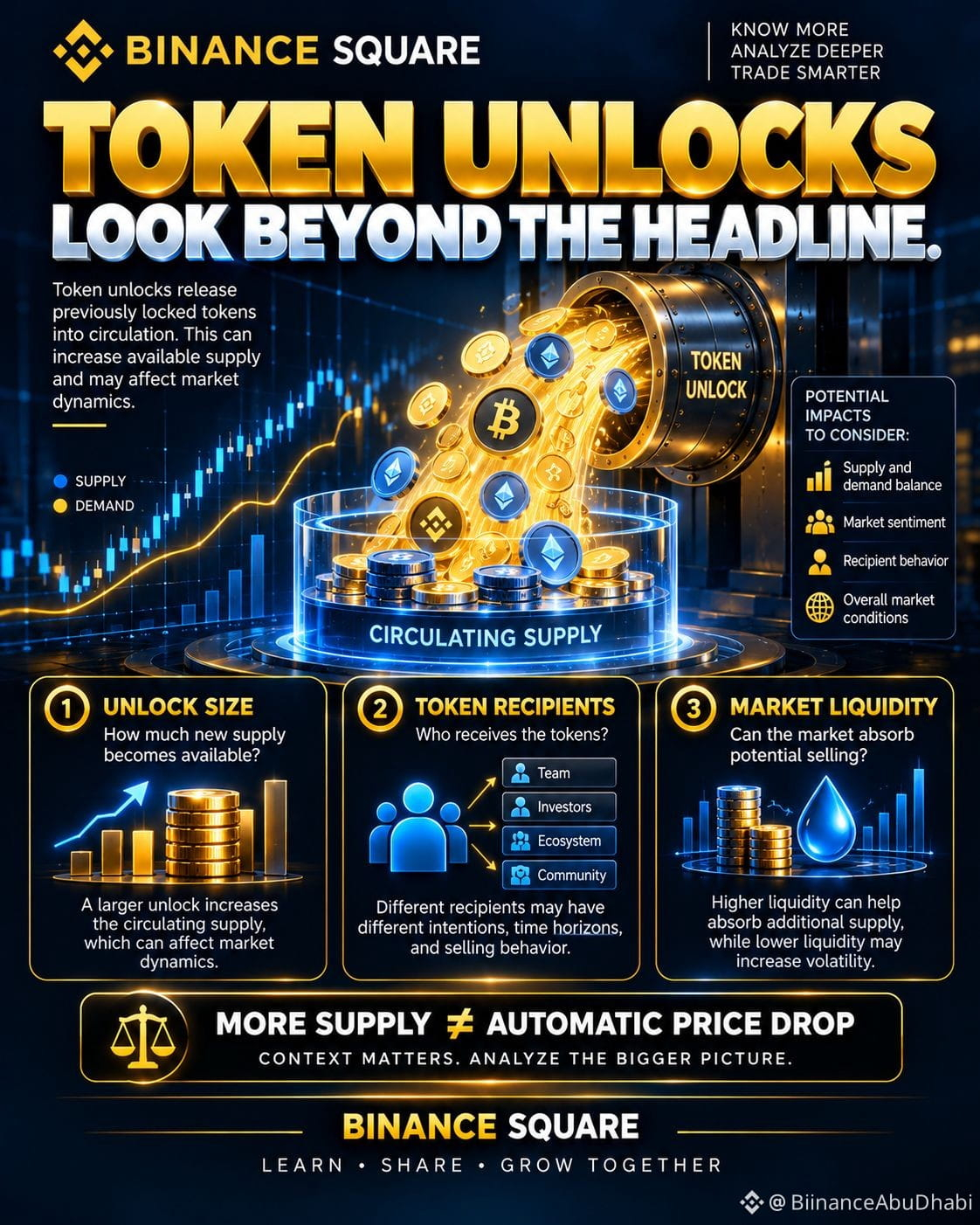
Un desbloqueo programado de tokens no significa automáticamente que el precio vaya a desplomarse. Pero puede cambiar el equilibrio entre la oferta y la demanda.
.
Antes de operar, comprueba tres cosas:
.
🔹 Tamaño del desbloqueo: ¿Qué parte de la oferta circulante quedará disponible?
🔹 Destinatarios: ¿Quién recibirá los tokens y qué podrían hacer con ellos?
🔹 Liquidez del mercado: ¿Puede el mercado absorber una posible presión vendedora?
.
Que haya más tokens disponibles no garantiza una venta masiva. El contexto importa más que los titulares.
.
Los traders inteligentes investigan la oferta, no solo el sentimiento del mercado.
.
¿Qué es lo primero que compruebas al investigar un desbloqueo de tokens?
.
#BTC $BTC #Tokenomics #CryptoEducation #TradingTips #BinanceSquare
🚨 DESBLOQUEOS DE TOKENS: VE MÁS ALLÁ DEL TITULAR.
.
Un desbloqueo programado de tokens no significa automáticamente que el precio vaya a desplomarse. Pero puede cambiar el equilibrio entre la oferta y la demanda.
.
Antes de operar, comprueba tres cosas:
.
🔹 Tamaño del desbloqueo: ¿Qué parte de la oferta circulante quedará disponible?
🔹 Destinatarios: ¿Quién recibirá los tokens y qué podrían hacer con ellos?
🔹 Liquidez del mercado: ¿Puede el mercado absorber una posible presión vendedora?
.
Que haya más tokens disponibles no garantiza una venta masiva. El contexto importa más que los titulares.
.
Los traders inteligentes investigan la oferta, no solo el sentimiento del mercado.
.
¿Qué es lo primero que compruebas al investigar un desbloqueo de tokens?
.
#BTC $BTC #Tokenomics #CryptoEducation #TradingTips #BinanceSquare
.
Un desbloqueo programado de tokens no significa automáticamente que el precio vaya a desplomarse. Pero puede cambiar el equilibrio entre la oferta y la demanda.
.
Antes de operar, comprueba tres cosas:
.
🔹 Tamaño del desbloqueo: ¿Qué parte de la oferta circulante quedará disponible?
🔹 Destinatarios: ¿Quién recibirá los tokens y qué podrían hacer con ellos?
🔹 Liquidez del mercado: ¿Puede el mercado absorber una posible presión vendedora?
.
Que haya más tokens disponibles no garantiza una venta masiva. El contexto importa más que los titulares.
.
Los traders inteligentes investigan la oferta, no solo el sentimiento del mercado.
.
¿Qué es lo primero que compruebas al investigar un desbloqueo de tokens?
.
#BTC $BTC #Tokenomics #CryptoEducation #TradingTips #BinanceSquare
16

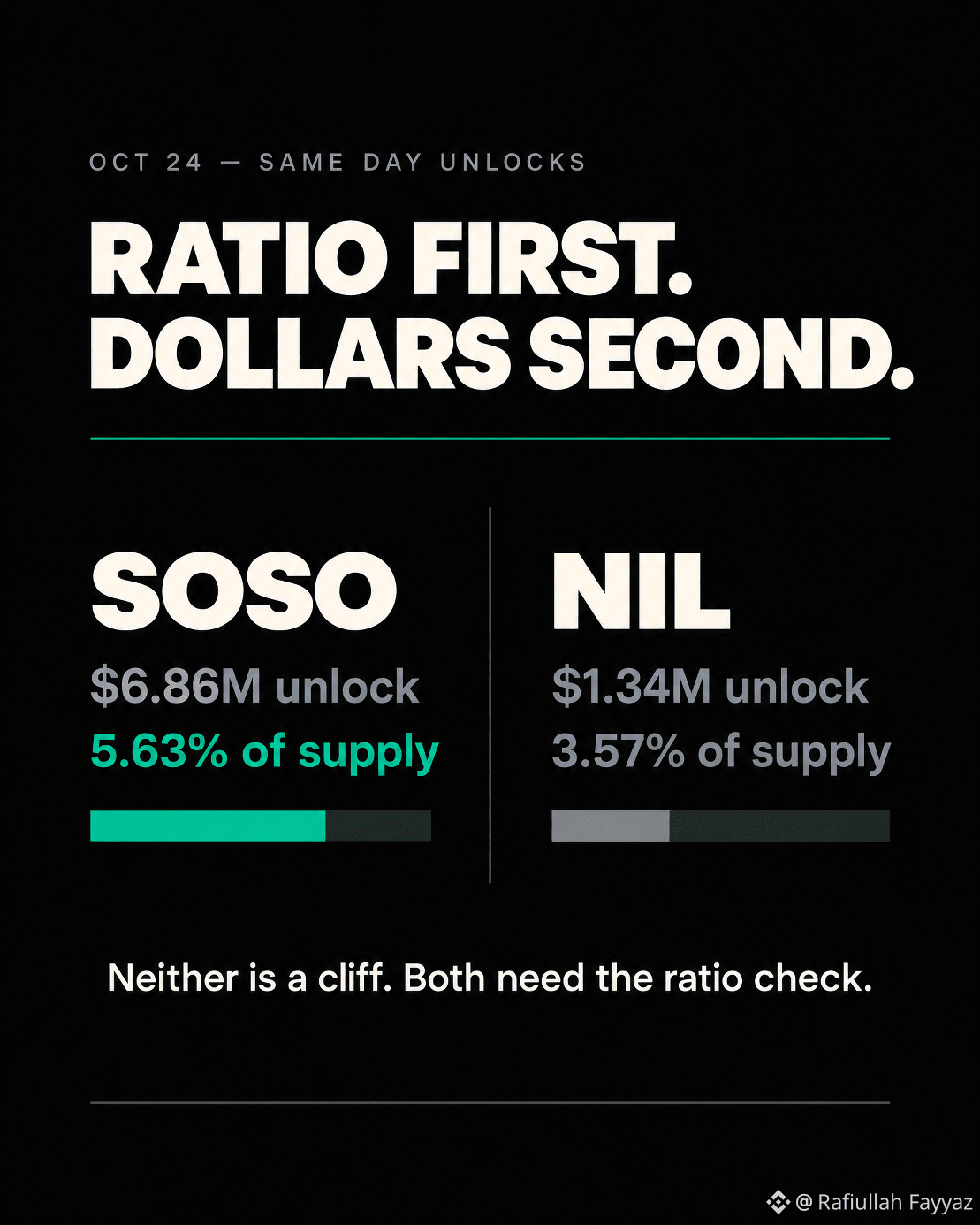
SOSO desbloqueó $6.86 millones hoy. NIL desbloquea $1.34 millones.
La cantidad en dólares de SOSO es cinco veces mayor. Pero el desbloqueo de SOSO representa el 5.63% de su suministro circulante. El de NIL, el 3.57%.
Ninguno es un desbloqueo abrupto. Ambos son porcentajes relativamente pequeños. Pero la comparación sigue siendo importante.
La mayoría de la gente evalúa los desbloqueos según su valor en dólares. Ese es el criterio equivocado. Un desbloqueo de $50M en un proyecto valorado en mil millones de dólares supone una dilución del 5%. Un desbloqueo de $5M en un proyecto de $40M supone una dilución del 12.5%. La cantidad menor en dólares representa el evento más grande.
Tanto SOSO como NIL están en el rango medio. Pero el marco de análisis es el mismo: primero el porcentaje, después los dólares.
$SOSO $NIL
#crypto #EducationalContent #Tokenomics #unlocks #BinanceSquare
{spot}(NILUSDT)
SOSO desbloqueó $6.86 millones hoy. NIL desbloquea $1.34 millones.
La cantidad en dólares de SOSO es cinco veces mayor. Pero el desbloqueo de SOSO representa el 5.63% de su suministro circulante. El de NIL, el 3.57%.
Ninguno es un desbloqueo abrupto. Ambos son porcentajes relativamente pequeños. Pero la comparación sigue siendo importante.
La mayoría de la gente evalúa los desbloqueos según su valor en dólares. Ese es el criterio equivocado. Un desbloqueo de $50M en un proyecto valorado en mil millones de dólares supone una dilución del 5%. Un desbloqueo de $5M en un proyecto de $40M supone una dilución del 12.5%. La cantidad menor en dólares representa el evento más grande.
Tanto SOSO como NIL están en el rango medio. Pero el marco de análisis es el mismo: primero el porcentaje, después los dólares.
$SOSO $NIL
#crypto #EducationalContent #Tokenomics #unlocks #BinanceSquare
La cantidad en dólares de SOSO es cinco veces mayor. Pero el desbloqueo de SOSO representa el 5.63% de su suministro circulante. El de NIL, el 3.57%.
Ninguno es un desbloqueo abrupto. Ambos son porcentajes relativamente pequeños. Pero la comparación sigue siendo importante.
La mayoría de la gente evalúa los desbloqueos según su valor en dólares. Ese es el criterio equivocado. Un desbloqueo de $50M en un proyecto valorado en mil millones de dólares supone una dilución del 5%. Un desbloqueo de $5M en un proyecto de $40M supone una dilución del 12.5%. La cantidad menor en dólares representa el evento más grande.
Tanto SOSO como NIL están en el rango medio. Pero el marco de análisis es el mismo: primero el porcentaje, después los dólares.
$SOSO $NIL
#crypto #EducationalContent #Tokenomics #unlocks #BinanceSquare
1
261

·
--
La tokenómica de Backpack(BP)vuelve a ser objeto de un intenso debate(2026-10-23): suministro total de 1.000 millones de tokens; desbloqueo del 25% en el TGE(240 millones para usuarios de puntos + 10 millones para Mad Lads); el 37,5% restante corresponde al fondo de hitos Pre-IPO y el otro 37,5% a la tesorería Post-IPO(bloqueada durante ≥1 año después de la IPO). Fundadores / ejecutivos / inversores: cero tokens y cero warrants. El staking ofrece descuentos en las comisiones; los tokens Pre-IPO pueden convertirse en una participación de hasta aproximadamente el ~20% del capital. Precio actual: aproximadamente ~$0,99; tasa de staking: aproximadamente ~56,4%(unos 140,88 millones de tokens).
Puntos clave del mecanismo: es una estructura de «cero asignación a personas internas + doble vía de hitos y tesorería» que vincula la liberación del suministro con la gobernanza posterior a la salida a bolsa, en lugar de seguir el desbloqueo lineal tradicional para equipos y fondos de capital riesgo. Que la tasa de staking supere la mitad implica una vinculación considerable con las restricciones de circulación y las comisiones, pero aún habrá que observar el ritmo de cumplimiento de los hitos y los detalles de ejecución de la conversión en participación accionaria.
Próximo punto a observar: si las condiciones que activan los hitos Pre-IPO se hacen públicas y pueden verificarse, y si la tasa de staking se mantiene por encima del 50% en mercados volátiles.
Fuentes: Crypto Briefing https://cryptobriefing.com/backpack-founder-extreme-tokenomics-no-insider-tokens/ ;Backpack https://backpack.exchange/bp ;Backpack oficial https://x.com/Backpack/status/2113643108449837214
#Backpack #BP #Web3 #Tokenomics $BP
Solo con fines informativos; no constituye asesoramiento de inversión / NFA
La tokenómica de Backpack(BP)vuelve a ser objeto de un intenso debate(2026-10-23): suministro total de 1.000 millones de tokens; desbloqueo del 25% en el TGE(240 millones para usuarios de puntos + 10 millones para Mad Lads); el 37,5% restante corresponde al fondo de hitos Pre-IPO y el otro 37,5% a la tesorería Post-IPO(bloqueada durante ≥1 año después de la IPO). Fundadores / ejecutivos / inversores: cero tokens y cero warrants. El staking ofrece descuentos en las comisiones; los tokens Pre-IPO pueden convertirse en una participación de hasta aproximadamente el ~20% del capital. Precio actual: aproximadamente ~$0,99; tasa de staking: aproximadamente ~56,4%(unos 140,88 millones de tokens).
Puntos clave del mecanismo: es una estructura de «cero asignación a personas internas + doble vía de hitos y tesorería» que vincula la liberación del suministro con la gobernanza posterior a la salida a bolsa, en lugar de seguir el desbloqueo lineal tradicional para equipos y fondos de capital riesgo. Que la tasa de staking supere la mitad implica una vinculación considerable con las restricciones de circulación y las comisiones, pero aún habrá que observar el ritmo de cumplimiento de los hitos y los detalles de ejecución de la conversión en participación accionaria.
Próximo punto a observar: si las condiciones que activan los hitos Pre-IPO se hacen públicas y pueden verificarse, y si la tasa de staking se mantiene por encima del 50% en mercados volátiles.
Fuentes: Crypto Briefing https://cryptobriefing.com/backpack-founder-extreme-tokenomics-no-insider-tokens/ ;Backpack https://backpack.exchange/bp ;Backpack oficial https://x.com/Backpack/status/2113643108449837214
#Backpack #BP #Web3 #Tokenomics $BP
Solo con fines informativos; no constituye asesoramiento de inversión / NFA
Puntos clave del mecanismo: es una estructura de «cero asignación a personas internas + doble vía de hitos y tesorería» que vincula la liberación del suministro con la gobernanza posterior a la salida a bolsa, en lugar de seguir el desbloqueo lineal tradicional para equipos y fondos de capital riesgo. Que la tasa de staking supere la mitad implica una vinculación considerable con las restricciones de circulación y las comisiones, pero aún habrá que observar el ritmo de cumplimiento de los hitos y los detalles de ejecución de la conversión en participación accionaria.
Próximo punto a observar: si las condiciones que activan los hitos Pre-IPO se hacen públicas y pueden verificarse, y si la tasa de staking se mantiene por encima del 50% en mercados volátiles.
Fuentes: Crypto Briefing https://cryptobriefing.com/backpack-founder-extreme-tokenomics-no-insider-tokens/ ;Backpack https://backpack.exchange/bp ;Backpack oficial https://x.com/Backpack/status/2113643108449837214
#Backpack #BP #Web3 #Tokenomics $BP
Solo con fines informativos; no constituye asesoramiento de inversión / NFA
26
·
--
Alcista
5 PREGUNTAS QUE DEBES RESPONDER ANTES DE INVERTIR EN UN TOKEN 🔍
No te fijes solo en el gráfico de precios ni te dejes llevar por la publicidad. Empieza investigando:
1️⃣ ¿Qué problema resuelve el proyecto?
¿Existe una necesidad real o solo depende de la atención de la comunidad?
2️⃣ ¿Para qué sirve el token?
¿Tiene una utilidad clara en el ecosistema o su valor se basa principalmente en las expectativas?
3️⃣ ¿Cómo es su tokenómica?
La oferta total, la cantidad en circulación, el calendario de desbloqueo de tokens y la asignación al equipo pueden influir en la presión vendedora.
4️⃣ ¿Cómo son el equipo y el ecosistema?
¿Hay un producto, actividad de desarrollo y usuarios reales?
5️⃣ ¿Cuál es el mayor riesgo?
¿La competencia, la seguridad, los aspectos legales, la liquidez o la dependencia de un grupo reducido?
Incluso en un ecosistema grande como Ethereum ($ETH ), investigar a fondo no puede garantizar ganancias.
En mi opinión, entender claramente por qué posees un activo es más importante que comprarlo solo porque otros lo están comprando.
Si solo pudieras elegir un factor para evaluar un proyecto cripto, ¿elegirías la tecnología, el equipo o la tokenómica?
#Ethereum #ETH #CryptoResearch #Tokenomics #Web3
{future}(ETHUSDT)
5 PREGUNTAS QUE DEBES RESPONDER ANTES DE INVERTIR EN UN TOKEN 🔍
No te fijes solo en el gráfico de precios ni te dejes llevar por la publicidad. Empieza investigando:
1️⃣ ¿Qué problema resuelve el proyecto?
¿Existe una necesidad real o solo depende de la atención de la comunidad?
2️⃣ ¿Para qué sirve el token?
¿Tiene una utilidad clara en el ecosistema o su valor se basa principalmente en las expectativas?
3️⃣ ¿Cómo es su tokenómica?
La oferta total, la cantidad en circulación, el calendario de desbloqueo de tokens y la asignación al equipo pueden influir en la presión vendedora.
4️⃣ ¿Cómo son el equipo y el ecosistema?
¿Hay un producto, actividad de desarrollo y usuarios reales?
5️⃣ ¿Cuál es el mayor riesgo?
¿La competencia, la seguridad, los aspectos legales, la liquidez o la dependencia de un grupo reducido?
Incluso en un ecosistema grande como Ethereum ($ETH ), investigar a fondo no puede garantizar ganancias.
En mi opinión, entender claramente por qué posees un activo es más importante que comprarlo solo porque otros lo están comprando.
Si solo pudieras elegir un factor para evaluar un proyecto cripto, ¿elegirías la tecnología, el equipo o la tokenómica?
#Ethereum #ETH #CryptoResearch #Tokenomics #Web3
No te fijes solo en el gráfico de precios ni te dejes llevar por la publicidad. Empieza investigando:
1️⃣ ¿Qué problema resuelve el proyecto?
¿Existe una necesidad real o solo depende de la atención de la comunidad?
2️⃣ ¿Para qué sirve el token?
¿Tiene una utilidad clara en el ecosistema o su valor se basa principalmente en las expectativas?
3️⃣ ¿Cómo es su tokenómica?
La oferta total, la cantidad en circulación, el calendario de desbloqueo de tokens y la asignación al equipo pueden influir en la presión vendedora.
4️⃣ ¿Cómo son el equipo y el ecosistema?
¿Hay un producto, actividad de desarrollo y usuarios reales?
5️⃣ ¿Cuál es el mayor riesgo?
¿La competencia, la seguridad, los aspectos legales, la liquidez o la dependencia de un grupo reducido?
Incluso en un ecosistema grande como Ethereum ($ETH ), investigar a fondo no puede garantizar ganancias.
En mi opinión, entender claramente por qué posees un activo es más importante que comprarlo solo porque otros lo están comprando.
Si solo pudieras elegir un factor para evaluar un proyecto cripto, ¿elegirías la tecnología, el equipo o la tokenómica?
#Ethereum #ETH #CryptoResearch #Tokenomics #Web3
2
58
·
--
Vigilando de cerca el calendario de suministro $SOL . Los próximos desbloqueos abruptos de tokens y los desbloqueos lineales son factores importantes mientras el precio se mantiene en 101.9. La verdadera historia está en el equilibrio entre el crecimiento del ecosistema y las asignaciones a los primeros inversores. Unas altas tasas de staking ayudan, pero la inflación neta y el ritmo de quema de comisiones son las métricas que hay que vigilar. La dinámica del suministro nunca miente. _
#TokenUnlocks #Tokenomics #SOL
Vigilando de cerca el calendario de suministro $SOL . Los próximos desbloqueos abruptos de tokens y los desbloqueos lineales son factores importantes mientras el precio se mantiene en 101.9. La verdadera historia está en el equilibrio entre el crecimiento del ecosistema y las asignaciones a los primeros inversores. Unas altas tasas de staking ayudan, pero la inflación neta y el ritmo de quema de comisiones son las métricas que hay que vigilar. La dinámica del suministro nunca miente. _
#TokenUnlocks #Tokenomics #SOL
#TokenUnlocks #Tokenomics #SOL
1
1

🚨 $JST
{spot}(JSTUSDT)
UN MÍNIMO DE $50M EN TESORERÍA CAMBIA LA HISTORIA DE LAS RECOMPRAS.
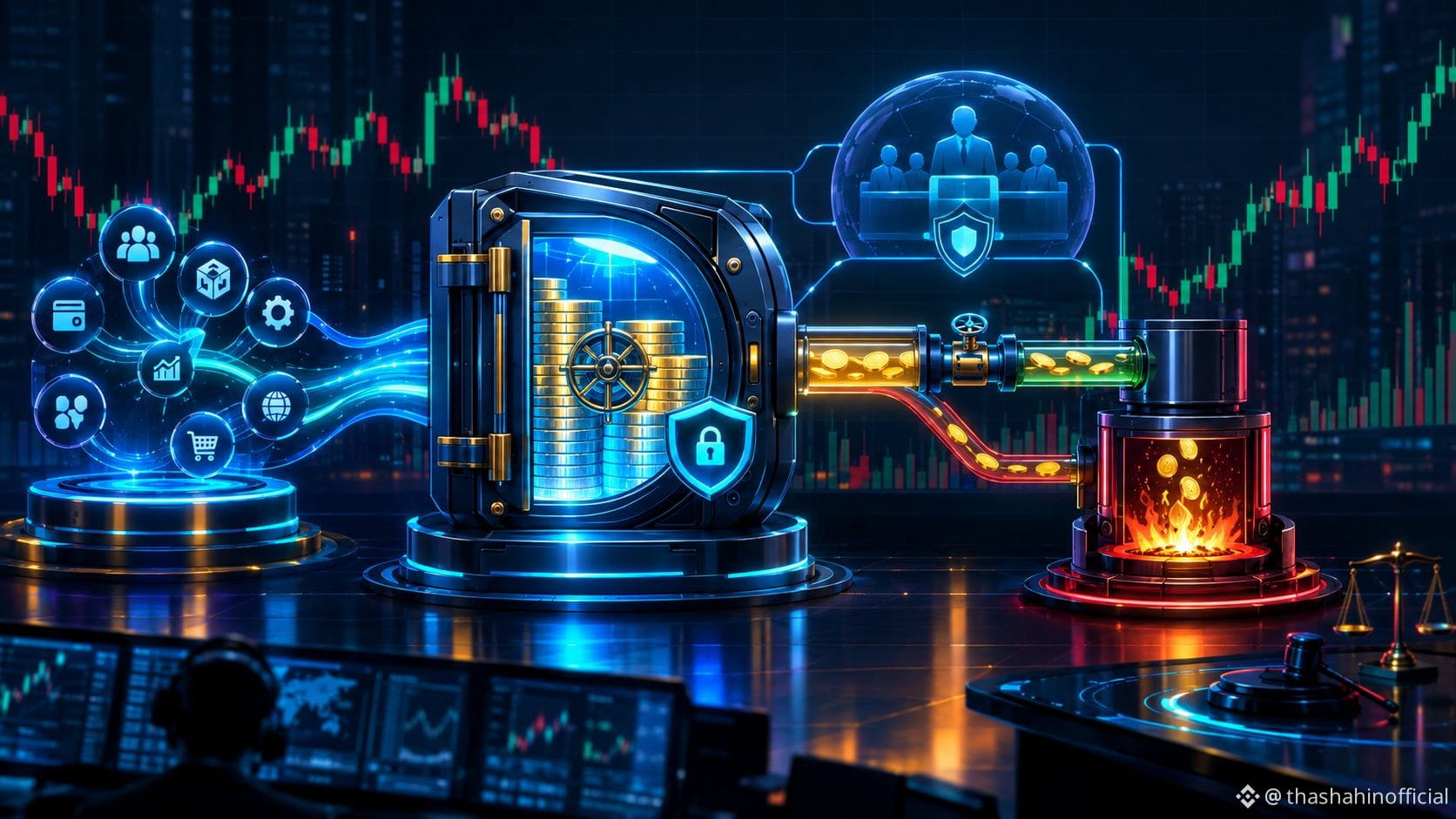
JUST anunció el 23 de octubre un mecanismo rediseñado de recompra y quema, que pone la gobernanza bajo JUST DAO y exige al menos $50M en reservas de tesorería. Las recompras se financian con ingresos trimestrales sostenibles del ecosistema, no con gasto ilimitado.
Para los holders de JST, la prueba clave es si los ingresos superan de forma constante las necesidades de reservas y operaciones. Sigue las transacciones reales de recompra, las divulgaciones de ingresos y los tokens quemados. Un mecanismo nuevo no garantiza subidas de precio.
¿Pueden las quemas impulsadas por los ingresos crear valor duradero para JST?
#JST #JUST #Tokenomics #CryptoNews
🚨 $JST
UN MÍNIMO DE $50M EN TESORERÍA CAMBIA LA HISTORIA DE LAS RECOMPRAS.
JUST anunció el 23 de octubre un mecanismo rediseñado de recompra y quema, que pone la gobernanza bajo JUST DAO y exige al menos $50M en reservas de tesorería. Las recompras se financian con ingresos trimestrales sostenibles del ecosistema, no con gasto ilimitado.
Para los holders de JST, la prueba clave es si los ingresos superan de forma constante las necesidades de reservas y operaciones. Sigue las transacciones reales de recompra, las divulgaciones de ingresos y los tokens quemados. Un mecanismo nuevo no garantiza subidas de precio.
¿Pueden las quemas impulsadas por los ingresos crear valor duradero para JST?
#JST #JUST #Tokenomics #CryptoNews
UN MÍNIMO DE $50M EN TESORERÍA CAMBIA LA HISTORIA DE LAS RECOMPRAS.
JUST anunció el 23 de octubre un mecanismo rediseñado de recompra y quema, que pone la gobernanza bajo JUST DAO y exige al menos $50M en reservas de tesorería. Las recompras se financian con ingresos trimestrales sostenibles del ecosistema, no con gasto ilimitado.
Para los holders de JST, la prueba clave es si los ingresos superan de forma constante las necesidades de reservas y operaciones. Sigue las transacciones reales de recompra, las divulgaciones de ingresos y los tokens quemados. Un mecanismo nuevo no garantiza subidas de precio.
¿Pueden las quemas impulsadas por los ingresos crear valor duradero para JST?
#JST #JUST #Tokenomics #CryptoNews
146

·
--
Por qué se desploman las criptomonedas con un FDV del 80%: el peligro oculto de los tokens con poca oferta circulante 🚨📉
Detectas un token nuevo que se dispara justo después de su lanzamiento. Su capitalización de mercado es de solo 200 millones de dólares, la comunidad no para de gritar «una joya que multiplicará su valor por 100» y tú te lanzas a comprar.
Seis meses después, el precio ha caído un 70 %, aunque el equipo cumplió con todas las actualizaciones de su hoja de ruta.
¿Qué pasó? Caíste de lleno en la trampa de poca oferta circulante y alto FDV.
1. Capitalización de mercado frente a valoración totalmente diluida (FDV)
Para sobrevivir en este mercado, debes entender la diferencia entre estas dos cifras:
Capitalización de mercado (MCap): precio actual × oferta circulante
Esto representa únicamente lo que actualmente es líquido y se puede negociar.
Valoración totalmente diluida (FDV): precio actual × oferta máxima total
Esto representa el valor del proyecto cuando se hayan desbloqueado todos y cada uno de los tokens.
La señal de alerta:
Si un token tiene una capitalización de mercado de 200 millones de dólares, pero un FDV de 2.000 millones de dólares, significa que solo el 10 % de la oferta está actualmente en circulación.
El 90 % restante de los tokens está bloqueado, y se dirige directamente al mercado
$BTC #ETH #Tokenomics #BinanceSquare #CryptoTradingInsights
Por qué se desploman las criptomonedas con un FDV del 80%: el peligro oculto de los tokens con poca oferta circulante 🚨📉
Detectas un token nuevo que se dispara justo después de su lanzamiento. Su capitalización de mercado es de solo 200 millones de dólares, la comunidad no para de gritar «una joya que multiplicará su valor por 100» y tú te lanzas a comprar.
Seis meses después, el precio ha caído un 70 %, aunque el equipo cumplió con todas las actualizaciones de su hoja de ruta.
¿Qué pasó? Caíste de lleno en la trampa de poca oferta circulante y alto FDV.
1. Capitalización de mercado frente a valoración totalmente diluida (FDV)
Para sobrevivir en este mercado, debes entender la diferencia entre estas dos cifras:
Capitalización de mercado (MCap): precio actual × oferta circulante
Esto representa únicamente lo que actualmente es líquido y se puede negociar.
Valoración totalmente diluida (FDV): precio actual × oferta máxima total
Esto representa el valor del proyecto cuando se hayan desbloqueado todos y cada uno de los tokens.
La señal de alerta:
Si un token tiene una capitalización de mercado de 200 millones de dólares, pero un FDV de 2.000 millones de dólares, significa que solo el 10 % de la oferta está actualmente en circulación.
El 90 % restante de los tokens está bloqueado, y se dirige directamente al mercado
$BTC #ETH #Tokenomics #BinanceSquare #CryptoTradingInsights
Detectas un token nuevo que se dispara justo después de su lanzamiento. Su capitalización de mercado es de solo 200 millones de dólares, la comunidad no para de gritar «una joya que multiplicará su valor por 100» y tú te lanzas a comprar.
Seis meses después, el precio ha caído un 70 %, aunque el equipo cumplió con todas las actualizaciones de su hoja de ruta.
¿Qué pasó? Caíste de lleno en la trampa de poca oferta circulante y alto FDV.
1. Capitalización de mercado frente a valoración totalmente diluida (FDV)
Para sobrevivir en este mercado, debes entender la diferencia entre estas dos cifras:
Capitalización de mercado (MCap): precio actual × oferta circulante
Esto representa únicamente lo que actualmente es líquido y se puede negociar.
Valoración totalmente diluida (FDV): precio actual × oferta máxima total
Esto representa el valor del proyecto cuando se hayan desbloqueado todos y cada uno de los tokens.
La señal de alerta:
Si un token tiene una capitalización de mercado de 200 millones de dólares, pero un FDV de 2.000 millones de dólares, significa que solo el 10 % de la oferta está actualmente en circulación.
El 90 % restante de los tokens está bloqueado, y se dirige directamente al mercado
$BTC #ETH #Tokenomics #BinanceSquare #CryptoTradingInsights
Mo7_Aj:
DONE ✅
100
5
100
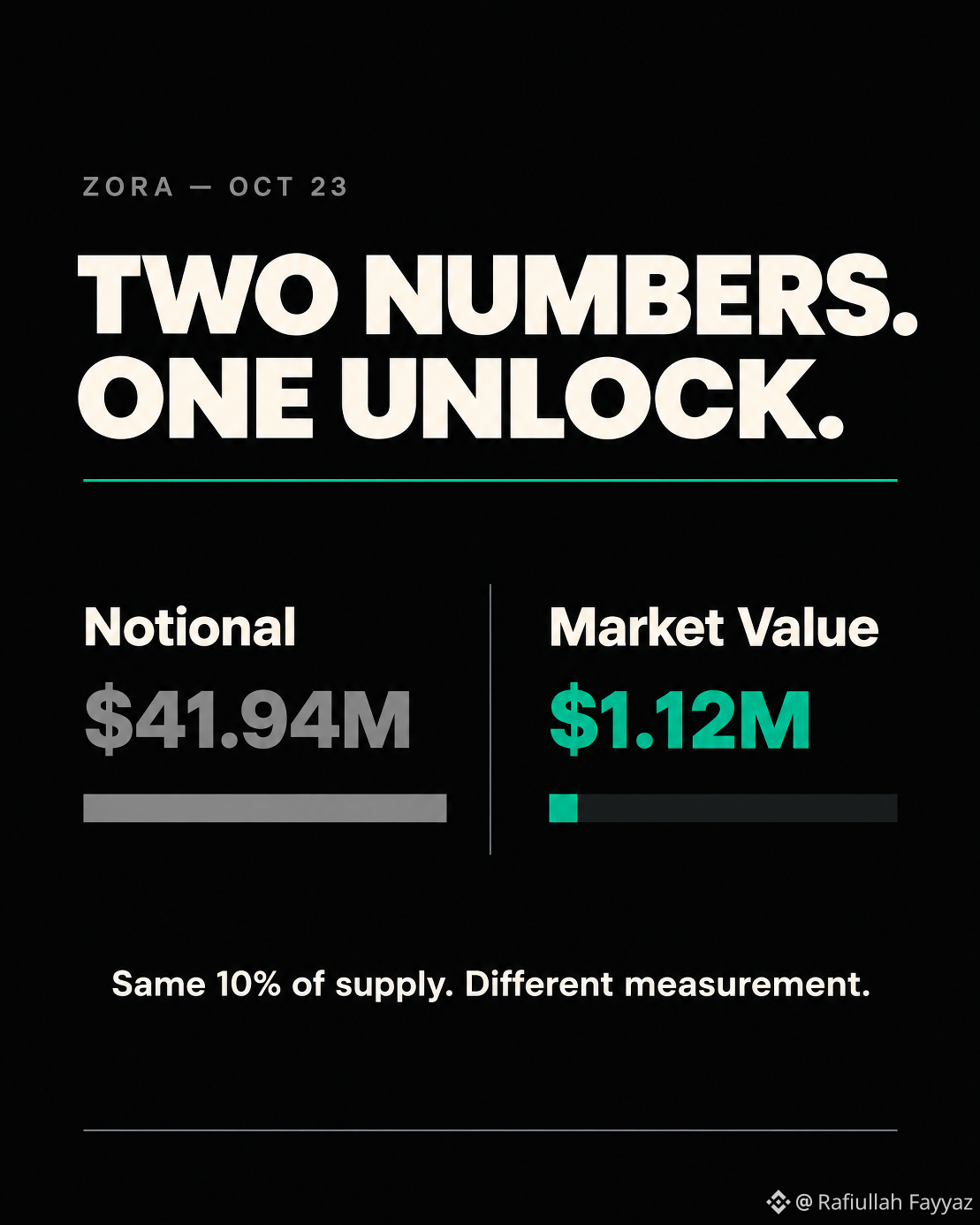
El desbloqueo de ZORA es hoy. Una fuente dice 41,94 millones de dólares. Otra dice 1,12 millones de dólares.
Ambas tienen razón. Están midiendo cosas distintas.
La cifra de 41,94 millones de dólares es el valor nocional de 1.670 millones de tokens a un precio de referencia. La cifra de 1,12 millones de dólares es el valor de mercado real a los precios actuales. La oferta en sí representa aproximadamente el 10 % de la oferta en circulación.
Este es el problema de los datos de desbloqueo. El valor nocional y el valor de mercado pueden diferir en un factor de 30. Si solo lees la cifra del titular, estás midiendo lo que no corresponde.
La proporción es del 10 %. Eso no cambia.
$ZORA
#crypto #EducationalContent #Tokenomics #unlocks #BinanceSquare
{future}(ZORAUSDT)
El desbloqueo de ZORA es hoy. Una fuente dice 41,94 millones de dólares. Otra dice 1,12 millones de dólares.
Ambas tienen razón. Están midiendo cosas distintas.
La cifra de 41,94 millones de dólares es el valor nocional de 1.670 millones de tokens a un precio de referencia. La cifra de 1,12 millones de dólares es el valor de mercado real a los precios actuales. La oferta en sí representa aproximadamente el 10 % de la oferta en circulación.
Este es el problema de los datos de desbloqueo. El valor nocional y el valor de mercado pueden diferir en un factor de 30. Si solo lees la cifra del titular, estás midiendo lo que no corresponde.
La proporción es del 10 %. Eso no cambia.
$ZORA
#crypto #EducationalContent #Tokenomics #unlocks #BinanceSquare
Ambas tienen razón. Están midiendo cosas distintas.
La cifra de 41,94 millones de dólares es el valor nocional de 1.670 millones de tokens a un precio de referencia. La cifra de 1,12 millones de dólares es el valor de mercado real a los precios actuales. La oferta en sí representa aproximadamente el 10 % de la oferta en circulación.
Este es el problema de los datos de desbloqueo. El valor nocional y el valor de mercado pueden diferir en un factor de 30. Si solo lees la cifra del titular, estás midiendo lo que no corresponde.
La proporción es del 10 %. Eso no cambia.
$ZORA
#crypto #EducationalContent #Tokenomics #unlocks #BinanceSquare
185

🚀 $OG : ¿Solo 5 millones de tokens? ¿Podría #Scarcity impulsar el próximo repunte?
💎 Si $OG tiene una oferta total fija de solo 5 millones de tokens sin más emisión, la escasez podría convertirse en una parte interesante de su narrativa de mercado.
📈 ¿Podría $15 ser el próximo objetivo? A $15 por token, una oferta completamente en circulación de 5 millones implicaría una capitalización de mercado de aproximadamente $75 millones.
{spot}(OGUSDT)
🎯 Vigilancia para inversores: antes de anticipar una ruptura, verifica la tokenómica oficial, la oferta en circulación, la liquidez en los exchanges y el volumen de compra. Una oferta limitada puede respaldar una tesis alcista, pero alcanzar $15 todavía requeriría suficiente demanda y momentum del mercado.
👀 ¿Está $OG preparándose para un movimiento importante, o necesita primero una confirmación más fuerte? ¡Comparte tu opinión abajo! 💬
#OG #CryptoAnalysis #Tokenomics #CoinVahini
🚀 $OG : ¿Solo 5 millones de tokens? ¿Podría #Scarcity impulsar el próximo repunte?
💎 Si $OG tiene una oferta total fija de solo 5 millones de tokens sin más emisión, la escasez podría convertirse en una parte interesante de su narrativa de mercado.
📈 ¿Podría $15 ser el próximo objetivo? A $15 por token, una oferta completamente en circulación de 5 millones implicaría una capitalización de mercado de aproximadamente $75 millones.
🎯 Vigilancia para inversores: antes de anticipar una ruptura, verifica la tokenómica oficial, la oferta en circulación, la liquidez en los exchanges y el volumen de compra. Una oferta limitada puede respaldar una tesis alcista, pero alcanzar $15 todavía requeriría suficiente demanda y momentum del mercado.
👀 ¿Está $OG preparándose para un movimiento importante, o necesita primero una confirmación más fuerte? ¡Comparte tu opinión abajo! 💬
#OG #CryptoAnalysis #Tokenomics #CoinVahini
💎 Si $OG tiene una oferta total fija de solo 5 millones de tokens sin más emisión, la escasez podría convertirse en una parte interesante de su narrativa de mercado.
📈 ¿Podría $15 ser el próximo objetivo? A $15 por token, una oferta completamente en circulación de 5 millones implicaría una capitalización de mercado de aproximadamente $75 millones.
🎯 Vigilancia para inversores: antes de anticipar una ruptura, verifica la tokenómica oficial, la oferta en circulación, la liquidez en los exchanges y el volumen de compra. Una oferta limitada puede respaldar una tesis alcista, pero alcanzar $15 todavía requeriría suficiente demanda y momentum del mercado.
👀 ¿Está $OG preparándose para un movimiento importante, o necesita primero una confirmación más fuerte? ¡Comparte tu opinión abajo! 💬
#OG #CryptoAnalysis #Tokenomics #CoinVahini
15
·
--
La dinámica de la oferta de $SILVER está experimentando ahora mismo una gran transición que muchos están pasando por alto en favor de la volatilidad de alto beta. Mientras la plata física se mantiene firme en 60.27 y el oro avanza hasta 4,140, la relación oro/plata, en 68.5, nos indica que el complejo de materias primas se inclina hacia un mejor desempeño de la plata. En el ámbito digital, los datos en torno a SILVER son aún más convincentes, porque estamos saliendo de la intensa fase de desbloqueo de tokens adquiridos y entrando en un ciclo estructural de quema.
Los datos actuales en cadena muestran que la oferta circulante se está reduciendo, ya que las mesas institucionales han absorbido el 12 por ciento final de los desbloqueos de la ronda semilla. Con el precio de referencia al contado en 53.716, la brecha entre el valor tokenizado y los lingotes físicos está generando una presión de arbitraje única. A diferencia de PAXG, que sigue el oro en una proporción de 1:1, la mecánica específica de SILVER implica una quema periódica de oferta activada por el volumen de transacciones, lo que reduce efectivamente el límite máximo de la oferta total cada vez que una ballena mueve liquidez entre exchanges.
Los bancos centrales siguen aumentando agresivamente sus reservas, y la correlación inversa con el DXY continúa siendo el principal motor macroeconómico. A medida que el índice del dólar muestra signos de agotamiento, se acelera la búsqueda de activos respaldados por materias primas. Estamos observando grandes salidas de exchanges centralizados hacia almacenamiento en frío, lo que refleja el mercado de lingotes físicos, donde las reservas de COMEX están alcanzando mínimos de varios años. La presión deflacionaria aquí no es solo una narrativa de marketing; está respaldada por cronogramas de desbloqueo codificados que oficialmente han pasado de inflacionarios a contractivos.
Las próximas semanas pondrán a prueba si el ritmo actual de quema puede mantenerse al día con la creciente demanda de exposición a materias primas en cadena. ¿Crees que ahora mismo ofrecen más valor los activos respaldados por bienes físicos o sigues apostando por proyectos puramente algorítmicos?
#TokenUnlocks #Tokenomics
La dinámica de la oferta de $SILVER está experimentando ahora mismo una gran transición que muchos están pasando por alto en favor de la volatilidad de alto beta. Mientras la plata física se mantiene firme en 60.27 y el oro avanza hasta 4,140, la relación oro/plata, en 68.5, nos indica que el complejo de materias primas se inclina hacia un mejor desempeño de la plata. En el ámbito digital, los datos en torno a SILVER son aún más convincentes, porque estamos saliendo de la intensa fase de desbloqueo de tokens adquiridos y entrando en un ciclo estructural de quema.
Los datos actuales en cadena muestran que la oferta circulante se está reduciendo, ya que las mesas institucionales han absorbido el 12 por ciento final de los desbloqueos de la ronda semilla. Con el precio de referencia al contado en 53.716, la brecha entre el valor tokenizado y los lingotes físicos está generando una presión de arbitraje única. A diferencia de PAXG, que sigue el oro en una proporción de 1:1, la mecánica específica de SILVER implica una quema periódica de oferta activada por el volumen de transacciones, lo que reduce efectivamente el límite máximo de la oferta total cada vez que una ballena mueve liquidez entre exchanges.
Los bancos centrales siguen aumentando agresivamente sus reservas, y la correlación inversa con el DXY continúa siendo el principal motor macroeconómico. A medida que el índice del dólar muestra signos de agotamiento, se acelera la búsqueda de activos respaldados por materias primas. Estamos observando grandes salidas de exchanges centralizados hacia almacenamiento en frío, lo que refleja el mercado de lingotes físicos, donde las reservas de COMEX están alcanzando mínimos de varios años. La presión deflacionaria aquí no es solo una narrativa de marketing; está respaldada por cronogramas de desbloqueo codificados que oficialmente han pasado de inflacionarios a contractivos.
Las próximas semanas pondrán a prueba si el ritmo actual de quema puede mantenerse al día con la creciente demanda de exposición a materias primas en cadena. ¿Crees que ahora mismo ofrecen más valor los activos respaldados por bienes físicos o sigues apostando por proyectos puramente algorítmicos?
#TokenUnlocks #Tokenomics
Los datos actuales en cadena muestran que la oferta circulante se está reduciendo, ya que las mesas institucionales han absorbido el 12 por ciento final de los desbloqueos de la ronda semilla. Con el precio de referencia al contado en 53.716, la brecha entre el valor tokenizado y los lingotes físicos está generando una presión de arbitraje única. A diferencia de PAXG, que sigue el oro en una proporción de 1:1, la mecánica específica de SILVER implica una quema periódica de oferta activada por el volumen de transacciones, lo que reduce efectivamente el límite máximo de la oferta total cada vez que una ballena mueve liquidez entre exchanges.
Los bancos centrales siguen aumentando agresivamente sus reservas, y la correlación inversa con el DXY continúa siendo el principal motor macroeconómico. A medida que el índice del dólar muestra signos de agotamiento, se acelera la búsqueda de activos respaldados por materias primas. Estamos observando grandes salidas de exchanges centralizados hacia almacenamiento en frío, lo que refleja el mercado de lingotes físicos, donde las reservas de COMEX están alcanzando mínimos de varios años. La presión deflacionaria aquí no es solo una narrativa de marketing; está respaldada por cronogramas de desbloqueo codificados que oficialmente han pasado de inflacionarios a contractivos.
Las próximas semanas pondrán a prueba si el ritmo actual de quema puede mantenerse al día con la creciente demanda de exposición a materias primas en cadena. ¿Crees que ahora mismo ofrecen más valor los activos respaldados por bienes físicos o sigues apostando por proyectos puramente algorítmicos?
#TokenUnlocks #Tokenomics
1
3

Advertencia sobre la oferta total y el calendario de desbloqueos: ¿es una señal de alerta para los holders? Advertencia sobre la oferta total y el calendario de desbloqueos: ¿es una señal de alerta para los holders?
Desglose de los datos:
• Oferta circulante: 3.82B WLD (aproximadamente el 38.2% de la oferta máxima de 10B WLD).
• FDV: ~5.4 mil millones de USD (2.6 veces la capitalización de mercado actual de ~2.06 mil millones de USD, en torno a 0.54 USD).
• Calendario de desbloqueos que desangra: se desbloquean regularmente ~5.59M WLD cada semana (~3 millones de USD/semana), con una distribución lineal que se prolongará hasta 2028-2029.
• Datos de derivados de Binance: los principales traders mantienen una posición larga dominante (76.42% en largo frente a 23.58% en corto), con un interés abierto elevado de 95.1M USD (176M WLD).
Advertencia sobre la oferta total y el calendario de desbloqueos: ¿es una señal de alerta para los holders?
Advertencia sobre la oferta total y el calendario de desbloqueos: ¿es una señal de alerta para los holders?
Desglose de los datos:
• Oferta circulante: 3.82B WLD (aproximadamente el 38.2% de la oferta máxima de 10B WLD).
• FDV: ~5.4 mil millones de USD (2.6 veces la capitalización de mercado actual de ~2.06 mil millones de USD, en torno a 0.54 USD).
• Calendario de desbloqueos que desangra: se desbloquean regularmente ~5.59M WLD cada semana (~3 millones de USD/semana), con una distribución lineal que se prolongará hasta 2028-2029.
• Datos de derivados de Binance: los principales traders mantienen una posición larga dominante (76.42% en largo frente a 23.58% en corto), con un interés abierto elevado de 95.1M USD (176M WLD).
Desglose de los datos:
• Oferta circulante: 3.82B WLD (aproximadamente el 38.2% de la oferta máxima de 10B WLD).
• FDV: ~5.4 mil millones de USD (2.6 veces la capitalización de mercado actual de ~2.06 mil millones de USD, en torno a 0.54 USD).
• Calendario de desbloqueos que desangra: se desbloquean regularmente ~5.59M WLD cada semana (~3 millones de USD/semana), con una distribución lineal que se prolongará hasta 2028-2029.
• Datos de derivados de Binance: los principales traders mantienen una posición larga dominante (76.42% en largo frente a 23.58% en corto), con un interés abierto elevado de 95.1M USD (176M WLD).
5

·
--
Verificado

Artículo
TOKENÓMICA DE AAVE 3.0: ¡RECOMPRAS, STAKING Y QUEMAS!¡Aave ($AAVE ) se prepara para una importante actualización de su tokenómica!
El fundador Stani Kulechov ha confirmado que Aavenomics 3.0 incluirá tres mecanismos clave:
💰 Recompras — compra de tokens AAVE en el mercado.
🔒 Staking — permite a los titulares de tokens ponerlos en staking con el sistema actualizado.
🔥 Quema de tokens — eliminación permanente de tokens de la circulación.
📉 ¿Por qué es importante?
Las recompras anteriores de Aave acumulaban tokens en su tesorería en lugar de destruirlos permanentemente. Añadir mecanismos de quema podría introducir un mecanismo directo para reducir la oferta.
TOKENÓMICA DE AAVE 3.0: ¡RECOMPRAS, STAKING Y QUEMAS!
¡Aave ($AAVE ) se prepara para una importante actualización de su tokenómica!
El fundador Stani Kulechov ha confirmado que Aavenomics 3.0 incluirá tres mecanismos clave:
💰 Recompras — compra de tokens AAVE en el mercado.
🔒 Staking — permite a los titulares de tokens ponerlos en staking con el sistema actualizado.
🔥 Quema de tokens — eliminación permanente de tokens de la circulación.
📉 ¿Por qué es importante?
Las recompras anteriores de Aave acumulaban tokens en su tesorería en lugar de destruirlos permanentemente. Añadir mecanismos de quema podría introducir un mecanismo directo para reducir la oferta.
El fundador Stani Kulechov ha confirmado que Aavenomics 3.0 incluirá tres mecanismos clave:
💰 Recompras — compra de tokens AAVE en el mercado.
🔒 Staking — permite a los titulares de tokens ponerlos en staking con el sistema actualizado.
🔥 Quema de tokens — eliminación permanente de tokens de la circulación.
📉 ¿Por qué es importante?
Las recompras anteriores de Aave acumulaban tokens en su tesorería en lugar de destruirlos permanentemente. Añadir mecanismos de quema podría introducir un mecanismo directo para reducir la oferta.
Rao G 914:
Great insight
1
2
62
Inicia sesión para explorar más contenidos
Únete a usuarios globales de criptomonedas en Binance Square
⚡️ Obtén información útil y actualizada sobre criptos.
💬 Avalado por el mayor exchange de criptomonedas en el mundo.
👍 Descubre perspectivas reales de creadores verificados.
Email/número de teléfono
Temas populares
1
#BinancePick
3M vistas
151,729 están debatiendo
2
#EarningsSeason
5.2M vistas
25,792 están debatiendo
3
#AnthropicTTMRevenueGrewAbout1200%
18,994 vistas
333 están debatiendo
4
#AnthropicS1ExpectedToday
20,461 vistas
296 están debatiendo
5
#SouthKoreaReportedlyWeighsFourthCryptoTaxDelay
25,433 vistas
416 están debatiendo
6
#FranklinTempletonFilesForTwoDividendToBitcoinETFs
33,564 vistas
511 están debatiendo
7
#StrategyMSTRSurpassesNasdaqInMarketCap
25,820 vistas
371 están debatiendo
8
#CanadaProposesStablecoinRedemptionWithin3BusinessDays
1,177 vistas
34 están debatiendo
9
#ElectrumWalletBugLetRogueServersStealFunds
27,339 vistas
448 están debatiendo
10
#ArgentineCourtDismissesLIBRACaseAgainstMilei
41,564 vistas
553 están debatiendo